- 128 pages
- English
- ePUB (mobile friendly)
- Available on iOS & Android
eBook - ePub
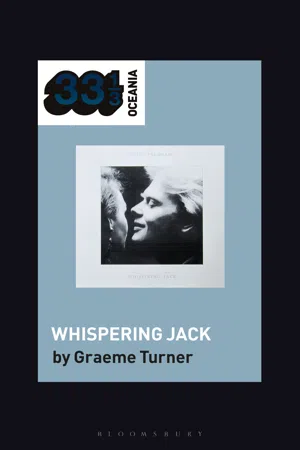
John Farnham's Whispering Jack
About this book
The album examined in this book transformed the singer John Farnham from a faded teen pop star into the most popular solo rock performer in Australia, in a career that has lasted for more than 30 years. Whispering Jack remains the top-selling album by an Australian artist in Australia, and constitutes the turning point in Farnham's bid to achieve credibility as an adult contemporary musician. The first single from the album, 'You're the Voice,' has achieved such iconic status that it is routinely referred to as Australia's unofficial national anthem. The book examines the album, its context and that history in order to recover a crucial conjuncture in the development of Australian rock and popular music, one that has previously been ignored in Australian popular music studies.
1 The backstory
From Johnny to John
In the beginning, it was Johnny Farnham, the teen pop star, who was crowned TV Week’s ‘King of Pop’ five years in a row during the late 1960s and early 1970s. ‘Sadie (The Cleaning Lady)’ was No. 1 in the singles charts for five weeks in 1968, and became the biggest-selling Australian single of the decade; it made Johnny Farnham a household name. However, the comprehensiveness with which he was identified with a song that was more George Formby than Elvis Presley meant that he experienced great difficulty moving from an ephemeral teen stardom into a more long-term and credible career as an adult rock performer. A video included in Australia’s National Film and Sound Archive online exhibition celebrating Farnham’s career, taken from the TV Week and Channel 10 ‘King of Pop’ awards of 1971, reveals how far that world of teen stardom was from where he might have wanted to be as an adult performer a decade later. The award was presented to him by Liberace (!), and involved accepting (and wearing) a large and silly fake fur-trimmed crown (Liberace, when he sees it, says ‘I want it, I want it!’). While doing his best to cooperate, Farnham looks extremely uncomfortable.
At this time he was managed by Darrell Sambell, whose strategy for helping Farnham to leave that world behind was to aim for that most familiar (and usually elusive) destination for pop music stars at the time: the role of the ‘all round entertainer’. Accordingly, Johnny Farnham appeared in television sitcoms and soaps, hosted ‘white floor’ TV variety series, sang cabaret and headlined stage musicals to build his all-round profile. But he still could not escape the consequences of his teen-pop star history. By the late 1970s, he was reduced to playing what Bernard Zuel (2016) has called ‘the rubber chicken circuit’: the local services and RSL (Returned Services League) clubs whose revenue was built on poker machines but who also provided variety entertainment (from cabaret acts, to magic shows, to popular music bands) to their members. (The ‘rubber chicken’ referred to the quality of the food served in these venues). There are plenty of accounts of just how dispiriting that experience could be for many of the pop and rock musicians who found themselves playing to small and often disinterested audiences rather than to a roomful of fans (see, for instance, Apter 2016a: 87–8). Farnham’s eventual route out of that circuit involved a change in management. He parted company with Darrel Sambell and signed with someone who supported his vision of a future as a rock singer, the Little River Band’s manager, Glenn Wheatley. Farnham changed his name to the more adult ‘John’, and began the task of earning credibility and respect as a serious contemporary rock performer.
In that endeavour, he became something of a regular on one of the few television outlets for local rock and pop musicians at the time, the Nine Network’s Hey Hey It’s Saturday. Eventually running for twenty-eight years, from 1971 to 1999, Hey Hey It’s Saturday had started out as a children’s variety and game show on Saturday mornings but had attracted such a loyal late teens and young adult audience – appreciating its amiable anarchy and slyly inserted adult jokes as they recovered from the big Friday night out – that it was moved into a 6.30 pm slot on Saturday evenings where the baby boomers could pick it up before heading out for the night. Hey Hey responded to that audience by promoting Australian bands and performers. Giving the music industry valuable mass exposure on a Saturday night, it addressed an audience for local musicians that was much broader than the audience for the pub-rock that was dominant for so much of that time. Farnham’s performances on Hey Hey most probably played a part in laying the basis for the breadth of his popular appeal later on. He was also a regular on the various late-night television chat and variety shows hosted by American entertainer Don Lane over the 1970s and 1980s; this audience usually skewed old, but Lane was a devoted fan and promoted Farnham tirelessly. Nevertheless, and valuable though it was, one would imagine that this kind of exposure was still a long way from where Farnham would have hoped to be.
The first point at which most Australians might have registered John Farnham’s reinvention of himself as a singer was probably through his contribution to a Royal Command concert in 1980, when he performed his re-interpretation of the Beatles’ song ‘Help’. Broadcast live on national television, this was an original and arresting re-casting of that song, and it eventually became Farnham’s first charting single in seven years (it reached No. 8). The album on which it appeared, Uncovered, was a hit when it was released in 1980: it formally launched his change of name, it ticked the box of being ‘a little more rock ’n’ roll’ (as Farnham described it in a TV interview1 ), and its success enabled him to take a band on the road to tour around Australia. Apart from ‘Help’, however, the material wasn’t especially distinctive (most of the remaining songs were written by Little River Band’s Graham Goble) and in subsequent interviews Farnham has implied that it didn’t really reflect the kinds of work he most wanted to record (he says that he may have been ‘led by the nose’ on song selection ([Gazzo 2015: 177]). While a good start, but still only making it to No. 20 on the album charts, Uncovered wasn’t quite the rebooting that his career needed.
It is understandable, if in retrospect possibly unfortunate, that he would take the next big opportunity offered to him – to replace Glenn Shorrock as the lead singer for the Little River Band (LRB). For some observers at the time, it seemed like a bit of a stretch for Farnham to front a rock band, even one as comparatively mellow as LRB, and it did take him out of Australia for an extended period. While there is no doubt he delivered in his stint as LRB’s frontman over 1982–5, this period also coincided with a more critical reception of LRB’s records, a marked decline in their commercial viability, and the gradual withdrawal of their record label’s support (Gazzo, among others, suggests that the American executives at Capitol did not approve of the switch from Shorrock to Farnham [2015: 183]). It was not an easy period for LRB or for their lead singer. There were ructions in the band, disputes about the selection of material and even concerns raised about how Farnham should present himself on stage (he was asked to tone down his characteristically exuberant stage persona). Apter (2016a) and Gazzo (2015) both report that Farnham learnt a lot from what seems like a personally and financially bruising experience, and consequently vowed to take on more direct personal control after he returned to Australia and began to resurrect his solo career. Unfortunately, though, by the mid-1980s in Australia, he had become almost untouchable for the industry: no recent hits, no recording contract, no prospects, and he was broke. At this time, ‘Farnham’s name’, says Apter (2016b), ‘was music industry poison. No record label would touch him. He hadn’t had a number one hit since 1969’s “Raindrops Keep Falling on My Head”, and was still known to many as Johnny Farnham, the pretty popstar’.
Looking back now it is hard to understand why John Farnham was not afforded greater respect as a singer at the time. Apter quotes Farnham as observing ruefully that, at this point in time, ‘people never saw me as being a credible singer’ (Apter 2016a: 141). Sam See, the former member of Sherbet who played in the Little River Band alongside Farnham, and who was also a member of Farnham’s touring band for a time, confirms that judgement, noting that audiences were mixed in their reactions to him: ‘We’d do a lot of gigs where the blokes would sort of regard him as a lightweight and I don’t think that changed until after Whispering Jack.’ (Gazzo 2015: 177). My own personal experience as a working musician in the early 1980s complicates that account slightly; I recollect very clearly that he was talked about by other musicians as the ‘singer’s singer’ back then, and their criticism focused on his choice of material rather than on his talent or ability. Apter (2016b) points to that as well, as an issue that was explicitly addressed by the team involved in developing Whispering Jack – producer Ross Fraser, keyboardist David Hirschfelder and Farnham himself: ‘Farnham needed to prove he could handle weightier emotional material – he made inroads with [the] 1980s rendering of the Beatles Help – but he also needed to update his sound. Technology was rapidly changing; he wanted to make a contemporary-sounding record.’ The challenge for Whispering Jack, then, was considerable: find a new set of career-defining songs, produce a technically cutting-edge album and get someone to release it!
The Australian music industry in the 1980s
Understanding that challenge involves some consideration of the context in which it was located – the industrial and cultural formations that shaped the Australian rock and popular music industry in the 1980s. John Farnham had a very particular relation to that context. As Jane Gazzo points out, Farnham’s history as a rock musician is not like most stories about starting out in the industry. He hadn’t had to ‘live in a grubby share house, starving or struggling to pay rent, or busking on the streets to earn money. He’d quit his job [as a plumber] two days before his debut single came out and had never looked back’ (2015: 182–3). Most crucially, unlike contemporaries such as the members of INXS, AC/DC, the Angels or Australian Crawl, for instance, he hadn’t worked his way up through the pub-rock circuit, and for quite a while that actually mattered. Over the 1970s, the pub circuit had become the standard training ground for the industry; it was seen almost as a kind of apprenticeship, which every aspiring rock musician needed to undertake in order to achieve their licence to rock ’n’ roll. Consequently, within the calculus of ‘cool’ that has always calibrated reputations in the rock music industry, and notwithstanding the fact that he had certainly paid his dues working in a range of equally challenging platforms and venues, Farnham had a significant deficit to overcome. Maybe that is why the stint with LRB seemed like a good idea at the time; it might have lent him some rock ’n’ roll credibility. Unfortunately, as Sam See’s comment quoted earlier suggests, it seems like it didn’t much help. Without having worked his way up through the pub-rock circuit, the five-time King of Pop faced a long struggle for respect within the world of 1980s Australian rock ’n’ roll.
Within the popular memory of Australian music over the 1970s and 1980s, pub-rock has been extensively mythologized around a particular breed of hard rock, guitar-based bands such as the Aztecs, Rose Tattoo and the Angels (Engleheart 2010). Notwithstanding this mythology, it is probably important to point out that the pub circuit wasn’t just populated by bands like them. It also included, for instance, soft-rock singer–songwriters such as Richard Clapton or Brian Cadd, soul divas such as Renee Geyer, folk-rock bands such as Goanna, country rockers such as the Dingoes and the various punk and post-punk elements of the alternative, ‘inner city sound’ documented by Clinton Walker (1982, 2005). Like most myths, however, it does have some genuine substance behind it: the undeniable industrial centrality of the ‘masculine and beer-soaked pub circuits’, which ‘produced [a] blunt and uncompromising pub culture’ (Homan 2006: 243), as well as successive generations of Australian rock bands. The size and character of the pub venues varied quite a lot (Oldham 2013): in inner Sydney or Melbourne, for instance, they could be quite intimate neighbourhood pubs presenting niche or emerging bands, but in the outer suburbs of Sydney or Melbourne or Perth they were often enormous characterless barns designed solely to absorb the large crowds attracted by the more established bands (Turner 1992). Some venues would programme music most nights across the whole week, often setting up longstanding ‘residencies’ on set nights, while others would concentrate on the weekend with the Saturday or Sunday afternoon ‘session’ a particular drawcard. These were Dionysian events; what people wanted to do at the pub was to ‘rage’.2 Culturally, as the coinage of that term would suggest, pub-rock was situated right smack in the middle of rock music’s mythology of excess, indulgence, rebellion and ‘attitude’. As Walker, Hogan and Beilhartz (2012: 121) describe it, pub-rock was ‘muscular, loud, white and proudly bogan.3 It was working class and slyly subversive: as it sang of sex, drugs and rock ’n’ roll, it also announced itself as the hegemonic culture of suburbia’s disaffected youth.’ Along the same lines, in our Myths of Oz: Reading Australian Popular Culture (Fiske, Hodge and Turner 1987: 17–25), in a section dealing with youth, rock ’n’ roll and the Australian pub, my co-authors and I talked about pub-rock venues stripping the rock performance back to its most basic and affordable elements, effectively ‘proletarianising’ the rock concert for suburban consumption. Interestingly, while notionally national in scale, in many cases the pub circuit also worked to localize audiences around their own bands, creating an element of tribalism that linked the fans, the bands, the suburb and the particular pubs identified as supporting them. These were the venues, then, which produced the punk rock of the Saints in the 1970s, as well as the post-punk and alternative bands that were so successful in the 1980s, such as INXS, Midnight Oil or The Triffids (Walker 2005). But, as we’ve seen, they didn’t produce John Farnham. While he has always come across as an authentic and unpretentious character on stage, it was not the sweaty, aggressive, masculinist persona of the pub rockers. Farnham was cheeky but likeable, suburban rather than urban, the everyman rather than the superstar, the nice guy rather than the guy with attitude.
There was another system of distinction that is relevant here. Homan (2006b: 4) has talked about the implications embedded in the industry’s hierarchical differentiation between the original performer and the cover artist, or between the artist and the entertainer: ‘while original composers saw themselves as artists and entertainers, the same group placed cover musicians distinctly (and disdainfully) in the “entertainers’ box”’, he says. Such a distinction is also inferred when McIntyre (2007: 85) discusses what he describes as the Romantic conception of the rock musician during the period under consideration: that ‘preferred rock artists to pop or soul performers, albums over singles, self-contained bands or solo artists . . . writing their own songs, rather than singers who worked with arrangers, session musicians and songwriters in putting together a package’. An Australian version of this in the 1970s and 1980s might be said to have preferred rock bands over pop stars, originals over covers, independents over corporate labels, ‘alternative’ over ‘commercial’, and those who had paid their dues in the pubs rather than, say, those who had built a career through television or variety shows (the reality TV show, Popstars, when it turned up in the early 2000s, attracted precisely this kind of criticism and was largely dismissed by the music industry).
However, things were changing by the time we head into the mid-1980s. The connection between the so-called Australian sound (Zion 1988), the pub-rock circuit and the strategic investment preferences of the commercial industry was starting to fragment. According to Homan, to some extent this acknowledged what had largely been the case already: ‘despite theories of a distinct “Australian sound” that was grounded in pub-rock, and visions of an isolated industry producing original musics, the local pattern has been to only exploit those artists deemed to possess an international aesthetic’ (2006: 244.) And while there was considerable debate within Australian popular music studies over this period about the existence of an identifiable ‘Australian sound’ (Homan 2006: 244; Hayward 1992b: 3–6), both Homan and I were probably among the majority4 in arguing that, at best and given the already thoroughly transnational character of the popular music industry, any ‘Australian sound’ could only ever be ‘an inflection’, or ‘the distinctive modification of an already internationally established musical style’ (Turner 1992: 13). That said, there was a short period when some music consumers overseas took a different view. There was what Glen A Baker (1986b) describes as the ‘Australian craze’ – American interest ...
Table of contents
- Cover
- Half-Title
- Series
- Title
- Contents
- Acknowledgements
- Introduction
- 1 The backstory: From Johnny to John
- 2 Whispering Jack – the album
- 3 ‘You’re the Voice’
- 4 And then . . .
- Notes
- References
- Index
- Copyright
Trusted by 375,005 students
Access to over 1.5 million titles for a fair monthly price.
Study more efficiently using our study tools.
Information
Publisher
Bloomsbury AcademicEdition
1Year
2022Print ISBN
9781501382062
Subtopic
MusiceBook ISBN
9781501382079
Frequently asked questions
Yes, you can cancel anytime from the Subscription tab in your account settings on the Perlego website. Your subscription will stay active until the end of your current billing period. Learn how to cancel your subscription
No, books cannot be downloaded as external files, such as PDFs, for use outside of Perlego. However, you can download books within the Perlego app for offline reading on mobile or tablet. Learn how to download books offline
Perlego offers two plans: Essential and Complete
- Essential is ideal for learners and professionals who enjoy exploring a wide range of subjects. Access the Essential Library with 800,000+ trusted titles and best-sellers across business, personal growth, and the humanities. Includes unlimited reading time and Standard Read Aloud voice.
- Complete: Perfect for advanced learners and researchers needing full, unrestricted access. Unlock 1.5M+ books across hundreds of subjects, including academic and specialized titles. The Complete Plan also includes advanced features like Premium Read Aloud and Research Assistant.
We are an online textbook subscription service, where you can get access to an entire online library for less than the price of a single book per month. With over 1.5 million books across 990+ topics, we’ve got you covered! Learn about our mission
Look out for the read-aloud symbol on your next book to see if you can listen to it. The read-aloud tool reads text aloud for you, highlighting the text as it is being read. You can pause it, speed it up and slow it down. Learn more about Read Aloud
Yes! You can use the Perlego app on both iOS and Android devices to read anytime, anywhere — even offline. Perfect for commutes or when you’re on the go.
Please note we cannot support devices running on iOS 13 and Android 7 or earlier. Learn more about using the app
Please note we cannot support devices running on iOS 13 and Android 7 or earlier. Learn more about using the app
Yes, you can access John Farnham's Whispering Jack by Graeme Turner in PDF and/or ePUB format, as well as other popular books in Media & Performing Arts & Music. We have over 1.5 million books available in our catalogue for you to explore.