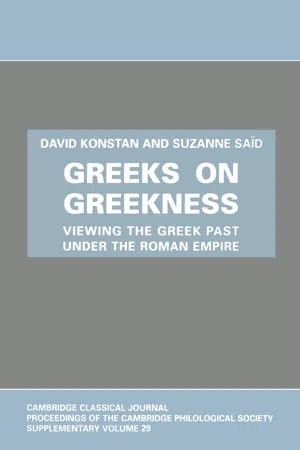
Karl Marx observed that 'just when people seem engaged in revolutionizing themselves... they anxiously conjure up the spirits of the past to their service'. While the Greek east under Roman rule was not revolutionary, perhaps, in the sense that Marx had in mind, it was engaged in creating something that had not previously existed, in part just through the millennia-long involvement with its own tradition, which was continually being remodelled and readapted. It was an age that was intensely self-conscious about its relation to history, a consciousness that manifested itself not only in Attic purism and a reverence for antique literary models but also in ethnic identities, educational and religious institutions, and political interactions with – and even among – the Romans. In this volume, seven scholars explore some of the forms that this preoccupation with the Greek past assumed under Roman rule. Taken together, the chapters offer a kaleidoscopic view of how Greeks under the Roman Empire related to their past, indicating the multiple ways in which the classical tradition was problematised, adapted, transformed, and at times rejected. They thus provide a vivid image of a lived relation to tradition, one that was inventive rather than conservative and self-conscious rather than passive. The Greeks under Rome played with their heritage, as they played at being and not being the Greeks they continually studied and remembered.
eBook - ePub
Greeks on Greekness
Viewing the Greek Past under the Roman Empire
- 206 pages
- English
- ePUB (mobile friendly)
- Available on iOS & Android
eBook - ePub
Greeks on Greekness
Viewing the Greek Past under the Roman Empire
About this book
Information
Subtopic
Greek Ancient HistoryIndex
History1
‘MACEDONIAN TIMES’: HELLENISTIC MEMORIES IN THE PROVINCES OF THE ROMAN NEAR EAST
1. Introduction1
A body of evidence, discussed in more detail below, reveals behaviour among the Greek-identified communities of the Roman near east – here defined in the first instance as the regions of Flat Cilicia, Syria and Egypt – which reflects, in different ways, their sense of identity with, or historical roots in, what we call the Hellenistic period. These were the centuries of Greek history which some Greek writers under Roman rule called the ‘Macedonian times’ (Makedonikoi chronoi or kairoi)2 after the dominant ethno-class (to borrow Pierre Briant’s formulation)3 in Hellenistic Asia and Egypt, the Macedonians.4 During this era, from the reign of Alexander down to the Roman conquest, Macedonian rulers had founded the majority of the Greek-style poleis in which the Greek-speakers of these regions lived in Roman times and laid the basis for their Roman-period socio-economic preeminence; in the case of a minority of these Greek-speakers who were of Greco-Macedonian, rather than indigenous, ethnic ancestry, these same rulers had created the favourable climate in which Aegean forbears had settled in the near east and, with their descendants, come to constitute the dominant group in the rich and powerful successor-states of the Seleucids and Ptolemies.
This evidence, which has not been collected in one place before, raises various questions of interpretation. Firstly, much of it belongs in the context of the projection of civic tradition, a purely local phenomenon at first sight. But the material raises the issue, when taken as a whole, as to whether somewhere here any sign should be recognised of a broader identification, among Greek-speakers in these regions, with the old Macedonian dispensation. Secondly, what relation does this body of evidence have to the phenomenon of Roman Alexander-imitation, the public and political manipulation of the myth of Alexander, the architect of the Makedonikoi chronoi, by successive emperors from Augustus on, in a climate of power-relations in which Greek cultural trends cannot be viewed in isolation from the comportment of central Roman governance?5 Thirdly, if the ‘Macedonian times’ can be shown to have been in some ways a historical touchstone for parts of the Roman East, how should this sensibility be understood in relation to the pride of place which contemporary Greek paideia gave to Classical Greece – with its implicit downgrading of the cultural standing of Hellenismus – as a focus of élite-Greek identity in imperial times?6
2. The Macedonian identity of the Hellenistic kingdoms in the east
This section is by way of a brief survey of how far the two major Hellenistic powers in the east, the Seleucid state, inheritor of the bulk of Alexander’s Asian conquests, and Ptolemaic Egypt, saw themselves, and were seen by others, not just as Greek but specifically as Macedonian in their primary identity. Its temporal focus, however, is not the heyday of these states in the third century, but their twilight years leading up to the Roman take-over of each in respectively 64 and 30 BC. Since both states had contracted territorially in their decline, the one to the Nile valley, the other effectively to Syria and Flat Cilicia, these areas will be the geographical foci of this section.
The purpose of this survey is to assess how meaningful it still is to talk of a Macedonian identity in regard to these states at the closest point in time to their incorporation into the Roman Empire. This groundwork is necessary in order to gauge and evaluate the historical and temporal distance beween the latest expressions of even a residual Macedonian identity in the core-territories of these states in their declining phases and the assertions of aspects of their Macedonian past in these same regions much later in the very different political and cultural climate of the high Roman Empire (second to third centuries AD). How reasonable is it, in other words, to suppose the existence at this later date of sections of society in the Greek cities of Egypt and Syria who saw themselves as the heirs, socially or even genealogically, of the dominant ethno-class of these regions in Ptolemaic and Seleucid times?
Charles Edson has shown how classical writers from the mid-first century BC onwards looked back on both the Seleucid state and dynasty as Macedonian, the continuation of Alexander’s empire in Asia, right down to their disappearance in 64 BC.7 This way of thinking, as Edson recognised, was linked in part to the ancient notion of a cycle of empires and succession of imperial races, a schema in which, as Roman power extended over the Hellenistic East, the ‘imperium Macedonicum’ was made to fall neatly between the empires of the Persians and Romans. That this ancient perception was something more than a historiographical formula is suggested by the Jewish historian Josephus, a native of Judaea born and raised in the Roman near east a century after the final Seleucid collapse. Josephus repeatedly presents the ‘Macedonians’ and ‘Greeks’ as distinctive ethnic components of the Seleucid state, even if they were so closely linked as to be regularly paired,8 and in his account of the struggles of the Maccabees and the Hasmoneans (second century BC) he repeatedly characterises the Seleucid enemy as ‘the Macedonians’.9 It is not easy to gauge the ethnic or political realities behind this perception of Josephus (or his earlier Greek sources),10 although it cannot be said that Josephus himself was unaware of the nuances of Greco-Macedonian ethnicity in the near east, since, for his own day, he carefully distinguished, in the ‘Macedonian’ bodyguard of the Commagenian crown-prince in AD 70, between the majority who were not ethnic Macedonians but merely trained in the Macedonian manner, and (by implication and au pied de la lettre) the minority who were.11 This usage, whereby ‘Macedonian’ and ‘soldier’ became synonymous, is found in Ptolemaic Egypt and (probably) the Seleucid state,12 whence neighbouring Commagene no doubt took it over, and it conceivably provides a partial explanation for the perception in Josephus that the Seleucid enemy of the Hasmoneans was ‘Macedonian’. Whether this perception also reflects the broader involvement in the running of the later Seleucid state of quantitatively significant numbers of people who called themselves Macedonian, might seem a riskier conjecture, although it is supported by a unique insight from Josephus into the social organisation in his own day (he uses the present tense) of the former Seleucid royal capital, Seleucea-Tigris, now Parthian, where the population comprised ‘many Macedonians’, ‘a majority of Hellenes’, and ‘not a few Syrians’.13 It is not necessary to have to pronounce on the thorny and insoluble (on the present evidence) question of the precise basis (customs, ethnicity, juridical status, military service, spatial apartheid, a mix of these?) for the social distinctiveness of Parthian Seleucea’s Macedonians, in order to accept the likelihood that this corporate identity must have been a survival (after some two centuries) from before the final Seleucid loss of Babylonia in 126 BC, since it is hard to see it as a creation of the Parthians themselves. It seems reasonable to ask whether similar concentrations of Macedonians might not have continued to exist in other parts of the later Seleucid state. The obvious place to look would be northern Syria. On a rough estimate about 25,000 Macedonians may have settled in Asia under Alexander and the Successors.14 Of these there was a large concentration – perhaps the largest – in the new city-foundations of this region. Strabo, for instance, says that ‘the majority of the Macedonians who made the expedition [with Alexander]’ eventually settled at Apamea, one of the new foundations of Seleucus I on the Orontes. Such was the dominating presence of Macedonian colonists in this and the other Seleucid cities nearby that the traditional local toponymy – rivers and districts as well as settlements – was recast into a ‘new Macedonia’ around the Orontes valley;15 this same region, in the second century BC, has produced rare evidence for the transposition of Macedonian institutions to the near east, in this case the peliganes or council of elders.16
As for the later dynasty itself, how much importance its rulers attached to their Macedonian ancestry is not directly attested, although, right to the end, the Seleucids continued to employ the same small handful of ‘Macedonian’ personal names, among which ‘Philip’ first appears only late in the dynasty’s history.17 A better clue is provided by the dynasty’s claim not just to be Macedonian, but specifically to descend from Heracles and the Argeads, the royal house of Philip and Alexander, a claim now known to have been in official circulation by 206/5 BC at the latest.18 One might predict that the last Seleucids would not have neglected such a claim as their ancestral i...
Table of contents
- Cover
- Title Page
- Copyright
- Contents
- Contributors
- Introduction
- Chapter 1: ‘Macedonian times’: Hellenistic memories in the provinces of the Roman Near East
- Chapter 2: Fiction, mimesis and the performance of the past in the Second Sophistic
- Chapter 3: The rewriting of the Athenian past: from Isocrates to Aelius Aristides
- Chapter 4: Choral performances
- Chapter 5: The sincerest form of imitation: Plutarch on flattery
- Chapter 6: Artemis and cultural identity in Empire culture: how to think about polytheism, now?
- Chapter 7: Playing games with Greeks: one Roman on Greekness
- Bibliography
- Index
- Back Cover
Trusted by 375,005 students
Access to over 1.5 million titles for a fair monthly price.
Study more efficiently using our study tools.
Frequently asked questions
Yes, you can cancel anytime from the Subscription tab in your account settings on the Perlego website. Your subscription will stay active until the end of your current billing period. Learn how to cancel your subscription
No, books cannot be downloaded as external files, such as PDFs, for use outside of Perlego. However, you can download books within the Perlego app for offline reading on mobile or tablet. Learn how to download books offline
Perlego offers two plans: Essential and Complete
- Essential is ideal for learners and professionals who enjoy exploring a wide range of subjects. Access the Essential Library with 800,000+ trusted titles and best-sellers across business, personal growth, and the humanities. Includes unlimited reading time and Standard Read Aloud voice.
- Complete: Perfect for advanced learners and researchers needing full, unrestricted access. Unlock 1.5M+ books across hundreds of subjects, including academic and specialized titles. The Complete Plan also includes advanced features like Premium Read Aloud and Research Assistant.
We are an online textbook subscription service, where you can get access to an entire online library for less than the price of a single book per month. With over 1.5 million books across 990+ topics, we’ve got you covered! Learn about our mission
Look out for the read-aloud symbol on your next book to see if you can listen to it. The read-aloud tool reads text aloud for you, highlighting the text as it is being read. You can pause it, speed it up and slow it down. Learn more about Read Aloud
Yes! You can use the Perlego app on both iOS and Android devices to read anytime, anywhere — even offline. Perfect for commutes or when you’re on the go.
Please note we cannot support devices running on iOS 13 and Android 7 or earlier. Learn more about using the app
Please note we cannot support devices running on iOS 13 and Android 7 or earlier. Learn more about using the app
Yes, you can access Greeks on Greekness by David Konstan,Suzanne Saïd, David Konstan, Suzanne Saïd in PDF and/or ePUB format, as well as other popular books in History & Greek Ancient History. We have over 1.5 million books available in our catalogue for you to explore.