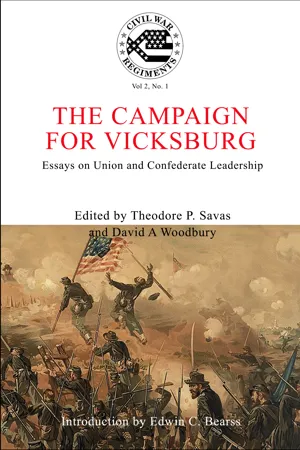
Balanced and in-depth military coverage (all theaters, North and South) in a non-partisan format with detailed notes, offering meaty, in-depth articles, original maps, photos, columns, book reviews, and indexes. 1st Battalion, 13th US Infantry – 22nd Iowa Infantry at the railroad – Command failure, Confederate loss – Brief history of the archival holdings of Vicksburg NMP
eBook - ePub
A Journal of the American Civil War: V2-1
The Vicksburg Campaign
- English
- ePUB (mobile friendly)
- Available on iOS & Android
eBook - ePub
A Journal of the American Civil War: V2-1
The Vicksburg Campaign
About this book
Information
Subtopic
American Civil War HistoryIndex
HistoryA Failure of Command:
The Confederate Loss of Vicksburg
Jim Stanbery1
This article examines the loss of the city of Vicksburg and its defending army from the perspective of the Confederate high command. Although it briefly discusses early Union attempts to capture Vicksburg during the late fall and winter of 1862, its primary thrust is an evaluation of Southern generalship and command decisions immediately before and after Union forces crossed over the Mississippi River below Vicksburg. Hopefully, this article will provide an interesting and helpful analysis of why Lt. Gen. John C. Pemberton and his generals lost both the city and the army entrusted to defend it. While strategic in tone and substance, the reader should keep in mind that coincident with an essay of this type is an examination of the combat evolution and development of the participating Confederate units and their leaders. Unappreciated by many students of the Civil War is the fact that the Vicksburg Campaign ultimately played a critical role in the structural evolution and fortunes of the Army of Tennessee, although an in-depth analysis of this impact is beyond the scope of this article. The string of defeats leading up to the siege, however, coupled with the onus attached to the loss of Vicksburg, forever stamped most of the officers and men serving under John Pemberton as second-rate losers. Ultimately, many of these stigmatized units and officers wound up fighting under the banners of the Army of Tennessee. In that capacity, they provided that “hard luck” army with a significant portion of its identity during its final twenty months of existence.
If it ever really existed, unity of command in the Rebel West died near the peach orchard at Shiloh with Gen. Albert Sidney Johnston. Johnston was the only Confederate officer to command a single departmental organization (styled Department Number 2) from Indian Territory in the far west, eastward across the Mississippi River to the Appalachians. It may have been too large a task for one man. In any case, no single theater commander after Johnston ever possessed as much overall authority spanning so many geographic areas, including both banks of the Mississippi River. What was equally significant, no other officer possessed such absolute confidence on the part of the Confederate government as did Johnston in early 1862. Johnston’s lasting legacy was not the surprise blow he dealt the unsuspecting Union army at Shiloh, but rather the concentration of scattered forces leading up to Shiloh, which ultimately resulted in a single Confederate army in the west.2
Under Johnston and his two immediate successors, Gens. P. G. T. Beauregard and Braxton Bragg, Confederate forces in the west concentrated around Corinth in northern Mississippi through the weeks before and after the battle of Shiloh. Most of the major bodies of Rebel troops then in service west of the Appalachian range wound up there, to comprise the nucleus of nearly every Confederate division ultimately fielded in the Western Theater3
These were heady months for the South. General Robert E. Lee had swept the war in Virginia away from Richmond and across the Potomac River with his victories in the Seven Days and Second Manassas Campaigns. Braxton Bragg performed nearly as great a feat, largely by maneuver. Leaving roughly two-fifths of his troops behind in Mississippi, he led the rest across the map in a great arc to the northeast which by-passed Union positions in Middle Tennessee. While Lee crossed over into Maryland, Bragg lunged deep into Kentucky, and with little cooperation from Maj. Gen. Edmund Kirby Smith’s army, finessed Union Maj. Gen. Don Carlos Buell’s army out of much of Tennessee, helping to restore, for a brief time, the Confederate perimeter in the West. His raid ended in the poorly-fought October 8, 1862 Battle of Perry ville, Kentucky.
The units Bragg left behind in Mississippi had for the most part joined the army after Shiloh. Bragg was attempting to shift the center of the war in the West by taking it from the Mississippi Valley and fixing it north of the Tennessee River. By and large, this was done with his proven officers and men, with the troops left under Maj. Gen. Earl Van Dom expected to play but a supportive role. As an army commander, Van Dom ultimately failed in Mississippi and was afterwards superceded in command.
On October 1, 1862, the District of the Mississippi was redesignated the Department of Mississippi and East Louisiana. This new military department was comprised of the state of Mississippi and that part of Louisiana resting east of the Mississippi River. Two of the Confederacy’s full generals, P. G. T. Beauregard and Joseph E. Johnston, were between assignments, but the new department of Mississippi went to neither officer. Instead, Beauregard returned to command the coastal department of South Carolina, Georgia and Florida, the place of his original claim to fame. The major general in command of the coastal department that Beauregard replaced was promoted to lieutenant general to command the new Mississippi department. That officer, of course, was John Clifford Pemberton.4
One of many Northern-born officers accepted for Confederate service, Pemberton was a native Philadelphian who graduated from West Point in the bottom half of his class in 1837. His poor scholastic showing resulted in an assignment to the same artillery regiment that Joseph E. Johnston had graduated into a decade earlier. Although he did not do well in an academic setting, Pemberton went on to perform good service in both the Second Seminole and Mexican Wars. His extensive career in the Fourth Artillery also included service against the Indians on the frontier and a bit part in the Utah expedition against the Mormons. In 1848, he married Martha Thompson, a Norfolk, Virginia, native and staunch advocate of Southern rights. It was a union that would strongly influence Pemberton in his decision to resign his commission in the United States army and join the Confederacy5
During the first year of the war, Pemberton served in Virginia under Joseph E. Johnston before succeeding General Robert E. Lee in command of the Department of South Carolina, Georgia and Florida. Headquartered in Charleston, the native Pennsylvanian was never fully accepted there. His arrogant style of command coupled with his northern heritage rapidly earned him the animosity of that city’s press and people. The 48-year-old officer looked the part of a warrior, however, carrying a five-foot, ten-inch frame of medium build. There are very few contemporary descriptions of Pemberton available. One member of Francis Cockrell’s famed Missouri Brigade described Pemberton during the Vicksburg Campaign as being
about forty-five, or perhaps a little older—scarcely six feet in height, and of rather slender proportions with dark eyes and hair—high forehead, thin visage and regular features; his face was considerably furrowed with lines, either of care or age; he appeared well on horseback, and seemed perfectly at ease in the saddle.6
After casting his lot with the Confederacy, John Pemberton was bestowed with more promotions to the upper echelons of rank than even Southern hospitality required. Without question, his rapid rise through the general grades during the first years of the Civil War was more the result of his friendship with Jefferson Davis than a plethora of military talent. Pemberton was made a major of artillery in the Confederate States Army on June 15, 1861, and two days later skipped the grades of lieutenant colonel and colonel and advanced to the rank of brigadier general, much to the dismay—and anger—of many fellow officers with long memories. The freshly-minted general took command of the Department of South Carolina, Georgia and Florida in June of 1861, and received for no outwardly apparent reason a promotion to major general in January of 1862. His tenure in the capacity of departmental commander was anything but stellar. More importantly, he took with him to his new assignment in Mississippi a dangerous and intransigent lesson learned from Gen. Robert E. Lee early in the war regarding Charleston: that it is often an overriding consideration to defend a fixed position regardless of the danger such a course posed for the troops of his command. The dangers inherent in this philosophy were exacerbated by later instructions from Secretary of War George Randolph to “consider the successful defense of those States [Mississippi and Louisiana] as the first and chief object of your command.” It was this lesson then, coupled with a lack of self-confidence, that Pemberton took with him when he traveled west to his new command.7
After setting up his headquarters in Jackson, Mississippi, the new lieutenant general promptly subdivided his department into three districts on October 21. He also proposed naming the troops under his command “The Army of North Mississippi,” but the Richmond War Department instead designated it the First and Second Army Corps of the Army of the Department of Mississippi and East Louisiana. These corps were led, respectively, by Maj. Gens. Earl Van Dom and Sterling Price.8
For the most part, the troops inherited by Pemberton in this new command had but limited combat experience, and what little they had engaged in had been largely unsuccessful. Unfortunately, the three main battles emblazoned on their standards were Pea Ridge, Iuka, and Corinth, all of medium scale and all defeats. A skilled and diligent administrator with a bureaucratic mentality, Pemberton restored troop morale and discipline with substantial changes in the quartermaster and commissary departments, reshuffled units, carved his department into districts, and earmarked his brigades for service at distinct geographic points. Among the raw materials rendered serviceable was Earl Van Dom. Pemberton elevated the energetic but rash Mississippian to command all of the cavalry in his department. It was a sound choice. Pemberton also saw to the gradual reassignment of each of Van Dorn’s generals, some of this his own doing, some of it instigated from Richmond. All in all, these changes provided Pemberton with a fresh, streamlined command structure, but one in which few senior officers, from Pemberton down, had ever commanded troops in a full- scale battle. Pemberton’s generals would also be leading soldiers grouped in brigades which, by and large, had never served together in the field.9
Although Pemberton had much to occupy his mind in his new command, his primary concern, and the main aim of Union planners, was the east bank city of Vicksburg, Mississippi. If the Confederacy had an eagle’s nest, Vicksburg was it. The Confederates actively began fortifying Vicksburg after the fall of New Orleans on April 25, 1862. The river bastion sat on high brown bluffs which commanded that reach of the river which flowed east and sharply south along its towering heights. The river continued its course to southward beyond the range of the city’s southern guns. Vicksburg represented the northern-most barrier against a Union invasion down the massive water artery, which if seized, would split the trans-Mississippi states apart from her sisters to the east. Between Vicksburg and heavily fortified Port Hudson, Louisiana, flowed the only stretch of the river left in Confederate hands, its defenses bolstered by the artillery stronghold of Grand Gulf, Mississippi.
Vicksburg could only be taken from the interior, or landward side, if it could be taken at all, a military feat that remained in doubt for a considerable time. One Union officer described the city’s land defenses as “a long line of high, irregular bluffs, clearly cut against the sky, crowned with cannon which peered ominously from embrasures to the right and left as far as the eye could see.” Almost eight miles of works protected the “Hill City,” running in a wide crescent anchored above and below the town itself on the river’s precipitous bluffs. This line of defenses consisted of earthworks buttressed by connecting rifle-pits, the whole dotted with powerful forts housing clusters of artillery pieces. General Joseph E. Johnston, theater commander of the Department of the West, together with President Jefferson Davis, arrived there for an inspection on December 20, 1862, but the works failed to impress Johnston. “Instead of a fort requiring a small garrison,” he later noted, the place had been converted “into an immense entrenched camp, requiring an army to hold it.” The Virginian drew the same conclusion of Port Hudson when shown a map of that locale. His words were perhaps more pro...
Table of contents
- Cover
- Title
- Subscription and General Information
- Copyright
- Contents
- Founding Contributors
- Introduction by Edwin C. Bearss
- The First Honor at Vicksburg: The 1st Battalion, 13th U. S. Infantry
- Into the Breach: The 22nd Iowa Infantry at the Railroad Redoubt
- A Failure of Command: The Confederate L oss of Vicksburg
- The Preservation Report
- The A rchival Holdings of Vicksburg National Military Park, A Brief History
- The Classic Regimental Bookshelf
- Jefferson Davis: The Man and His Hour,
- The Battle of Belmont: Grant Strikes South,
- Pemberton, A Biography,
- Soldiering in the Army of Tennessee,
- The Campaign for Vicksburg,
- The Road to Glory: Confederate General Richard S. Ewell,
Trusted by 375,005 students
Access to over 1.5 million titles for a fair monthly price.
Study more efficiently using our study tools.
Frequently asked questions
Yes, you can cancel anytime from the Subscription tab in your account settings on the Perlego website. Your subscription will stay active until the end of your current billing period. Learn how to cancel your subscription
No, books cannot be downloaded as external files, such as PDFs, for use outside of Perlego. However, you can download books within the Perlego app for offline reading on mobile or tablet. Learn how to download books offline
Perlego offers two plans: Essential and Complete
- Essential is ideal for learners and professionals who enjoy exploring a wide range of subjects. Access the Essential Library with 800,000+ trusted titles and best-sellers across business, personal growth, and the humanities. Includes unlimited reading time and Standard Read Aloud voice.
- Complete: Perfect for advanced learners and researchers needing full, unrestricted access. Unlock 1.5M+ books across hundreds of subjects, including academic and specialized titles. The Complete Plan also includes advanced features like Premium Read Aloud and Research Assistant.
We are an online textbook subscription service, where you can get access to an entire online library for less than the price of a single book per month. With over 1.5 million books across 990+ topics, we’ve got you covered! Learn about our mission
Look out for the read-aloud symbol on your next book to see if you can listen to it. The read-aloud tool reads text aloud for you, highlighting the text as it is being read. You can pause it, speed it up and slow it down. Learn more about Read Aloud
Yes! You can use the Perlego app on both iOS and Android devices to read anytime, anywhere — even offline. Perfect for commutes or when you’re on the go.
Please note we cannot support devices running on iOS 13 and Android 7 or earlier. Learn more about using the app
Please note we cannot support devices running on iOS 13 and Android 7 or earlier. Learn more about using the app
Yes, you can access A Journal of the American Civil War: V2-1 by Theodore P. Savas, David A. Woodbury, Theodore P. Savas,David A. Woodbury in PDF and/or ePUB format, as well as other popular books in History & American Civil War History. We have over 1.5 million books available in our catalogue for you to explore.