Balanced and in-depth military coverage (all theaters, North and South) in a non-partisan format with detailed notes, offering meaty, in-depth articles, original maps, photos, columns, book reviews, and indexes.
Gray’s Louisiana Brigade – Union Naval Expedition – Beard and the Consolidated Crescent Regiment – Campaign Letters – Touring the Red River Campaign
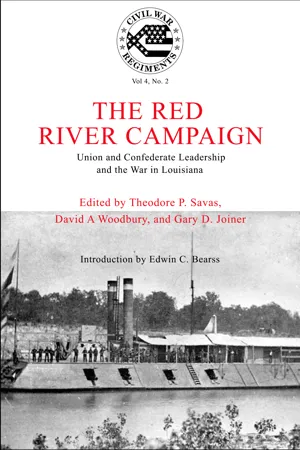
eBook - ePub
A Journal of the American Civil War: V4-2
Red River Campaign
- 160 pages
- English
- ePUB (mobile friendly)
- Available on iOS & Android
eBook - ePub
A Journal of the American Civil War: V4-2
Red River Campaign
About this book
Information
Subtopic
American Civil War HistoryIndex
HistoryThe Best of Their Genre
Historians and Their Favorite Civil War Books
Have you ever wondered what Civil War books some of your favorite authors consider to be the best of their genre? What book in particular they would name if asked to list their favorite title? Since Civil War Regiments deals primarily with unit-related studies, we decided to inaugurate our Annual Civil War Books issue by asking a few dozen historians, authors, and researchers to tell our readers which Civil War unit-related book was their favorite, and why. If no particular book of that type came readily to mind, we requested that they discuss their favorite Civil War title in general, and why they would classify it as such. We asked for as little as one or two sentences, or as much as several pages.
While many of the “standard” studies one would expect to find in such a compilation were provided (John Pullen’s Twentieth Maine and John Casler’s Four Years in the Stonewall Brigade, for example), some of the answers surprised us—and may surprise you as well. Who among you would have wagered that James I. Robertson, recognized Confederate/Army of Northern Virginia scholar, would have waxed poetic about a Union regimental? Or that Lawrence Lee Hewitt of Port Hudson/Trans-Mississippi fame would have written about Douglas Southall Freeman?
We were impressed by the expeditious response of the participants and the enthusiasm with which they tackled this assignment. We hope you enjoy it as well.

William C. “Jack” Davis
author of Jefferson Davis: The Man and the Hour (New York, 1991).
The unit history that has always impressed me greatly is Ed Porter Thompson’s History of the First Kentucky Brigade. This is one of the first Confederate unit histories to appear after the war, and I discovered in his small collection of papers at the Library of Congress that he was actually working on it even before the surrenders. He interviewed scores of soldiers, borrowed the few diaries in existence, and had the benefit of being custodian of a major chunk of the brigade’s official archives, which he later turned over to the National Archives. As a result, it is one of the most accurate and well-founded of all unit histories by an actual participant. It also includes capsule biographies of most members of the outfit, often with telling anecdotal incidents.
Of course, historians of today, with access to a wide range of sources, are producing regimentals that are much better, and more balanced, than those written by the veterans. But from among the latter, I think it would be very hard to top Thompson. Over 125 years after publication, it remains a major source on the Army of Tennessee.
Steven E. Woodworth
author of Jefferson Davis and His Generals in the West (Lawrence, 1990)
It’s not easy to pick a favorite out of the many excellent books on Civil War units. If a unit as large as an army could qualify for inclusion in this category, I might choose Bruce Catton’s incomparable Army of the Potomac trilogy, Mr. Lincoln’s Army, Glory Road, and Stillness at Appomattox. Catton’s prose has rarely been equaled and never excelled, and the smoothness and balance with which he covers both the lot and experience of the common soldier, as well as the grand strategy and monumental decisions of the generals is truly amazing.
If (not unreasonably) one might object that a unit history really means the study of some unit smaller than an army, then my choice would be Richard Moe’s The Last Full Measure: The Life and Death of the First Minnesota Volunteers (New York: Henry Holt, 1993). Moe focuses on the wartime experiences of two brothers, Isaac and Henry Taylor, who left behind abundant letter and diary material. He fills in the story with information from other members of the regiment as well as from official sources, thus giving a well-rounded account that nevertheless has the personal touch of a biography. The reader comes to feel as if he had personal friends in the First Minnesota. Moe skillfully blends all of the various aspects that went into soldiering in the Civil War, such as camp life, boredom, combat, the food, imprisonment, including such details as the soldiers’ insatiable desire for news and newspapers.
The narrative flows smoothly, with none of the sense of reading a meaningless compilation of facts that one gets with some books. Moe also captures the regimental personality of the First Minnesota—the characteristics that made it as different from other Union regiments as any of them were from the others. And he loses none of the poignant drama of its career. In the regiment’s apotheosis, the famous charge at Gettysburg in which it suffered 82% casualties, one of the Taylor brothers was among the slain. The battle thus becomes more than the movement of pieces on an imaginary chess board and takes on its true color as a personal tragedy.
In sum, I think one could find no better way to experience the life and death of a Civil War regiment than by reading The Last Full Measure.
Gary Gallagher
editor of Fighting For the Confederacy: The Personal Recollections of General Edward Porter Alexander (Chapel Hill, 1989)
My favorite title on a Civil War unit—assuming that you will accept the Army of Northern Virginia.as a “unit”—is Douglas Southall Freeman’s Lee’s Lieutenants: A Study in Command, 3 vols. (New York, 1942-1944). Freeman undertook this exploration of the high command of the Army of Northern Virginia because he feared that his four-volume biography of R. E. Lee might have “put in undeserved shadow the many excellent soldiers” who fought under the Confederacy’s premier commander. His decision to give Lee’s subordinates their due resulted in three large volumes totaling roughly 2,500 pages. It is a work of many virtues, not the least of which is the depth and quality of Freeman’s research. He canvassed a remarkable array of printed sources, and any historian pursuing work on Lee’s army today has cause repeatedly to offer thanks for the clues about useful material contained in Freeman’s notes. Considerable evidence from unpublished manuscripts—many of them still in private hands when Freeman worked on Lee’s Lieutenants—supplemented the printed materials. Freeman was the first scholar to make extensive use of Jedediah Hotchkiss’ journal, William Dorsey Pender’s letters, and other invaluable sources that have since been published and widely cited. Overall, Freeman’s research holds up very well after more than a half-century.
Lee’s Lieutenants also benefits from the author’s considerable gifts as a writer. Although some readers find Freeman’s style difficult, I believe it is well suited to the sweeping scale of his subject. Some of his best prose appears in the chapter devoted to the surrender at Appomattox: “The men stepped forward four paces across the road and stacked their arms. Off came the cartridge boxes. In a moment these were hanging from the muskets. The color sergeants folded the regimental flags and laid them, too, on the stack. Silence held. ‘We did not even look into each other’s faces.’ They turned; they came back onto the road, they marched past the Court House. It was over.” No other historian whom I can name has begun so many sentences with adverbs and gotten away with it. Language such as “admirably they moved forward. . .” or “gallantly they resisted. . . .” or “Persistently he sought the enemy. . . .” occurs frequently and to surprisingly good effect. Many of Freeman’s chapter titles also are memorable. “Promotion for Rodes and for Jackson” refers to Robert E. Rodes’ elevation to major general and Stonewall Jackson’s advancement to a greater reward (at least Freeman, like Jackson, assumed so) following Chancellorsville. “The Army Slips Back a Year” captures in shorthand what Lee must have thought as he waited with growing anxiety for his offensive to begin during the second day at Gettysburg. The descriptions of fighting southwest and west of the Chancellor’s house on May 3, 1863, and in the Mule Shoe at Spotsylvania on May 12, 1864, command the reader’s attention in a way few historians achieve.
Freeman clearly identified with the Army of Northern Virginia and the officers who led it—a circumstance that sometimes prompts questions about his ability to engage in detached analysis. The aroma of the Lost Cause undoubtedly permeates Lee’s Lieutenants, and in some ways Freeman can be considered the 20th-century heir to Jubal Early in Confederate historiography. But although he admired most of his subjects in Lee’s Lieutenants, a close reading reveals clear-eyed criticism of everyone from Jackson and James Longstreet and Jeb Stuart on down the chain of responsibility. Nor did Freeman fail to place events on the battlefield within a broader context. His focus remains with the army on the march and in battle, but newspapers and other sources provide background about economics, politics, and morale among the large Confederate populace.
As a boy and young man in Colorado, I read and re-read Lee’s Lieutenants and was transported to the company of the officers who fought in the Army of Northern Virginia. As a professional historian, I still turn to these books with profit. Anyone who writes a book that can serve needs as diverse as mine in 1962 and 1995 has accomplished something unusual. Lee’s Lieutenants stands as Douglas Southall Freeman’s best work and remains one of the cornerstones of the military literature on the Confederacy.
Lawrence L. Hewitt
Author of Port Hudson: Confederate Bastion on the Mississippi (Baton Rouge, 1987).
My favorite unit history is Douglas Southall Freeman’s Lee’s Lieutenants: A Study in Command. Freeman begins his three-volume examination of the Army of Northern Virginia with a foreword that describes the evolution of his study. In the process, he also provides a list of the essentials required for a good unit history. Although lengthy, they are worthy of note: (1) the unit has to stand alone and be the only common bond of its members; (2) adequate background material about the unit’s members must be presented; (3) where possible, sketches of individuals should appear in the text when the person takes on an added measure of importance (additional information should be included, but could be relegated to notes or appendices); (4) the text should be written from the point of view of the unit’s members, rather than those of their superiors, their opponents, or some latter-day revisionist historian; (5) the colorful members should not be overemphasized at the expense of the mundane or those about whom little is known, because such an emphasis would present a distorted picture of the majority of the unit’s membership; (6) the writer should not minimize a member’s flaws and should strive to present a balanced portrayal of the subject; (7) do not neglect the routine off the battlefield, because “what is shown in battle is created in camp” (xxv); (8) “mirror the era” of the subject, not your own (xxviii); and (9) do not edit quotations in a way that distorts the grammatical skills of the unit’s members.
I think that Freeman failed to follow his own advice—and he acknowledged this—by not providing sufficient biographical information about many of the unit’s members. Although not included among Freeman’s requirements, Lee’s Lieutenants includes appropriate maps, illustrations, and footnotes, and an adequate bibliography and index, requirements essential to outstanding unit histories.
Any unit history that meet’s Freeman’s nine conditions has the potential for success, but to be included in that small list of elite unit histories, the author must surpass Freeman’s list. Freeman himself hinted at a tenth requirement, one later expounded upon by historian T. Harry Williams. A unit history should include a theme that transcends the topic in time and space in a way that provides keener insight into other aspects of history. Hayes of the Twenty-third: The Civil War Volunteer Officer (New York, 1965) enabled Williams to combine the subject of how civilian officers came to “master the rudiments of military knowledge” (x) with a suitable individual who offered the additional attraction of later serving as president of the United States. Freeman hoped to boost the American people’s confidence in their World War II leadership in 1942 by emphasizing that fifteen months of fighting had transpired before the emergence of the Lee-Jackson team that won Second Manassas.
Shortly after having won a Pulitzer Prize for his biography of Huey Long, Williams confided to this writer that some future Pulitzer prize-winning author will have achieved at least half of that goal with the selection of the subject. For example, what unit in all of American history has more inherent appeal than the Army of Northern Virginia?
Finally, Lee’s Lieutenants was written in Freeman’s “fog of war” style. The reader is given no more information than that which was available to the individual being discussed in the text. Don...
Table of contents
- Cover
- Title Page
- Copyright
- Contributors
- Contents
- Introduction
- A Colonel Gains His Wreath: Col. Henry Gray’s Louisiana Brigade at Mansfield
- The Union Naval Expedition on the Red River
- Col. James H.Beard and the Consolidated Crescent Regiment
- The Red River Campaign Letters of Lt. Charles Washington Kennedy, 156th New York Volunteer Infantry
- Unpublished After-Action Reports
- Book Reviews
- With Grant and Meade: From the Wilderness to Appomattox, by Theodore Lyman
- A Captain’s War: The Letters and Diaries of William H. S. Burgwyn, 1861-1865, edited by
- Civil War Spoken Here, by Robert D. Quigley
- The Class of 1846, by John C. Waugh
- The Confederacy’s Fighting Chaplain: Father John B. Bannon, by Phillip Thomas Tucker
- War in Kentucky: From Shiloh to Perryville, by James Lee McDonough
- Index
Trusted by 375,005 students
Access to over 1.5 million titles for a fair monthly price.
Study more efficiently using our study tools.
Frequently asked questions
Yes, you can cancel anytime from the Subscription tab in your account settings on the Perlego website. Your subscription will stay active until the end of your current billing period. Learn how to cancel your subscription
No, books cannot be downloaded as external files, such as PDFs, for use outside of Perlego. However, you can download books within the Perlego app for offline reading on mobile or tablet. Learn how to download books offline
We are an online textbook subscription service, where you can get access to an entire online library for less than the price of a single book per month. With over 1.5 million books across 990+ topics, we’ve got you covered! Learn about our mission
Look out for the read-aloud symbol on your next book to see if you can listen to it. The read-aloud tool reads text aloud for you, highlighting the text as it is being read. You can pause it, speed it up and slow it down. Learn more about Read Aloud
Yes! You can use the Perlego app on both iOS and Android devices to read anytime, anywhere — even offline. Perfect for commutes or when you’re on the go.
Please note we cannot support devices running on iOS 13 and Android 7 or earlier. Learn more about using the app
Please note we cannot support devices running on iOS 13 and Android 7 or earlier. Learn more about using the app
Yes, you can access A Journal of the American Civil War: V4-2 by Theodore P. Savas, David A. Woodbury, Gary D. Joiner, Theodore P. Savas,David A. Woodbury,Gary D. Joiner in PDF and/or ePUB format, as well as other popular books in History & American Civil War History. We have over 1.5 million books available in our catalogue for you to explore.