How can leaders promote diversity, equality and inclusion? What does it mean to let go of leadership? How do learning, feedback and coaching help us become better leaders?
Following the success of Leading Beyond the Ego, this book shows how to apply transpersonal leadership – practiced leaders who are radical, ethical, authentic and act beyond their own interests to create high-performing organisations – in a wide range of contexts. It considers the attributes of transpersonal leaders and how they transform organisations by building strong, collaborative relationships and a caring, sustainable and performance-enhancing environment.
Shining a light on the way forward for senior leaders and HR and talent professionals, the book covers:
Characteristics of transpersonal leaders such as purpose, ethics and adult development
Impact of transpersonal leaders on global organisations, during digital transformation and change and through crises
Case studies of transpersonal leadership in different contexts including in India and East Asia, when leading remotely, in HR and politics
Transpersonal Leadership in Action is essential reading for senior leaders, HR professionals and those responsible for leader and organisational development.
Everyone thinks of changing the world, but no one thinks of changing himself.
Leo Tolstoy
Overview
It is becoming more generally accepted that there is a need to develop a new kind of leader to meet the needs of our 21st century volatile, uncertain, complex, ambiguous (VUCA) world. The bookcases are full of volumes that describe “what” great leaders should do, but “how” to develop such leaders is usually limited to a macro or systemic solution rather than focusing on granular behavioural change of the individual. Our book ‘Leading Beyond the Ego – How to Become a Transpersonal Leader’ published in 2018 (Routledge 2018) describes the qualities and characteristics of transpersonal leaders, then focuses on developing these leaders through a new codified process that introduces readers to the concepts of transpersonal leadership and the journey an individual might undertake to move closer to it.
This new book seeks to continue to build on that initial concept and provide useful contexts in the practical application of transpersonal leadership. After all, a recipe might look great on paper, but it is only when the dish is prepared, cooked and consumed that we fully understand the feast as intended.
Introduction
We know that the climate and culture of organisations is an echo of the behaviours of its leaders, especially the Leader, the CEO or President.
Imagine if you worked in a place that had a clear sense of purpose that you and your colleagues shared, and that sense of purpose was ethical, authentic and caring whilst also being sustainably successful; taking care not only of shareholders, but of all the stakeholders. Imagine too, if that sense of purpose and environment allowed the organisation to be so nimble that it was able to respond to radical shifts in the environment with equally radical solutions. An environment where input, initiative and innovation are encouraged; people valued, listened to and cared about with strong relationships between colleagues with an expectation of competence to get on with things. Wouldn’t that be a place you would want to work?
So often we hear of organisational environments where knowledge is power, where there is a lack of engagement, brought about by managers relying on carrot and stick methods to motivate staff and where managers often have, for any variety of reasons, their own interests at the forefront of their minds. In addition to job security, those reasons could include the desire for power, prestige, recognition or reward. We’ve probably all experienced a boss like that at some stage in our careers. It may well have been a reason for us moving on from an organisation; it’s rarely a positive experience.
An organisation that is a great place to work, like the one described above, needs to be led by exceptional people. They have become exceptional not only because they are demonstrably great leaders but because they have developed a level of self-awareness of their own strengths and weaknesses. They have also brought into full consciousness who they are in terms of values, ethics and beliefs and they know what they want to do with who they are; their motivation, courage, resilience and aspiration. They know their purpose, and they don’t let self-interest get in the way. They are leading beyond the ego.
The news channels and social media are becoming increasingly full of instances where organisations have suffered financial penalties or even collapse because they have been found to have operated in ways that are unethical or they have failed to adapt to a change in context or disruptive technology. These might sound quite different things, but at their centre is the organisational ego set by the top leaders. That self-interest is getting in the way, driven either by placing personal reward over ethics, perhaps by the size of their personal income and bonus, or the fear that being radical will place their own position, power or income under threat. This is so often echoed throughout the organisation, mirroring the behaviour of those at the top.
There’s a term for a person who acts beyond their ego, it’s called being transpersonal. Transpersonal Leaders have developed the emotional intelligence (EI) to lead in ways that mean people follow them, there is empathy, trust and inspiration; all the things that equip someone to be an effective leader. When you have followers, you can afford to be radical in the knowledge that people will stay with you with a shared sense of values and purpose, understanding that you are making decisions in the interests of the greater good. That way organisations stay around, building a sustainable future that continually performs well, builds trust with its customers, staff, suppliers, shareholders, communities and making a valuable contribution to the world we live in.
That’s an organisation many would go out of their way to work in.
There are many leaders who aspire to be like the Transpersonal Leader, but for one reason or another find the road to that goal challenging. If this is your desired path, then the first step we would encourage you to take is our previous publication, ‘Leading Beyond the Ego – How to Become a Transpersonal Leader’ (Routledge 2018). It sets out a structured journey in practical steps towards becoming a Transpersonal Leader, which we will describe briefly in this chapter to provide you with a taste of what is involved.
The journey
Having completed the first 20 years of the 21st century, we have a VUCA world in which we are still in the early stages of the post-industrial information age. (VUCA stands for “Volatile, Uncertain, Complex and Ambiguous”. Originally used by the American military to describe extreme conditions in Afghanistan and Iraq, but more recently as the state of the world in general.)
Just like the industrial revolution before, it needed different kinds of leaders, so does the information age. Hierarchical leadership does not work effectively any more in this increasingly complex world in which society is also changing rapidly. Such a world requires collaboration, participation, delegation and distribution of leadership. We need leaders who are more self-aware, emotionally intelligent and who can use a variety of leadership styles for different situations. They need all these attributes to be able to build a performance-enhancing culture in their organisations. But in addition to that, in order to create a culture that is also ethical, caring and sustainable, they need to bring their values to a higher level of consciousness. They must think radically, be authentic, lead beyond their ego and work for all the stakeholders of the organisation – and that includes the planet. And no one can achieve that without continuous personal and professional development. We call them Transpersonal Leaders (Knights et al., 2018).
To attain these heights of leadership competence, a leader needs to reach an advanced level of adult development (Kegan, 1982; Garvey Berger, 2006). But if we allow this to happen by serendipity, it will at least take until late middle-age, and then only 5% or so of the population will attain it.
So, our goal is to develop as many Transpersonal Leaders as possible and as young as possible. Then, we might start to change the world. To achieve this, the approach we have used is to enable leaders to rewire their own brains proactively based on the knowledge we provide, the insights they create, regular practice (primarily in the workplace) and regular reflection (Schon, 1983; Rock and Schwartz, 2007; Rock, 2009; Patterson, 2017). What we have developed over the last 20 years is a programme that uses state-of-the-art blended learning together with a process of learning that is in the most effective order to encourage embedding of the learning and the forming of new habits (Knights et al., 2018 – Ch22).
The journey of development
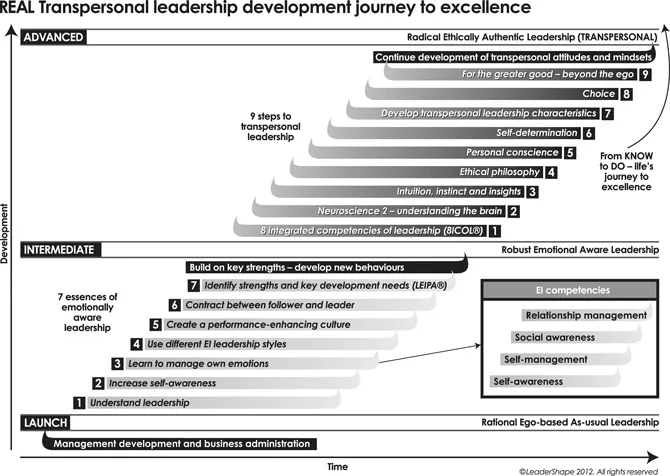
As we can see from Figure 1.1, the entire “Transpersonal leadership development journey to excellence” is made up of a programme to the intermediate level, followed by one to the advanced level. To reach the intermediate level, leaders must understand what leadership is about in the 21st century, investigate how the brain actually works in the context of leadership, learn to increase self-awareness and understand how emotions impact our behaviour and leadership styles impact culture.
Figure1.1 Transpersonal leadership development journey
To progress through the advanced level of development, participants must learn to bring their values, beliefs and purpose to full consciousness and then act on them by using the new and improved behaviours they have already learned at the intermediate stage, and other behaviours they still need to learn, in order to manage their ego. During this part of the advanced journey, they become better decision-makers, addressing ethical issues and developing other transpersonal characteristics of being caring, radical, authentic and sustainable as well as emotionally intelligent and performance-enhancing. This provides a deep level of consciousness, allowing leaders to make their own choices, work for the greater good and lead beyond their ego.
At the very start of the journey, using our “REAL” mnemonic, participants function as a “Rational, Ego-based, As-usual Leader” (REAL-1). What do we mean by this? Throughout our education (school, university, workplace and probably at home too), most of us are taught, told or persuaded to think logically and analytically; it is certainly what we are praised for and measured on. We are taught that our answers, responses and decisions should be thought out rationally and objectively. We are rarely (if ever) encouraged to think intuitively, emotionally or spiritually. By the time individuals are in a position of responsibility and take on a leadership role, most of us will have had any non-rational thinking “knocked” out of us. When we start our role as leaders, we usually have relevant job skills, know how to use them and also understand management processes and strategic planning (what we refer to as the “foundation” or “basic” level of leadership development). However, we often assume that other individuals think and act like us, although in reality, we all have different preferences. Every individual will have varying levels of innate intuitive thinking and emotional awareness, but most often, we will not be fully aware of our capabilities, and therefore will not be managing these attributes to maximise levels of self-management, relationships and performance. That takes care of “Rational”.
In our early careers, both from a human maturity perspective and one of economics and sustainability, it is natural and usual to focus more on our personal needs. We want to get ahead with our careers, find the right partner, earn more money, get a nice car, buy a house, take care of our children and more. We want to establish ourselves and build our persona. It is primarily about “me”. Fundamentally, we seek power, reward, prestige or recognition, or any combination of these. Usually, one or more of these needs will be the prime motivator for the leadership decisions we make. We are Ego-based. There is nothing wrong or immoral in any of this, and it is the nature of things, but as an employee and especially as we develop as a leader, we should instead be making ...
Table of contents
Cover
Half Title
Title Page
Copyright Page
Table of Contents
List of figures
List of tables
Acknowledgements
List of contributors
Introduction: transpersonal leadership in action
1 Understanding transpersonal leadership
Part 1 Becoming a transpersonal leader
Part 2 Impact of a transpersonal leader
Part 3 Transpersonal leadership in action
Index
Trusted by 375,005 students
Access to over 1.5 million titles for a fair monthly price.
Study more efficiently using our study tools.
Frequently asked questions
Yes, you can cancel anytime from the Subscription tab in your account settings on the Perlego website. Your subscription will stay active until the end of your current billing period. Learn how to cancel your subscription
No, books cannot be downloaded as external files, such as PDFs, for use outside of Perlego. However, you can download books within the Perlego app for offline reading on mobile or tablet. Learn how to download books offline
Perlego offers two plans: Essential and Complete
Essential is ideal for learners and professionals who enjoy exploring a wide range of subjects. Access the Essential Library with 800,000+ trusted titles and best-sellers across business, personal growth, and the humanities. Includes unlimited reading time and Standard Read Aloud voice.
Complete: Perfect for advanced learners and researchers needing full, unrestricted access. Unlock 1.5M+ books across hundreds of subjects, including academic and specialized titles. The Complete Plan also includes advanced features like Premium Read Aloud and Research Assistant.
Both plans are available with monthly, semester, or annual billing cycles.
We are an online textbook subscription service, where you can get access to an entire online library for less than the price of a single book per month. With over 1.5 million books across 990+ topics, we’ve got you covered! Learn about our mission
Look out for the read-aloud symbol on your next book to see if you can listen to it. The read-aloud tool reads text aloud for you, highlighting the text as it is being read. You can pause it, speed it up and slow it down. Learn more about Read Aloud
Yes! You can use the Perlego app on both iOS and Android devices to read anytime, anywhere — even offline. Perfect for commutes or when you’re on the go. Please note we cannot support devices running on iOS 13 and Android 7 or earlier. Learn more about using the app
Yes, you can access Transpersonal Leadership in Action by Duncan Enright, John Knights, Danielle Grant, Greg Young, Duncan Enright,John Knights,Danielle Grant,Greg Young in PDF and/or ePUB format, as well as other popular books in Business & Human Resource Management. We have over 1.5 million books available in our catalogue for you to explore.