- 248 pages
- English
- ePUB (mobile friendly)
- Available on iOS & Android
eBook - ePub
About this book
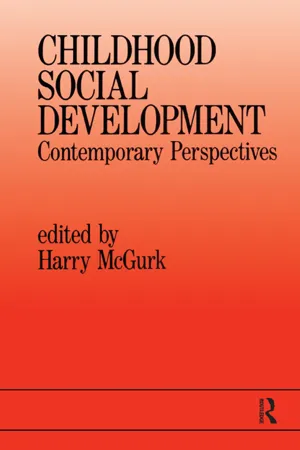
This book provides an account of research in action and debate in progress in a selection of areas of childhood social development where significant progress is underway. The chapters are written by an eminent group of British and American developmental psychologists each of whom has made primary contributions to research in the areas covered in the volume. The contributors were invited to reflect upon the current scene in social developmental research and to develop their own distinctive viewpoint and contribution to the field. The book addresses issues in social development from infancy to adolescence. The topics examined include: interactions between biological and social factors in social development; sex role development; the development of friendships; the role of peer interaction in social and cognitive development; and the influence of cultural artifacts in the social and cognitive development of children. Although each chapter is concerned with a different aspect of social development, there are a number of themes that recur throughout the volume. One concerns the nature of social development: the acquisition of social understanding and the development of social skills are not individual achievements of children reared in isolation. Rather, they are the outcome of social processes in which the developing child engages, sometimes in an unequal partnership with experienced adults; at other times in more equal partnership with peers and playmates. In both cases the development change is a constructive outcome. A second recurrent theme is a concern for developmental researchers to take fuller account than they may traditionally have done of the nature of the cultural settings in which social development occurs. Different cultures have different customs and artifacts, and these can constrain development in different ways. This issue is considered throughout the book and is the specific focus of the final chapter.
Information
Publisher
Psychology PressYear
2022Print ISBN
9780863772757
9780863772733
Edition
1eBook ISBN
9781317716327
1 | Human Social Development: An Ethological/Relationship Perspective |
M.R.C. Development and Integration of Behaviour Group, Madingley and St. John’s College, Cambridge, U.K.
INTRODUCTION
Direct parallels between animals and humans are dangerous because of the differences in cognitive abilities; because of the importance of cultural factors in the human case; because the diversity of animal species and human cultures make it too easy to find superficial parallels; and because there are difficulties in finding the appropriate level of analysis at which to make comparisons (Hinde, 1987). Nevertheless the orienting attitudes of ethology can prompt new perspectives on human development, and animal data can suggest principles whose applicability to the human case can subsequently be assessed.
In this chapter I am not concerned with the methodological contributions made by students of animal behaviour, which have been well reviewed elsewhere (e.g. Martin & Bateson, 1986). In focusing on the conceptual orientation that an ethological approach can bring to studies of child development, I have not attempted a complete review, but rather to sketch some areas, selected in part by my own predilections, where a biological approach has been valuable. Limitations of space preclude discussion of a number of other areas where biological concepts have been used by child developmentalists, such as sensitive periods (see Bateson, 1988, & Hinde, 1987), or where biological and psychological approaches are proceeding in tandem, such as the issue of continuity/discontinuity (Hinde & Bateson, 1984; Rutter, 1987) and the study of non-verbal communication (e.g. van Hooff, 1972).
We have, I believe, passed the stage in which biologists and developmental psychologists glowered at each other from opposite sides of an apparently unbridgeable crevasse. Few developmental psychologists still think that our evolutionary history is irrelevant to our current nature, and few biologists still think that principles sufficient for understanding the behaviour of animals are also likely to be adequate for our own. My current aim, therefore, is to attempt to specify just what sort of bridges can be built. In order to avoid going over old ground, I shall assume that certain issues are now generally agreed:
(a) Items or aspects of behaviour cannot be divided into those that are genetically determined and those that are the products of experience (see e.g. Oyama, 1985). Rather, individuals and their behaviour are to be seen as the result of continuing transactions between the individual at each point in time and the environment and, tracing this backwards, between the genes and their environment. This does not mean that characteristics of the individual or of behaviour are direct reflections of the genes, or indeed of the environment. However, there are some aspects of human behaviour that are so developmentally stable that they appear in all or virtually all environments experienced by human individuals.
(b) Natural selection operates through the reproductive success of individuals or their close relations. Selection operating to favour one species or group over another is unlikely to be effective, because it would pay individuals to cheat when a rule operated to disadvantage them with respect to their group companions, even though adherence to that rule could benefit the group as a whole. However, it has been suggested that group selection may operate in certain special contexts—for instance to promote cooperation leading to success in inter-group warfare (Alexander & Borgia, 1978; Bateson, 1988).
(c) Natural selection has operated to produce not only more or less fixed patterns of behaviour, but also alternative strategies to meet varying circumstances. For instance, while it may be best to be at the top of a dominance hierarchy, when not at the top a variety of alternative behavioural styles may be preferable to challenging the leadership (Lack, 1954; 1966).
(d) Individuals do not learn all things with equal ease: rather there are constraints on what can be learned and predispositions to learn some things rather than others. A classic example is song-learning in some birds: the chaffinch only sings the species-characteristic song if it has heard others singing it, but can learn only chaffinch song (Thorpe, 1961; Seligman & Hager, 1972; Hinde & Stevenson-Hinde, 1973). Similar principles are likely to operate in our own species. The constraints and predispositions may, of course, result from experience.
(e) Humans are unique in many respects, but humans are also one of a vast number of species, each with its own repertoire of behaviour and behavioural alternatives. That repertoire has been evolved to develop in and to suit a limited range of environmental circumstances. This basic orientation underlies all that follows.
Since misunderstandings are so frequent, it must quickly be said that this does not mean genetic determinism, nor does it mean that what is natural is necessarily best. These issues will be discussed later.
PHYSIOLOGICAL CONSIDERATIONS
During the period in which my own children were growing up, the debate in the country between schedule and on-demand feeding was gradually resolved in favour of the latter. Part of the evidence was comparative. Across mammals in general, suckling frequency is inversely related to the protein content of the milk. Those mammals that suckle their young very infrequently (e.g. once every two days), have very concentrated milk, and vice versa (Table 1.1). Human milk is dilute, suggesting that they are adapted to being suckled frequently. In harmony with this view, mammalian babies that are suckled infrequently suck faster and for a shorter period than those that are suckled frequently: human babies suck very slowly, suggesting that they are adapted to being suckled frequently (Blurton Jones, 1972).
Species | Milk Concentration | Suckling Interval (approx.) |
|---|---|---|
Tree shrews | Very High | 48 hours |
Rabbits | High | 24 hours |
Ungulates (cached young) | High/moderate | 4 hours |
Ungulates (following young) | Moderate | 2–3 hours |
Apes | Low | 1 hour |
Humans | Low | ? |
Because milk concentration and sucking frequency can be measured relatively objectively, this is evidence that is fairly easy to accept. Much of what follows is similarly concerned with the desirability of recognising the nature of children (and parents), though behavioural characteristics are less tangible than physiological ones. But to prevent misunderstanding from the start, it is wise to repeat that there is no implication that what is “natural” is always right.
INTEGRATION OF DIVERSE FACTS
A biological perspective can help to integrate facts about development that otherwise seem diverse and unrelated. It is apparent that, in animals, the various characters of anatomy, physiology and behaviour form an harmonious whole adapted to the species way of life. To take a crude example, birds have wings adapted for flying, they have skeletal, muscular, vascular and respiratory systems efficient for flying, and they use flight. In the same way the composition of milk, the physiology of suckling, babies’ demands, and one could add the milk ejection reflex and so on, all fit together.
But it does not end there: the system of co-adaptation can be followed almost indefinitely. Thus newborn primates are relatively helpless, but their mothers must move about to find food. With few exceptions, most of them carry their babies with them, and it is probable that this was also the case in early humans. A number of facts support this hypothesis. First, the Moro reflex (Prechtl & Lenard, 1968) and vestigial grasping reflex of the human newborn indicate that they originally held onto their mothers. Second, unlike the young of those mammals that cache their infants in a nest or hiding place, human newborns do not have to be stimulated by the mother to urinate or defaecate. And third, the poor thermoregulatory ability of human newborns is more compatible with their being carried than with their being cached or following their mothers (Blurton Jones, 1972). With the reduction of maternal body hair it must have become difficult for babies to grasp their mothers, especially as, by analogy with modern hunter gatherers, mothers were probably responsible for much of the food gathering. Presumably the establishment of home bases ameliorated this issue (Isaac, 1979). The continuous maternal availability that this implies would have been associated with maternal protection and with infant dependence on that protection. Hence the “irrational fears of childhood” mentioned later.
It would have been in a mother’s evolutionary interests to direct her maternal care to her own infant, or of those of close relatives. Indeed in mammals in general, female animals unrelated to the mother may be potential competitors to her own, so that a female will do better not to aid them and even to harm them. Hence fear of strangers, emerging around the age when the infant becomes capable of independent locomotion, must have been adaptive in our environment of evolutionary adaptiveness (and may still be so).
Furthermore a mammalian infant must learn to seek protection and comfort from its own parent. Thus a close mother-infant relationship is in the interests of both. It is from this perspective one must view the smile, the games that parents and infants play, affect attunement (Stern, 1985), the importance of social referencing, and other issues that contribute to attachment. Infants thrive better with parents who are sensitively responsive, not only because such parents provide for their needs in the short-term, but also because sensitive responsiveness promotes a better long-term relationship.
However, we must beware of the implication that mothers who behave in an ideally sensitive way will raise an ideally well-adapted infant in all circumstances. Animals acquire alternative strategies, which they exploit to meet the prevailing circumstances. The data seem to show that sensitive parenting and a secure parent–child relationship leads to a socially well-adjusted personality, while a more unpredictable and tensionful attachment relationship leads to a more aggressive and competitive individual. A biologist might ask, why is it this way round? Why does not sensitive mothering lead to a spoiled child, a stricter regime to gentleness and consideration for others? One possible answer is that natural selection has shaped offspring to use parental styles as “cues” to the environmental conditions they will have to face when they reach reproductive age. The only evidence about later conditions available to the infant are those current at the time, and if they involve a competitive social situation for the parent, leading to less sensitive parenting, it may pay the offspring to develop a competitive temperament (see Hinde, 1984; 1986).
LEVELS OF SOCIAL COMPLEXITY
Some issues, so well known to the developmental psychologist and to the person-in-the-street that they are easily neglected, have an importance that is more apparent in studies of animals in relatively simple situations. For example, it is impossible to work long with monkeys without recognising that the behaviour of individuals is crucially influenced by the presence of group c...
Table of contents
- Cover
- Half Title
- Title Page
- Copyright Page
- Table of Contents
- Contributors
- Editor’s Introduction
- 1 Human Social Development: An Ethological/Relationship Perspective
- 2 Childhood Gender Roles: Social Context and Organisation
- 3 Changes in Self Feelings During the Transition Towards Adolescence
- 4 Joint Involvement Episodes as Context for Development
- 5 Parent and Peer Relations in the Emergence of Cultural Competence
- 6 Children Constructing Society: A New Perspective on Children at Play
- 7 Friendships and their Developmental Significance
- 8 Cultural Artefacts in Social Development: The Case of Computers
- Author Index
- Subject Index
Trusted by 375,005 students
Access to over 1.5 million titles for a fair monthly price.
Study more efficiently using our study tools.
Frequently asked questions
Yes, you can cancel anytime from the Subscription tab in your account settings on the Perlego website. Your subscription will stay active until the end of your current billing period. Learn how to cancel your subscription
No, books cannot be downloaded as external files, such as PDFs, for use outside of Perlego. However, you can download books within the Perlego app for offline reading on mobile or tablet. Learn how to download books offline
Perlego offers two plans: Essential and Complete
- Essential is ideal for learners and professionals who enjoy exploring a wide range of subjects. Access the Essential Library with 800,000+ trusted titles and best-sellers across business, personal growth, and the humanities. Includes unlimited reading time and Standard Read Aloud voice.
- Complete: Perfect for advanced learners and researchers needing full, unrestricted access. Unlock 1.5M+ books across hundreds of subjects, including academic and specialized titles. The Complete Plan also includes advanced features like Premium Read Aloud and Research Assistant.
We are an online textbook subscription service, where you can get access to an entire online library for less than the price of a single book per month. With over 1.5 million books across 990+ topics, we’ve got you covered! Learn about our mission
Look out for the read-aloud symbol on your next book to see if you can listen to it. The read-aloud tool reads text aloud for you, highlighting the text as it is being read. You can pause it, speed it up and slow it down. Learn more about Read Aloud
Yes! You can use the Perlego app on both iOS and Android devices to read anytime, anywhere — even offline. Perfect for commutes or when you’re on the go.
Please note we cannot support devices running on iOS 13 and Android 7 or earlier. Learn more about using the app
Please note we cannot support devices running on iOS 13 and Android 7 or earlier. Learn more about using the app
Yes, you can access Childhood Social Development by Harry McGurk in PDF and/or ePUB format, as well as other popular books in Psychology & Developmental Psychology. We have over 1.5 million books available in our catalogue for you to explore.