![]()
PART 1
TECHNICAL FASHION DRAWING
![]()
INTRODUCTION
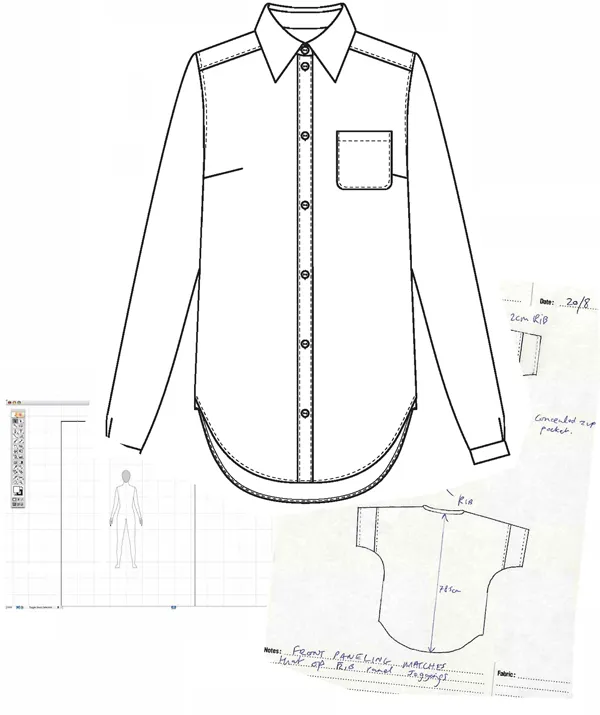
The ability to produce technical drawings, or flats, is a necessary skill in the fashion industry. Flats are used to convey a design idea and all its construction details to anyone involved in the production process. They are also an effective way of communicating silhouette, proportion, and detail. Differently adapted flats are used on line boards, costing sheets, specification sheets, on paper patterns, in fashion forecasting publications, look books, sales books, and catalogs.
With production services being sourced from a host of international locations, any means that can be found to overcome language and skill barriers can provide a very effective way of speeding up the production process and eliminating errors caused by misunderstandings. Drawing offers a universal means of communication, a visual language to facilitate this.
In this book you will learn how to communicate your design ideas using flats. The technique demonstrated starts with the creation of a generic body template, which can then be adapted and used to create the flats. This can be done by hand or using CAD, or a combination of the two. Both hand-drawn and CAD methods are shown in the book, the latter demonstrated using Adobe Illustrator. The aim is to convey basic information and demonstrate a skill, rather than to teach a drawing style. However, no two people’s flats will be exactly alike and there is room to develop your own personal style.
The techniques demonstrated in this book will result in flats that can be used and understood across all branches/sectors/stages of the fashion industry. In addition, the simple step-by-step method can also be used as part of the creative design process. Using a process called “speed designing” you will see how, once a garment template has been drawn, it can be used as inspiration for an almost limitless range of garment shapes and details.
A fundamental requirement for fashion design is a sound knowledge of the basics: understanding key basic garment styles and their construction will enable you to develop and design endless variations. The second part of the book presents a visual directory of classic garment shapes and their variations, key garment styling and details, as well as the names by which each is most commonly known. By presenting the basic styles as a muslin photographed on a mannequin as well as in the form of a technical drawing, you will be able to understand how to translate a three-dimensional shape into a two-dimensional, or flat, drawing.
Armed with this basic information, and following the simple step-by-step method, you will be able to create your own templates—or utilize those provided—to produce your own finished garment designs, while developing your own unique style of drawing.
![]()
ILLUSTRATION IN THE FASHION PROCESS
Technical drawing is one of the methods used in the fashion design process to present a garment in a visual format. The others are sketching and fashion illustration. Each has a specific function and thus demands a specific set of drawing requirements and techniques.
SKETCHING
A sketch is a rough, spontaneous drawing that is not necessarily accurate or even in proportion. It is the beginning of an idea, the inspiration. You can sketch from your imagination, from an existing style or from reference. If you are producing store reports, or gathering field information, the aim is to note down a rough interpretation of a garment with key details that can be deciphered easily at a later stage if required.
Part of design development, the sketching process is when you let your imagination run riot, investigating sources of inspiration and abstract themes. It is the stage when you can work freely and experiment, thinking on paper. Usually produced by hand, the sketches can be drawn using any media.
FASHION ILLUSTRATION
The aim of a fashion illustration is to seduce and enhance, rather than provide technical information. Apparel is often illustrated on the figure to give an idea of a garment’s proportions and how it will look when worn. Fashion illustrations are used in advertising, in catalogs, magazines, brochures, pattern books, and promotional material. A successful illustration will show mood, attitude, silhouette, proportion, and color to assist in the marketing of the garment. Its aim is to sell garments or to promote a brand.
Containing emotion, energy, flair, creativity, and often movement, the fashion illustration allows the illustrator artistic freedom to inject their own personality and character into the drawing. With this freedom comes the artistic license to alter the proportions of the female bod...