![]()
1
AIR: STRUCTURES
1.1 / AIR-SUPPORTED STRUCTURES
Air-supported structures are typically fabric membrane enclosures anchored to the ground around the perimeter, and held aloft by low pressure pumped into the structure via air blowers or fan units. While this type of structure uses airlocks (of en with two sets of doors) to prevent a sudden drop in pressure, they are ‘leaky’ and so require constant or intermittent air to top-up the relative internal pressure. The internal pressure can be increased to resist strong winds or snow loads.
Pavilions for the 12th World Orchid Conference
Yutaka Murata and Mamoru Kawaguchi
Kanagawa, Japan. 1987
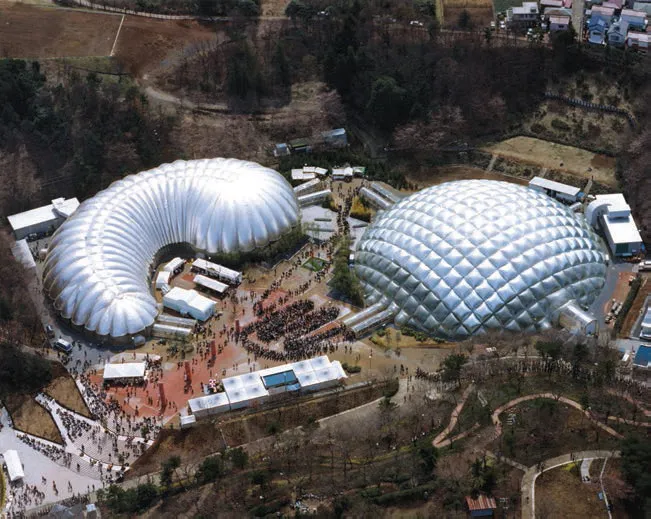
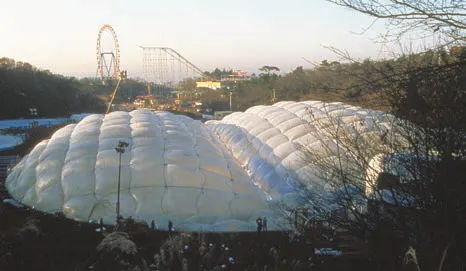
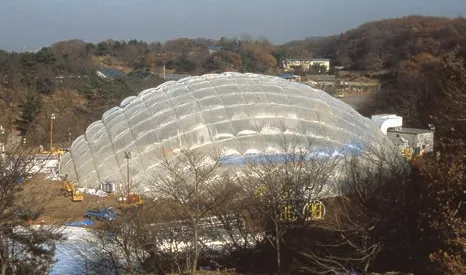
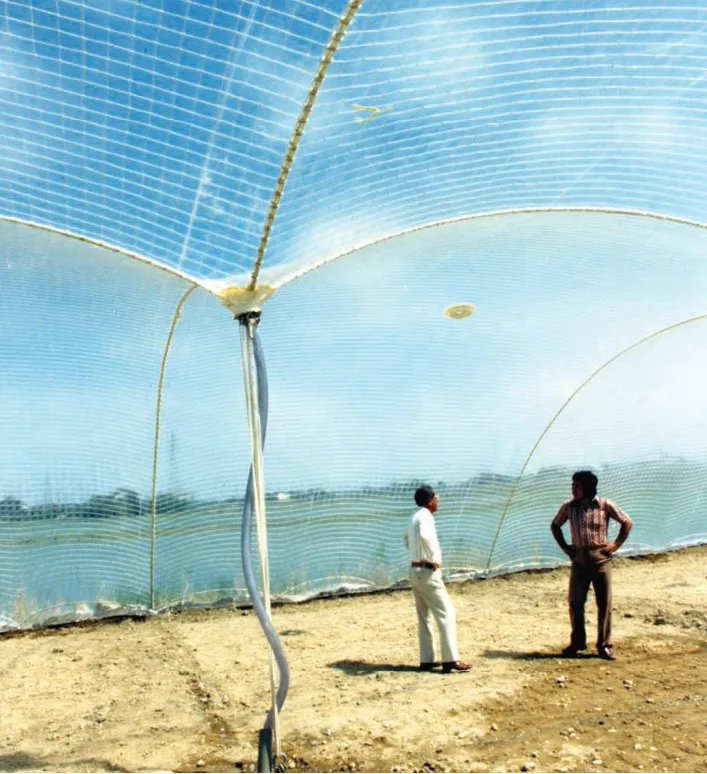
Both pavilions are single-skinned, cable restrained, air-supported structures. The circular pavilion has a diameter of 75 m (246 ft) and rises to a height at the apex of 19.5 m (64 ft). The pavilion is reinforced by a two-way wire rope ‘cable net’ on a 5 m (16 ft) grid. Kawaguchi’s great innovation was to introduce a secondary reinforcing mesh of fishing net. This net, on a 100 mm (3.87 in.) grid allows the airtight skin to be formed with a very thin and inexpensive layer of transparent PVC film, only 0.1 mm (0.003 in.) thick.
The tight grid of the fishing net avoids any significant stresses on the PVC film and obviates the need for expensive pattern-cut and tailored fabric. The second pavilion is shaped like a caterpillar and is 40-m (131-ft) wide and 100-m (328-ft) long. This structure is also reinforced with wire ropes (in transverse and radial directions), with longitudinal reinforcement along the ridge. Both pavilions use double-door airlocks to maintain the internal pressure that supports these enormous structures.
Aerial view of the pavilions.
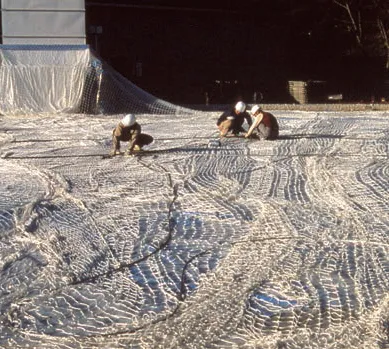
Pavilion 1 is prepared for inflation. Both the fishing-net mesh and the cable net (in black) are visible. In the background of the image the prefabricated double-door airlock can be seen.
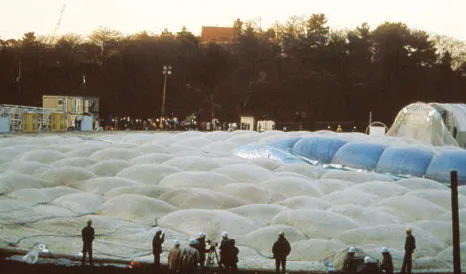
Inflation begins. Airlock tube entrances are visible to the left of the image. Next, the large dome is lifted off the ground with low-pressure air. The cable net is now clearly visible.
Interior of an agricultural air dome, also by Murata and Kawaguchi. The image clearly illustrates the hierarchy of structure with a grid of cables (clamped at their intersection) defining the key geometries, while the 100 mm (3.87 in.) fishing-net grid holds the (almost invisible) plastic film.
Oase No. 7
Haus-Rucker-Co
Kassel, Germany. 1972
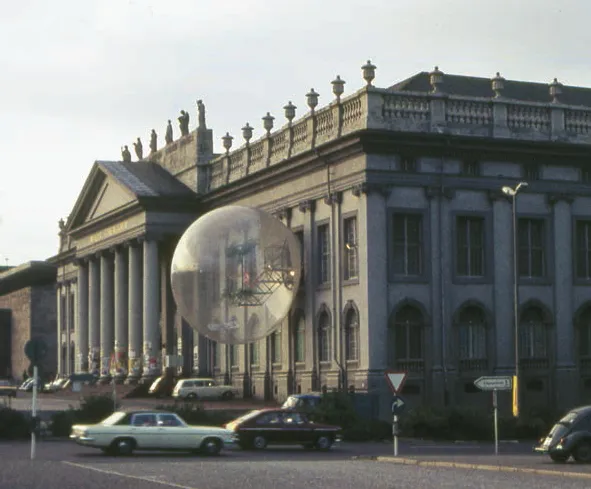
Documenta is an exhibition of contemporary art held every five years in Kassel, Germany. As part of documenta 5, the avant-garde Viennese architecture collective of Haus-Rucker-Co created an 8-m (26-ft) diameter transparent protuberance inflated out of the facade of the Fridericianum museum. A tubular steel space-frame deck connects through the window opening and acts as a cantilevered deck on which a circular steel frame supports the clear PVC sphere. A small air blower pressurizes the bubble and air pressure is maintained by using zips on the inside edge that form an airlock. The ‘oasis’ featured a pair of fake palm trees with plastic leaves, with a hammock strung between them for the single-occupant castaway.
Lange House Cover
Haus-Rucker-Co
Krefeld, Germany. 1971
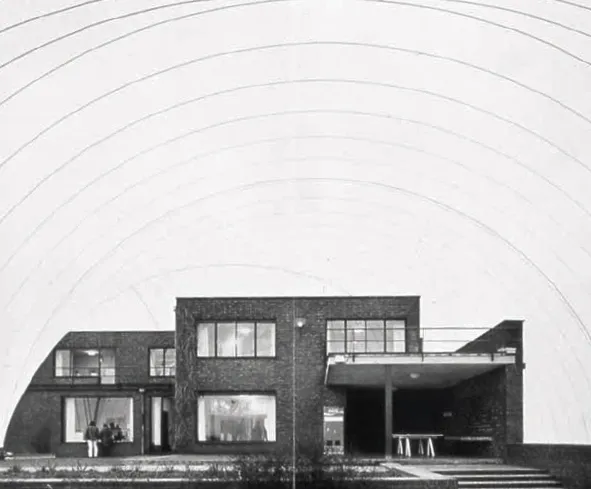
As part of a site-specific artwork entitled Cover, the architects Haus-Rucker-Co created an inflated translucent membrane that entirely covered Mies van der Rohe’s 1921 Lange House in Krefeld. The architects, speculating on future environmental pollution, described the resulting, temporary structure: ‘In the interior, the light, evenly filtered through the shell from all sides, created a pallid hothouse atmosphere in which not only the garden plants started to change but also the proportions of the house itself.’ Fabricated from translucent, reinforced PVC, a hemispherical cross-section follows the footprint of the building. With the rounded corners of an inflatable structure, the project forms a heart shape in plan.
Spacebuster
Raumlaborberlin
New York City. 2009
‘Spacebuster was developed and designed to explore the public space in New York City. As a research tool it acts as a transformer of the architectural and the social space, i.e. the urban space.’
RAUMLABORBERLIN
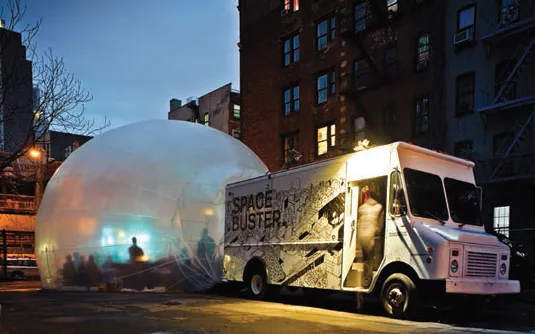
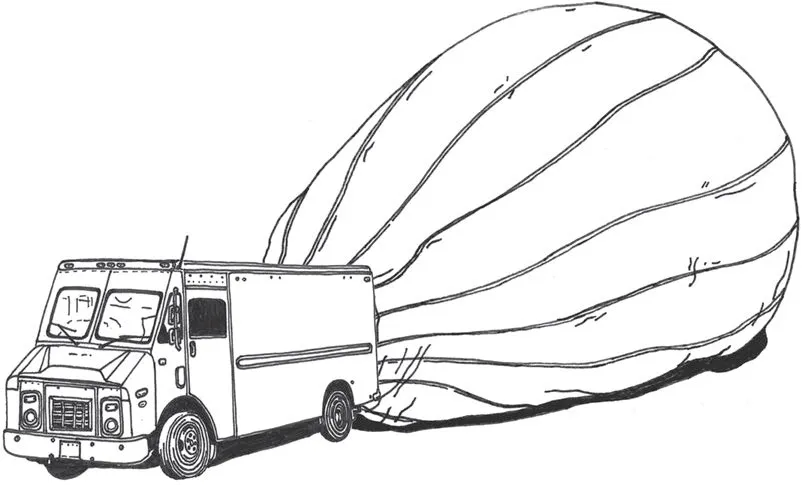
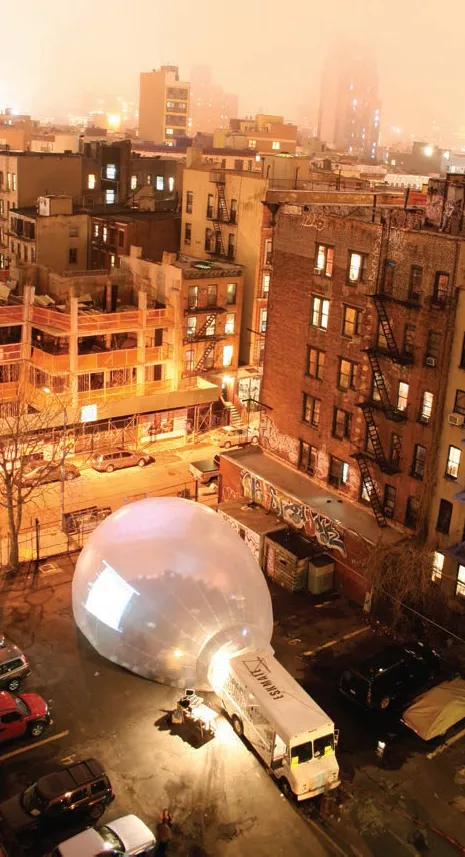
Commissioned by New York’s Storefront Gallery, Spacebuster was a travelling conversation and learning space that literally operated out the back of a van or, in this case, a US utility truck. A single-skin polythene bubble was inflated out of the back of a truck at a series of event locations across Manhattan and Brooklyn. The inflated space created could house up to 80 people and the translucent skin offered its visitors an enclosure while maintaining a view of their surroundings - and some incidental theatre for onlookers and passers-by.
Spacebuster at an event in New York City.
Sketch of the Spacebuster concept.
Coolhurst Tennis Airhall
Birds Portchmouth Russum
London, UK. 2006
This single-skin, air-supported dome uses low, fan-assisted air pressure, maintained by a double set of doors that form an airlock. The Airhall is a demountable structure covering two tennis courts. It is inflated during the winter to protect the courts against the weather. The Airhall has a robust, reinforced white PVC perimeter skirt with a translucent PVC crown that allows natural light to enter during the day and the existing tennis floodlighting to illuminate the hall at night. The structure can be assembled and demounted over two days. The PVC skin is restrained using a network of exterior cables, which are...