![]()
PART 1
Why
Stroytelling
Wins Every
Time
![]()
CHAPTER 1
Why stories work
Stories change people. Since our cave-dwelling days we’ve enjoyed sitting around the fire to talk and to listen. Our brains are magically transformed by stories, creating fresh pathways where new tales wipe out old ways of thinking and acting.
Like me, you prefer short intros
We love great stories even more than we hate terrible presentations.
We are all natural-born storytellers. Our listeners admire our honesty when we admit our mistakes, and they cheer as we conquer the obstacles in our path. They identify with us even as we excite and inspire them. Our success – as wizened CEO or fresh-faced whizz-kid – is their success.
Storytelling creates an emotional connection that mere facts can never attain. You won’t make a connection with your ninety-nine bullets about sales targets and employee churn rate. Reciting dull data isn’t enough. That guy in row three may look as though he’s listening, but real influence comes only when you change what’s in his heart.
We all want our tales to be so exciting, instructive or funny that people repeat them. You’ve made a great choice, because this book will show you how.
How I wrote this chapter
Introductions are hard to write. You’re never sure if they will be read – like prefaces and acknowledgements, they’re generally skipped by readers who are hungry for the good stuff.
So, I decided to start with Chapter 1 instead. Novels don’t have introductions, and I’m always advising my clients to jump right into their tale. There’s no point dilly-dallying when there’s a story to be shared.
At this stage you’ll have liked the name of the book, its cover and its general design, size and feel. It follows that anyone reading this sentence in a bookshop or on Amazon is close to being a buyer. Don’t muck it up, I’m telling myself, make sure this first chapter is a winner.
The opening chapter sets the tone for the whole book. So I’ve made sure that it reflects the content and structure of The Story Is Everything.
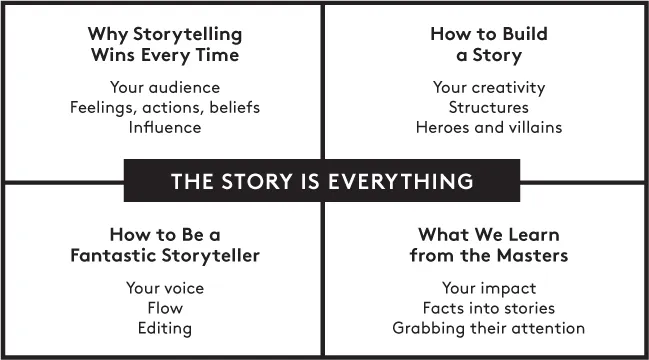
→ I start off with why stories win over audiences.
When I picture you, I see someone who is smart and eager to learn, yet slightly sceptical. You’ll be pushed for time, so there’s no point in writing 800 pages on literary theory. But you may also be frustrated by the books you’ve read recently on business storytelling, which pad out a single idea with examples you’ve seen before. I’m fed up of buying books that have barely enough content for a single chapter. I want my readers to know that there are lots of reasons why stories win.
→ Then I show you how to build a story.
I love structure, especially when it’s hidden. Did you find mine in the opening section? I know you’ll skim the first words of each paragraph while you’re deciding to buy, so I deliberately front-loaded each sentence with my most important points:
We love stories
Stories change people
We are all natural-born storytellers
Storytelling creates an emotional connection
We all want our tales to be exciting, instructive or funny
I decided against putting a personal story in Chapter 1 instead. Competing books tend to have a tale about a massive personal breakthrough, a moment of epiphany when the author realizes her slides aren’t making an impression or a big contract is lost because she can’t connect with the audience. I will show you the impact of storytelling on my life, but I’ll reveal it slowly.
By the time you’ve finished this book, you’ll be peppering your conversation with ‘hero’s journey’, ‘narrative arc’ and ‘plot points’. But it’ll take time and work to make this happen. The book demands input from you: commit to the exercises, read with a pen in your hand, write your ideas down. Creation is an active process, so be prepared to roll up your sleeves and get messy.
→ Next I’ll share loads of ideas on how to become a fantastic storyteller.
Voice is key. Throughout The Story Is Everything I use the pronoun ‘we’ to suggest that my readers and I want the same benefits when we communicate. We’re in this together; it’s only us who can save the world from dull PDF handouts.
But I also ‘talk’ to you directly, as if we were in a conversation. This sense of dialogue is important to me. I’m a friendly adviser, not an aloof lecturer. The occasional rhetorical question increases this sense of face-to-face communication. That’s an effective technique, isn’t it?
I want to come across as someone with useful ideas, but not a show-off. I’ll present both sides of an argument because I rarely have an axe to grind. But I avoid the language of doubt (‘I hope to’, ‘this might possibly work’), because you want to trust me as an authority.
→ We’ll finish off with what we can learn from the masters of communication.
My dominant tone is positivity. Psychologists have taught me to emphasize your gains (‘You will benefit in many ways by improving your storytelling skills’) rather than your losses (‘Don’t be dumb and miss out on learning this topic’).
Experts on influence and persuasion have warned me away from being too strident. If I spend the whole chapter banging on about how fantastic the book is, you will end up feeling manipulated. ‘Always be closing’ may be a great mantra for the salesmen in Glengarry Glen Ross, but it’s the wrong approach for a book that you are choosing to buy and read.
I’m convinced that writing success comes from planning. I wrote this opening chapter only once I’d finished the rest of the book. Believe me, knowing how your story ends is a huge help at the beginning.
Where to Next?
→ You can read The Story Is Everything in chapter order, but the book is also designed for you to jump to topics that currently spark your interest. I’ll list possible next steps at the end of every chapter, except for this one. Now I want you to do the logical thing and go straight to Chapter 2. After that, you’re free to roam.
![]()
CHAPTER 2
Feelings, actions and beliefs
Business storytelling is about influence. You know a story works when it changes the feelings, actions or thoughts of your audience.
A great storyteller knows how to influence
An influential storyteller changes people. Their tales excite you or make you anxious. They can make you reject capitalism, change your mind about recycling or spend £200 on a pair of trainers that cost £2 to make.
Let’s look at feelings, actions and beliefs in more detail.
→ Feelings
These are the instinctive reactions we experience when we see a smiling child or a starving animal, when we learn that our team has won the cup or that someone we love has died. Although most of us use ‘feelings’ and ‘emotions’ as interchangeable words, there’s a subtle (yet very important) difference: think of feelings as the physical and mental representation of an emotion.
→ Actions
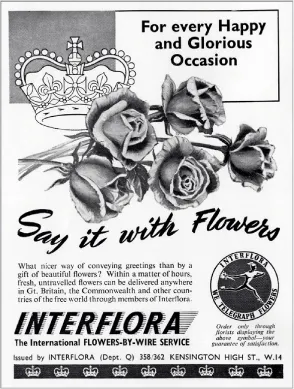
We may want our listeners to change their behaviour or act in a certain way. It could be simple (‘Buy this great book you are currently flicking through’) or more nuanced (‘Keep yourself isolated to avoid infecting others’). Slogans that begin with an imperative verb want the reader to do something – Interflora has been telling us to ‘Say it with flowers’ since 1917.
Interflora’s slogan has been successful for more than 100 years.
→ Beliefs
Our thoughts reflect the way we perceive and interpret the world. Our experiences mould the way we think, especially when we’re young; for example, I have always thought that dogs are dangerous because I saw one bite my dad when I was 7 years old. Our thoughts are also formed by evidence, facts, the opinions of our peers, social-media influencers and a host of other sources. We believe our beliefs have a rational ba...