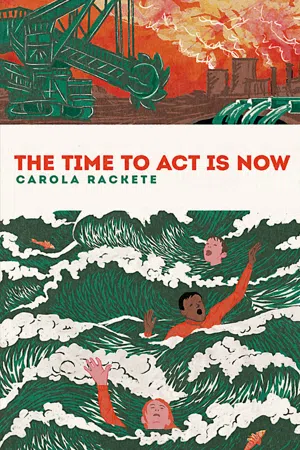
»We are at a turning point in human history. To stop climate breakdown and extinction, environmental movements need to be actively anti-racist and join struggles for social justice.« Carola RacketeIn 2019, Carola Rackete became publicly known for docking the sea rescue vessel »Sea-Watch 3« in Italy and thereby challenging a national decree that contradicted international obligations to engage in sea rescue. Due to this act of civil disobedience and her public confrontation of the Italian far right and the structural racism of the EU's Fortress Europe policy, Carola became a powerful symbol for people seeking to take practical action for a world based on justice and equality.Carola has worked in the polar regions since 2011 and holds a degree in natural resources management. Consequently, her book shows how the ecological crises we are facing today are rooted in social and political power structures. The book details moments of the rescue mission but also connects the dots to forced migration and the urgency of our environmental predicament.Overall, it is a call to engage and act to become part of initiatives and movements struggling for social and environmental justice.This version of the book includes a new afterwordfocused on centring justice and human rights in nature and biodiversity conservation - a topic often overlooked by climate activists in the Global North.The authors will donate the revenue from this book to the association borderline-europe - Menschenrechte ohne Grenzen e.V. in order to launch a new criminalization fund. The money from this fund will be used to support refugees who are criminalized in the EU for fleeing to Europe.This edition is supported by the Rosa-Luxemburg-Stiftung with funds from the German Federal Foreign Office.
- 176 pages
- English
- ePUB (mobile friendly)
- Available on iOS & Android
eBook - ePub
The time to act is now
About this book
Information
Chapter One:
No more hoping
It’s a little before noon and we’re still not moving. The stair railing leading up to the ship’s bridge is as hot as a radiator pipe. I climb the steps two at a time and when I reach the top I stop for a moment, my skin covered in a thin film of sweat. There is not a whisper of a breeze; the air is still. Really, it’s too sweltering to move around; this is the hottest month since climate records began.
Today is Friday, 28 June 2019, and it’s been twenty days since we left the Sicilian port of Licata for a rescue mission. We had only been at sea for four days when we rescued 53 people from a fragile raft about 50 nautical miles off the Libyan coast; a raft loaded with men, pregnant women, and minors, including two young children. The Italian Coast Guard has taken the most seriously sick and vulnerable. That leaves forty people on the boat. They’re weak and discouraged.
Now we’re hoping that someone will tell us what will happen to them.
But we’re running out of time.
With every minute that passes, we risk losing another life.
The island of Lampedusa is in sight, sparkling before us like a long, thin band of lights. It’s one of the most southern points of Europe and, right now, the nearest safe port. The air is charged with the glittering reflections from the water. If we were allowed to, we could reach the harbour in an hour. Instead, we’re stuck here, waiting for the European states to find a solution. I look across the deck, where the speedboats are stowed, and the main deck below. To shield the lower decks against the sun we’ve hung up tarps; under them lie all the people we’ve saved from the raft.
We can’t care for so many people on this ship for very long. She only has three bathrooms, and while we can purify seawater for drinking, the process takes ages. Even with the tank we refilled at the port, there’s not enough water for this many people to wash and do their laundry regularly. What is more, those sleeping on the boat deck have to make do with just one blanket. It’s not comfortable there; either you fold the blanket as a mattress and freeze all night, or you wrap yourself in it to keep warm but before long every part of your body touching the PVC-tiled floor will be aching.
All around us the sea sparkles and the small waves break against the hull of the boat. Sea-Watch 3 is an old offshore supply vessel from the seventies, once used by the oil industry before falling into the hands of Médecins Sans Frontières before she was finally acquired by Sea-Watch using donations from their supporters. In short, a big ship that requires a lot of maintenance.
She does the job, of course, but I don’t like her very much.
The truth is that, under different circumstances, I wouldn’t be here. This year, I wasn’t planning to embark on any »missions,« the Sea-Watch term for rescue operations. Not that I haven’t spent some years at sea, mainly as navigating officer on board large research vessels in the Arctic, and also with Greenpeace; but then I did a master’s degree in environmental conservation and, when I finished, I wanted to concentrate on protecting the natural world.
To be honest, I’ve never been a seafaring enthusiast, and after dedicating a few years to my profession, I felt it was more important to fight for the preservation of our biosphere. But my nautical knowledge came in handy when I started collaborating with Sea-Watch and other rescue NGOs doing something that I consider essential: saving lives.
A few short weeks ago I received an email telling me that the captain of a rescue mission due to start in the next few days had fallen ill. At the time, I was busy in Scotland, where I was working as a trainee on a conservation programme. What we were doing, basically, was collecting data on butterflies, maintaining the hiking trails, and most recently, when torrential rains fell, spending three days in the greenhouse transplanting Scots pines.
The landscape in that part of Scotland is beautiful: steepsloped mountains cloaked with dark, mossy hoods, where the smell of wet meadows combines with conifer resin and the fragrance of delicate flowers. At night you can hear the squawking of the little loons over the fog-wrapped sea. The air is so clear, so full of aromas, that if I could, I would have spent every hour of the day outside.
In short, I didn’t want to leave. But that message was sent to everyone on the emergency contact list – a list of everyone who could replace a crew member at the last minute. Whereas volunteers for unskilled jobs are easy to recruit, it’s much more difficult to find people qualified to handle a ship or provide medical care.
My intuition told me that Sea-Watch would struggle to find a replacement in such a short time, and when I spoke to the head of operations on the phone, he confessed that he had no one who could captain the boat. If I didn’t do it, the ship couldn’t sail, even though she had all the other necessary crew. Feeling the weight of responsibility, I packed my bags.
That’s why I’m here now, in the middle of this scorching summer, on a boat anchored in southern Europe. Above the splash of the waves I hear a few snippets of conversation from time to time; otherwise, all is calm. I’ve gone over everything we can do, both with the crew and with the Sea-Watch team on land, where we have lots of volunteers and a handful of employees working mainly from Berlin, but also Amsterdam, Rome, Brussels, and other cities. This is the team that deals with logistics, media, and internal communications, in addition to providing legal advice and political advocacy work. They are in contact with other organisations and political actors on land, and provide the crew with information and advice on what’s going on.
We’ve been trapped in international waters for two weeks now. Via our unreliable internet connection, I’ve sent out an email to the competent bodies in Rome and Valletta asking for their support, and also the Den Helder coastguard headquarters, because Sea-Watch 3 is flying the Dutch flag. Via the German Ministry of Foreign Affairs, we’ve also asked Spain and France for assistance.
Several members of the Italian Coast Guard boarded the ship. Then came the Guardia di Finanza, the customs and tax police that reports to the Italian Ministry of Economy and Finance in Rome. They told us to wait. They said they had no solutions for us.
Nothing happened.
We were running out of possibilities. It became increasingly difficult to keep people safe on our ship; the people we rescued were in urgent need of medical attention. One of the women confessed to our doctor that she was so desperate, she was contemplating suicide. She told her that she felt safer with someone by her side.
But we can’t give her what she needs. Our crew consists of more than twenty people, including engineers and maritime-technical personnel such as myself, but also medical specialists and the speedboat crew. Most of them are volunteers, such as Oscar, a student about to graduate from law school. There are only three people employed by Sea-Watch, but some volunteers have been involved for a long time – like Lorenz, who takes care of our passengers. Staff or volunteer, everyone is assigned their shifts, in order to ensure we can care for people day and night. But with mounting uncertainty and their already precarious condition worsening, this is becoming increasingly difficult.
So, two days ago, I declared a state of emergency and entered Italian waters without proper authorisation. The Guardia di Finanza stopped us, took the crew’s details and checked the ship’s documentation. They said a political solution to our situation would soon be found, and in the meantime we would just have to wait.
And, having said that, they left again.
Yesterday, in view of our plight, I asked once again to be allowed to dock in the port. And, again, we were stopped by vessels from the Italian authorities.
»The solution is imminent,« they said.
Then a chartered boat arrived with journalists and a few MPs on board.
Lots of cameras.
Lots of phone calls.
And no solutions.
Today we received a message from the Italian Public Prosecutor’s Office informing us that an investigation has been opened against me for promoting illegal immigration. Although it may sound strange, this is our first ray of hope in a long time. On our last mission in May, an investigation launched by the Public Prosecutor’s Office led to the vessel being seized. If such an order were given now, the Prosecutor’s Office would have to take responsibility for the people on board, and they would finally be able to disembark.
That is exactly what we are waiting for today.
I raise a hand to my forehead, shading my eyes and wiping away the sweat. Around us there are fishing boats coming and going, and a few yachts leaving the harbour. If we weren’t going through this terrible situation, we’d be taking a dip right now. But for now we have to stay on the ship, roasting in the heat.
According to what I am told later, 17 boats have arrived in Lampedusa in recent days, carrying 300 people. That is, 300 refugees, mostly from Tunisia, who have managed against the odds to reach the Italian coast. The perilous vessels they travel in are called ghost boats. As the people on them are already in territorial waters, the Coast Guard simply lets them approach land and then notifies the police or the humanitarian services. Usually, the passengers do not try to flee or hide, because Lampedusa is so small as to make hiding futile. Normally a fisherman or some other resident spots the refugees before their rickety boat reaches the beach or the cliffs. Then the authorities come to take them to the reception centre, where they are identified and fingerprinted.
Only we are still being held here, with forty refugees in urgent need of medical care. There are people with physical ailments that require immediate attention, such as those whose illnesses have worsened on board and who we can no longer treat effectively because they have high fever or severe pain. It was these, the sickest people, who were taken by the Coast Guard. A majority of the passengers are suffering from post-traumatic stress disorder. There are others with older injuries documenting the violence they were exposed to in the Libyan camps, or with broken bones, who should be treated immediately. According to the Italian Coast Guard, these ailing people are not in a state of emergency. In this way, a question of maritime law has been turned into an absurd discussion about the health status of the refugees who, like all people, healthy or otherwise, have a right to a safe harbour.
In our morning meeting, Lorenz, a qualified nurse who, as passenger coordinator, is in charge of looking after our passengers, once again sums up the difficult situation: »The biggest danger,« he says, »is that people will decide to act on their own. I’m afraid they might jump overboard.« Lorenz is a thin, brown-haired man with one side of his head shaved. He’s been going on missions as long as I have and also studied environmental science. That’s one thing we have in common, in addition to the fact that we’re both here for the same reason. No one signs up for something like this for the sake of adventure, or on some insubstantial whim. No member of the crew would. Nor would I, or the people we rescue.
Quite the contrary, these refugees are all fleeing violence. Most of them have made their worst experiences on the last leg of their journey, in Libya, a country torn apart by civil war.
Lorenz tells me that when talking with them about the conditions in the Libyan camps, one might say: »See this head wound? That came from a metal pipe.« On someone else he sees ten cigarette burns on their body. One man lifts up his shirt and shows Lorenz a scar. »These were electric shocks,« he tells him.
»These people don’t mind showing their wounds because they’ve become normal to them. Almost all of them have been tortured,« Lorenz says.
He wants to help make the world a better place, one shaped more by freedom than discrimination. He is one of the volunteers who has been on countless Sea-Watch missions, and for this he sacrifices a lot, above all a regular life. Again and again, he repeats what each of us is thinking: how incredibly strong – and kind – these people are, despite all they’ve been through. And how alive they are, given everything they have seen and suffered.
According to medical reports, many of our passengers are suffering from the violence and torment inflicted on them in the Libyan camps: fractured bones, bayonet blows, and burns from hot plastic poured on their skin, not to mention, of course, post-traumatic stress disorder. On their heads they have visible scars and, on their souls, invisible ones, from the beatings, threats, trafficking, and enslavement they have suffered, from the fear of death and, among the women, from the rape and prostitution to which they have been forced by threats to their families. Many are dehydrated from seasickness, which further aggravates their condition. As a result, they suffer from sleep disorders, nervousness, anxiety, and lack of impulse control.
»All these injuries reflect the reports of what is happening in the refugee camps and along the migrant routes,« Victoria, the doctor responsible for the medical reports, points out. She specialises in anaesthesiology and emergency medicine, and has worked for years in the intensive care unit of a Hamburg hospital. This is the first time she’s been involved in a rescue operation, and also the first time she has spent so much time away from her children. »It makes me incredibly angry that the world is so unfair, so I felt I had to do something.«
The Coast Guard initially took ten refugees whose lives were in immediate danger, but had to come back twice more to deal with further emergencies. One man lost consciousness; another suffered severe abdominal pain and was evacuated along with his brother, who is still a minor. Every time one of the refugees was taken away, the others formed a double line to let the sick person past: they wanted to say goodbye to them, even to the unconscious. I was touched to see such connection between people who had never met before and were forced to live together in crowded conditions.
Other than collecting the most seriously ill passengers, the men of the Coast Guard don’t do much. They understand our situation – they know very well what it’s like, as they used to do sea rescue off the coast of Libya. They’re quite nice but completely useless for the time being, because they’re only helping us as much as they’re allowed to. Every time they evacuate a refugee, the others ask us if they have to fall as seriously ill before they can leave the ship too.
These people need to reach a safe harbour and go ashore – now. I cannot imagine how difficult the wait is for someone who’s been through what they have. The departure into the unknown, the long journey across the desert, hunger, deprivation, false promises, assaults. The utter despair of being held indefinitely in an internment camp, torture, rape, seeing your friends and family shot. The fear of dying in a fragile inflatable raft in the middle of the sea.
The Mediterranean is much more dangerous than most vacationers imagine; the weather can change in the blink of an eye, which means that a raft with four air chambers doesn’t offer much in the way of protection. If just one of these chambers loses air, the boat, already heavily overloaded, can sink.
»I have great respect for the sea,« says Oscar. He’s a law student, and by driving our speedboats, he risks not being admitted to the bar association if he ends up tried and convicted for taking part in these missions. The Mediterranean is a huge sea, and it’s easy to get lost in her waters. On Sea-Watch 3 we have technical equipment that can save our lives in an emergency. From the speedboat, all we can see are the wind-churned waves, but suddenly, we come across a dinghy full of people barely a metre above the water. Hardly any of the occupants can swim; in rough seas they’re in great danger, because the floor of the dinghy or one of the air chambers could break. Then the rescue operation becomes more complicated, because, naturally, panic sets in. The petrol drums on board are often uncapped, and when the boat capsizes, the petrol spills into the sea along with the people. Anyone swallowing as much as a mouthful of this toxic mix will faint and drown. On inflatable boats, people sit right on the edges, with pregnant women and small children in the middle. Every time I see that, I realise what a risk these people are taking. How much misery must a person have suffered to go through such danger? As soon as they’re on the beach and the boat is ready for the last leg of their journey, they’re left with no choice. Some of them are even forced to get on. And...
Table of contents
- Dedication
- Contents
- Preface by Hindou Oumarou Ibrahim
- No more hoping
- A humanitarian imperative
- The last generation?
- Questioning the system
- Let’s get cracking
- Afterword
- Acknowledgements
- Bibliography and websites
- About the authors
- Copyright
Trusted by 375,005 students
Access to over 1.5 million titles for a fair monthly price.
Study more efficiently using our study tools.
Frequently asked questions
Yes, you can cancel anytime from the Subscription tab in your account settings on the Perlego website. Your subscription will stay active until the end of your current billing period. Learn how to cancel your subscription
No, books cannot be downloaded as external files, such as PDFs, for use outside of Perlego. However, you can download books within the Perlego app for offline reading on mobile or tablet. Learn how to download books offline
Perlego offers two plans: Essential and Complete
- Essential is ideal for learners and professionals who enjoy exploring a wide range of subjects. Access the Essential Library with 800,000+ trusted titles and best-sellers across business, personal growth, and the humanities. Includes unlimited reading time and Standard Read Aloud voice.
- Complete: Perfect for advanced learners and researchers needing full, unrestricted access. Unlock 1.5M+ books across hundreds of subjects, including academic and specialized titles. The Complete Plan also includes advanced features like Premium Read Aloud and Research Assistant.
We are an online textbook subscription service, where you can get access to an entire online library for less than the price of a single book per month. With over 1.5 million books across 990+ topics, we’ve got you covered! Learn about our mission
Look out for the read-aloud symbol on your next book to see if you can listen to it. The read-aloud tool reads text aloud for you, highlighting the text as it is being read. You can pause it, speed it up and slow it down. Learn more about Read Aloud
Yes! You can use the Perlego app on both iOS and Android devices to read anytime, anywhere — even offline. Perfect for commutes or when you’re on the go.
Please note we cannot support devices running on iOS 13 and Android 7 or earlier. Learn more about using the app
Please note we cannot support devices running on iOS 13 and Android 7 or earlier. Learn more about using the app
Yes, you can access The time to act is now by Carola Rackete,Anne Weiss in PDF and/or ePUB format, as well as other popular books in Politics & International Relations & Political Freedom. We have over 1.5 million books available in our catalogue for you to explore.