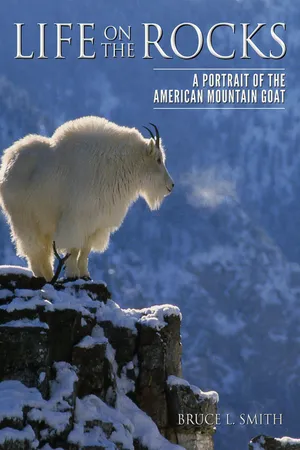
National Outdoor Book Award Winner: A photo-filled study of the elegant, elusive American mountain goat in its rugged natural habitat.
Confined to the remote, rugged mountains of the western United States and Canada, the American mountain goat is one of the least familiar species of hoofed mammals in North America. These extraordinary mountaineers are seldom seen, and their lives and fortunes may be the least understood among the continent's large mammals.
Life on the Rocks offers an intimate portrayal of this remarkable animal through the lens of field biologist and photographer Bruce Smith.
Color photographs and accounts of Smith's personal experiences living in Montana's Selway-Bitterroot Wilderness Area accompany descriptions of the American mountain goat's natural history. Smith explores their treacherous habitat, which spans the perilous cliffs and crags of the Rocky, Cascade, and Coast mountain ranges. The physical and behavioral adaptations of these alpine athletes enable them to survive a host of dangers, including six-month-long winters, scarce food sources, thunderous avalanches, social strife, and predators like wolves, bears, lions, wolverines, and eagles. Smith also details the challenges these animals face as their territory is threatened by expanding motorized access, industrial activities, and a warming climate.
"The noble mountain goat is exquisitely adapted to place. As this fine book makes clear, though, people are changing those places, and fast. Here's one more face of creation asking implicitly that we back off some." ?Bill McKibben, environmentalist and
New York Times–bestselling author of
Falter
- 160 pages
- English
- ePUB (mobile friendly)
- Available on iOS & Android
eBook - ePub
About this book
Trusted by 375,005 students
Access to over 1.5 million titles for a fair monthly price.
Study more efficiently using our study tools.
Information
Part I
Like a ghost that drifts among clouds and cliffs, in defiance of gravity itself, abides this improbable beast of the peaks. From the loftiest vantage of any large mammal on the continent, it has watched the comings and goings of others over untold generations. This time-tested perspective accords the Old Man of the Mountains some authority on success and failure and what conditions render each. We may do well to take heed.
Chapter One
Beginnings
From American Indians, the Corps of Discovery first heard about a white beast that dwelt among the peaks. They marveled at the shaggy hide purchased from Chinookan Indians along the Columbia River. In 1805 Captain William Clark even glimpsed a live one, albeit at a great distance, near what now is the Idaho-Montana border.

Just as fascinating and incomparable as the mountain goat are the topography and geology of the realm the animal inhabits. (Photo by author)
In 1778 Captain James Cook recorded the earliest hint of the creature’s existence. During stops at British Columbia and Alaskan villages on his around-the-world voyage, he was struck by the spun wool garments worn by the natives. When the Indians pointed out white animals perched high on the rocks as the source of the garments’ wool, Cook called them polar bears.
Others have confused the animal with mountain sheep, which also occupy the continent’s western mountains. Indeed the English translation of the mountain goat’s taxonomic genus, Oreamnos, suggests as much—lamb of the mountains.
Still others reckoned the beast bearing a shoulder hump and simple black horns as a new variety of a familiar species. In 1798, Alexander McKenzie described the animal he spotted in the mountains near the McKenzie River as a white buffalo. Although albino bison do exist, McKenzie’s arctic animal was likely the mountain goat.

Curious yet cautious, a goat peers over a lichen-encrusted rock. (Photo by author)
It’s not hard to imagine how the early explorers, trappers, and fortune-seekers might find the notion of a white buffalo roaming the mountaintops as much reality as phantom or fable. Some 25–50 million bison once roamed the continent and were well known to most who ventured west. Even in fiction, the taxonomy of this stout-shouldered creature was enigmatic. A passage from The Big Sky, Pulitzer prize-winning author A. B. Guthrie’s yarn about the mountain men of Montana, describes the mountain goat this way:
It ain’t a buffler proper, nor a white antelope, neither, though you hear the name put to it and a sight of others. They keep to the high peaks, they do, the tip top of mountains, in the clouds and snow. . . . Not many’s seen a live one. A man has to climb some for that.
Native people of North America’s First Nations, of course, had known the animal for centuries. Some hunted them for food, ceremonial items, and clothing. But well into the twentieth century, these wilderness cliff-walkers were relatively untouched by the westward march of Euro-Americans. It was an animal more of myth and mystery than avarice, and thus it escaped the tsunami of exploitation suffered by the more easily targeted bison, pronghorn, deer, elk, and the goat’s mountain cousin the bighorn sheep.
Along with its closest relatives that inhabit European and Asian peaks, the mountain goat completes a distinct taxonomic grouping, the Rupicaprini Tribe (Rupes = rock, capra = goat), within the sheep, goat, antelope, and cattle family (the Bovidae). The rupicaprids are regarded as goat-antelopes, possessing traits of both true goats and antelopes but are neither. Characteristic of the mountain goat and its relations—and distinguishing those species from other members of the Bovidae family—are their thin-boned and fragile skulls, and short, dagger-like horns that look similar in both sexes.

From Alaska’s Kenai Fiords to Washington’s Mount Shuksan (this photo), ice, rock, and stunning scenery typify the domain of the mountain goat. (Photo by author)
The mountain goat’s rupicaprid relatives are the mysterious gorals and serows of Asia, and the chamois of Europe. The total number of species depends upon which taxonomist you ask, but there may be as many as four species of goral and between three and six species of serows (see Walker’s Mammals of the World and Mammal Species of the World for species accounts). Most authorities agree on two species of chamois—Rupicapra pyrenaica of the Pyrenees and Apennine Mountains of France, Spain, and Italy, and the more abundant Rupicapra rupicapra of the Alps, the Balkans, Asia Minor, and the Caucasus.

An adult Chinese goral (Naemorhedus griseus) (Photo by author)

An adult Japanese serow (Capricornis crispus) (Photo by author)

An adult European chamois (Rupicapra rupicapra) (Courtesy Valentina Ruco)

An adult musk ox (Ovibos moschatus) (Photo by author)
The gorals (all of the genus Naemorhedus) are the most primitive rupicaprids and likely the most similar in appearance to the ancestral form that gave rise to the modern tribal descendants. The gorals are grayish or reddish, coarse-haired, short-horned, and most weigh fifty to seventy-five pounds as adults. The species’ geographic range includes mountainous regions of eastern Russia and China, Thailand, Myanmar, Vietnam, and possibly Laos. A population of the species called the long-tailed goral occupies the demilitarized zone of the Korean Peninsula.
Also resident to Asian mountains and ranging from Siberia south across the Himalayan region through Myanmar and Thailand to Malaya and Sumatra are the serows, all of the genus Capricornis. Resembling robust versions of gorals, they weigh up to 200 pounds and are reddish brown to gray-brown in color. Leading even more secretive lives than the gorals, the serows inhabit steep hillsides cloaked in dense vegetation. Isolated when the Japanese archipelago broke from the Asian mainland, the Japanese serow is perhaps the best known of the serows and gorals, which are among the least studied of the world’s large mammals. Historic ranges of gorals and serows have been reduced by excessive hunting and habitat loss. Several species are now considered in danger of extinction.
The chamois, on the other hand, is the best known and studied among this small group of mountain dwellers. Easily the fleetest of the bunch and a prodigious leaper, the chamois is longer-legged and slimmer than other rupicaprids. Adults weigh seventy-five to one hundred pounds, are tawny to reddish brown in color with distinctive white markings, and are more gregarious than the...
Table of contents
- Cover
- Contents
- Preface
- Part I
- Chapter 1. Beginnings
- Chapter 2. How to Build a Goat
- Chapter 3. Behaving Appropriately
- Chapter 4. Rewards and Risks
- Chapter 5. Among the Goats
- Part II
- Chapter 6. Across the Continent
- Chapter 7. Conservation: Local Challenges
- Chapter 8. The Global Challenge
- Epilogue
- Acknowledgments
- Suggested Reading
Frequently asked questions
Yes, you can cancel anytime from the Subscription tab in your account settings on the Perlego website. Your subscription will stay active until the end of your current billing period. Learn how to cancel your subscription
No, books cannot be downloaded as external files, such as PDFs, for use outside of Perlego. However, you can download books within the Perlego app for offline reading on mobile or tablet. Learn how to download books offline
Perlego offers two plans: Essential and Complete
- Essential is ideal for learners and professionals who enjoy exploring a wide range of subjects. Access the Essential Library with 800,000+ trusted titles and best-sellers across business, personal growth, and the humanities. Includes unlimited reading time and Standard Read Aloud voice.
- Complete: Perfect for advanced learners and researchers needing full, unrestricted access. Unlock 1.5M+ books across hundreds of subjects, including academic and specialized titles. The Complete Plan also includes advanced features like Premium Read Aloud and Research Assistant.
We are an online textbook subscription service, where you can get access to an entire online library for less than the price of a single book per month. With over 1.5 million books across 990+ topics, we’ve got you covered! Learn about our mission
Look out for the read-aloud symbol on your next book to see if you can listen to it. The read-aloud tool reads text aloud for you, highlighting the text as it is being read. You can pause it, speed it up and slow it down. Learn more about Read Aloud
Yes! You can use the Perlego app on both iOS and Android devices to read anytime, anywhere — even offline. Perfect for commutes or when you’re on the go.
Please note we cannot support devices running on iOS 13 and Android 7 or earlier. Learn more about using the app
Please note we cannot support devices running on iOS 13 and Android 7 or earlier. Learn more about using the app
Yes, you can access Life on the Rocks by Bruce L. Smith in PDF and/or ePUB format, as well as other popular books in Biological Sciences & Photography. We have over 1.5 million books available in our catalogue for you to explore.