eBook - ePub
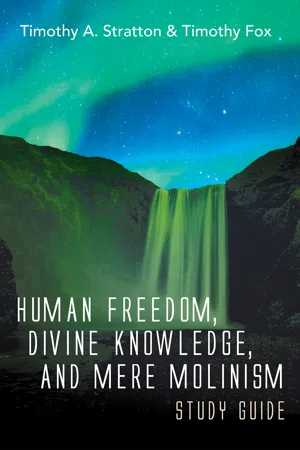
Human Freedom, Divine Knowledge, and Mere Molinism Study Guide
- 92 pages
- English
- ePUB (mobile friendly)
- Available on iOS & Android
eBook - ePub
Human Freedom, Divine Knowledge, and Mere Molinism Study Guide
About this book
This study guide will help everyone from laypersons to theology students navigate Human Freedom, Divine Knowledge, and Mere Molinism, by Timothy A. Stratton. Timothy Fox walks readers through each chapter, identifying key terms and asking pertinent questions. Stratton adds multiple "Going Deeper" sections to clarify and expand his case. This companion is a vital resource for the aspiring theologian.
Information
Topic
Theology & ReligionSubtopic
Christian Theology1
Introduction, Definitions, and Methodology
Humans have been thinking about the extent of our free will for centuries. This discussion isn’t relegated only to philosophers in the ivory towers of academia, however. Human freedom is also highly contested within the Christian church. This first chapter sets the stage for the rest of the book, introducing key words and concepts that are invaluable in discussing the relationship between divine sovereignty and human freedom.
The first important concept is causal determinism, or, as Stratton often clarifies, “exhaustive” causal determinism. If exhaustive determinism is true, then all things about humanity are causally determined (in one way or another) by external factors. If “all things” really means all things, then all human physical action, as well as every thought, belief, evaluation, and judgement in the history of mankind, has been causally determined by something—or someone—else. To use philosophical language, causal determinism is the idea that a specific event occurs necessarily due to previous events and conditions together with the laws of nature and/or the decree of God.
This chapter discusses two branches of determinism: scientific (or natural) determinism and theological determinism. Both are contrasted with libertarian freedom.
Key Terms
ӫScientific (natural) determinism
ӫTheological determinism
ӫLibertarian freedom
Thinking about Scientific Determinism
•Why do you think many naturalists affirm exhaustive determinism?
•Why do many naturalists believe that humans do not possess libertarian freedom?
•If the forces and events of nature causally determine all human thoughts, beliefs, evaluations, and judgements, what problems would this raise with rationality?
Thinking about Theological Determinism
•Why do you think many Calvinists reject human libertarian freedom?
•Does exhaustive divine determinism (EDD) have the same “rationality problems” as scientific determinism, but for different reasons? Why or why not?
Thinking about Libertarian Freedom
Both types of determinism stand in direct contrast with libertarian free will (LFW), or simply libertarian freedom. Libertarian freedom is often defined as “the conjunction of a rejection of compatibilism . . . along with the claim that humans (at least occasionally) possess free will.”1 Stratton offers two more specific definitions. Sourcehood libertarian freedom holds that libertarian freedom “always refers to source agency without any ultimate external deterministic causes.”2 The principle of alternate possibilities (PAP) view of libertarian freedom holds that “libertarian freedom sometimes refers to a categorical ability to act or think otherwise.”3 The stronger version of libertarian freedom that Stratton defines in Mere Molinism is “what most people seem to think of when they use the term ‘free will’”—that at the moment of choice, an agent possesses “the categorical ability to choose among a range of alternative options, each of which is consistent or compatible with one’s nature.”4
•In your own words, explain the difference between sourcehood libertarian freedom and the principle of alternative possibilities (PAP) view of libertarian freedom.
•Why is the PAP view a sufficient condition for libertarian freedom?
•Why is the sourcehood view a necessary condition for libertarian freedom?
•Do you believe you possess libertarian freedom in either the source sense or the PAP sense (or both)? Why or why not?
Since publishing Mere Molinism, Stratton has been defining libertarian freedom in the following manner:
Libertarian Freedom: (1) Referring to an agent’s choice, action, evaluation, or judgement that is not causally determined by something or someone else.5 (2) The opportunity to exercise an ability to choose among a range of options, each of which is compatible with one’s nature in a circumstance where the antecedent (previous) conditions are insufficient to causally determine or necessitate the agent’s choice.6
Consider other key and clarifying definitions:
Compatibilism: the thesis that free will and/or moral (and rational) responsibility is compatible with causal determinism.
Incompatibilism: t...
Table of contents
- Title Page
- Preface
- Chapter 1: Introduction, Definitions, and Methodology
- Chapter 2: Biblical Foundations: Determinism and Human Freedom
- Chapter 3: A Survey of Human Freedom during the Pre-Reformation Period: Augustine
- Chapter 4: A Survey of Human Freedom during the Pre-Reformation Period: Pelagius
- Chapter 5: A Survey of Human Freedom during the Pre-Reformation Period: Aquinas
- Chapter 6: A Survey of Human Freedom during the Reformation and Post-Reformation Periods: Desiderius Erasmus
- Chapter 7: A Survey of Human Freedom during the Reformation and Post-Reformation Periods: Martin Luther
- Chapter 8: A Survey of Human Freedom during the Reformation and Post-Reformation periods: John Calvin
- Chapter 9: A Survey of Human Freedom during the Reformation and Post-Reformation Periods: Arminius
- Chapter 10: A Survey of Human Freedom during the Reformation and Post-Reformation periods: The Synod of Dort
- Chapter 11: A Survey of Human Freedom during the Reformation and Post-Reformation Periods: Jonathan Edwards
- Chapter 12: Philosophical Arguments for Libertarian Freedom
- Chapter 13: Theological Arguments for Libertarian Freedom
- Chapter 14: A Spaniard Named Luis de Molina
- Chapter 15: Arguments for Middle Knowledge and Mere Molinism
- Chapter 16: The Apologetic Significance of Molinism
- Bibliography
Trusted by 375,005 students
Access to over 1.5 million titles for a fair monthly price.
Study more efficiently using our study tools.
Frequently asked questions
Yes, you can cancel anytime from the Subscription tab in your account settings on the Perlego website. Your subscription will stay active until the end of your current billing period. Learn how to cancel your subscription
No, books cannot be downloaded as external files, such as PDFs, for use outside of Perlego. However, you can download books within the Perlego app for offline reading on mobile or tablet. Learn how to download books offline
Perlego offers two plans: Essential and Complete
- Essential is ideal for learners and professionals who enjoy exploring a wide range of subjects. Access the Essential Library with 800,000+ trusted titles and best-sellers across business, personal growth, and the humanities. Includes unlimited reading time and Standard Read Aloud voice.
- Complete: Perfect for advanced learners and researchers needing full, unrestricted access. Unlock 1.5M+ books across hundreds of subjects, including academic and specialized titles. The Complete Plan also includes advanced features like Premium Read Aloud and Research Assistant.
We are an online textbook subscription service, where you can get access to an entire online library for less than the price of a single book per month. With over 1.5 million books across 990+ topics, we’ve got you covered! Learn about our mission
Look out for the read-aloud symbol on your next book to see if you can listen to it. The read-aloud tool reads text aloud for you, highlighting the text as it is being read. You can pause it, speed it up and slow it down. Learn more about Read Aloud
Yes! You can use the Perlego app on both iOS and Android devices to read anytime, anywhere — even offline. Perfect for commutes or when you’re on the go.
Please note we cannot support devices running on iOS 13 and Android 7 or earlier. Learn more about using the app
Please note we cannot support devices running on iOS 13 and Android 7 or earlier. Learn more about using the app
Yes, you can access Human Freedom, Divine Knowledge, and Mere Molinism Study Guide by Timothy A. Stratton,Timothy Fox in PDF and/or ePUB format, as well as other popular books in Theology & Religion & Christian Theology. We have over 1.5 million books available in our catalogue for you to explore.