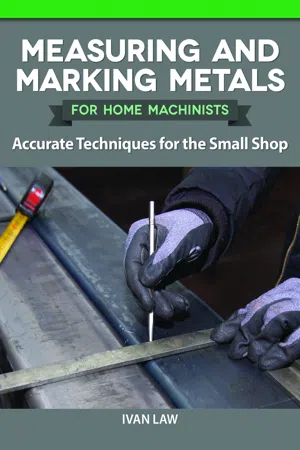
For model engineers and small workshops that don't have access to sophisticated and expensive measuring equipment, this guide will show them how to sufficiently measure and mark themselves! Measuring and Marking Metals for Home Machinists will inform readers on how to use measuring equipment and how to mark out, which are essential skills for engineers and imperative for success. A comprehensive resource written by renowned expert engineer, Ivan Law, this crucial metalworking resource not only emphasizes the importance of exactness of the initial marking out and the accuracy of measurements made throughout a work's progress, but will also clearly guide readers on how to achieve such vital precision! Author Ivan Law is an experienced and respected engineer who is also known for his sought-after demonstrations at the International Model Show.
eBook - ePub
Measuring and Marking Metals for Home Machinists
Accurate Techniques for the Small Shop
- 250 pages
- English
- ePUB (mobile friendly)
- Available on iOS & Android
eBook - ePub
About this book
Information
CHAPTER 1
Concepts of Measurement
Every time we go into our workshop to produce even the smallest component, or part of a component, we have to do some form of measurement. It may be a complicated exercise requiring some form of sophisticated equipment, or it may be a mundane task calling for nothing more than an ordinary rule; occasionally judgment of the eye will be all that is needed, but consciously, or unconsciously, we will be performing some act of measuring.
There are a number of books available on the science of measurement, or, to give it its correct name, metrology, but these are basically for industry rather than the model engineer or home machinist. The needs of the ‘back garden’ engineer are totally different from those in industry and it is hoped that the following chapters will help to satisfy some of the needs.
The model engineer produces his workpieces with very little equipment and often without the knowledge possessed by a skilled craftsman. It is a case of using his equipment to the best advantage and selecting new tools with care and thought when financial circumstances allow. For it must not be forgotten that expenditure on one’s hobby has to come after all other family commitments are met. It is possible that the products of the model engineer’s workshop can equal, and in some cases, surpass, those produced in industry but nevertheless there is one great difference between the home constructor and industry. The model engineer produces all the various components of any mechanism himself with the whole of the project being done in the one workshop, by the same pair of hands, and using the same measuring equipment for all the components.
This fact completely changes the whole concept of measurement. For example, consider the simple cylinder and its piston. In industry the designer or draftsman would have to consider the maximum and minimum clearance that could be allowed for the correct functioning of the component. Suppose it was decided that the minimum clearance was to be .0005in. and the maximum .0015in. with the nominal size 1½in. The cylinder bore would have to be produced to a size of 1.500in. minimum and 1.5005in. maximum. The piston drawing would call for a maximum of 1.4995in. and a minimum size of 1.499in. In other words the complete tolerance band on each item would be no more than a half of one-thousandth of an inch! Tolerances of this magnitude are expensive to achieve and also difficult to maintain as there is little room for tool wear.
In modern industry it could well be that the two items could be produced in two different and independent factories – indeed, they may even be in two different countries and made by people speaking different languages. The assembly of the items could well be in a third factory completely remote from the other two. It is therefore essential that some very accurate measuring equipment is used by both manufacturing companies and that their respective equipment is set to the same standards. The manufacturing companies must therefore know the actual size of each component. Even when the components are made to these exacting conditions the complete tolerance band of 1½ thousandths of an inch will be frequently experienced. It is not a feasible proposition to give the manufacturers more latitude by increasing the tolerance band by even one half thousandth of an inch in the ‘metal on’ direction. If this were to be done then “Dr. Sod’s” law would most certainly operate and tolerances would accumulate unidirectionally toward maximum difficulty of assembly, the result being that the piston would be an interference fit in the cylinder bore, thus making assembly impossible. The parts would be useless for the purpose for which they were intended and the assembly shop would come to a halt. The whole idea behind the tolerance band, and the expense that the process demands, is to guarantee that any two parts will fit together and give the correct working clearance. There is a system in industry known as selective assembly but this is not used if it can be avoided as selecting parts to obtain a desired fit is clearly time consuming, messy and expensive.
The model engineer’s approach to machining and fitting a cylinder and piston is completely nominal. The success of the engine is not dependent on the bore being precisely 1.500in.; it is much more important that the model engineer obtains a round and parallel bore and it is much easier to obtain this condition if the final size is relatively unimportant. The model engineer therefore concentrates his attention not on the size but on the finish. As long as the final size is reasonably near the nominal and is not so large as to interfere with other factors – such as fixing bolts for the cover, or the port and passage ways – the actual size is of no consequence. What does matter is that the piston is made to suit. Since the modeler is making only one, or maybe two, cylinders, interchangeability does not enter into it. Each respective piston is made to fit its own cylinder and will never be required to fit any other.
When the piston is being made no accurate measuring equipment will be required as the cylinder itself will be the final gauge as to size. The constructor may not know, and indeed has no need to know, what the exact sizes are, but he will be able to obtain a nice sliding fit and in all probability, a closer one than the 1½-thou obtained by his industrial counterpart. This condition will have been achieved without the expensive and sophisticated measuring equipment used in industry. In fact the only measuring tool the modeler may have used might be an ordinary steel rule. To assist in getting the piston near to its final size an outside micrometer may have been used, the procedure being to set a pair of inside calipers to the cylinder bore, adjusting the micrometer to the caliper size and then using the micrometer to turn the piston nearly to size. Even if this method has been used the final fitting will have been obtained by using the cylinder as the gauge.
The model engineer will have used his equipment not to measure the actual size but as comparators – and that is, as the word suggests, to compare one size to another one. When used in this way the measuring equipment need not be accurate to British Standard Institute requirements, indeed it could well be inaccurate, but as its duty is to transfer a size from one component onto another, the inaccuracy is of no consequence. Quite often when using measuring equipment as comparators the units shown on the equipment are of no consequence. They could be imperial, metric or even millifurlongs, it matters not! Bowlers on the bowling greens use a piece of string to compare two bowls to the jack. This measure has no unit calibrated on it at all, yet the nearest bowl to the jack can be ascertained to within close limits!
Only one example has been discussed above but the same principle applies to almost the whole of model making: the desired fit between components can be achieved by producing one component to a ‘nominal’ size and producing its mating part to fit. It can therefore be realized that the whole concept of measurement in model engineering is completely different from general production practice. This is fortunate as far as we modelers are concerned since it means that we do not have to purchase a large amount of measuring equipment, nor do we have to have it constantly checked in order to maintain its accuracy. I have heard people claim that they can measure with a steel rule to within .002in.; they can’t, of course, as this is less than the tolerances allowed by the manufacturers of the rules between any two marks. They can, perhaps, if they have good eyesight or use a magnifying glass, compare two sizes to within .002in. using the same rule, but this is not measuring, this is another example of using a rule as a comparator.
As can be seen from the above, any beginner to the model engineering hobby need have no fears at all about his ability to produce parts to the linear standards required. He will be able to construct a perfectly satisfactory working model using simple measuring equipment provided he uses it intelligently and understands just what it is that he is trying to achieve. The man the beginner has to ignore is the chap who, at club meetings, announces that whatever component he is making he always measures to a “tenth of a thou”. Maybe he does, but it is doubtful if he knows which one! – fortunately it rarely matters.
CHAPTER 2
Rules and Calipers
RULES
The most common, and certainly the best-known, piece of measuring equipment is the ordinary rule. In actual fact, after looking into the number and types of rules available, the term ‘ordinary rule’ becomes meaningless. There is a large number of types and styles of rules available, most trades and crafts having their own special rules or range of rules. However, all these can be disregarded; as far as the model or amateur engineer is concerned the term ‘rule’ means what the trade calls “Engineers’ precision steel rule”. Even when the field is narrowed down to this small band, there is still a number of rules left from which a choice can be made.
The model engineer rarely requires a rule above twelve inches long even though a model may be large, like a 5in. gauge locomotive, as it is very rare to find that any feature is more than twelve inches from a given datum. We can say, therefore, that for marking-out purposes we require a 12in. rule or, if the model is metric-based, the equivalent size rule of 300 mm. We have a few from which we can make our selection. A rule can have one end square – this being the end from which all measurements are to be made and from which all the graduations are based – and the other end rounded with the graduations ending about a half-inch or so from this rounded end. A small hole is usually drilled in this plain portion, thus providing a means of hanging it onto a hook on the wall or drawer cabinet when not in use. This type of rule is known by manufacturers as a ‘round-end rule’.
Another type of rule is called the ‘square-end rule’, and this, as its name suggests, is square at both ends and as a result either end can be used as the datum end when measuring. With this type a 12in. rule is, within the limits of manufacture, exactly twelve inches long. The method of graduating differs from the round-end rule in that, with the round-end rule, when this is held so that the rounded end is to the right, both scales – top and bottom – are of necessity graduated from the square or left-hand end, and both scales have to be read with the rule held in this attitude otherwise the graduations and numbers are upside down. With the square-ended rule the graduations are arranged so that no matter how the rule is held the markings always start from the left-hand end, so that when held in the hand the bottom edge, or the one nearest to the user, is the one to be read. It is not possible to say that one type is better or more useful than the other, for if this were so only one type would be made. Both types have advantages and disadvantages. If the workshop had to be limited to only one 12in. rule then the author would prefer the square-ended type but, if possible, it is an advantage to have one example of each type. Figs. 1 and 2 illustrate four 12in. or 300 mm rules.

Fig.1 This shows four different styles of 12-inch or 300mm rules. The top two are round-end rules, the lower two are square-ended. The upper one is a two-edge rule while the other three are the four-edged variety.
The 12in. or 300 mm rule is, however, rather large for measuring workpieces held in the relatively small machine tools found in the home workshop and for this type of work the 6in. or 150 mm rule is decidedly superior. For example, it is difficult to apply the 12in. rule to a workpiece in the lathe without moving the tailstock from its supporting position and sliding it down toward the end of the bed to allow access for the rule. It is both quicker and easier to use the 6in. rule in this and similar circumstances.
Like the 12in. rule, the 6in. rule is made in both rounded-and square-ended styles. The same method and pattern of markings are used on the small rules as on the larger ones. There is, however, one big difference between them and that is in the width of the two rules, the 12in. and 300 mm rules are supplied with a width of 1in. or 25 mm, while the smaller rules are usually 3/4in. or 19 mm wide.
All the rules described above are of the type known as rigid; this means that they do not bend easily and they should be kept and used in the ‘flat’ state in which they are supplied. There is available, however, another type of rule known as the flexible steel rule which is much thinner and narrower than the rigid rule and made from spring steel. The flexible rules, both 12in. and 6in. long (or metric equivalent) are usually only ½in. wide and this, and the fact that they are manufactured from thinner material allows them to bend to an extent far greater than would be required in normal use, and without taking on a permanent set or breaking. Again, this range of rules is available round-ended or square-ended and a 6in. square-ended rule of this type is very useful for measuring workpieces held in the lathe as both its size and flexibility allow it to be used in spaces that would make direct measurement with other rules difficult, if not impossible.

Fig.2 This shows the reverse side of the same four rules. As can be seen, the two-edge rule has no markings on it at all. The second rule down is imperial on this side and therefore has two metric edges and two imperial edges. The upper square-ended rule has four metric edges while the lower one has two imperial edges.

Fig.3 This illustration shows four six-inch or 150mm rules. The top three are rigid rules while the lower one is flexible. Three are round-edge rules and one is squareended. The second one down is a bright finish rule while the others have a non-reflecting pearl chrome finish.
Rules made with graduations on one side and plain on the other are termed ‘two-edge rules’. The other, and more common, rules are the four-edge rules and, as its name implies, this rule has graduations on both sides thus allowing all four edges to be utilized. As can be imagined there are many ways and permutations that can be employed on graduating rules. The all-imperial four-edge can be obtained with the scale in 1/32in. and 1/64in. on one side while the reverse side has 1/8in. and 1/16in. spacings. There are some imperial rules that have scales graduated in 1/10in. – 1/20in. with short lengths – usually one inch – marked 1/50in. and 1/100in. respectively. The author finds that fine graduations such as 1/64in. and 1/100in. are too fine for the naked eye and difficult to read; it can be easier to judge to 1/64in. by using the 1/32in. scale rather than the 1/64in. range which is difficult to see clearly.

Fig.4 The reverse side of the ‘six-inch’ rules. The bright-finish rule has four imperial edges while the others have two imperial and two metric edges. It is unusual for a squareended rule to have both imperial and metric edges as the length of the two scales is not similar and as a result the top and bottom scales on one are out of register. This can be seen on the metric scales on the square-ended rule.

Fig.5 This photograph shows the advantage of the flexible rule when measuring in the lathe. It is possible to obtain a reading without withdrawing the tailstock support by ‘bending’ the rule to lay on the workpiece.

Fig.6 Using the same rule to set the position of a parting tool. Note, a different edge is being used than in the previous illustration. This is possible because with a round-ended rule both scales have the same datum end. This type of rule is very useful for measuring workpieces in the lathe.
One advantage of the metric scale is that it eliminates the necessity for a range of fractional sizes. The markings on a metric rule are every millimeter or half millimeter with the figures marked at 10 mm intervals. Some rules are...
Table of contents
- Cover
- Title
- Copyrights
- Contents
- Preface
- Acknowledgments
- Chapter 1: Concepts of Measurement
- Chapter 2: Rules and Calipers
- Chapter 3: Micrometers
- Chapter 4: Vernier Caliper Gauges
- Chapter 5: Dial Gauges
- Chapter 6: Angular Measurement
- Chapter 7: General Marking-out Tools
- Chapter 8: Tools for Marking Castings, Forgings etc.
- Chapter 9: Marking out Sheet Components and Interpreting Drawings
- Chapter 10: A Summary involving a practical example
Trusted by 375,005 students
Access to over 1.5 million titles for a fair monthly price.
Study more efficiently using our study tools.
Frequently asked questions
Yes, you can cancel anytime from the Subscription tab in your account settings on the Perlego website. Your subscription will stay active until the end of your current billing period. Learn how to cancel your subscription
No, books cannot be downloaded as external files, such as PDFs, for use outside of Perlego. However, you can download books within the Perlego app for offline reading on mobile or tablet. Learn how to download books offline
Perlego offers two plans: Essential and Complete
- Essential is ideal for learners and professionals who enjoy exploring a wide range of subjects. Access the Essential Library with 800,000+ trusted titles and best-sellers across business, personal growth, and the humanities. Includes unlimited reading time and Standard Read Aloud voice.
- Complete: Perfect for advanced learners and researchers needing full, unrestricted access. Unlock 1.5M+ books across hundreds of subjects, including academic and specialized titles. The Complete Plan also includes advanced features like Premium Read Aloud and Research Assistant.
We are an online textbook subscription service, where you can get access to an entire online library for less than the price of a single book per month. With over 1.5 million books across 990+ topics, we’ve got you covered! Learn about our mission
Look out for the read-aloud symbol on your next book to see if you can listen to it. The read-aloud tool reads text aloud for you, highlighting the text as it is being read. You can pause it, speed it up and slow it down. Learn more about Read Aloud
Yes! You can use the Perlego app on both iOS and Android devices to read anytime, anywhere — even offline. Perfect for commutes or when you’re on the go.
Please note we cannot support devices running on iOS 13 and Android 7 or earlier. Learn more about using the app
Please note we cannot support devices running on iOS 13 and Android 7 or earlier. Learn more about using the app
Yes, you can access Measuring and Marking Metals for Home Machinists by Ivan Law in PDF and/or ePUB format, as well as other popular books in Technology & Engineering & Mining Engineering. We have over 1.5 million books available in our catalogue for you to explore.