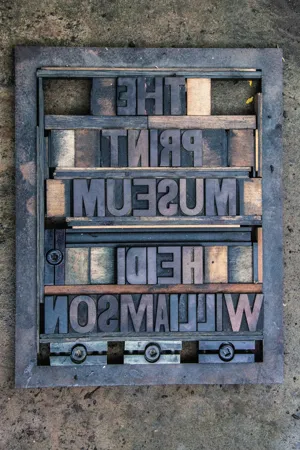
In her second collection, printer's daughter Heidi Williamson mines the rich language and history of printing to consider themes of belonging, parenthood, love, and how we communicate, and fail to communicate, with each other. Individual, familial and cultural inheritance is explored - through subjects ranging from Gutenberg to Gill, Kindles, Twitter, ultrasounds, the death of Diana, 3D printing, climate change, childlessness, genes, and what is downloadable. By turns sensual, playful, and stark, The Print Museum collects exhibits and fragments from this fading industrial art and displays them alongside pieces driven by the same forces of longing, loss, transformation and delight. 'Heidi Williamson's poems are about contact with the haunted world. She understands uncertainty and loss, as well as the trace loss leaves behind as memory, memory that acts like a Blitz incendiary waiting to ignite later in life. The sensuousness of language is asserted…through tender explorations of our haunted fabric.' - George Szirtes 'Williamson knows that poetry is a means of investigation, rigorous and disciplined; her poems often begin with a thought that a lesser poet would be content to end with. This approach is evident in the beautiful precision of her language, the way form itself becomes a means of discovery.' - Esther Morgan 'At their heart is human tenderness and a sense of human friability... The poems display an incisive mind, a powerful imagination and an equally impressive purchase on language.' - Moniza Alvi & Paul Farley, PBS Bulletin, on Electric Shadow
- 72 pages
- English
- ePUB (mobile friendly)
- Available on iOS & Android
eBook - ePub
The Print Museum
About this book
Information
Subtopic
PoetryIndex
LiteratureGlossary of printing terms
Adhesion: Disparate things bonded together: ink adheres to paper.
Antimony, tin and lead: Ideal combination of metals for casting letters: durable but not brittle and doesn’t shrink when cooled, allowing good reproduction of even the tiniest type.
Apprentice: Printers served a seven-year apprenticeship learning the trade.
Ascender: The upper part of a letter like ‘d’ that rises up from the base.
Bed: The flat base of the press that the platen presses on to print.
Bewick: Thomas Bewick, celebrated 18th century artist and naturalist whose woodcuts remain technically and artistically influential. See Jenny Uglow’s wonderful biography Nature’s Engraver (Faber & Faber, 2007).
Bleed: Overspill of colours beyond the page edges to avoid gaps appearing when cut to size.
Body: The main text (body copy) of a typeset page (vs headlines etc).
Bound: Books are bound in a cover to secure everything in place.
Case: Type case: where individual letters were stored for hand-composing. Most often used letters were in the ‘lower case’ at hip height, the lesser used capitals were in the ‘upper case’ on a higher shelf. This became a description for the letters.
Cast: In hot metal (letterpress), individual letters are cast in a mould.
Chase: Frame holding type and furniture together while they’re printed.
Clicker: The foreman of the section you worked in.
Close spacing: Reducing the space between letters and/or sentences so more can be fitted onto the page.
Cod: The cod: slang for taking the mickey/mucking about.
Coffin: Another term for ‘bed’.
Compose: To arrange or set type to be printed.
Compositor: The person setting/composing the type.
Creep: Inner sheets sticking out beyond the ones they’re enclosed in.
Crossover: An image that extends across two facing pages.
Cursive: Sloping font initially designed to replicate handwriting.
Dabber: A cushioned pad used to apply ink. (Using it with a rocking motion makes for a more even distribution.)
Deep impression: Letterpress printing that leaves a deep mark in the paper.
Descender: The portion of a lower case letter like g or p that falls below the main body of the letter.
Devil: Apprentices were called ‘printer’s devils’.
Dilutee: Slang for an unskilled worker who takes the job of a skilled worker. (After WWII, ex-servicemen were treated as fully apprenticed printers after just two years. This angered veteran printers, who had undertaken seven years’ training, many of whom had served in WWI.)
Dimensional stability: Paper’s ability to withstand changes in its environment.
Diss: After printing, the fiddly and painstaking job of distributing (dissing) all the pieces back in their place in the case.
Dot gain: When halftone dots print larger than they were on the plate, resulting in a distorted image.
Eighth Wonder of the World: What Thomas Edison called the invention of the Linotype machine, which allowed entire lines of type to be set quickly by typing into a machine, instead of letter-by-letter manual setting.
Em dash: Dash that’s longer than a hyphen: the width of an M.
Father of the chapel: The union shop steward. (Thought to derive from print shops initially being heavily involved with religious orders.)
Figure: An illustrative image.
Finish: Paper’s finish depends on processes it goes through.
Flong: A lightweight pulped paper mould used in relief printing.
Flying fingers: Parts of a printing machine that lift and move the paper.
Forge: Casting individual letters with hot metal.
Form(e): In letterpress, type secured in a chase, ready for printing.
Furniture: Pieces of wood, metal and plastic used to create space around words and lines and hold the set text and images in place.
Gold: Gold leaf, used in bookbinding and for illuminating (decorating) manuscripts. It doesn’t tarnish like other metals.
Graphic: Visual elements of print: drawings, engravings, photos etc.
Grave: As in ‘engrave’. Scoring lines into a (usually copper) plate.
Guilloché: Interlaced curved designs as in architecture/on banknotes.
Gutenberg: Widely accepted as the ‘inventor’ of the first modern printing press and many of its associated processes.
Handgloves: A word commonly used to showcase or compare fonts. It gives a good indication of how the whole alphabet comes across, including ascending (d, h) and descending letters (g), curves meeting straights (n, d, g), the angle of the counters (the holes in a, d, g, o, e), and diagonals (v).
Hard ground: Ground is a coating worked onto the metal plate used in etching, for the acid to bite an image into. Hard ground (as opposed to soft ground) gives a deeper bite.
Heidelberg: Printing press revered for its mechanical beauty and efficiency.
Hellbox: Where ‘bad’ characters go: a receptacle for broken and battered letters.
Holding lines: Lines showing the exact size, shape and location of images.
Inset: To set a small image within the borders of a larger one.
Interleave: To insert sheets between other printed pages.
Intertype: A typecasting machine closely resembling the Linotype.
Jogger: A vibration machine that evens-up stacks of printed materials.
Kerning: Adjusting spacing between letters and words for ease of reading, to optimise layout.
Kiss: Kiss impression: light but stable pressure between ink and paper for quality printing.
Landscape: Page set-up that’s wider than it is high.
Leading: In hand-typesetting, thin strips of lead were put between lines of text to create space around words and make reading easier.
Letterpress: Printing by pressing paper against a raised, inked surface.
Levered eagle: The widely used Columbian iron hand-press used an innovative lever system that made it work with the lightest of touches. The best-known model had an eagle as its counterweight.
Lineage: The number of lines in a piece of printed matter and how output was measured e.g. for newspaper work.
Linotype: The Linotype machine assembled whole lines of type to be cast in one slug, simply by t...
Table of contents
- Cover
- Description
- Title Page
- Dedication
- Epigraph
- ACKNOWLEDGEMENTS
- CONTENTS
- PREFACE
- Out of print
- Span
- Work and turn
- The dark manner
- Furniture
- At the Print Museum
- Uncoated
- Letterpress
- Gutenberg
- Em dash
- Majuscule
- Offcuts
- Crossover
- Bewick
- The print mausoleum
- The Case
- Machine Minder
- Newton’s Rings
- Separations
- Repeatability
- Shingling
- Coffin
- Hard ground
- Landscape
- Portrait
- Dimensional stability
- Figure
- Bleed
- Non-printing blue
- Hellbox
- Proof
- Lineage
- Dot gain
- States
- Adhesion
- Cursive
- Graphic
- Ascender
- Descender
- Minuscule
- Permanent
- Manifold
- GLOSSARY OF PRINTING TERMS
- About the Author
- Copyright
Trusted by 375,005 students
Access to over 1.5 million titles for a fair monthly price.
Study more efficiently using our study tools.
Frequently asked questions
Yes, you can cancel anytime from the Subscription tab in your account settings on the Perlego website. Your subscription will stay active until the end of your current billing period. Learn how to cancel your subscription
No, books cannot be downloaded as external files, such as PDFs, for use outside of Perlego. However, you can download books within the Perlego app for offline reading on mobile or tablet. Learn how to download books offline
Perlego offers two plans: Essential and Complete
- Essential is ideal for learners and professionals who enjoy exploring a wide range of subjects. Access the Essential Library with 800,000+ trusted titles and best-sellers across business, personal growth, and the humanities. Includes unlimited reading time and Standard Read Aloud voice.
- Complete: Perfect for advanced learners and researchers needing full, unrestricted access. Unlock 1.5M+ books across hundreds of subjects, including academic and specialized titles. The Complete Plan also includes advanced features like Premium Read Aloud and Research Assistant.
We are an online textbook subscription service, where you can get access to an entire online library for less than the price of a single book per month. With over 1.5 million books across 990+ topics, we’ve got you covered! Learn about our mission
Look out for the read-aloud symbol on your next book to see if you can listen to it. The read-aloud tool reads text aloud for you, highlighting the text as it is being read. You can pause it, speed it up and slow it down. Learn more about Read Aloud
Yes! You can use the Perlego app on both iOS and Android devices to read anytime, anywhere — even offline. Perfect for commutes or when you’re on the go.
Please note we cannot support devices running on iOS 13 and Android 7 or earlier. Learn more about using the app
Please note we cannot support devices running on iOS 13 and Android 7 or earlier. Learn more about using the app
Yes, you can access The Print Museum by Heidi Williamson in PDF and/or ePUB format, as well as other popular books in Literature & Poetry. We have over 1.5 million books available in our catalogue for you to explore.