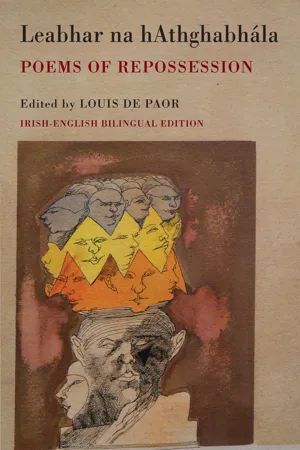
Leabhar na hAthghabhála
eBook - ePub

Leabhar na hAthghabhála

Poems of Repossession

  1. 543 pages
  2. English
  3. ePUB (mobile friendly)
  4. Available on iOS & Android
eBook - ePub

Leabhar na hAthghabhála

Poems of Repossession

About this book

Poetry Book Society Recommended Translation

Irish-English bilingual edition

This is the first comprehensive critical anthology of modern poetry in Irish with English translations. It forms a sequel to Seán Ó Tuama and Thomas Kinsella's pioneering anthology, An Duanaire 1600-1900 / Poems of the Dispossessed (1981), but features many more poems in covering the work of 26 poets from the past century.

It includes poems by Pádraig Mac Piarais and Liam S. Gógan from the revival period (1893-1939), and a generous selection from the work of Máirtín Ó Direáin, Seán Ó Ríordáin and Máire Mhac an tSaoi, who transformed writing in Irish in the decades following the Second World War, before the Innti poets – Michael Davitt, Liam Ó Muirthile, Nuala Ní Dhomhnaill, Cathal Ó Searcaigh, Biddy Jenkinson – and others developed new possibilities for poetry in Irish in the 1970s and 80s. It also includes work by more recent poets such as Colm Breathnach, Gearóid Mac Lochlainn, Micheál Ó Cuaig and Áine Ní Ghlinn.

The anthology has translations by some of Ireland's most distinguished poets and translators, including Valentine Iremonger, Michael Hartnett, Paul Muldoon, Eiléan Ní Chuilleanáin, Bernard O'Donoghue, Maurice Riordan, Peter Sirr, David Wheatley and Mary O'Donoghue, most of them newly commissioned for this project. Many of the poems, including Eoghan Ó Tuairisc's anguished response to the bombing of Hiroshima, 'Aifreann na marbh' [Mass for the dead] have not previously been available in English.

In addition to presenting some of the best poetry in Irish written since 1900, the anthology challenges the extent to which writing in Irish has been underrepresented in collections of modern and contemporary Irish poetry. In his introduction and notes, Louis de Paor argues that Irish language poetry should be evaluated according to its own rigorous aesthetic rather than as a subsidiary of the dominant Anglophone tradition of Irish writing.

Frequently asked questions

Yes, you can cancel anytime from the Subscription tab in your account settings on the Perlego website. Your subscription will stay active until the end of your current billing period. Learn how to cancel your subscription.
No, books cannot be downloaded as external files, such as PDFs, for use outside of Perlego. However, you can download books within the Perlego app for offline reading on mobile or tablet. Learn more here.
Perlego offers two plans: Essential and Complete
  • Essential is ideal for learners and professionals who enjoy exploring a wide range of subjects. Access the Essential Library with 800,000+ trusted titles and best-sellers across business, personal growth, and the humanities. Includes unlimited reading time and Standard Read Aloud voice.
  • Complete: Perfect for advanced learners and researchers needing full, unrestricted access. Unlock 1.4M+ books across hundreds of subjects, including academic and specialized titles. The Complete Plan also includes advanced features like Premium Read Aloud and Research Assistant.
Both plans are available with monthly, semester, or annual billing cycles.
We are an online textbook subscription service, where you can get access to an entire online library for less than the price of a single book per month. With over 1 million books across 1000+ topics, we’ve got you covered! Learn more here.
Look out for the read-aloud symbol on your next book to see if you can listen to it. The read-aloud tool reads text aloud for you, highlighting the text as it is being read. You can pause it, speed it up and slow it down. Learn more here.
Yes! You can use the Perlego app on both iOS or Android devices to read anytime, anywhere — even offline. Perfect for commutes or when you’re on the go.
Please note we cannot support devices running on iOS 13 and Android 7 or earlier. Learn more about using the app.
Yes, you can access Leabhar na hAthghabhála by Louis de Paor in PDF and/or ePUB format, as well as other popular books in Literature & European Poetry. We have over one million books available in our catalogue for you to explore.

Information

Nuala Ní Dhomhnaill (1952–)

Nuala Ní Dhomhnaill was born to Irish-speaking parents in Lancashire, England, and brought up in Nenagh, County Tipperary, spending part of her childhood with her extended family in the west Kerry Gaeltacht of Corca Dhuibhne. She studied with the other Innti poets at University College Cork before moving with her husband, initially to Holland and then to Turkey, where she taught English for several years, before returning to Ireland and settling in Dublin in 1980.
While she draws on a broad range of writing in several languages, the most significant formative influence on Ní Dhomhnaill’s poetry and poetics is the spoken language of Corca Dhuibhne and its oral tradition of songpoems and stories which, she says, provide ‘a plumbline into the subconscious’ (1992: 29), an alternative history and language that record obliquely the psychological and emotional experience of women. Her deep reading in the archives of the National Folklore Collection provides a basis for a feminine discourse that draws on Jungian psychology and feminist ideas of écriture feminine inflected by Irish tradition (Nic Dhiarmada 2005; Ní Fhrighil 2008). As in the poems of Máire Mhac an tSaoi, the continuity between her poetic voice and the Gaelic tradition gives the authority of historical precedent to work which explores female experience in ways that contest and subvert established morality in language that is ‘like that of children brought up by their grandmothers, a hundred years old, a kind of miracle of survival’ (Mhac an tSaoi 1988: 7).
The celebration of female sexuality is central to her work which refuses moral codes that reject the carnal element of human existence; in her early poems, she rewrites some of the most powerful stories in the Christian tradition that insist on sexual continence as the ultimate human achievement. The need to reconcile the physical and the spiritual, the traditional and the individual, is part of a larger project which proposes union and integration rather than the separation and fragmentation authorised by rationalist ‘masculine’ discourse. In her most accomplished work, the quest for integration blurs the rational distinction between the human and natural worlds so that t...

Table of contents

  1. Cover
  2. Description
  3. Title Page
  4. Dedication
  5. Clár | Contents
  6. Aistritheoirí | Translators
  7. Réamhrá | Introduction
  8. Pádraig Ó hÉigeartaigh (1871-1936)
  9. Pádraig Mac Piarais (1879-1916)
  10. Liam S. Gógan (1891-1979)
  11. Máirtín Ó Direáin (1910-1988)
  12. Seán Ó Ríordáin (1916-1977)
  13. Máire Mhac an tSaoi (1922–)
  14. Eoghan Ó Tuairisc (1919-1982)
  15. Seán Ó Tuama (1926-2006)
  16. Tomás Mac Síomóin (1938–)
  17. Conleth Ellis (1937-1988)
  18. Caitlín Maude (1941-1982)
  19. Cathal Ó Searcaigh (1956–)
  20. Micheál Ó hAirtnéide (1941-1999)
  21. Michael Davitt (1950-2005)
  22. Nuala Ní Dhomhnaill (1952–)
  23. Áine Ní Ghlinn (1955–)
  24. Deirdre Brennan (1934–)
  25. Liam Ó Muirthile (1950–)
  26. Micheál Ó Cuaig (1950–)
  27. Seán Ó Curraoin (1942–)
  28. Derry O’Sullivan (1944–)
  29. Biddy Jenkinson (1949–)
  30. Colm Breathnach (1961–)
  31. Louis de Paor (1961–)
  32. Gearóid Mac Lochlainn (1966–)
  33. Ord foilsithe na ndánta | Chronology of publication
  34. Aistritheoirí | Translators
  35. Nótaí na n-aistritheoirí | Translators’ notes
  36. Nótaí ar dhánta | Notes on individual poems
  37. Logainmneacha | Place names
  38. Tagairtí | References
  39. Buíochas | Acknowledgements
  40. Dánta in ord aibítre | Index of Irish titles
  41. Aistriúcháin in ord aibítre | Index of English titles
  42. Filí in ord aibítre | Index of poets
  43. Copyright