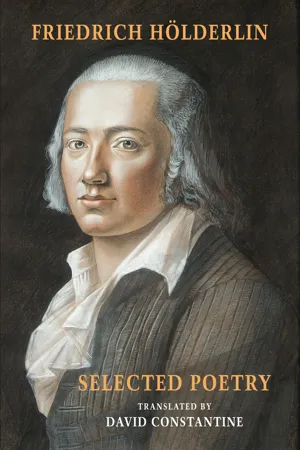
Friedrich Hölderlin was one of Europe's greatest poets. The strange and beautiful language of his late poems is recreated by David Constantine in these remarkable verse translations. This is a new expanded edition of Constantine's widely-praised Hölderlin Selected Poems (1990/1996), containing many new translations as well as the whole of Hölderlin's Sophocles (2001), in which he sought to create an equivalent English for Hölderlin's extraordinary German recreations of the classic Greek verse plays. Constantine won the European Poetry Translation Prize in 1997 for his translations of Hölderlin. This new volume presents a substantial selection from the work of a poet who, writing around 1800, addresses us ever more urgently two centuries later. Hölderlin translated all his writing life. Through translation he reached a poetic language of his own, so that much of his best poetry reads like a translation from elsewhere. He was intensely occupied with Sophocles in the winter of 1803-04. His versions of Oedipus Rex and Antigone (he worked at but never finished Oedipus at Colonus and Ajax) came out in the spring of 1804 and were taken, by the learned, as conclusive proof of his insanity. He was by then very near to mental collapse, but no one now would dismiss his work for that. He translated in a radical and idiosyncratic way, cleaving close to the Greek yet at the same time striving to interpret these ancient, foreign and – as he thought – sacred originals, and so bring them home into the modern day and age. Constantine has translated Hölderlin's translations, carrying as much of their strangeness as possible into his English. The plays themselves need no introduction or apology. These double translations, links in literature from land to land and from age to age, demonstrate the vitality of ancient and modern poetic tradition. Poetry Book Society Recommended Translation.
- 412 pages
- English
- ePUB (mobile friendly)
- Available on iOS & Android
eBook - ePub
Selected Poetry
About this book
Information
Table of contents
- Cover
- DESCRIPTION
- TITLE PAGE
- CONTENTS
- INTRODUCTION
- ACKNOWLEDGEMENTS
- Greece
- The oak trees
- To Diotima (‘Come and look at the happiness…’)
- Diotima (‘Heavenly Muse of Delight…’)
- ‘The peoples were silent…’
- Empedocles
- To the Fates
- To her good angel
- Plea for Forgiveness
- To the Sun God
- Hyperion’s Song of Fate
- ‘When I was a boy…’
- Achilles
- ‘Once there were gods…’
- ‘If I heeded them warning me now…’
- Parting
- The Zeitgeist
- Evening fantasy
- Morning
- The Main
- That which is mine
- ‘Another day…’
- ‘The sun goes down…’
- Peace
- Heidelberg
- The Gods
- The Neckar
- Home
- Love
- Course of life
- Parting, second version
- Diotima (‘You are silent, you suffer it…’)
- Return to the homeland
- Encouragement, second version
- Sung under the Alps
- The calling of poetry
- Voice of the people, second version
- The blind singer
- Poetic courage, first version
- Poetic courage, second version
- The fettered river
- Chiron
- Tears
- To Hope
- Vulcan
- Timidity
- Ganymede
- Half of life
- Ages of life
- Hahrdt Nook
- Menon’s lament for Diotima
- A walk into the country
- Stuttgart
- Bread and Wine
- Homecoming
- The Archipelago
- Those sleeping now
- As when on a holiday…
- To Mother Earth
- At the source of the Danube
- Celebration of Peace, first version
- Celebration of Peace, final version
- The journey
- The Rhine
- Germania
- The only one, first version
- The only one, ll. 50-97 of the second version
- The only one, third version
- Patmos
- Patmos, fragments of a later version
- Patmos, ll. 136-195 of work on a final version
- Remembrance
- The Ister
- Mnemosyne, second version
- Mnemosyne, third version
- ‘As birds slowly pass over…’
- ‘As upon seacoasts…’
- Home
- ‘For when the juice of the vine…’
- ‘On pale leaves…’
- ‘When over the vineyard…’
- To the Madonna
- The Titans
- ‘Once I asked the Muse…’
- ‘But when the heavenly powers…’
- ‘But formerly, Father Zeus…’
- The Eagle
- Nearest and best, third version
- Tinian
- ‘And to feel the lives…’
- ‘Where we began…’
- …the Vatican…
- Greece, first version
- Greece, ll. 13-21 of the second version
- Greece, third version
- ‘Severed and at a distance now…’
- ‘I have enjoyed…’
- ‘When out of heaven…’
- Spring (‘When new joy quickens…’)
- A happy life
- The walk
- The churchyard
- Not all days…
- Spring (‘How blessed to see again…’)
- Autumn (‘The stories that are leaving earth…’)
- Spring (‘The new day comes…’)
- View (‘To us with images…’)
- ‘In a lovely blue…’
- TRANSLATIONS FROM THE GREEK
- HÖLDERLIN’S SOPHOCLES
- TRANSLATOR’S NOTES
- GLOSSARY
- COPYRIGHT
Trusted by 375,005 students
Access to over 1.5 million titles for a fair monthly price.
Study more efficiently using our study tools.
Frequently asked questions
Yes, you can cancel anytime from the Subscription tab in your account settings on the Perlego website. Your subscription will stay active until the end of your current billing period. Learn how to cancel your subscription
No, books cannot be downloaded as external files, such as PDFs, for use outside of Perlego. However, you can download books within the Perlego app for offline reading on mobile or tablet. Learn how to download books offline
Perlego offers two plans: Essential and Complete
- Essential is ideal for learners and professionals who enjoy exploring a wide range of subjects. Access the Essential Library with 800,000+ trusted titles and best-sellers across business, personal growth, and the humanities. Includes unlimited reading time and Standard Read Aloud voice.
- Complete: Perfect for advanced learners and researchers needing full, unrestricted access. Unlock 1.5M+ books across hundreds of subjects, including academic and specialized titles. The Complete Plan also includes advanced features like Premium Read Aloud and Research Assistant.
We are an online textbook subscription service, where you can get access to an entire online library for less than the price of a single book per month. With over 1.5 million books across 990+ topics, we’ve got you covered! Learn about our mission
Look out for the read-aloud symbol on your next book to see if you can listen to it. The read-aloud tool reads text aloud for you, highlighting the text as it is being read. You can pause it, speed it up and slow it down. Learn more about Read Aloud
Yes! You can use the Perlego app on both iOS and Android devices to read anytime, anywhere — even offline. Perfect for commutes or when you’re on the go.
Please note we cannot support devices running on iOS 13 and Android 7 or earlier. Learn more about using the app
Please note we cannot support devices running on iOS 13 and Android 7 or earlier. Learn more about using the app
Yes, you can access Selected Poetry by Friedrich Hölderlin in PDF and/or ePUB format, as well as other popular books in Literature & Poetry. We have over 1.5 million books available in our catalogue for you to explore.