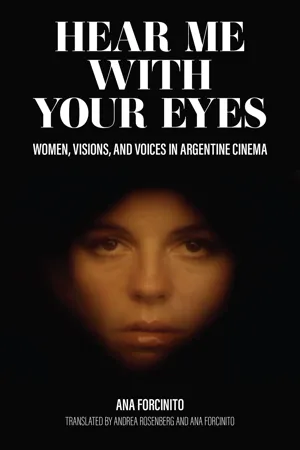
Hear Me with Your Eyes examines the intrusion of the voice into the cinematographic gaze and the intersections (and ruptures) of the sound-image in Argentine women filmmakers from a feminist perspective. In different ways, María Luisa Bemberg, Lita Stantic, Lucrecia Martel, Albertina Carri, María Victoria Menis, Lucía Puenzo, Sabrina Farji, Paula de Luque, Anahí Berneri, Sandra Gugliotta, and Gabriela David explore the visual realm through the continuities, intrusions, irrelevancies, harmonies, and desynchronizations of the voice. Or, instead, they explore different voices and their modulations, including whispers, screams, singing, echoes, breathing, resonance, sighs, and the transcendent voice, the narrative voice, the silenced voice, the articulated and unarticulated voice, and that which is none of the above. These voices suggest another relationship with the audiovisual realm, one that seems to include a closeness that erases, if only intermittently, the unalterable relationship between subject and object that characterizes the patriarchal visual regime.
- English
- ePUB (mobile friendly)
- Available on iOS & Android
eBook - ePub
About this book
Trusted by 375,005 students
Access to over 1.5 million titles for a fair monthly price.
Study more efficiently using our study tools.
Information
CHAPTER 1
Transcendence, Gaze, and Voice: María Luisa Bemberg

MANY OF THE DISCUSSIONS that emerged in Argentina in the mid-1990s highlight the nuevo cine and its clear break with the cinema that preceded it, especially the cinema of the 1980s. Yet, if we consider the articulation of gender from perspectives that examine women’s position as subjects of the gaze and of the audible voice, we can draw an unbroken line back from many recent filmmakers to the pioneering work of María Luisa Bemberg (1917–1995). By noting this inheritance, I do not mean to suggest that there are no new aesthetics of the gaze or attempts to expand and multiply women’s visions and the voices or sounds that go with them. Instead, I wish to posit Bemberg’s contribution as a vital landmark in the history of women filmmaking in Argentina and to underscore that the development of her approach to the gaze — as well as the dislocated (if only intermittently) acoustic realm of masculine, heteronormative logic — can be seen as a significant precedent for today’s feminist discussions.
From her first films, Bemberg has called into question the very relevance of the masculine control of sight, instead exploring the relation between women and the gaze within a framework that, while it starts out as essentialist, eventually becomes more oriented toward an examination of difference. There is in her films a rejection of what Laura Mulvey calls women’s “exhibitionist role” (1975: 19). Her work reveals a clear concern with subverting the image of women as objects of the patriarchal gaze associated with male pleasure. Though it exists within the parameters of a monolithic logic that represents all women in terms of Bemberg’s class privilege, the image of confinement serves as a fundamental starting point for analyzing all those gazes, voices, and sounds that attempt to find ways to escape the suffocation created by prevailing heteronormative norms and their regulation of how women are walled in (and especially how they are walled in the home and in the convent).
In this chapter, I explore not so much the feminist, consciousness-raising gaze of Bemberg’s earliest films (Momentos [Moments] from 1981, or Señora de nadie [Nobody’s Wife] from 1982), which reflect a more intimate approach to the portrayal of women, but instead the articulation of a new feminist vision that starts with Camila (1984), and the intersection between domestic oppression and the mechanisms of public repression in this film. Then, I examine the reconceptualization of the gaze/look and the starting point of Bemberg’s emphasis on difference in her autobiographical Miss Mary (1986), in which the protagonist’s vision is depicted through different visual positionalities. The more essentialist version of the female gaze starts to fall apart, leading instead to an examination of tensions and differences and of looking relations. Her last two films — Yo, la peor de todas (1990; I, the Worst of All) and De eso no se habla (1993; I Don’t Want to Talk About It) — also reflect complex, fragmentary, and varying visions, as well as sonic elements (especially voicework), to depict the intermittent emergence of images that escape the monitoring of the dominant gaze, but which are still subjected to scrutiny. The possibility (or lack thereof) of the transcendence of the feminine voice becomes in these films intertwined with the transcendence of feminist visions, a transcendence that is linked to the suspension of the synchronization of the voice-body and an emphasis on image-voice-thought.
Gaze, Sound, and Feminism: Some Considerations
The question of the place and relevance of the female gaze is central to Bemberg’s films, especially as she begins to question her initial essentialism, which led to a crisis of representation in her films from the 1990s. After her first films, which exhibit a militant, consciousness-raising feminist agenda, Bemberg seems to develop a series of conflicting frameworks, which are counterposed and juxtaposed. Through these frameworks, she examines the cracks both in the patriarchal gaze and in feminist visions. One of the metaphors that Bemberg uses is the shifting of the camera from one shoulder to the other, marking a shift in perspective or angle (Burton-Carvajal, 1999: 338). Though the camera is defined as a metaphor for the patriarchal gaze, this movement (from one shoulder to the other) can begin to dismantle the rigid, gendered framework that Mulvey applies to the relationship between the gaze (which Mulvey argues is only ever male) and the image (which is only ever female).
Moving now to the relationship between gender and voice, Kaja Silverman’s theory is relevant for thinking about acoustic mirrors of patriarchal representations and the emphasis on the male voice, or, more specifically, how men’s voices are emphasized as subjects of interpretation (the example she provides is the documentary voice-over, which is generally a male voice). As Silverman sees it, women are always reduced to their physical image (the synchronization of body and voice), while male voices achieve transcendence and knowledge. This shift from the voice associated with materiality to the voice associated with logos can be seen in Bemberg’s work, which affirms the transcendence of women’s voices, as well as the dual use of the female voice. On the one hand, there is a more articulated and audible voice that reproduces hegemonic norms; on the other, there are other voices that question those norms, whether in whispers (such as expressions of desire that disrupt the normalizing paternal voice) or in the desynchronization of the physical image (such as transcendent voices that defy the monopoly of male transcendence of the voice). Relevant here is Silverman’s warning that analyzing only narrative images (without sound) means setting aside narrative control (acoustic and visual) and the possible zones of tension that can arise between sound and image. According to Silverman, what is in play is the affirmation of male transcendence and the reduction of women’s voices to mere corporeality, as if her reality were limited to the contours of her body (1988: 70–71).
Bemberg’s work on the gaze seems to suggest that recovering one’s sight is a nearly impossible task. There is a recovery but, at the same time, a loss. This loss is repeated in the last moments of almost all of her films, when she portrays the annulment of the central female gaze or when the male voice ends up narrating even the recovery of that gaze. The final images in Camila, Miss Mary, Yo, la peor de todas, and De eso no se habla represent a farewell to (and thus a loss of) the vision the films attempt to explore. At the same time, while the protagonist’s gaze is either suppressed or departed from in these films, something remains in suspense, whether a voice that transcends the image (Camila, Yo, la peor de todas), a photographic image that never appears visually in the film, even though it is present through sound (Miss Mary), or a recovered gaze that moves toward the edges of the visual field (De eso no se habla).
From the Personal to the Political
From Momentos (1981) to De eso no se habla (1993), there is a shift from the monolithic, essentialist feminism of Bemberg’s earlier films to the feminism of differences in her later ones, a transition that nevertheless remains within the cultural code of Latin American feminism of the period.3 In the case of Momentos, the gender transgression (the film had to be reviewed by the censors of the last military dictatorship and was therefore limited by it) is anchored in the intimate look at a widow who remarries and has a brief affair, during which she recalls fragments from her past, especially the tragic loss of her first husband and her son. The exploration of Lucía’s subjective world and of a vision tied to her sexual desire, as well as to her grief, is shaped by an exercise of remembrance. There is an affirmation of Lucía’s existence as a subject of desire and memory, though her eyes (especially with regard to her lover) seem to be dependent on the transcendent voice of her husband, who provides the key to the interpretations that the film proposes.4 Señora de nadie (1982), written before Momentos but filmed afterward because it had not been approved by the censors (King, 2000: 19), centers on the intimate exploration of female subjectivity. The protagonist, Leonor, leaves her husband when she learns that he has a mistress. Her vision, as a constitutive aspect of her identity, seems to be poised here in confrontation with her husband (for whom her identity is defined through her reduction to an object of the gaze). In this film, the voice is tied to the figure of the mother, as well as to the figures of other women in maternal roles who repeat the patriarchal discourse. In both cases, there is an exploration of the protagonist’s subjectivity in the moment of confrontation. This confrontation creates a new way of looking (marked by her stepping out of the home into the outside world) and a new voice (marked by the confrontation with her mother’s voice and, at the same time, a confrontation with motherhood as the only space in which women can be defined).5
In 1984, with her film Camila, Bemberg shifts from a vision anchored in intimacy to one that portrays the intersections between the domestic and the political. Through a love story, Bemberg examines how authoritarianism has shaped both the public and the private spheres. With Camila (using the melodrama format and with the limitations on the representation of the female protagonist that such format implies), Bemberg gives a gendered historical reading to establish the connections between politics in the household and in the public space. Portraying the domestic sphere as one of confinement (Camila’s mother remarks in the film, “the best prison is the one you can’t see”), Bemberg sketches out an authoritarianism that is as much private as it is public by telling an impossible love story amid the battles between unitarios and federales during the nineteenth-century Rosas government. Although the gaze is represented through political surveillance (which is intertwined with surveillance in the domestic sphere) and ecclesiastical surveillance, Camila’s eyes are associated with that of her paternal grandmother, La Perichona, who opens the film with the question “Tell me, do you like love stories?” introducing what will be key to the camera’s gaze. Camila’s eyes thus embrace the transgression of norms and she ends up being punished.6 Camila becomes a victim not only of gender norms (which place her in the private realm) but also, and especially, of the political struggles between unitarios and federales.7 This film exposes the movement (or, rather, the spilling out) of gender norms from private isolation into the public discourse. History is interpreted here through the lens of the rights-deprived subjectivities that dwell between those spaces. In the face of the failure of the transgression represented by Camila and Ladislao Gutiérrez (in which Camila is a nonexistent historical and political subject), Bemberg represents the possibility of restoring both the woman’s role as a subject of the gaze and the transcendence of her voice.
Camila’s love story is narrated in whispers. In the confessional, still unaware that her confessor is the new priest, she talks about a dream in which she cannot stop looking at a moaning woman, until ultimately realizing that the woman is herself. Her whisper and the image in her dream reveal her own unconfessed desire. And, later, also in a whisper, she confesses her love to Ladislao in the confessional, a space reserved for the Church to exercise control over bodies and their excesses.
Fear of the spectacle of violence is also expressed through the gaze/look (both that of the camera and those of its characters) and through sound (as the flip side of the whisper: the shout). The death of Mariano, the bookseller, and the public display of his body are narrated through Camila’s eyes, through those of her family, and through the shout that announces the horror. One of the first moments in which we see Camila looking at Ladislao is when the priest violates the norm of silence in the face of violence by speaking from the pulpit. Looking at him implies looking with him at the world around her, despite her father’s warnings. The secret love story attempts to elude the watchful gaze and, upon being discovered, is punished. The gaze, which is associated with masculine power (of the father, the Church, the state, and even the liberal project that begins with Rosas’s defeat), is an authoritarian one. Fleeing from that gaze and thus evading it is one of the avenues of escape proposed in the film. However, such escape is only temporary. After the lovers have fled, a priest recognizes Ladislao and the couple is arrested. In the face of the nearly absolute power of the authoritarian gaze, which is encapsulated in the image of the lovers being blindfolded before their execution by a firing squad, the film points to the edges of the visual field (a space where vision remains interlinked with desire and life) and highlights those edges through sound. Through the use of the voice, Bemberg points to a surplus in the narrative image and to the constitution of the subject within the limits of the visual realm.

Still Image Camila (dir. María Luisa Bemberg, Lita Stantic Producciones, Cinematography Fernando Arribas, 1984)
The film interrogates the authoritarianism and violence of the state, the use of terror, and the obligatoriness of meaning in Rosas’s government. But it also offers a critique of the liberal project by revealing, lurking behind the aim of liberty and equality, the existence of certain subjects, such as women, who are conceived of as being “without rights.” In the face of the promise of freedom articulated by the liberals, Camila stands as a metaphor of the failure of that project of liberation. She remains located in an intermediate space between Rosas’s watchful eye and the voices (the furious language) of the exiled intellectuals and politicians — the masculine and transcendent voices that will consolidate the Argentine nation after Rosas. Between Rosas’s gaze and the voice of liberal opposition to Rosas is Camila, voiceless and gazeless in the historical account. Bemberg imagines that gaze and that voice. Although the film ends with Camila losing the ability to see when her eyes are blindfolded during the execution, the film seems to posit that she does not completely lose the possibility of speaking.

Still Image Camila (dir. María Luisa Bemberg, Lita Stantic Producciones, Cinematography Fernando Arribas, 1984)
The intimate interrelation between female oppression in the domestic and public spheres, as portrayed in Camila, reappears in Miss Mary (1986). In this film, Bemberg examines the continuity between family events and national ones. Bemberg acknowledges that the film is her most personal one; while the movie is not strictly autobiographical, Bemberg’s own personal experiences serve as the foundation for the film’s perspective regarding the dominant class and its oppressive, fraudulent methods. The film recounts the story of the Martínez-Bordagain family from the years 1938 to 1945 and the arrival of a new governess, Miss Mary. The first shots in the film go back to 1930, when Hipólito Yrigoyen was defeated by General Uriburu. The two images from the film’s opening scene present the framework of Argentina in the 1930s after Uriburu’s coup: a governess prays in English with some children while their parents go out to celebrate the coup d’état. By portraying the 1930s, its dictatorships and electoral frauds, and the applauding ruling class, these two narrative images put us in contact with the coup-happy, repressive, Anglophile tradition of the Argentine aristocracy.
The final sequences refer to the triumph of Juan Domingo Perón in 1945 and depict the masses occupying the streets after Perón’s release. The opening and final images present the contrast between two completely divergent historical and political moments. The first is the beginning of the dark years in Argentine history, known as the “década infame” [infamous decade], a period characterized by political persecution, fraud, and murky dealings with foreign corporations, with the attendant scandals. It was a time marked by Argentina’s attempts to deepen its ties to England and by a lack of popular political participation. The second moment, however, reflects the events that led up to October 17, 1945, and the administrations of Juan Domingo Perón, with the people’s presence in Argentine politics and the beginning of a story that would have a major political impact on the 1960s and 1970s. Framed between these two moments (with two very different visions of the nation), the film explores the governess’s complex gaze and a voice that repeats, from the place of her marginalized position, the imperial control of the dominant classes. Located amid an interplay of mirrors that reflect European and Eurocentric gazes on family, politics, gender, and social class, Miss Mary, with her strict rigidity, represents the vision of the Martínez-Bordagains and their desire to educate their descendants in accordance with the rules of the imperial, conservative, and patriarchal order. Nevertheless, Miss Mary’s imperial gaze is not that of the Martínez-Bordagains, offering us instead a distant, confused perspective — confusion that becomes evident early on in the movie, when the governess stares in bewilderment at the lady of the house after the latter shows Miss Mary her room “for crying.” Her gaze, plagued by racist and imperialist formulati...
Table of contents
- Cover Page
- Title Page
- Copyright Page
- Dedication
- Index
- Acknowledgments
- Introduction
- 1. Transcendence, Gaze, and Voice: María Luisa Bemberg
- 2. Whispers in a Realm of Voices: Lucrecia Martel
- 3. That Scream, That Writing, That Lost Voice: Albertina Carri
- 4. Voices and Echoes
- 5. Politics and Aesthetics of the Visible and the Audible
- 6. The Sonorous Crystal-Images of Memory
- 7. The Voice and the Unlivable
- Coda
- Bibliography
- Filmography
- Back Cover
Frequently asked questions
Yes, you can cancel anytime from the Subscription tab in your account settings on the Perlego website. Your subscription will stay active until the end of your current billing period. Learn how to cancel your subscription
No, books cannot be downloaded as external files, such as PDFs, for use outside of Perlego. However, you can download books within the Perlego app for offline reading on mobile or tablet. Learn how to download books offline
Perlego offers two plans: Essential and Complete
- Essential is ideal for learners and professionals who enjoy exploring a wide range of subjects. Access the Essential Library with 800,000+ trusted titles and best-sellers across business, personal growth, and the humanities. Includes unlimited reading time and Standard Read Aloud voice.
- Complete: Perfect for advanced learners and researchers needing full, unrestricted access. Unlock 1.5M+ books across hundreds of subjects, including academic and specialized titles. The Complete Plan also includes advanced features like Premium Read Aloud and Research Assistant.
We are an online textbook subscription service, where you can get access to an entire online library for less than the price of a single book per month. With over 1.5 million books across 990+ topics, we’ve got you covered! Learn about our mission
Look out for the read-aloud symbol on your next book to see if you can listen to it. The read-aloud tool reads text aloud for you, highlighting the text as it is being read. You can pause it, speed it up and slow it down. Learn more about Read Aloud
Yes! You can use the Perlego app on both iOS and Android devices to read anytime, anywhere — even offline. Perfect for commutes or when you’re on the go.
Please note we cannot support devices running on iOS 13 and Android 7 or earlier. Learn more about using the app
Please note we cannot support devices running on iOS 13 and Android 7 or earlier. Learn more about using the app
Yes, you can access Hear Me with Your Eyes by Ana Forcinito in PDF and/or ePUB format, as well as other popular books in History & Film & Video. We have over 1.5 million books available in our catalogue for you to explore.