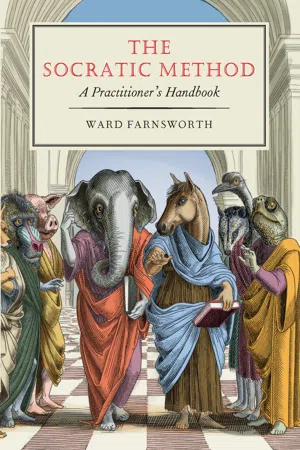
"Remarkable."— Wall Street Journal A thinking person's guide to a better life. Ward Farnsworth explains what the Socratic method is, how it works, and why it matters more than ever in our time. Easy to grasp yet challenging to master, the method will change the way you think about life's big questions. "A wonderful book."—Rebecca Goldstein, author of Plato at the Googleplex. About 2, 500 years ago, Plato wrote a set of dialogues that depict Socrates in conversation. The way Socrates asks questions, and the reasons why, amount to a whole way of thinking. This is the Socratic method—one of humanity's great achievements. More than a technique, the method is an ethic of patience, inquiry, humility, and doubt. It is an aid to better thinking, and a remedy for bad habits of mind, whether in law, politics, the classroom, or tackling life's big questions at the kitchen table. Drawing on hundreds of quotations, this book explains what the Socratic method is and how to use it. Chapters include Socratic Ethics, Ignorance, Testing Principles, and Socrates and the Stoics. Socratic philosophy is still startling after all these years because it is an approach to asking hard questions and chasing after them. It is a route to wisdom and a way of thinking about wisdom. With Farnsworth as your guide, the ideas of Socrates are easier to understand than ever and accessible to anyone.As Farnsworth achieved with The Practicing Stoic and the Farnsworth's Classical English series, ideas of old are made new and vital again. This book is for those coming to philosophy the way Socrates did—as the everyday activity of making sense out of life and how to live it—and for anyone who wants to know what he said about doing that better.
- English
- ePUB (mobile friendly)
- Available on iOS & Android
eBook - ePub
About this book
Trusted by 375,005 students
Access to over 1 million titles for a fair monthly price.
Study more efficiently using our study tools.
Information
Publisher
David R. Godine, PublisherYear
2021Print ISBN
9781567928464
9781567926859
eBook ISBN
9781567926866
1

The Socratic Problem
When we study the method and thought of Socrates, are we talking about the real person or a literary character? The short answer is that nobody knows. In many ways it doesn’t matter, though it’s occasionally relevant to how we think about one issue or another in the dialogues. But the arguments about the question are interesting, so the rest of this chapter will spin them out at more length (though still scratching the surface of the literature on the point, which is endless). The reader who doesn’t care, or who already knows the arguments, or who just wants to get on with the method without a lot of background, can skip this with no harm done.
Let me start by assuming no knowledge of our topic and briefly introducing Socrates and those who have told us about him.
Socrates. Socrates lived from about 470 bc to 399 bc. We know little about his life. Ancient biographers say that his father was a mason and that the young Socrates may have practiced the craft as well. Socrates served in the Athenian army in the Peloponnesian War against Sparta. He was then in his forties. He had a wife, Xanthippe; legend regards her as a shrew who dumped a chamber pot on him when they fought.1 He had three sons. His physical appearance evidently was remarkable and is always described as ugly. He was said to have a potbelly, an odd nose (perhaps snubbed), and eyes with a bulging quality.2 There are jokes about him seeing to the sides like a crab.3
Socrates was widely credited with turning philosophy from the study of nature to hard questions in ordinary life—to have made it, in other words, a fit subject of anyone’s personal interest.4 He wrote nothing of his own but was a familiar and controversial figure in Athens, loved by his students, parodied on the stage, and associated with some famous political villains (we will see more on these points below). At the age of about seventy he was put on trial for impiety and for corrupting the youth of Athens. The jury in the case probably consisted of five hundred male citizens over the age of thirty who were selected by lottery (out of about 20,000 free Athenian men of eligible age). Speeches were made on both sides, and the outcome was determined by a majority vote. Socrates was found guilty and put to death.
Plato. Plato lived from around 427 bc to 347 bc (eighty years). He was born to a prominent Athenian family and had two brothers and a sister. Ancient biographers said that his name at birth was Aristocles, and that “Plato” was a nickname taken from the word platon; it meant “broad” and might have referred to some feature of his body or face. But all this is uncertain. We know almost nothing about Plato personally.
The most elaborate source of information about Plato’s life is a letter he may have written in old age—the so-called Seventh Letter, the authenticity of which is disputed. The letter is addressed to followers of Dion, a former student of Plato’s who became a politician in Syracuse and had recently been assassinated. The letter talks about Plato’s interest in politics as a young man and his travels later in life. It also offers some ideas we will discuss in chapter 12. A generation ago, one scholar conducted a tally of others in the field (“purely for amusement”) and found that thirty-six accepted the Seventh Letter as genuine and fourteen rejected it.5 Some are agnostic. The letter largely consists, at any rate, of narration and discussion of events. It tells us little of Plato himself. On our lack of information about him, Emerson offers this comment:
Great geniuses have the shortest biographies. Their cousins can tell you nothing about them. They lived in their writings, and so their house and street life was trivial and commonplace. If you would know their tastes and complexions, the most admiring of their readers most resembles them. Plato, especially, has no external biography. If he had lover, wife, or children, we hear nothing of them. He ground them all into paint. As a good chimney burns its smoke, so a philosopher converts the value of all his fortunes into his intellectual performances.6
Plato was probably in his teens when he began to associate with Socrates as a student. (His uncle was also part of Socrates’ circle.) He was in his late twenties when Socrates died. Plato went to Sicily and maybe elsewhere for a number of years before coming back to Athens and founding his school, the Academy. His main writings—perhaps his only ones—were his dialogues. He wrote about thirty. He never figures directly in them, though in the Apology he is identified by Socrates as present at his trial. Scholars often suppose that Plato’s earlier dialogues were written before the travels noted above, which they suggest produced a turn in his thinking.7 They wonder whether Plato wrote any of his Socratic dialogues before Socrates died.
Socrates is said to have had an even closer student than Plato: Antisthenes, who reportedly produced more than sixty writings of various lengths, including Socratic dialogues of his own; dialogues of that kind became a little literary genre. None of those writings has survived. We just have testimony from others about what Antisthenes said, and it doesn’t help us much in understanding the historical Socrates. But the ancient historian Diogenes Laertius tells us that Antisthenes and Plato didn’t get along, and their feud provides a rare if uncharitable glance at Plato as a character of his own.
Antisthenes, being about to recite something that he had written, invited [Plato] to be present; and [Plato] having asked what he was going to recite, he said it was an essay on the impropriety of contradicting. “How then,” said Plato, “can you write on this subject?” and then he showed him that he was arguing in a circle. But Antisthenes was annoyed, and composed a dialogue against Plato, which he entitled Sathon; after which they were always enemies to one another.8
“Sathon” rhymed with a longer form of Plato’s name (Platon). It meant “big prick.”9
Xenophon (about 431–354 bc) was an Athenian general, another student of Socrates, and a contemporary of Plato. He wrote long recollections of Socrates, most prominently his Memorabilia. Those recollections are often dialogues between Socrates and others. The Socrates shown by Xenophon is a more earnest and less dazzling moralist than the Socrates of Plato. A quick example:
In answer to the question: what is envy? [Socrates] discovered it to be a certain kind of pain; not certainly the sorrow felt at the misfortunes of a friend or the good fortune of an enemy—that is not envy; but, as he said, “envy is felt by those alone who are annoyed at the successes of their friends.” And when someone or other expressed astonishment that any one friendly to another should be pained at his well-doing, he reminded him of a common tendency in people: when any one is faring ill their sympathies are touched, they rush to the aid of the unfortunate; but when fortune smiles on others, they are somehow pained. “I do not say,” he added, “this could happen to a thoughtful person; but it is no uncommon condition of a silly mind.”10
Xenophon left Athens shortly before Socrates went on trial. He wrote his memoirs of Socrates later—possibly decades later. His memoirs seem to rely in some places on Plato’s dialogues, and at other points they obviously fictionalize. Relying on Xenophon’s recollections of Socrates, like relying on Plato, therefore is risky.11 Whether one of them is more reliable than the other will be considered below.
Aristophanes (about 446–386 bc) wrote comedies (especially The Clouds) in which Socrates is mentioned or appears as a character and is ridiculed. This evidence of the historical Socrates is especially tantalizing because it was written while Socrates was alive, and indeed almost twenty-five years before his death. It’s clear that he was well known in Athens, and in these portrayals we see some of ...
Table of contents
- Also by Ward Farnsworth
- Title Page
- Copyright
- Contents
- Preface
- 1. The Socratic Problem
- 2. Method vs. Doctrine
- 3. Elements of the Method
- 4. The Socratic Function
- 5. Question and Answer
- 6. The Elenchus
- 7. Consistency
- 8. Systole and Diastole
- 9. Analogies
- 10. Socratic Rules for Dialogue
- 11. Ignorance
- 12. Aporia
- 13. Socratic Goods
- 14. Socratic Ethics
- 15. Socrates and the Stoics
- 16. Socrates and the Skeptics
- 17. Finding Principles
- 18. Testing Principles
- Epilogue: Socratic Rules of Engagement
- Translations
- Bibliography
Frequently asked questions
Yes, you can cancel anytime from the Subscription tab in your account settings on the Perlego website. Your subscription will stay active until the end of your current billing period. Learn how to cancel your subscription
No, books cannot be downloaded as external files, such as PDFs, for use outside of Perlego. However, you can download books within the Perlego app for offline reading on mobile or tablet. Learn how to download books offline
Perlego offers two plans: Essential and Complete
- Essential is ideal for learners and professionals who enjoy exploring a wide range of subjects. Access the Essential Library with 800,000+ trusted titles and best-sellers across business, personal growth, and the humanities. Includes unlimited reading time and Standard Read Aloud voice.
- Complete: Perfect for advanced learners and researchers needing full, unrestricted access. Unlock 1.4M+ books across hundreds of subjects, including academic and specialized titles. The Complete Plan also includes advanced features like Premium Read Aloud and Research Assistant.
We are an online textbook subscription service, where you can get access to an entire online library for less than the price of a single book per month. With over 1 million books across 990+ topics, we’ve got you covered! Learn about our mission
Look out for the read-aloud symbol on your next book to see if you can listen to it. The read-aloud tool reads text aloud for you, highlighting the text as it is being read. You can pause it, speed it up and slow it down. Learn more about Read Aloud
Yes! You can use the Perlego app on both iOS and Android devices to read anytime, anywhere — even offline. Perfect for commutes or when you’re on the go.
Please note we cannot support devices running on iOS 13 and Android 7 or earlier. Learn more about using the app
Please note we cannot support devices running on iOS 13 and Android 7 or earlier. Learn more about using the app
Yes, you can access The Socratic Method by Ward Farnsworth in PDF and/or ePUB format, as well as other popular books in Philosophy & Arbitration, Negotiation & Mediation in Law. We have over one million books available in our catalogue for you to explore.