eBook - ePub
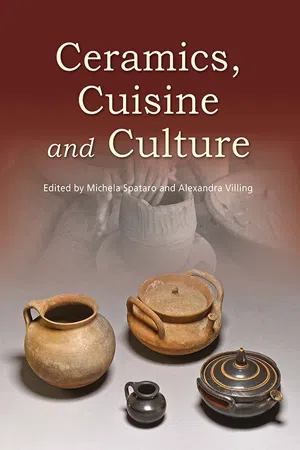
Ceramics, Cuisine and Culture
The archaeology and science of kitchen pottery in the ancient Mediterranean world
- 304 pages
- English
- ePUB (mobile friendly)
- Available on iOS & Android
eBook - ePub
Ceramics, Cuisine and Culture
The archaeology and science of kitchen pottery in the ancient Mediterranean world
About this book
The 23 papers presented here are the product of the interdisciplinary exchange of ideas and approaches to the study of kitchen pottery between archaeologists, material scientists, historians and ethnoarchaeologists. They aim to set a vital but long-neglected category of evidence in its wider social, political and economic contexts. Structured around main themes concerning technical aspects of pottery production; cooking as socio-economic practice; and changing tastes, culinary identities and cross-cultural encounters, a range of social economic and technological models are discussed on the basis of insights gained from the study of kitchen pottery production, use and evolution. Much discussion and work in the last decade has focussed on technical and social aspects of coarse ware and in particular kitchen ware. The chapters in this volume contribute to this debate, moving kitchen pottery beyond the Binfordian 'technomic' category and embracing a wider view, linking processualism, ceramic-ecology, behavioural schools, and ethnoarchaeology to research on historical developments and cultural transformations covering a broad geographical area of the Mediterranean region and spanning a long chronological sequence.
Information
Subtopic
Ancient HistoryIndex
History1
INVESTIGATING CERAMICS, CUISINE AND CULTURE – PAST, PRESENT AND FUTURE
“When I wish to mention a ‘cooking pot’ [chytra] to you, shall I say ‘cooking pot’?
Or: hollow-bodied jar formed by the whirling potter’s wheel, moulded of earth, baked in another chamber sprung from mother earth,
and pregnant with the succulent stewed forms
of a milk-nursed, newborn flock?”
of a milk-nursed, newborn flock?”
(Antiphanes, Aphrodisios fr. 55 PCG, apud Athenaios 449b)
1. Food, foodways and pottery: setting the scene
Food is fundamental to human existence. Much effort and ingenuity goes into its procurement and preparation; access to it and its consumption are central factors in socioeconomic relations; and foodways (a group’s traditional food habits, encompassing feeling, thinking and behaviour towards food) and cuisine (the art of cooking) are deeply linked to social and cultural identity. The introduction of cooking – or rather food processing, often involving heat – was a major step in human evolution in both biological and social terms. Tools such as cooking pots, which enabled boiling to make plants foods digestible and maximise nutritional value, played a key role in this. Cooking practices and food processing technology are central to the social matrix of life.
Food, foodways, cuisine and commensality are rightly beginning to occupy an important space in scholarly research1 – as are the utensils they require, notably cooking pots and other utilitarian vessels, often ceramic, related to food production, storage, preparation and consumption. Utilitarian ceramics balance the picture gained from a more traditional focus on high-value, high-visibility or more “artistic” élite goods and monuments. Even the humblest cooking pot, grinding bowl or storage jar can be a vital piece of socio-historical evidence: a decorated storage jar may tell of the value accorded to certain foods, its presence or absence indicating differentiated access to food and social hierarchies; the scorch marks on a cooking pot or the remains of cooking installations can be tell-tale marks of cultural identity or level of economic wealth; a proliferation of cooking and serving implements may attest social stratification and the development of an “haute cuisine”; a new shape of cooking pot may speak of cross-cultural contact or migration and concomitant social change; shapes and fabric choices tell us of craft specialisation and of the technical, cultural and symbolic practices that shape a society’s craft production.
The present volume aims to capture the richness of research into the topic of ceramics, cuisine and culture by presenting the latest research across different disciplines, regions and periods. Covering over three millennia of Mediterranean history, from the Bronze Age through to the Roman period and up the modern day, its contributions range widely, from Portugal to the Balearic Islands, France, Italy, the Aegean islands and mainland Greece, Cyprus and the southern Levant (Fig. 1.1). Yet they all share a common aim: to tease out what kitchen wares can reveal about past and present societies and their development, by utilising, combining and pushing the boundaries of the diverse investigative tools available today: from typological, functional and contextual studies and the evaluation of written sources, to scientific analyses, archaeobotany and archaeozoology, and experimental and ethnographic archaeology. Where the book differs from other publications is the conscious effort made to integrate the results of scientific analyses with more “traditional” sources of evidence, such as textual studies, to foster a lasting dialogue and collaboration across disciplinary boundaries particularly in scholarship on early historical periods.2

Figure 1.1. The Mediterranean Sea, main regions and sites discussed in the present volume. Drawing Kate Morton, ©The Trustees of the British Museum.

Figure 1.2. Cooking pots made from pottery are ubiquitous in many world cultures, often with similar functional characeristics in culturally specific rendering: tripod cooking pots, left, from China, with decorative features based on metal prototypes, 2800–2000 BC (Harvard, Arthur M. Sackler Museum 2006.170.106, photograph © Harvard Art Museums, Arthur M. Sackler Museum); centre, from Cyprus, tripod cooking amphora, 1900–1800 BC (British Museum 1884,1210.63, photograph © The Trustees of the British Museum); right, from Nigeria, late 20th century AD (British Museum AOA 2011,2052.40, photograph © The Trustees of the British Museum).

Figure 1.3. Blowing onto the embers: cooking pots placed above the fire on three supports were common in the first millennium BC Mediterranean world. Phoenician (?) terracotta figurine, 7th–6th century BC (Paris, Musée du Louvre AO 29576. Photo © RMN Grand Palais (Musée du Louvre)/Franck Raux).

Figure 1.4. Elaborate sauces prepared in pottery grinding bowls (mortaria) became emblematic for the conspicuous consumption of luxury foods that was critically debated in Classical Greece: a series of 5th–4th century BC terracotta figurines parodies the practice by showing monkeys with mortars and pestles (Tübingen, Museum Schloß Hohentübingen/Antikensammlung, inv. 5703. Photograph Museum).
Our approach ultimately takes its inspiration from the New (processualist) Archaeology, which criticised traditional archaeology as mere data collection (e.g. Binford 1983), and called for a more reflexive attitude (“self-awareness ….of what we are doing” [Snodgrass 1985, 34]). Quantitative methods, middle-range theory (the link between human behaviour and artefacts) and cognitive archaeology – bridging the gap between archaeology and anthropology (see Renfrew 1980) – were influential particularly in prehistoric archaeology. Prehistorians had, of course, long paid attention to coarse pottery artefacts as type-fossils and chronological markers in archaeological assemblages (e.g. Petrie 1891; Gillam 1957; Fulford 1975). In contrast to Shepard (1976), who focussed mainly on context and physical properties, from the 1980s attention increasingly turned to pottery function and use, which previously had been little considered (Rice 1990, 1). Binford’s category of “technomic” “artifacts [that] have their primary functional context in coping with the physical environment, and [for which] variability is explainable in ecological terms” (Rice 1990, 3) became widely used to interpret cooking vessels. In combination with increasingly social perspectives, notably the interest in “coarse” utilitarian ceramics as reflections of activities that are essential daily aspects of society such as preparing, cooking, sharing and consuming food (e.g. Schiffer 1990), cooking vessels developed into valuable tools of investigation.
Scholarship of the ancient world has been affected by these developments to varying degrees. Aegean Bronze Age archaeology welcomed processualist ideas, in particular the emphasis on processes rather than events (Snodgrass 1985, 37), alongside new sociological approaches (e.g. Mee and Renard 2007; Karageorghis and Kouka 2011), as did scholarship on contact zones of the Mediterranean world (e.g. Dietler 2010), where textual records are more elusive. Within Classical archaeology, the richness of the archaeological record offered great opportunities for processual interpretation (Dyson 1981; Snodgrass 1985). Yet with a plethora of textual records and a traditional art historical emphasis, the application of new approaches and methods, including also scientific research, remained limited. In pottery studies, typological and iconographic analysis of fine wares still prevail and kitchen pottery or cooking installations remain marginalised.3 However, utilitarian ceramic wares4 can be unique tools for investigating social, economic and political aspects of the past also (and particularly) in “historical” periods, where they offer valuable additional evidence for a deeper understanding of complex social and cultural processes behind fast-paced political and historical change. Ubiquitous in the archaeological record and bound into social competition in different ways from table wares, the more publicly visible tools of conspicuous consumption, their direct link to food preparation means that they allow for a socially and temporally broader and more inclusive picture than many other, rarer and more high-profile objects. They can provide insights into key areas of behaviour related to cultural and social identity and illuminate topics as diverse as social identities, networks and hierarchies, economic and ecological developments, trade, migration and cultural change, craft specialisation, knowledge-exchange and technical innovation (cf. e.g. Rodríguez-Alegría and Graff 2012).
Indeed, as the chapters in the present volume illustrate, new research, particularly with the help of scientific techniques, shows that we have long been misled by the humble appearance of “coarse wares”: “plain” does not necessarily equal simple. Manufacture of utilitarian vessels was often sophisticated, involving diverse processes of technical and social choices, and vessels could have complex life cycles and travel considerable distances. Potters may have devised special fabrics for a pot’s intended function, or continued to use fabrics of traditional cultural or symbolic significance. Traders carried specialised kitchen wares to far-flung places, along complex networks of trade and contact, to consumers attracted by a ware’s quality, actual or reputational.
Pottery was the favoured material for many ancient kitchen vessels (Fig. 1.2), even if other materials that are less commonly preserved in the archaeological record, such as wood or metal, certainly also played a role (such as in Frankish practice: see Donnelly this volume). This was not only because of pottery’s relative cheapness and accessibility, but also because of the intrinsic properties of clay vessels, such as low maintenance requirements and special suitability for certain types of cooking and storing food (Ionas 2000, 124; cf. also Skibo 1992, 28–29), which were clearly recognised already in antiquity. Hence Galen in his On the Properties of Foodstuffs (489–490) notes that bread is best baked in an oven, klibanos (clibanus), made of clay, where it is baked right through,5 while Anthimus (see Donnelly this volume) specifically recommends ceramic pots for making stews.6 Porous clay water jars to this day are popular for keeping water cool (Kyriakopoulos this volume). In fact, pottery played a role in all stages of alimentation: from food production (e.g. beehives,7 dormice jars – see Meulemans this volume) and storage (e.g. pithoi, water storage jars, amphorae for wine, oil and many other things) to the preparation (cooking, frying, parching…) and consumption of meals (cups, bowls, platters…).8 New research that utilises and integrates different approaches – scientific, archaeological, anthropological, sociological, historical – begins to provide a considered, if complex, picture of the role of household pottery within social, economic, cultural and technological praxis and exchange, and in relation to wider contexts such as environmental conditions and subsistence practices.9
In this first chapter we aim to set the scene for what follows – introducing some of the key ideas and methods that have been, are, or could be applied to the study of cooking ware and culinary practice, with particular reference to the ancient Mediterranean world, and to the chapters assembled in this volume.
2. What is a cooking pot?
When ceramics first appear in Neolithic Europe, it is difficult to identify a “cooking pot” as such. No relationship between shape, fabric and function has yet been traced (e.g. Spataro 2006; Tsirtsoni and Yiouni 2002; Vieugué et al. 2008). Cooking ware from the Neolithic onwards has always been equated with so-called coarse ware, in contrast to finer, often painted or slipped ware, but the use of coarse ware and early slipped monochrome or painted pots has rarely been studied in detail. However, recent investigations of charred food crusts on a small number of pots attributed to the Late Mesolithic Ertebølle and Neolithic Funnel Beaker cultures at the coastal site of Neustadt (Germany) have yielded evidence not only for meat fat and fish, but also for spice, early indications for a relatively sophisticated cuisine (Saul et al. 2013). It is likely that mo...
Table of contents
- Cover
- Title Page
- Copyright
- Table of Contents
- Preface
- List of contributors
- Chapter 1: Investigating ceramics, cuisine and culture – past, present and future
- Part I: How to make a perfect cooking pot: technical choices between tradition and innovation
- Part II: Lifting the lid on ancient cuisine: understanding cooking as socio-economic practice
- Part III: New pots, new recipes? Changing tastes, culinary identities and cross-cultural encounters
- Postscript: Looking beyond antiquity
Trusted by 375,005 students
Access to over 1.5 million titles for a fair monthly price.
Study more efficiently using our study tools.
Frequently asked questions
Yes, you can cancel anytime from the Subscription tab in your account settings on the Perlego website. Your subscription will stay active until the end of your current billing period. Learn how to cancel your subscription
No, books cannot be downloaded as external files, such as PDFs, for use outside of Perlego. However, you can download books within the Perlego app for offline reading on mobile or tablet. Learn how to download books offline
Perlego offers two plans: Essential and Complete
- Essential is ideal for learners and professionals who enjoy exploring a wide range of subjects. Access the Essential Library with 800,000+ trusted titles and best-sellers across business, personal growth, and the humanities. Includes unlimited reading time and Standard Read Aloud voice.
- Complete: Perfect for advanced learners and researchers needing full, unrestricted access. Unlock 1.5M+ books across hundreds of subjects, including academic and specialized titles. The Complete Plan also includes advanced features like Premium Read Aloud and Research Assistant.
We are an online textbook subscription service, where you can get access to an entire online library for less than the price of a single book per month. With over 1.5 million books across 990+ topics, we’ve got you covered! Learn about our mission
Look out for the read-aloud symbol on your next book to see if you can listen to it. The read-aloud tool reads text aloud for you, highlighting the text as it is being read. You can pause it, speed it up and slow it down. Learn more about Read Aloud
Yes! You can use the Perlego app on both iOS and Android devices to read anytime, anywhere — even offline. Perfect for commutes or when you’re on the go.
Please note we cannot support devices running on iOS 13 and Android 7 or earlier. Learn more about using the app
Please note we cannot support devices running on iOS 13 and Android 7 or earlier. Learn more about using the app
Yes, you can access Ceramics, Cuisine and Culture by Michela Spataro, Alexandra Villing, Michela Spataro,Alexandra Villing in PDF and/or ePUB format, as well as other popular books in History & Ancient History. We have over 1.5 million books available in our catalogue for you to explore.