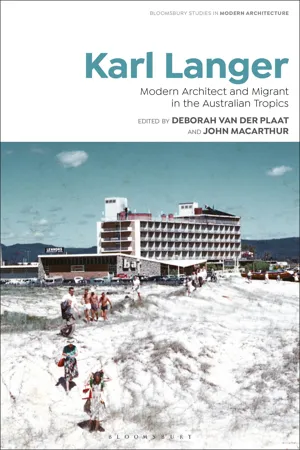
Despite a European training and an early career working with Peter Behrens, a migration from Vienna to the Australian state of Queensland positioned the architect Karl Langer (1903-1969) at the very edge of both European and Australian modernism. Confronted by tropical heat and glare, the economics of affordable housing, fiercely proud and regional architectural practices, and a suspicion of the foreign, Langer moulded the European language of international modernism to the unique climatic and social conditions of tropical Australia.
This book will tell Langer's story through a series of edited essays focused on key themes and projects. Published as part of the Bloomsbury Studies in Modern Architecture series, which brings to light the work of significant yet overlooked modernist architects, it is both an examination of an architect's work and international legacy, and also a case study in the trans-global dissemination of design ideas.
Studying the architect's built and proposed work, both regional and metropolitan, the scale and reach of Langer's practice will be considered for the first time, showing how, given his continued influence on the contemporary culture of tropical design, Langer has been unjustly ignored by the historiography of both Australian and Modernist architecture to date.
- 304 pages
- English
- ePUB (mobile friendly)
- Available on iOS & Android
eBook - ePub
About this book
Information
1INTRODUCTION
Modern and Migrant Architect
Deborah van der Plaat and John Macarthur
In 1939, two architects made the decision to leave Austria, which had been occupied by Nazi Germany in the previous year. Friends and colleagues, the two were the same age (born in 1903), had studied at the Vienna Academy of Fine Arts, had worked for prominent avant-garde practices in Vienna and collaborated on a number of architectural competitions together. Growing anti-Semitism and an intolerance for the European avant-garde under the new regime also saw opportunities for the development of architectural modernism dry up. As the architect and historian August Sarnitz has argued in Architecture in Vienna (1998): ‘when one attempts nowadays to offer an interpretation of the effect of emigration from Vienna had on culture, it can be said for the field of architecture that practically the entire artistic avant-garde was compelled to leave the country involuntarily’.1 The two architects fled the city of Vienna in search of safer and more productive environs.
The first architect, Viktor David Grünbaum, emigrated to America with his wife Alice Kardos. He arrived in New York unable to speak English but quickly secured work as a draftsman. With the help of a network of German-speaking migrants, Grünbaum quickly found work as an architect, designing stores and houses. Receiving commendations for the design of the Lederer leather-goods boutique on Fifth Avenue in New York, he went on to design Ciro’s on Fifth Avenue, Steckler’s on Broadway, Paris Decorators on the Bronx Concourse and a series of branches for the clothing chain Grayson’s. In 1941, he moved to Los Angeles, remarried and anglicized his name. In 1951, he founded Victor Gruen Associates.2

FIGURE 1.2 Dr Karl Langer, Brisbane, August 1950. Shown before town plan, possibly Mackay and notes in hand. Photographer: Queensland Newspapers Pty Ltd. State Library of Queensland, Negative number #196738.
The second, Karl Langer and his wife – the art historian and critic Gertrude Langer (née Fröschel) – travelled instead to Australia. The couple were attracted by the filmmaker and travel writer Colin Ross’s idea of Australia as Der unvollendete Kontinent (the ‘Unfinished Continent’) open to cultural innovation and ripe for improvement (see Chapter 2).3 Arriving in Sydney in 1939, they were met with much press and publicity (see Chapter 3). Yet the road to employment was difficult to negotiate. Unable to find work, the Langers moved to sub-tropical Brisbane that same year, some 467 miles (751 km) north of Sydney where Langer secured work with the Brisbane-based practice Cook and Kerrison before moving onto Queensland Rail where he worked during the war years.
Despite their different destinations, Langer and Grünbaum (Gruen) remained in contact, corresponding and exchanging Christmas cards in the 1950s, while Langer occasionally drew on Gruen’s ideas in projects for Brisbane (see Chapter 7). Despite the common elements of their early training and careers, Gruen and Langer went on to occupy very different places in the historiography of modern architecture. Gruen became a household name associated with the invention of the suburban shopping mall in America and the urban revitalisation of a number of American cities, including Fort Worth, Texas; Kalamazoo, Michigan (1958); and Fresno, California (1965) and now occupies an important slot in the historiography of modern architecture.4 Langer, on the other hand, is largely unknown. In Australian architectural culture, Langer has been largely an emblematic figure, one of the many European architects who are given small parts in the story of the arrival of international modernism to Australian shores. Even in Queensland where he is much honoured in reputation, information on Langer is scarce and hidden in archives. The generation of his students have largely passed on and many of his best buildings have been demolished or greatly altered. This book is the first attempt to represent the breadth of Langer’s work and thought – and its value. We aim not only to introduce Langer’s work to the world, but also to substantiate the important place he holds in Australia.
The historiography of modernism: European and Australian
Migration has played an important role in the idea of International Modernism and its shift from German-speaking Europe to America following the Second World War. As Rebecca Hawcroft has recently argued in The Other Moderns (2017), Walter Gropius’ migration to America is explained by Siegfried Giedion in the context of the emigration of the ‘most advanced scientists, humanists and artists who during the mid-thirties had a direct impact in every domain of science and culture, from modern aesthetics to nuclear physics’.5 It appears, however, not all migrations are equal. Unlike Gruen (and Gropius), the Langers migrated to Australia and in doing so placed themselves geographically at the very margins of what the historiography on architectural modernism has considered. Despite claims to being ‘international’, histories of modernism in architecture have focused primarily on its roots in northern Europe and its spread to North America and Japan in the war and post-war years.6 When Australia is mentioned by these survey studies, it is not to appreciate the ‘modernism’ of an Australian or Australian-based architect but rather to demonstrate the growing international reach of the architectural competition and the European or American architect. As Macarena de la Vega de León has demonstrated in ‘A Tale of Inconsistency’ (2018), the presence of Australia in histories of modern architecture in the 1960s and 1970s was largely restricted to ‘ “just” the Sydney Opera House’.7 Won by Danish architect Jørn Utzon, the project shone the spotlight of European modernism and its influence briefly on Australia. This, however, was quickly extinguished by an unsympathetic Australian bureaucracy focused on budget blowouts and other practicalities such as function and performance as opposed to artistic expression and modern aesthetics.8 Recalling the nation’s earlier experimentation with the international competition for the Canberra plan (1912), won by the American architects Walter Burley and Marion Mahony Griffin, bureaucratic interference not only resulted in the resignation of the winning architects from both proposals, but cast the Australian public as intolerant of the modernist project.9 Ironically, Langer played a formative role in the Opera House story in that he selected the site and submitted a competition entry.10 This part of the story, however, has remained untold.
With a shift in interest from universal to regional architectural languages and an expanding geographical focus, Australia grew in popularity with writers of mainstream modernism from the 1980s on.11 Queensland architecture, with its local architectural traditions of ‘timber and tin’ and lightweight construction, was successfully translated by a generation of local architects into a idiom that sat comfortably under the concept of ‘critical regionalism’.12 Langer’s work, which retained an architectural language that was not only modernist but distinctly European, placed him also outside these new interests. It is only in the early twenty-first century, in parallel with the popular nostalgia for ‘mid-century modernism’, that a properly scholarly account of Langer has been possible.13
Alongside European travel by Australian architects, modern periodicals, books and exhibitions, the European migrant was as an important catalyst of modernism in Australia.14 Yet despite this acknowledgment, surveys of Australian modernism, as Hawcroft has suggested, have focused largely on two individuals: Chinese born, German national and Swiss-educated Frederick Romberg (1913–1992), who arrived in Australia in 1938 and who worked out of Melbourne; and Viennese born but American-trained Harry Seidler (1923–2006), who arrived in Sydney on 20 June 1948. This pattern, Hawcroft argued, was first set in place when Robin Boyd, in Australia’s Home (1952) identified Romberg and Seidler as Australia’s only European designers, aside from a brief mention of Fritz Janeba (1905–1983). J.M. Freeland, in Architecture in Australia (1968) and Donal...
Table of contents
- Cover
- Half-Title Page
- Series Page
- Title Page
- Contents
- List of Illustrations
- Series Preface
- Notes on Contributors
- 1 INTRODUCTION: Modern and Migrant Architect
- 2 VIENNA: Karl and Gertrude
- 3 ‘AUSTRALIA IS OUR FATE!’
- 4 BEND LIKE BAMBOO: Always Bounce Back
- 5 THE SPELL OF THE SUNNY SOUTH, THE URGE FOR ‘LIGHT, SUN AND AIR’: The ‘Human Aspect’ and Other Ideas in Langer’s Australian Writings (1944–69)
- 6 BRIDGING CONTINENTS: Karl Langer’s Contributions to Housing
- 7 MAN ABOUT TOWN
- 8 A TOUCH OF VIENNA, A PINCH OF AMERICA AND A WHIFF OF EXOTICISM: Karl Langer’s Architecture for Leisure and Lifestyle in Australia
- 9 A LEAGUE OF HIS OWN: Karl Langer’s Landscape Australia
- ‘Sub-Tropical Housing’ Plates
- Bibliography
- Index
- Copyright
Trusted by 375,005 students
Access to over 1.5 million titles for a fair monthly price.
Study more efficiently using our study tools.
Frequently asked questions
Yes, you can cancel anytime from the Subscription tab in your account settings on the Perlego website. Your subscription will stay active until the end of your current billing period. Learn how to cancel your subscription
No, books cannot be downloaded as external files, such as PDFs, for use outside of Perlego. However, you can download books within the Perlego app for offline reading on mobile or tablet. Learn how to download books offline
Perlego offers two plans: Essential and Complete
- Essential is ideal for learners and professionals who enjoy exploring a wide range of subjects. Access the Essential Library with 800,000+ trusted titles and best-sellers across business, personal growth, and the humanities. Includes unlimited reading time and Standard Read Aloud voice.
- Complete: Perfect for advanced learners and researchers needing full, unrestricted access. Unlock 1.5M+ books across hundreds of subjects, including academic and specialized titles. The Complete Plan also includes advanced features like Premium Read Aloud and Research Assistant.
We are an online textbook subscription service, where you can get access to an entire online library for less than the price of a single book per month. With over 1.5 million books across 990+ topics, we’ve got you covered! Learn about our mission
Look out for the read-aloud symbol on your next book to see if you can listen to it. The read-aloud tool reads text aloud for you, highlighting the text as it is being read. You can pause it, speed it up and slow it down. Learn more about Read Aloud
Yes! You can use the Perlego app on both iOS and Android devices to read anytime, anywhere — even offline. Perfect for commutes or when you’re on the go.
Please note we cannot support devices running on iOS 13 and Android 7 or earlier. Learn more about using the app
Please note we cannot support devices running on iOS 13 and Android 7 or earlier. Learn more about using the app
Yes, you can access Karl Langer by in PDF and/or ePUB format, as well as other popular books in Architecture & Architecture Essays & Monographs. We have over 1.5 million books available in our catalogue for you to explore.