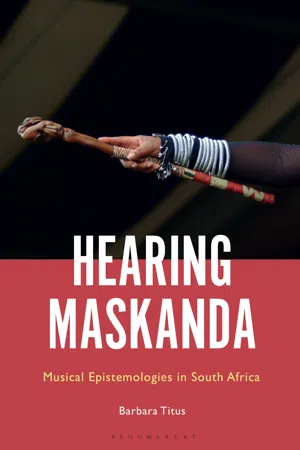
Hearing Maskanda outlines how people make sense of their world through practicing and hearing maskanda music in South Africa. Having emerged in response to the experience of forced labour migration in the early 20th century, maskanda continues to straddle a wide range of cultural and musical universes. Maskanda musicians reground ideas, (hi)stories, norms, speech and beliefs that have been uprooted in centuries of colonial and apartheid rule by using specific musical textures, vocalities and idioms.
With an autoethnographic approach of how she came to understand and participate in maskanda, Titus indicates some instances where her acts of knowledge formation confronted, bridged or invaded those of other maskanda participants. Thus, the book not only aims to demonstrate the epistemic importance of music and aurality but also the performative and creative dimension of academic epistemic approaches such as ethnography, historiography and music analysis, that aim towards conceptualization and (visual) representation. In doing so, the book unearths the colonialist potential of knowledge formation at large and disrupts modes of thinking and (academic) research that are globally normative.
- 280 pages
- English
- ePUB (mobile friendly)
- Available on iOS & Android
eBook - ePub
About this book
Trusted by 375,005 students
Access to over 1.5 million titles for a fair monthly price.
Study more efficiently using our study tools.
Information
Part I
Maskanda in Colonial, Apartheid and Post-Apartheid South Africa
1
Maskanda’s Colonial, Apartheid and Post-Apartheid Presence
‘Sab’ Inganono’ (Afraid of the Cannon) is ‘an age-old Zulu war song’ (Clegg 2009). In the innumerable struggles over land documented in South Africa’s history, such as the Battle of the Blood River (1838), the Battle of Isandlwana (1879) and the Bambatha Rebellion (1906), cannons coerced warriors from various camps to fight or flee. The song produces and presents the various attitudes, emotions and states of mind that accompanied these acts: fear, aggression, interrogation of each other’s position. At present, the song is most readily available in two recent maskanda renditions, performed by white Zulu maskandi, Jonathan (Johnny) Clegg a.k.a. Sikeyi (1953–2019) and David Jenkins a.k.a. Qadasi (b. 1992). The immediate presence of singing voices and antiphonal backing choruses, virtuosic guitar picking, synchronized regimental ingoma dance routines and assertive poetic statements in spoken self-praise summon the circumstances and conditions of maskanda’s emergence, dis/placement and transculturation. This song is about itself. For it was (and is) the cannons featuring in this song that managed to impose the controlling ideologies of difference and segregation as well as to enforce the massive labour migration of the late nineteenth and early twentieth centuries that gave rise to maskanda practice. Both this migration and these ideologies unabatedly govern South African cohabitation on many levels in the early twenty-first century. Past and present cannot easily be separated.
White maskandi
Both Clegg and Jenkins immersed themselves fully in Zulu culture from a young age onwards. Clegg recalls his participation in Bhaca dance sessions as a life-changing experience at the age of fifteen (Clegg 2009). He joined the Nala age regiment of the Zulu king Zwelethini as a Shameni dancer and continued to participate in isiShameni and umzansi dance and street guitar song next to his successful career as an internationally acclaimed pop artist until the very end of his life. Several Zulu South Africans stated they learned about their own culture through Johnny Clegg (Ngwekazi 2009; Nkabinde 2009). Jenkins developed a passionate interest in Zulu culture at the age of nine, initially through the TV series Shaka Zulu (Faure 1986).1 Thus, he began his collection of books, traditional clothing, beadwork and music. He was given a guitar at the age of twelve and taught himself maskanda with maskandi Phuzekhemisi as his musical example (Jenkins 2013a). Both Clegg and Jenkins are fluent in the Zulu language and present themselves as members of the Zulu community in their language, music and clothing (Figure 1.1). The fact that they have grown up in/with the culture they say they represent is often quoted as a reason by musickers (Nkabinde 2009; Ntuli 2009) for taking them seriously as Zulu musicians.

Figure 1.1 David Jenkins (a.k.a. Qadasi) (left) with his friend and mentor Maqhinga Radebe (right), 2015. Photograph by Amy Jenkins. Reproduced with kind permission.
It is highly problematic to start a monograph about a musical practice known as a Zulu way of expression with the igamas of two white Zulu South Africans. The participation of white people in black performance practices that are so closely intertwined with black life experiences during colonial and apartheid eras is profoundly meaningful and carries a range of tensions. It triggers long and consistent histories of white appropriations of black cultural capital, which are and have been present anywhere in the world, but which have been sanctioned and encouraged extensively in South Africa in particular. Nevertheless, I have decided to employ the maskanda performances of Clegg and Jenkins as modes of telling the story of maskanda’s emergence in this chapter and to situate them at the start of this book. I state three reasons for doing this.
Firstly, their participation in maskanda practice, although far more long-standing and intensive than mine, unearths similar issues as to my participation, which will be addressed throughout this book. There are inequalities on almost every level of interaction with those maskanda musickers who still experience in their daily lives the circumstances from which maskanda emerged: inequalities in social status, financial remuneration, education, mobility, available means of expression, self-confidence, etc. Inevitably, this leads to acts of white appropriation of black musical and cultural agency, which audibly and visibly surfaces in performance, aesthetic judgements and academic research. These appropriations need to be foregrounded and critically discussed in order to facilitate a dialogue about the dynamics of these processes and an honest acknowledgement of everyone’s subject position in performance and conceptual discourses that are so closely intertwined.
Secondly, I intend to resist the representation of maskanda as a parochial Zulu artefact. Although Clegg’s and Jenkins’s Zuluness is beyond doubt for the Zulu South Africans I talked to, it is important to emphasize that maskanda is no longer only practised and presented as the musical equivalent of an apartheid homeland. ‘Sab’ Inganono’ is a song that invites many ways of hearing it, and allows for associations with many musics from within and from outside Africa that account for maskanda’s early and current syncretism. Thus, I emphatically aim to foreground not only Clegg’s and Jenkins’s aural experiences and the way they use their bodies and voices to present their igama, but also the comments, interpretations and critiques of those maskanda musickers who engage with the igamas of these two ‘white Zulus’.
Thirdly, the renderings that Clegg and Jenkins present are in many ways emblematic for the (different) ways in which maskanda is created, experienced and appreciated in present-day South Africa, possibly because they need to assert their Zulu status as white maskandi. In a way, the emblematic character of their renderings says something about their position as relatively privileged maskandi, a privilege that enables them to engage themselves with conserving the genre and with the genre’s orientation to musical practices elsewhere in the world.
I discuss four renderings of ‘Sab’ Inganono’, two by David Jenkins – a live performance on stage in Dublin, Ireland from 2013 (Jenkins and Band 2013) and his 2011 release of the song on his album Child of Africa / Ingane yase Afrika (Jenkins and Band 2011)2 – and two by Johnny Clegg. One of them has been released on his DVD My Favourite Zulu Street Guitar Songs, set in the famous Mai Mai Market in Johannesburg where many street musicians performed and competed with each other during apartheid times (Clegg and Band 2007: 02’33’’). A slightly different non-staged version of this rendering is available and widely accessed on YouTube (Clegg 2011). Like all maskandi, Clegg and Jenkins re-‘read’ and appropriate an existing ‘text’ that has verbal, musical and performance-based dimensions. By analysing what they do – with my own culturally situated eurogenic tools – I participate in this process of re-reading and appropriation.
Who is talking here? This question inevitably surfaces when white Zulu maskandi articulate the lyrics of an age-old Zulu war song (Figure 1.2). Multiple voices are speaking simultaneously in this song. ‘He’ is afraid of the cannon and is running away, but ‘we’ are coming with our warriors in their thousands. These multiple voices represent opposite affective attitudes towards the sound of the cannons with opposite movements: fear (through flight) and aggression (through attack). Whether the protagonist is described as a distant third person (‘he’) or addressed directly as a second person (‘you’) remains undecided, since the verb conjugation with prefix u- can refer to both the second and third person singular, and the subject is not articulated, apart from the exclamation we that could – but does not have to – be short for wena (‘you’). There is a multivocality not only in manner of address but also in singular and plural addressees. Translator Ignatia Madalane observed that through ‘Sab’ Inganono’’s distinctiveness as a war cry song, ‘the “he” in the song can refer to any man who is afraid of going to war or battle. Therefore, though it is singular, it can refer to anyone or any man’ (Madalane 2016b). Both instances of undecidedness are features of the Zulu language at large and are functional to this specific statement, enhancing its immediacy in the here and now (with third and second person being the same) and enhancing its general validity (with individual and general addressees). These instances of undecidedness were substantiated by the various translations I heard for the sentence ‘Ubalekelani?’. Madalane observed the confrontational manner of the inquisitive tense: ‘Why are you running away?’ (2016b). In other sources, this confrontational tone has been incorporated in a stating rather than inquisitive translation: ‘Don’t run from the gun’ (Mchunu 1979).

Figure 1.2 ‘Sab’ Inganono’. Lyrics transcribed and translated by Ignatia Madalane and Elias Nxumalo with kind permission from David Jenkins.
The ‘Sab’ Inganono’ lyrics refer to the sound rather than the sight of the cannons and the warriors in their thousands, enhancing the immediacy of the statement: ‘even if you don’t see them, they are here: hear!’. Crucial for the focus on the sound rather than the sight of the battle is the interpretation of the stem ‘-duma’ which refers to being noisy as well as being (in)famous, and literally means (to) thunder. Thus, the reference to warriors in their thousands could refer to Zulu armies with thunderous impi (warrior) regiments as well as to British or Boer armies with thunderous cannons. Madalane observed that those who flee and those who fight can be understood to belong to the same (Zulu) camp against the British or Boers, ‘confronting the coward … members of the team about their cowardice’,3 or they can be understood to belong to opposing (Zulu) camps, one with cannons (possibly siding with the British or Boers),4 and another without (running from the cannons). Deliberate textual obscurities are abundant in Zulu poetry, including maskanda practice. Often the lyrics are directed towards those who have witnessed the expressed event themselves, so that only members of the community will understand what is being said. This further enhances the immediacy of the event ‘as if you were/are there’.
Thus, the igama is cast in the lyrics, dance, dress and music simultaneously. This multimodality of the statement illustrates how ‘the physical experience of the body … sustains a particular view of society’ (Mary Douglas [1970] 1996: 69 quoted in Clegg 1982: 13). This sustenance of ‘a particular view of society’ acquires a specific urgency in Jenkins and Clegg being ‘white Zulus’, a subject position that crystalizes from their stage presence in embodiment, dance and dress, but also from the sound composition and the lyrics they identify with. Their performances could be described as acts of Bhabhaesque mimicry. They claim cultural authority by appropriating (partly colonially constructed) Zulu modes of performance and expression (mimicry as strategy of colonial authority), they erect structures of cultural discrimination through this appropriation (mimicry as discriminatory knowledge) and they undermine, respell and queer these authorities and structures at the same time (mimicry as menace to this same colonial authority).
The implications of their performances that confirm or reproduce colonial authority became clear to me only gradually through Ignatia Madalane’s explanation of the subject positions in the war song, and how these are complicated by being sung by a white man. By speaking in the Zulu language, the song’s protagonist likely converses with Zulu men, and this leaves room for their self-representation ‘as the colonizer with his “magical negro” warriors’ (Madalane 2016c). The stereotype of the ‘magical negro’ as a ‘lower-class, uneducated, and magical black character who transforms disheveled, uncultured, or broken white characters into competent people’ (Hughey 2009: 543) has been prominent in centuries of literary imagination and decades of globally distributed US cinema. ‘“Magical negro” films thus … empower normalized and hegemonic forms of whiteness, and glorify powerful black characters in so long as they are placed in racially subservient positions’ (Hughey 2009: 543). In South Africa, this trope has acquired a compelling historical dimension through the many examples of ‘blacks who … revolted against the leader’ (Madalane 2016c) and sided with the whites. Clegg mentions the example of the Chunu and the Tembu people absconding from the Zulu state (1981: 3), to be discussed in Chapter 2. All battles with cannons that ‘Sab’ Inganono’ potentially reproduces, ranging from the Battle of the Blood River in 1838 to the Bambatha Rebellion in 1906, feature such allegiances that always thrived on black subservience to a white cause. In this context, Jenkins’s performance facilitates a very specific third scenario of the various subject positions in ‘Sab’ Inganono’ outlined earlier by Madalane: ‘our [colonial] warriors [with thunderous cannons] come in their thousands, and why are you [“magical negro” belonging to our camp] running away from them?’ (Madalane 2016c).
The appearance of Jenkins’s band on the Dublin stage can be seen to reinforce the ‘magical negro’ stereotype. Jenkins’s maskandi name Qadasi means ‘white person’. This indicates that those who gave him this name – a maskandi’s name is always given by fellow musickers – consider his skin colour to be meaningful. The privileges that Jenkins and his ancestors have enjoyed because of this as well as his image on centre stage flanked by black musicians complicate the inclusive message he embodies: we see a white protagonist with subservient black helpers (Jenkins and Band 2013). Clegg’s setting on the Mai Mai Market is more diversified: Clegg is not visually centralized and the members of his backing chorus, Bongani Masuku, Sithembiso Makhoba, Bafazana Qoma and Sipho Nxumalo, not only have responsive agency to his lead call, but also take on parts of the izibongo self-praise (Clegg and Band 2007: 04’17’’ – Bafazana Qoma). They are named in the credit titles of the documentary. Yet, in many of the other songs, Clegg is the central protagonist walking through the market, flanked by several black singers and dancers, which has a musical equivalent in lead singer calls and backing-chorus responses. Many extremely profitable musical collaborations (ranging from Paul Simon’s Graceland in 1986 to Miley Cyrus’s ‘We Can’t Stop’ in 2013) continue to thrive on this stage delivery. Clegg and Jenkins may be seen to reinforce the discriminatory knowledge on which these collaborations thrive.5
Another issue that begs critical engagement was the fact that Madalane (being a black, Zulu-speaking South African) noted this third scenario, and I (being a white, barely Zulu-speaking European) initially did not. Moreover, I felt reluctance in writing down the problematic implications of Jenkins’s and Clegg’s stage deliveries. Explicating the conformist potential of their stage deliveries to colonial and apartheid epistemologies went against my intention to present them as musickers that consciously want to reach beyond apartheid and segregation. I was much more inclined to highlight their menacing of colonial gazes: Jenkins’s stage presence as a white Zulu and Clegg’s walking through the formerly black domain of the Mai Mai Market ‘rewrite’ the categorical inscriptions that the concept of r...
Table of contents
- Cover
- Halftitle Page
- Title Page
- Dedication Page
- Contents
- List of Figures
- Preface
- Introduction: Foregrounding Aural Experiences
- Part I Maskanda in Colonial, Apartheid and Post-Apartheid South Africa
- Part II Maskanda as a Discourse of Power in Post-Apartheid South Africa
- Part III Hearing Maskanda
- Conclusion: Maskanda Epistemology
- Appendix: Song Lyrics and Translations
- References
- Index
- Imprint
Frequently asked questions
Yes, you can cancel anytime from the Subscription tab in your account settings on the Perlego website. Your subscription will stay active until the end of your current billing period. Learn how to cancel your subscription
No, books cannot be downloaded as external files, such as PDFs, for use outside of Perlego. However, you can download books within the Perlego app for offline reading on mobile or tablet. Learn how to download books offline
Perlego offers two plans: Essential and Complete
- Essential is ideal for learners and professionals who enjoy exploring a wide range of subjects. Access the Essential Library with 800,000+ trusted titles and best-sellers across business, personal growth, and the humanities. Includes unlimited reading time and Standard Read Aloud voice.
- Complete: Perfect for advanced learners and researchers needing full, unrestricted access. Unlock 1.5M+ books across hundreds of subjects, including academic and specialized titles. The Complete Plan also includes advanced features like Premium Read Aloud and Research Assistant.
We are an online textbook subscription service, where you can get access to an entire online library for less than the price of a single book per month. With over 1.5 million books across 990+ topics, we’ve got you covered! Learn about our mission
Look out for the read-aloud symbol on your next book to see if you can listen to it. The read-aloud tool reads text aloud for you, highlighting the text as it is being read. You can pause it, speed it up and slow it down. Learn more about Read Aloud
Yes! You can use the Perlego app on both iOS and Android devices to read anytime, anywhere — even offline. Perfect for commutes or when you’re on the go.
Please note we cannot support devices running on iOS 13 and Android 7 or earlier. Learn more about using the app
Please note we cannot support devices running on iOS 13 and Android 7 or earlier. Learn more about using the app
Yes, you can access Hearing Maskanda by Barbara Titus in PDF and/or ePUB format, as well as other popular books in Media & Performing Arts & Ethnomusicology. We have over 1.5 million books available in our catalogue for you to explore.