Energy Materials: A Short Introduction to Functional Materials for Energy Conversion and Storage provides readers with an accessible overview of the functional materials currently employed or investigated for energy provision, conversion, and storage. Rather than exploring the physical and chemical basics of energy conversion and storage, this book focuses on the various materials used in this field with simple explanations of their design principles, specific functionality, and quantitative figures of merit.
It is suited for advanced undergraduate and graduate students studying energy and energy materials in physics, material science, engineering, and chemistry courses, as well as scientists starting their research in the field of functional materials for energy applications.
Key Features:
Provides an accessible introduction to complex subjects in simple terms with pedagogical features to enhance learning
Contains the latest developments in this exciting and growing area
Discusses examples from modern high-impact research and applications
Let’s start the discussion in this chapter with a conventional definition of energy sources.
Definition:
According to the United Nations Concepts and Methods in Energy Statistics, fossil fuels (like oil, coal, and natural gas) and “natural energy” (like hydropower, solar power, or even nuclear power) are collectively referred to as primary energy (sources). The term secondary energy (sources) is to designate all sources of energy that result from the transformation of primary sources.
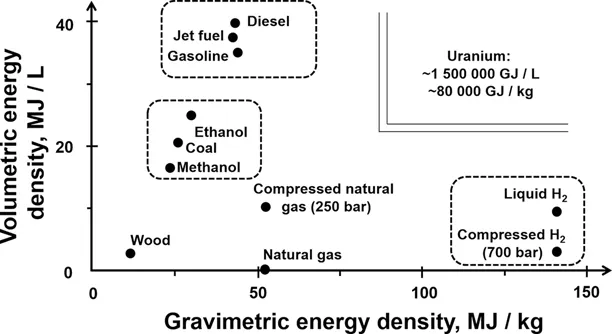
We know that fuels are one of the main energy sources. There are various fuels nowadays, but choosing the best one depends on several application aspects and criteria. Let us first understand the requirements in terms of the volumetric and gravimetric energy density of fuels. This is probably the most straightforward approach: one wants to spend less (in terms of volumes and weights) and get the most (in terms of energy). With this in mind, one can look at Figure 1.1, where the volumetric and gravimetric energy densities are compared for the common fuels. It needs to be mentioned here that the best fuel should also allow the release of the maximum “useful” energy both per unit of volume and per unit of mass in relatively simple, cheap, and safe engines and reactors. It is clear that uranium (used in nuclear fission, nuclear reactors) wins in both nominations [1] with ca 1 500 000 GJ/L and ca 80 GJ/kg. However, several factors are limiting its usage now. First, the reactor design and necessary infrastructure are complicated and expensive to implement in practice. Worldwide, to build a 1,200 MW reactor, one needs up to 10 years, with the entire infrastructure, which costs from 6 to 10 billion US dollars [2]. Another complication is related to the safety issues, problems with storing the radioactive wastes, and disassembling of the reactors after their use [3]. This is why fossil fuels are widely in use today, as they are the next alternatives (Figure 1.1). Diesel, jet fuels, and gasoline can be produced from the available oil. The former are liquids, and this fact simplifies their transportation and consumption in conventional combustion engines. However, the energy applications of oil are commonly not safe for human health and the environment [4] due to the generation of cancer-causing pollutants, toxic CO, and greenhouse gases like CO2, which are released into the atmosphere after their burning [5,6]. The same environmental and health problems are common in energy applications of coal or natural gas [7].
FIGURE1.1 Volumetric vs. gravimetric energy densities for some standard fuels. Note that the exact values usually depend on several parameters in each particular case, i.e., purity, type of the reactor, etc.
Taking into account the concerns mentioned above, various participants of the global and local energy markets have begun considering hydrogen (H2) as a viable fuel in everyday applications [8, 9, 10, 11, 12]. It has a relatively large gravimetric energy density and quite good volumetric energy density, whether compressed or liquefied, as shown in Figure 1.1. Moreover, the main ecological advantage of H2 used as a fuel is that it leaves only pure water as an exhaust – a perfect solution for the urbanized areas and the environment in general. Unfortunately, there are no natural sources of pure gaseous hydrogen on the Earth: it needs to be procured from resources like water or natural gas. This requires additional energy, and many existing technologies and infrastructures are not ready for the broader commercialization of this fuel. These issues will be considered later in this chapter.
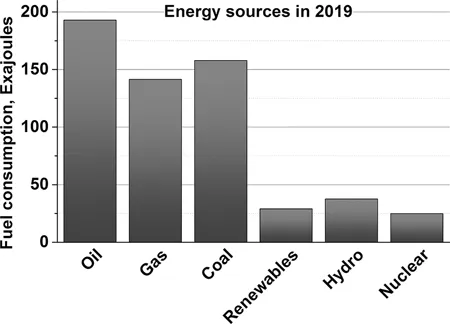
Accounting for the concerns mentioned earlier, it is not easy to answer the question on the best fuel: the problem is multiparametric, and it looks like there are no simple ideal solutions for the nearest future. The challenge is even more complicated, as one should consider that the existing infrastructure is created for fossil fuel usage, with massive investments already made. This is also clear from the graph showing the current contribution of the available fuels and energy technologies to the annual world energy consumption, which was ~6 × 10²⁰ joules in 2019 (see Figure 1.2).
The figure demonstrates that the energy market is mainly dependent on oil, natural gas, and coal. Nuclear technologies can be considered as “outsiders” in this respect. In Figure 1.2, hydro sources and the so-called “renewables” (other than hydro energy) are also indicated. What are those?
FIGURE1.2 Annual world energy consumption by fuels and energy sources according to [13].
Definition:
Renewable energy sources (renewables) are natural energy sources that are inexhaustible from the viewpoint of the current human standards. These include solar, biomass, hydroelectricity, wind energy, ambient heat, geothermal, and ocean energy.
According to conservative forecasts, fossil fuels will likely continue to supply almost 80% of the world’s energy consumption by 2040. However, renewables are the world’s fastest-growing energy sources that increased by ca 3.2 EJ in 2019 (among them, wind energy contributed ~1.4 EJ and solar energy ~1.2 EJ) and demonstrated ~11% growth per year [14]. With the rapid depletion of fossil fuel resources, one could envisage even faster growth in renewables in the near future [15,16].
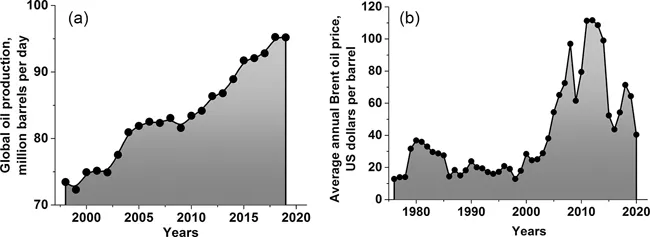
Probably, one of the very sound concerns about the availability and the future of fossil fuels for the global economy and energetics was that stated in the influential 1998 Scientific American article entitled The End of Cheap Oil. The authors claimed that the “global production of conventional oil would begin to decline sooner than most people think, probably within 10 years” [17]. These lines of thought led to an upsurge in oil prices and contributed to the energy crisis around 2007–2008. However, as one can see from Figure 1.3a, global oil production was in continuous growth. The amount of oil produced annually in the present time is at an all-time high, with ~95 million barrels produced daily. Figure 1.3b, in turn, shows large fluctuations in the average oil prices for the last four decades. These large price fluctuations destabilize the world’s economy, stimulating the search for alternative sustainable energy solutions.
FIGURE1.3 (a) Global annual oil production in 1998–2019 and (b) average Brent oil prices according to [13,14]. The annual consumption of oil in 2019 was ~35 billion barrels.
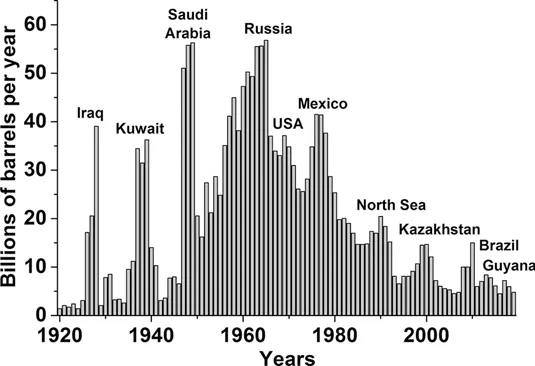
As one can see from Figure 1.4, the annual discoveries of natural oil deposits were maximal between 1960 and 1970, when the leading market players could discover almost 60 billion barrels of oil per year. After that, even relatively high oil prices could not invert the tendency of declining discoveries. Today, the companies worldwide discover only one barrel of oil for every seven the society consumes globally (compare the data in Figures 1.3a and 1.4). Of course, this is a rather dangerous tendency, which questions the future of fuels produced from oil.
FIGURE1.4 Global annual oil discoveries in 1920–2019, based on [26, 27, 28]. The names of the regions on the graph indicate the significant oil discoveries during the corresponding periods.
Each country would probably solve the energy problems of the future differently, depending on the available resources and dominating visions [18, 19, 20, 21, 22, 23, 24, 25]. Some countries or even regions will continue to focus on fossil fuels. Some will continue to consider nuclear reactors as the pillars of the electricity provision, and some will widely rely on hydropower. However, there is a growing awareness and understanding that one needs new alternative scenarios and concepts, like the so-called hydrogen economy discussed below.
1.2 The Concept of the Hydrogen Economy
As mentioned above, there are several good rationales for reconsidering energy provision and storage paradigms today. The first rationale deals with the quality of life of the people. N...
Table of contents
Cover
Half Title
Title Page
Copyright Page
Dedication
Table of Contents
Acknowledgment
Preface
Author
Chapter 1 Energy and Fuels
Chapter 2 Heterogeneous Catalysts for Fuel Processing
Chapter 3 Electrocatalysts for Energy Provision
Chapter 4 Ionic Conductors
Chapter 5 Materials for Supercapacitors
Chapter 6 Functional Materials for Primary and Rechargeable Batteries
Chapter 7 An “Artificial Leaf”: A Dream or a Viable Energy Provision Concept?
Chapter 8 Materials for Solar Cell Applications
Chapter 9 Transparent Electron Conductors
Chapter 10 Superconductors as Energy Materials
Chapter 11 Permanent Magnets for Motors and Generators
Chapter 12 Materials for Hydrogen Fuel Storage
Index
Trusted by 375,005 students
Access to over 1.5 million titles for a fair monthly price.
Study more efficiently using our study tools.
Frequently asked questions
Yes, you can cancel anytime from the Subscription tab in your account settings on the Perlego website. Your subscription will stay active until the end of your current billing period. Learn how to cancel your subscription
No, books cannot be downloaded as external files, such as PDFs, for use outside of Perlego. However, you can download books within the Perlego app for offline reading on mobile or tablet. Learn how to download books offline
Perlego offers two plans: Essential and Complete
Essential is ideal for learners and professionals who enjoy exploring a wide range of subjects. Access the Essential Library with 800,000+ trusted titles and best-sellers across business, personal growth, and the humanities. Includes unlimited reading time and Standard Read Aloud voice.
Complete: Perfect for advanced learners and researchers needing full, unrestricted access. Unlock 1.5M+ books across hundreds of subjects, including academic and specialized titles. The Complete Plan also includes advanced features like Premium Read Aloud and Research Assistant.
Both plans are available with monthly, semester, or annual billing cycles.
We are an online textbook subscription service, where you can get access to an entire online library for less than the price of a single book per month. With over 1.5 million books across 990+ topics, we’ve got you covered! Learn about our mission
Look out for the read-aloud symbol on your next book to see if you can listen to it. The read-aloud tool reads text aloud for you, highlighting the text as it is being read. You can pause it, speed it up and slow it down. Learn more about Read Aloud
Yes! You can use the Perlego app on both iOS and Android devices to read anytime, anywhere — even offline. Perfect for commutes or when you’re on the go. Please note we cannot support devices running on iOS 13 and Android 7 or earlier. Learn more about using the app
Yes, you can access Energy Materials by Aliaksandr S. Bandarenka in PDF and/or ePUB format, as well as other popular books in Physical Sciences & Environmental Science. We have over 1.5 million books available in our catalogue for you to explore.