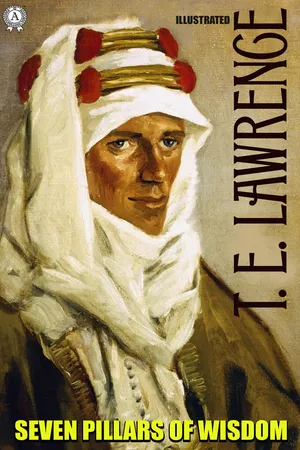
Seven Pillars of Wisdom is the autobiographical account of the experiences of British Army Colonel T. E. Lawrence ("Lawrence of Arabia"), of serving as a military advisor to Bedouin forces during the Arab Revolt against the Ottoman Turks of 1916 to 1918.
Winston Churchill quoted in an advertisement for the 1935 edition said "It ranks with the greatest books ever written in the English language. As a narrative of war and adventure it is unsurpassable."
The book was adapted into the film Lawrence of Arabia.
- 1,015 pages
- English
- ePUB (mobile friendly)
- Available on iOS & Android
eBook - ePub
Seven Pillars of Wisdom. Illustrated
About this book
Information
Subtopic
Historical BiographiesIndex
HistoryBOOK X
THE HOUSE IS PERFECTED
CHAPTER CVII
IT was an inexpressible pleasure to have left the mists behind. We caught at each other with thankfulness as we drove along, Winterton, Nasir and myself. Lord Winterton was our last-found recruit; an experienced officer from Buxton's Camel Corps. Sherif Nasir, who had been the spear-point of the Arab Army since the first days of Medina, had been chosen by us for the field work on this last occasion also. He deserved the honour of Damascus, for his had been the honours of Medina, of Wejh, of Akaba, and of Tafileh; and of many barren days beside.
A painstaking little Ford hung on in the dust, behind, as our splendid car drank up the familiar miles. Once I had been proud of riding from Azrak to Akaba in three days; but now we drove it in two, and slept well of nights after this mournful comfort of being borne at ease in Rolls-Royces, like the great ones of war.
We noted again how easy their lives were; the soft body and its unexhausted sinews helping the brain to concentrate upon an arm-chair work: whereas our brains and bodies lay down only for the stupor of an hour's sleep, in the flush of dawn and the flush of sunset, the two seasons of the day unwholesome for riding. Many a day we had been twenty-two out of the twenty-four hours in the saddle, each taking it in turn to lead through the darkness while the others let their heads nod forward over the pommel in nescience.
Not that it was more than a thin nescience: for even in the deepest of such sleep the foot went on pressing the camel's shoulder to keep it at the cross-country pace, and the rider woke if the balance were lost ever so little at a false stride or turn. Then we had had rain, snow or sun beating upon us; little food, little water, and no security against either Turks or Arabs. Yet those forced months with the tribes had let me plan in a surety which seemed lunatic rashness to new comers, but actually was an exact knowledge of my materials.
Now the desert was not normal: indeed, it was shamefully popular. We were never out of sight of men; of tenuous camel columns of troops and tribesmen and baggage moving slowly northward over the interminable Jefer flat. Past this activity (of good omen for our punctual concentration at Azrak) we roared, my excellent driver, Green, once achieving sixty-seven miles an hour. The half-stifled Nasir who sat in the box-body could only wave his hand across a furlong to each friend we overtook.
At Bair we heard from the alarmed Beni Sakhr that the Turks, on the preceding day, had launched suddenly westward from Hesa into Tafileh. Mifleh thought I was mad, or most untimely merry, when I laughed outright at the news which four days sooner would have held up the Azrak expedition: but, now we were started, the enemy might take Aba el Lissan, Guweira, Akaba itself – and welcome! Our formidable talk of advance by Amman had pulled their leg nearly out of socket, and the innocents were out to counter our feint. Each man they sent south was a man, or rather ten men, lost.
In Azrak we found a few servants of Nuri Shaalan, and the Crossley car with a flying officer, an airman, some spares, and a canvas hangar for the two machines protecting our concentration. We spent our first night on their aerodrome and suffered for it. A reckless armoured-plated camel-fly, biting like a hornet, occupied our exposed parts till sunset. Then came a blessed relief as the itch grew milder in the evening cool – but the wind changed and hot showers of blinding salty dust swept us for three hours. We lay down and drew covers over our heads, but could not sleep. Each half-hour we had to throw off the sand which threatened to bury us. At midnight the wind ceased. We issued from our sweaty nests and restfully prepared to sleep – when singing, a cloud of mosquitoes rolled over us: them we fought till dawn.
Consequently, at dawn we changed camp to the height of the Mejaber ridge, a mile west of the water and a hundred feet above the marshes, open to all winds that blew. We rested a while, then put up the hangar, and afterwards went off to bathe in the silver water. We undressed beside the sparkling pools whose pearl-white sides and floor reflected the sky with a moony radiance. ‘Delicious!’ I yelled as I splashed in and swam about. ‘But why do you keep on bobbing under water?’ asked Winterton a moment later. Then a camel-fly bit him behind, and he understood, and leapt in after me. We swam about desperately keeping our heads wet, to dissuade the grey swarms: but they were too bold with hunger to be afraid of water, and after five minutes we struggled out, and frantically into our clothes, the blood running from twenty of their dagger-bites.
Nasir stood and laughed at us: and later we journeyed together to the fort, to rest midday there. Ali ibn el Hussein's old corner tower, this only roof in the desert, was cool and peaceful. The wind stirred the palm-fronds outside to a frosty rustling: neglected palms, too northerly for their red-date-crop to be good; but the stems were thick with low branches, and threw a pleasant shade. Under them, on his carpet, sat Nasir in the quietness. The grey smoke of his thrown-away cigarette undulated out on the warm air, flickering and fading through the sun-spots which shone between the leaves. ‘I am happy’, said he. We were all happy.
In the afternoon an armoured car came up, completing our necessary defence, though the risk of enemy was minute. Three tribes covered the country between us and the railway. There were only forty horsemen in Deraa, none in Amman: also, as yet the Turks had no news of us. One of their aeroplanes flew over on the morning of the ninth, made a perfunctory circle, and went off, probably without seeing us. Our camp, on its airy summit, gave us splendid observation of the Deraa and Amman roads. By day we twelve English, with Nasir and his slave, lazed, roaming, bathing at sunset, sight-seeing, thinking; and slept comfortably at night: or rather I did: enjoying the precious interval between the conquered friends of Aba el Lissan and the enemy of next month.
The preciousness would seem to have been partly in myself, for on this march to Damascus (and such it was already in our imagination) my normal balance had changed. I could feel the taut power of Arab excitement behind me. The climax of the preaching of years had come, and a united country was straining towards its historic capital. In confidence that this weapon, tempered by myself, was enough for the utmost of my purpose, I seemed to forget the English companions who stood outside my idea in the shadow of ordinary war. I failed to make them partners of my certainty.
Long after, I heard that Winterton rose each dawn and examined the horizon, lest my carelessness subject us to surprise: and at Umtaiye and Sheikh Saad the British for days thought we were a forlorn hope. Actually I knew (and surely said?) that we were as safe as anyone in the world at war. Because of the pride they had, I never saw their doubt of my plans.
These plans were a feint against Amman and a real cutting of the Deraa railways: further than this we hardly went, for it was ever my habit, while studying alternatives, to keep the stages in solution.
The public often gave credit to Generals because it had seen only the orders and the result: even Foch said (before he commanded troops) that Generals won battles: but no General ever truly thought so. The Syrian campaign of September 1918 was perhaps the most scientifically perfect in English history, one in which force did least and brain most. All the world, and especially those who served them, gave the credit of the victory to Allenby and Bartholomew: but those two would never see it in our light, knowing how their inchoate ideas were discovered in application, and how their men, often not knowing, wrought them.
By our establishment at Azrak the first part of our plan, the feint, was accomplished. We had sent our ‘horsemen of St. George’, gold sovereigns, by the thousand to the Beni Sakhr, purchasing all the barley on their threshing floors: begging them not to mention it, but we would require it for our animals and for our British allies, in a fortnight. Dhiab of Tafileh – that jerky, incomplete hobbledehoy – gossiped the news instantly through to Kerak.
In addition, Feisal warned the Zebn to Bair, for service; and Hornby, now (perhaps a little prematurely) wearing Arab clothes, was active in preparations for a great assault on Madeba. His plan was to move about the nineteenth, when he heard that Allenby was started; his hope being to tie on to Jericho, so that if we failed by Deraa our force could return and reinforce his movement: which would then be, not a feint, but the old second string to our bow. However, the Turks knocked this rather crooked by their advance to Tafileh, and Hornby had to defend Shobek against them.
For our second part, the Deraa business, we had to plan an attack proper. As preliminary we determined to cut the line near Amman, thus preventing Amman's reinforcement of Deraa, and maintaining its conviction that our feint against it was real. It seemed to me that (with Egyptians to do the actual destruction) this preliminary could be undertaken by the Ghurkas, whose detachment would not distract our main body from the main purpose.
This main purpose was to cut the railways in the Hauran and keep them cut for at least a week; and there seemed to be three ways of doing it. The first was to march north of Deraa to the Damascus railway, as on my ride with Tallal in the winter, cut it; and then cross to the Yarmuk railway. The second was to march south of Deraa to the Yarmuk, as with Ali ibn el Hussein in November, 1917. The third was to rush straight at Deraa town.
The third scheme could be undertaken only if the Air Force would promise so heavy a daylight bombing of Deraa station that the effect would be tantamount to artillery bombardment, enabling us to risk an assault against it with our few men. Salmond hoped to do this; but it depended on how many heavy machines he received or assembled in time. Dawnay would fly over to us here with his last word on September the eleventh. Till then we would hold the schemes equal in our judgement.
Of our supports, my bodyguard were the first to arrive, prancing up Wadi Sirhan on September the ninth: happy, fatter than their fat camels, rested, and amused after their month of feasting with the Rualla. They reported Nuri nearly ready, and determined to join us. The contagion of the new tribe's first vigour had quickened in them a life and spirit which made us jolly.
On the tenth the two aeroplanes came through from Akaba. Murphy and Junor, the pilots, settled down to the horse-flies, which gambolled in the air about their juiciness. On the eleventh, the other armoured cars and Joyce drove in, with Stirling, but without Feisal. Marshall had remained to squire him up next day; and things were always safe to go well where Marshall, the capable soul, directed them with a cultivated humour, which was not so much riotous as persistent. Young, Peake, Scott-Higgins and the baggage arrived. Azrak became many-peopled and its lakes were again resonant with voices and the plunge of brown and lean, brown and strong, copper-coloured, or white bodies into the transparent water.
On the eleventh the aeroplane from Palestine arrived. Unfortunately, Dawnay was again ill, and the staff officer who took his place (being raw) had suffered severely from the roughness of the air; and had left behind the notes he was to bring us. His rather concrete assurance, that regard upon his world of the finished Englishman, gave way before these shocks, and the final shock of our naked carelessness out there in the desert, without pickets or watching posts, signallers, sentries or telephones, or any apparent reserves, defence-line, refuges and bases.
So he forgot his most important news, how on September the sixth Allenby, with a new inspiration, had said to Bartholomew, ‘Why bother about Messudieh? Let the cavalry go straight to Afuleh, and Nazareth’: and so the whole plan had been changed, and an enormous indefinite advance substituted for the fixed objective. We got no notion of this; but by cross-questioning the pilot, whom Salmond had informed, we got a clear statement of the resources in bombing machines. They fell short of our minimum for Deraa; so we asked for just a hamper-bombing of it while we went round it by the north, to make sure of destroying the Damascus line.
The next day Feisal arrived with, behind him, the army of troops, Nuri Said the spick and span, Jemil the gunner, Pisani's coster-like Algerians, and the other items of our ‘three men and a boy’ effort. The grey flies had now two thousand camels to fatten upon, and in their weariness gave up Junor and his half-drained mechanics.
In the afternoon Nuri Shaalan appeared, with Trad and Khalid, Faris, Durzi, and the Khaffaji. Auda abu Tayi arrived, with Mohammed el Dheilan; also Fahad and Adhub, the Zebn leaders, with ibn Bani, the chief of the Serahin, and ibn Genj of the Serdiyeh. Majid ibn Sultan, of the Adwan near Salt, rode across to learn the truth of our attack on Amman. Later in the evening there was a rattle of rifle fire in the north, and Talal el Hareidhin, my old companion, came ruffling at the gallop, with forty or fifty mounted peasants behind him. His sanguine face beamed with joy at our long-hoped-for arrival. Druses and town-Syrians, Isawiyeh and Hawarneh swelled the company. Even the barley for our return if the venture failed (a possibility we seldom entertained) began to arrive in a steady file of loads. Everyone was stout and in health. Except myself. The crowd had destroyed my pleasure in Azrak, and I went off down the valley to our remote Ain el Essad and lay there all day in my old lair among the tamarisk, where the wind in the dusty green branches played with such sounds as it made in English trees. It told me I was tired to death of these Arabs; petty incarnate Semites who attained heights and depths beyond our reach, though not beyond our sight. They realized our absolute in their unrestrained capacity for good and evil; and for two years I had profitably shammed to be their companion!
To-day it came to me with finality that my patience as regards the false position I had been led into was finished. A week, two weeks, three, and I would insist upon relief. My nerve had broken; and I would be lucky if the ruin of it could be hidden so long.
Joyce meanwhile shouldered the responsibility which my defection endangered. By his orders Peake, with the Egyptian Camel Corps, now a sapper party, Scott-Higgins, with his fighting Ghurkas, and two armoured cars as insurance, went off to cut the railway by Ifdein.
The scheme was for Scott-Higgins to rush a blockhouse after dark with his nimble Indians – nimble on foot that was to say, for they were like sacks, on camels. Peake was then to demolish until dawn. The cars would cover their retreat eastward in the morning, over the plain, upon which we, the main body, would be marching north from Azrak for Umtaiye, a great pit of rain-water fifteen miles below Deraa, and our advanced base. We gave them Rualla guides and saw them off, hopefully, for this important preliminary.
CHAPTER CVIII
JUST at dawn our column marched. Of them one thousand were the Aba el Lissan contingent: three hundred were Nuri Shaalan's nomad horse. He had also two thousand Rualla camel-riders: these we asked him to keep in Wadi Sirhan. It seemed not wise, before the supreme day, to launch so many disturbing Beduin among the villages of Hauran. The horsemen were sheikhs, or sheikhs’ servants, men of substance, under control.
Affairs with Nuri and Feisal held me the whole day in Azrak: but Joyce had left me a tender, the Blue Mist, by which on the following morning I overtook the army, and found them breakfasting among the grass-filled roughness of the Giaan el Khunna. The camels, joying to be out of the barren circle of Azrak, were packing their stomachs hastily with this best of food.
Joyce had bad news. Peake had rejoined, reporting failure to reach the line, because of trouble with Arab encampments in the neighbourhood of his proposed demolition. We had set store on breaking the Amman railway, and the check was an offence. I left the car, took a load of gun-cotton, and mounted my camel, to push in advance of the force. The others made a detour to avoid harsh tongues of lava which ran down westwards towards the railway; but we, Ageyl and others of the well-mounted, cut straight across by a thieves’ path to the open plain about the ruined Um el Jemal.
I was thinking hard about the Amman demolition, puzzled as to what expedient would be quickest and best; and the puzzle of these ruins added to my care. There seemed evidence of bluntness of mind in these Roman frontier cities, Um el Jemal, Um el Surab, Umtaiye. Such incongruous buildings, in what was then and now a desert cockpit, accused their builders of insensitiveness; almost of a vulgar assertion of man's right (Roman right) to live unchanged in all his estate. Italianate buildings – only to be paid for by taxing more docile provinces – on these fringes of the world disclosed a prosaic blindness to the transience of politics. A house which so survived the purpose of its builder was a pride too trivial to confer honour upon the mind responsible for its conception.
Um el Jemal seemed aggressive and impudent, and the railway beyond it so tiresomely intact, that they blinded me to an air-battle between Murphy in our Bristol Fighter and an enemy two-seater. The Bristol was badly shot about before the Turk went down in flames. Our army were delighted spectators, but Murphy, finding the damage too great for his few materials at Azrak, went for repair to Palestine in the morning. So our tiny Air Force was reduced to the B.E. 12, a type so out of date that it was impossible for fighting, and little use for reconnaissance. This we discovered on the day: meanwhile we were as glad as the army at our man's win.
Umtaiye was reached, just before sunset. The troops were five or six miles behind, so as soon as our beasts had had a drink we struck off to the railway, four miles downhill to the westward, thinking to do a snatch-demolition. The dusk let us get close without alarm, and, to our joy, we found that the going was possible for armoured cars: while just before us were two good bridges.
These points decided me to return in the morning, with cars and more gun-cotton, to abolish the larger, four-arched bridge. Its destruction would give the Turks some days’ hard mending, and set us free of Amman all the time of our first Deraa raid; thus the purpose of Peake's frustrated demolition would be filled. It was a happy discovery, and we rode back, quartering the ground while the darkness gathered, to pick the best car road.
As we climbed the last ridge, a high unbroken watershed which hid Umtaiye completely from the railway and its possible watchmen, the fresh north-east wind blew into our faces the warm smell and dust of ten thousand feet; and from the crest the ruins appeared so startlingly unlike themselves three hours before that we pulled up to gasp. The hollow ground was festively spangled with a galaxy of little evening fires, fresh-lighted, still twinkling with the flame reflections in their smoke. About them men were making bread or coffee, while others drove their noisy camels to and from the water.
I rode to the dark camp, the British one, and sat there with Joyce and Winterton and Young, telling them of what we must do first thing in the morning. Beside us lay and smoked the British soldiers, quietly risking themselves on this expedition, because we ordered it. It was a thing typical, as instinct with our national character as that babbling laughing turmoil over there was Arab. In their crises the one race drew in, the other spread.
In the morning, while the army breakfasted, and thawed the dawn-chill from its muscles in the sun, we explained to the Arab leaders in council the fitness of the line for a car-raid; and it was determined that two armoured cars should run down to the bridge and attack it, while the main body continued their march to Tell Arar on the Damascus Railway, four miles north of Deraa. They would take post there, possessing the line, at dawn to-morrow, September the seventeenth; and we with the cars would have finished this bridge and rejoined them before that.
About two in the afternoon, as we drove towards the railway, we had the great sight of a swarm of our bombing planes droning steadily up towards Deraa on their first raid. The place had hitherto been carefully reserved from air attack; so the damage among the unaccustomed, unprotected, unarmed garrison was heavy. The morale of the men suffered as much as the railway traffic: and till our onslaught from the north forced them to see us, all their efforts went into digging bomb-proof shelters.
We lurched across plots of grass, between bars and fields of rough stone, in our two tenders and two armoured cars; but arrived all well behind a last ridge, just this side of our target. On the rise south ...
Table of contents
- AUTHOR'S PREFACE
- INTRODUCTORY CHAPTER
- INTRODUCTION FOUNDATIONS OF REVOLT
- BOOK I THE DISCOVERY OF FEISAL
- BOOK II OPENING THE ARAB OFFENSIVE
- BOOK III A RAILWAY DIVERSION
- BOOK IV EXTENDING TO AKABA
- BOOK V MARKING TIME
- BOOK VI THE RAID UPON THE BRIDGES
- BOOK VII THE DEAD SEA CAMPAIGN
- BOOK VIII THE RUIN OF HIGH HOPE
- BOOK IX BALANCING FOR A LAST EFFORT
- BOOK X THE HOUSE IS PERFECTED
Trusted by 375,005 students
Access to over 1.5 million titles for a fair monthly price.
Study more efficiently using our study tools.
Frequently asked questions
Yes, you can cancel anytime from the Subscription tab in your account settings on the Perlego website. Your subscription will stay active until the end of your current billing period. Learn how to cancel your subscription
No, books cannot be downloaded as external files, such as PDFs, for use outside of Perlego. However, you can download books within the Perlego app for offline reading on mobile or tablet. Learn how to download books offline
Perlego offers two plans: Essential and Complete
- Essential is ideal for learners and professionals who enjoy exploring a wide range of subjects. Access the Essential Library with 800,000+ trusted titles and best-sellers across business, personal growth, and the humanities. Includes unlimited reading time and Standard Read Aloud voice.
- Complete: Perfect for advanced learners and researchers needing full, unrestricted access. Unlock 1.5M+ books across hundreds of subjects, including academic and specialized titles. The Complete Plan also includes advanced features like Premium Read Aloud and Research Assistant.
We are an online textbook subscription service, where you can get access to an entire online library for less than the price of a single book per month. With over 1.5 million books across 990+ topics, we’ve got you covered! Learn about our mission
Look out for the read-aloud symbol on your next book to see if you can listen to it. The read-aloud tool reads text aloud for you, highlighting the text as it is being read. You can pause it, speed it up and slow it down. Learn more about Read Aloud
Yes! You can use the Perlego app on both iOS and Android devices to read anytime, anywhere — even offline. Perfect for commutes or when you’re on the go.
Please note we cannot support devices running on iOS 13 and Android 7 or earlier. Learn more about using the app
Please note we cannot support devices running on iOS 13 and Android 7 or earlier. Learn more about using the app
Yes, you can access Seven Pillars of Wisdom. Illustrated by T.E. Lawrence in PDF and/or ePUB format, as well as other popular books in History & Historical Biographies. We have over 1.5 million books available in our catalogue for you to explore.