Maximize your chances of investment success with this accessible and profitable guide which pulls away the curtain to put you on a level footing with the professionals - and points out where the pros can get it wrong.
Never in history has it been easier for private investors to get involved in the market, and changes in technology, regulation and access to information mean that the advantage experts may have had is fast disappearing. Written by Matthew Partridge, a financial journalist for the UK's leading investment magazine, Investing Explained is filled with real life examples and plain English summaries of research produced by banks and academics to separate fact from fiction when it comes to investment clichés.
Investing Explained covers the basics for beginner investors and includes more in-depth advice for those with more experience. Benefit from an overview of behavioural psychology (and how you can profit from the irrational behaviour of others), advice on fintech apps and cryptocurrencies, and the impact of a political or economic crisis on your investments. Access the stock market with this invaluable guide and build an investment portfolio which can secure your financial future.
eBook - ePub
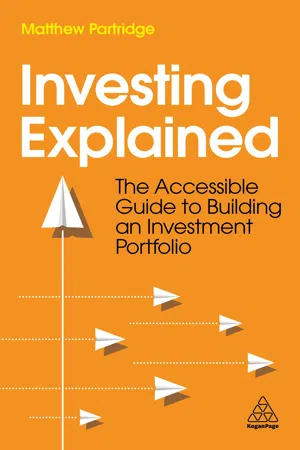
Investing Explained
The Accessible Guide to Building an Investment Portfolio
- English
- ePUB (mobile friendly)
- Available on iOS & Android
eBook - ePub
About this book
Information
01
The basics of investing
Summary
Investing is putting your money to work so that it grows. To do this you need to work out your financial goals, sort out your finances so you can start saving regular amounts of money and then start investing it in assets like shares and bonds (with the balance between the two depending on your investment horizon). Over time, such a strategy should ensure that you can accumulate sufficient money to more than meet your needs. This is particularly important in the case of retirement because, with firms providing less generous pensions, and governments around the world constantly increasing the retirement age, you will need to take responsibility for your financial future.
1. Why do I need to bother with investing?
Whenever I reveal to people that I’m a financial journalist, I get one of three reactions.
Some people try and get me to reveal the secret of making a fortune in the stock market. Others start ranting about their bank, or the latest financial scandal, as if I’m responsible. Finally, some people’s eyes glaze over and they politely say ‘that sounds interesting’ before changing the subject. (Though one person has been blunt enough to simply say, ‘What a boring job.’)
Obviously, I don’t agree with this last sentiment, since I find following the twists and turns in the financial markets fascinating. But it’s true that, to quote Nicholas Cage in Matchstick Men, ‘For many people, money is a foreign film without subtitles.’ And there’s nothing wrong with that. However, there’s no escaping the fact that sticking your head in the sand about money isn’t an option in today’s world.
Unless you’re planning on living like a monk, you will have financial goals. That could be to enjoy a comfortable retirement, or to buy a house, or to go travelling, or to pay for school fees (or all of the above). And if you want to meet those financial goals, there’s no way round it: we have to make our money work for us.
Which is what investing is – allocating your money and wealth to either generate an income or increase in value, rather than either spending it or leaving it lying around.
As recently as 20 years ago most people could expect to retire on an index-linked final salary pension – a scheme that paid a portion of their final wages, which then automatically increased with inflation. Such schemes are vanishingly rare in 2021. (By the start of 2018 not a single FTSE 100 company offered one to new entrants.)1 Instead you have to join what are known as ‘defined contribution’ schemes where both you and your employer pay into a retirement plan, which is then invested, with the proceeds used to fund your retirement.
There are a few key reasons for this shift, but they don’t really matter here. The sad fact is, the days of the most generous pension schemes are gone. And the default pension options are not going to provide enough for us to live off. As of the 2021–22 financial year, the UK state pension is currently only £179.60 per week, or just £9,339.20 a year – roughly a quarter of the average full-time wage – and the UK government keeps increasing the retirement age.2
Things are made even worse by the fact that longer life expectancies and low interest rates mean that annuities, a low-risk product that pays people a guaranteed income until their death, pay much less than they used to. Indeed, with life expectancy increasing at an average of two–three years every decade since the 19th century, and some like Stuart Kim of Stanford University even suggesting that the first person to reach the age of 200 has already been born, they could fall even further.3,4
To get an annuity that pays an inflation-linked sum equal to 40 per cent of what you earn (which is what the final salary schemes used to pay), you will have needed to accumulate a sum equal to 15 times your salary.
Not all investment goals are as long term as retirement. Rapidly increasing property prices means that many people may have to build up a sizable deposit if they want to get on the property ladder (or want to be able to give their children a helping hand). Some large discretionary purchases, such as a new car or dream holiday, may also require advance financial planning if you want to avoid going into debt in order to pay for them.
Those who don’t plan ahead for the future are at risk of ending up like the grasshopper in the ancient Greek writer Aesop’s story of The Ant and the Grasshopper. In the story the grasshopper spends the summer idling while the ant takes the time to store food for the coming winter. When winter finally arrives the improvident grasshopper finds that he has nothing left to eat, while the ant has plenty of food. When the grasshopper begs for food, the ant refuses him by pointing out that he had the opportunity to save for the future.
2. What’s the best way to free up money for investment?
If you’re lucky enough to have a significant sum of money to hand, you’ll be able to start investing immediately. However, if you want to be able to consistently save a portion of your income, you’ll need to get your finances in order. That means reducing your spending so that it is consistently less than your income. As Mr Micawber says (and finds out the hard way) in Charles Dickens’ novel David Copperfield, ‘Annual income twenty pounds, annual expenditure nineteen nineteen and six, result happiness. Annual income twenty pounds, annual expenditure twenty pounds ought and six, result misery.’
As well as ensuring that you spend less than you earn, you’ll also need to get your debts under control, if you want to start investing – especially ‘bad debt’, such as high-interest, short-term loans that don’t produce any lasting reward.
For example, it makes sense to start paying off any credit card bills before thinking about investment. Even the best investors in history would struggle to consistently generate returns close to the 15–25 per cent a year (or more) that credit card companies typically charge. While this may seem obvious, a surprising number of people fail to heed this, with the average UK household (as of March 2021) having unsecured consumer debts of £7,057, of which £1,945 are credit card bills. Overall, nearly 40 per cent of people in the UK have some form of high-interest debt.5
That said, it doesn’t make sense to repay all loans immediately. While you should never get in arrears with your mortgage, mortgages are ‘good debt’ in that the interest rate charged on mortgages is much lower than that on more short-term loans. This means that it still makes sense to invest money rather than use it to repay your mortgage early. Since most people won’t repay their mortgages until they are in their 50s (or later) you wouldn’t have much opportunity to invest if you held off until you were debt-free.
The exact portion of your income you should save also needs to be big (and consistent) enough to meet your investment goals. For example, to get the lump sum of 15 times your salary recommended to ensure a comfortable retirement you need to save 15 per cent of your pre-tax income over a 45-year working life.
This may sound like a lot of money, but bear in mind that everyone employed in the UK already pays at least 4 per cent of their gross salary into a pension plan, while their employer is also paying in another 4 per cent. This means that in this case you only need to save an additional 7 per cent to bring your total saving up to 15 per cent of your income. Of course, this only applied to retirement savings, as other goals may require a bigger or smaller percentage, while those who start saving for retirement savings later in life may have to save more.
While there is no one money-saving technique that works for everybody, I’ve found it useful to set up a monthly standing order equal to around 10 per cent of my gross salary which is paid directly into an investment account. Not only does this ensure that I put a certain amount of money away each month, but saving small amounts money regularly helps me cut down my spending by giving me a clear idea of how much money I have left.
3. What’s the difference between stocks, shares and bonds?
In the 1985 film A View To A Kill, James Bond assumes the nom de plume of ‘James Stock’. But in the world of finance, stocks and bonds definitely aren’t the same thing by a different name.
Bonds
Bonds are a form of IOU, issued by firms, governments and occasionally other bodies, where the investor lends the borrower a certain amount of money in return for an annual (or semi-annual) interest payment (known as a coupon) and the promise to repay the full amount at a certain date.
One way to think of them is as a form of savings account. You’re also able to buy and sell them before they mature, though most ordinary investors hang onto them until they come due (known as ‘holding them to maturity’). Some ‘zero coupon’ bonds don’t pay any interest during their lifespan, but pay a lump sum at the end.
Unlike savings accounts, bonds are not guaranteed by the government (with the exception of government bonds). However, just as a bank can repossess a house if the owners are unable to pay the mortgage, bondholders can seize control of a bankrupt company and then sell off the assets. Indeed, during bankruptcy, shareholders don’t have a right to anything until the bondholders are paid off in full (and in most cases receive only a nominal amount or nothing at all).
This means that bonds should have a greater degree of security than shares.
The only downside is that, no matter how well the company does, the bondholders who hold the bond to maturity won’t receive any more than the face value of the bond and any interest payments that they are entitled to.
Shares
While shareholders may be last in the queue in the case of bankruptcy, owning a share gives you effec...
Table of contents
- Investing Explained
- Investing Explained
- Contents
- About the author
- Foreword
- Acknowledgements
- Introduction
- 01 The basics of investing
- 02 Managing risk
- 03 The role of psychology in investing
- 04 Investing with the professionals
- 05 Types of investment vehicles
- 06 Picking an active fund
- 07 Value investing
- 08 Growth investing
- 09 Income investing
- 10 Investing in the aftermath of chaos
- 11 Other financial assets
- 12 Financial technology and alternative finance
- Conclusion
- INDEX
Trusted by 375,005 students
Access to over 1.5 million titles for a fair monthly price.
Study more efficiently using our study tools.
Frequently asked questions
Yes, you can cancel anytime from the Subscription tab in your account settings on the Perlego website. Your subscription will stay active until the end of your current billing period. Learn how to cancel your subscription
No, books cannot be downloaded as external files, such as PDFs, for use outside of Perlego. However, you can download books within the Perlego app for offline reading on mobile or tablet. Learn how to download books offline
Perlego offers two plans: Essential and Complete
- Essential is ideal for learners and professionals who enjoy exploring a wide range of subjects. Access the Essential Library with 800,000+ trusted titles and best-sellers across business, personal growth, and the humanities. Includes unlimited reading time and Standard Read Aloud voice.
- Complete: Perfect for advanced learners and researchers needing full, unrestricted access. Unlock 1.5M+ books across hundreds of subjects, including academic and specialized titles. The Complete Plan also includes advanced features like Premium Read Aloud and Research Assistant.
We are an online textbook subscription service, where you can get access to an entire online library for less than the price of a single book per month. With over 1.5 million books across 990+ topics, we’ve got you covered! Learn about our mission
Look out for the read-aloud symbol on your next book to see if you can listen to it. The read-aloud tool reads text aloud for you, highlighting the text as it is being read. You can pause it, speed it up and slow it down. Learn more about Read Aloud
Yes! You can use the Perlego app on both iOS and Android devices to read anytime, anywhere — even offline. Perfect for commutes or when you’re on the go.
Please note we cannot support devices running on iOS 13 and Android 7 or earlier. Learn more about using the app
Please note we cannot support devices running on iOS 13 and Android 7 or earlier. Learn more about using the app
Yes, you can access Investing Explained by Matthew Partridge in PDF and/or ePUB format, as well as other popular books in Personal Development & Personal Finance. We have over 1.5 million books available in our catalogue for you to explore.