Christianity is a religion of conversion, but what is conversion? This book explores the fullness of the Christian life and the threefold turnings that it demands of Jesus' followers. Starting with St. Paul while looking in detail at his Damascus Road experience and examining the remarkable lives of exemplary Christians, the authors unfold dynamics of conversion and call all followers to grow deeper in their discipleship.
eBook - ePub
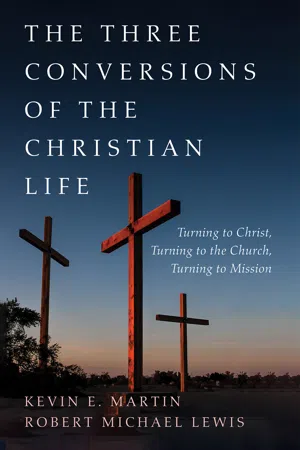
The Three Conversions of the Christian Life
Turning to Christ, Turning to the Church, Turning to Mission
- 74 pages
- English
- ePUB (mobile friendly)
- Available on iOS & Android
eBook - ePub
The Three Conversions of the Christian Life
Turning to Christ, Turning to the Church, Turning to Mission
About this book
Information
Topic
Theology & ReligionSubtopic
Christian MinistryA Religion of Conversion
Christianity, at its core, is a religion of conversion. The word conversion comes from the Latin conversio which means to turn, or a turning, especially a religious or moral turn of direction. While this can begin with a significant event in a person’s life, such as Saul who became Paul on the road to Damascus, it most fully refers to an on-going process. Conversion is the distinguishing characteristic of Christianity and of the life of a disciple of Jesus.
Of course, many Christians are not of the road to Damascus variety. Most of us prefer to think about ourselves more like Barnabas; quietly faithful people who are kind and want to help and encourage others. However, we do know that Christianity does begin with conversion. Even when we baptize an infant, we believe that this child will have to come to a moment when she or he turns to their faith, claims it for themselves, and must take on what was promised for them in Baptism.
Often church members do not have a very clear understanding of conversion and what the process involves. It is one of the primary tasks of clergy to help our people understand conversion and what is being formed in us through this process.
The place to start is with is the realization that Christianity involves more than accepting Jesus as Savior and Lord and certainly more than becoming a member of the church. What we fail to understand is that Christianity actually includes three conversions. These conversions or turnings are quite often completely separate from one another and the fully formed Christian may have these turnings at distinctly different times in their life.
Turning to Christ
There is, of course, a conversion to Christ—to embrace him as our Savior and to consciously choose to follow him as a disciple. The generally accepted definition of evangelism originally penned by Archbishop William Temple communicates this, “Evangelism is to present Jesus Christ in the power of the Holy Spirit so that men and women are led to accept him as Savior and follow him as Lord in the fellowship of his church.”1
All of the church’s official and historical formularies, whether we refer to the creeds or the various catechisms and confessions of peculiar branches of Christianity, affirm this definition. In the risen Christ, we find both a Savior who by his Crucifixion and Resurrection has given us a new life and a Lord who calls us to a new way of living. Dean Urban Holmes rightfully caught the fullness of this in his extremely important book Turning to Christ.
In North America, evangelical Christians often put most emphasis on the first part of this, “being saved.” Some even say that this being saved is the main thing because it guarantees us eternal life. Some even equate salvation with eternal life. Jesus and his early followers, however, called people to discipleship; following after Jesus in a disciplined and intentional way. “Come and follow me” was both Jesus’ invitation and that of the early church. If salvation were only about a ticket to heaven, it would be a weak proclamation as it would infer no real transformation in this life, only a fleeting hope in a better one to come. Making accepting Christ to be only about going to heaven is a serious theological fault and one that lessens the fullness of salvation which begins when we do turn to Jesus. A real conversion bears the evidence not only of a changed mindset, but a systematic re-ordering of the believer’s whole heart and life.
In order to understand this conversion, we must also wrestle with the person of Jesus Christ. Who is this historical person anyhow? After all, twenty centuries have elapsed since he walked this earth. How can we know a real Jesus?
In the nineteenth century, a group of scholars began a “quest for the historical Jesus.” This has now been through four different efforts as scholars try to find the historical person Jesus of Nazareth. The last of these is the “Jesus Seminar.” The thesis of such a quest is that behind the gospels and the other books of the New Testament there is the “real” Jesus who the church and the apostles made into the Christ of the church.
This latter quest was largely done by progressive scholars. They examined the various stories and events in the gospels and voted up and down whether each scholar believed this event or saying came from the original Jesus, the “historical” one. Thus they eliminated most of the miracle stories of the gospels and anything they believe was created by the early church after Jesus’ death. One of their leaders, the Roman Catholic scholar John Dominic Crossan, concluded from these studies that Jesus was a first century Jewish cynic whose teachings were misunderstood by his disciples and re-interpreted after his death. There are two observations we can make about this process.
First, the idea that there was a historical Jesus who is hidden by the gospels leads inevitable to the division between the historical Jesus and the Christ of the church. One scholar has even written on how Jesus became the Christ, meaning evolved into the idea of the Christ. Secondly, much of the argument about the “real Jesus” depends on what you think possible, one’s worldview. So, it was easy for such scholars to project into the unknown what they believe to be true. Adolph Harnack was one of the first scholars to undertake the quest for Jesus. He was a nineteenth century liberal German scholar and, when he discovered the real Jesus, it was no surprise that Jesus acted and spoke like a nineteenth century German liberal. One critic of his time, Roman Catholic modernist George Tyrrell said, “The Christ that Adolf Harnack sees, looking back through nineteen centuries of Catholic darkness, is only the reflection of a liberal Protestant face, seen at the bottom of a deep well.”2
What is important for our question “Who was Jesus?” is to understand that no first century Christian would have made this division between Jesus and the Christ. For them, he was one and the same. This was because everything written about Jesus was written after the Resurrection. Just as the church has always understood that the Old Testament was written by the believing community after the Exodus event, so the church also understood that the Jesus they were proclaiming was the resurrected Messiah.
Here Paul is a helpful example. Two years after his conversion, Paul made his way to Jerusalem to visit with Peter and other apostles. We think that Barnabas may have made this meeting possible. In any case, we could understand their unwillingness to meet with this person who had so brutally persecuted the early believers. They had to wonder if his so-called conversion was genuine or if he had taken this story on to spy upon them and betray them. Now, with the intervention of the Christians in Damascus, Paul finally had his conversion.
He found the house where Peter was staying and remained with him for two weeks to “finish off” what he needed to know about Jesus. Paul had never met or heard Jesus before the Resurrection and his dramatic conversion and his calling to the mission to the Gentiles was directly from the resurrected Christ. This meeting took place long before the writing of any of the four Gospels and explains to us why Paul, in his letter, tells us things not in the Gospels. For example, “Remember the words of our Lord Jesus, who himself said, it is more blessed to give then receive.” (Acts 20:35) This phrase doesn’t appear in the Gospels. Another example is Paul’s words of institution of the Lord’s Supper found in First Corinthians, dated between 50–57 CE. that are much older than the Gospel accounts.
Now while it was obviously important for Paul to have some background on Jesus, the really interesting thing is that after just two weeks, he had learned all he needed to fill in the blanks. Then Peter and the other apostles having welcomed Paul, thanked him, and sent him on the way to his home in Tarsus with the promise that they would write him if needed. To our knowledge, they never did. But Barnabas called on Paul fourteen years later when a revival had broken out in Antioch of Syria among Gentiles.
What we learn from this is very important. The early Christians both Jew and Gentile were focused on the resurrected and living Jesus. For them, this Jesus was alive and moving among and through them to reach the whole world with the good news that God had in Christ reconciled the world to himself. The message of repentance of our sins and forgiveness was being spontaneously spread to the ends of the Roman world.
How was this possible? Didn’t the church believe that Jesus has ascended to the Father in heaven? As Paul would teach in Romans, all Christians had, in believing and receiving his actions of forgiveness, been given the new life, the resurrected life, by the power of the Spirit of Jesus living in us. The Holy Spirit was, in our new birth, united to our spirit. This gave Christians a number of spiritual benefits and first of all was the Holy Spirit bearing wit...
Table of contents
- Title Page
- Preface
- A Religion of Conversion
- What Really Happened on the Damascus Road
- A Great Sinner meets a Greater Savior
- A Charcoal Fire and the Chance to Get It Right
- John Wesley
- We are the Body of Christ
- Hudson Stuck— Archdeacon and Advocate for Reform
- A Greater Family
- Fulton Sheen
- Meeting the Neighborhood
- Fred Rogers
- Small Deeds Big Impact
- Charlotte Diggs “Lottie” Moon
- The Three Conversions and the Process of Conversion
- Bibliography
Trusted by 375,005 students
Access to over 1.5 million titles for a fair monthly price.
Study more efficiently using our study tools.
Frequently asked questions
Yes, you can cancel anytime from the Subscription tab in your account settings on the Perlego website. Your subscription will stay active until the end of your current billing period. Learn how to cancel your subscription
No, books cannot be downloaded as external files, such as PDFs, for use outside of Perlego. However, you can download books within the Perlego app for offline reading on mobile or tablet. Learn how to download books offline
Perlego offers two plans: Essential and Complete
- Essential is ideal for learners and professionals who enjoy exploring a wide range of subjects. Access the Essential Library with 800,000+ trusted titles and best-sellers across business, personal growth, and the humanities. Includes unlimited reading time and Standard Read Aloud voice.
- Complete: Perfect for advanced learners and researchers needing full, unrestricted access. Unlock 1.5M+ books across hundreds of subjects, including academic and specialized titles. The Complete Plan also includes advanced features like Premium Read Aloud and Research Assistant.
We are an online textbook subscription service, where you can get access to an entire online library for less than the price of a single book per month. With over 1.5 million books across 990+ topics, we’ve got you covered! Learn about our mission
Look out for the read-aloud symbol on your next book to see if you can listen to it. The read-aloud tool reads text aloud for you, highlighting the text as it is being read. You can pause it, speed it up and slow it down. Learn more about Read Aloud
Yes! You can use the Perlego app on both iOS and Android devices to read anytime, anywhere — even offline. Perfect for commutes or when you’re on the go.
Please note we cannot support devices running on iOS 13 and Android 7 or earlier. Learn more about using the app
Please note we cannot support devices running on iOS 13 and Android 7 or earlier. Learn more about using the app
Yes, you can access The Three Conversions of the Christian Life by Kevin E. Martin,Robert Michael Lewis in PDF and/or ePUB format, as well as other popular books in Theology & Religion & Christian Ministry. We have over 1.5 million books available in our catalogue for you to explore.