eBook - ePub
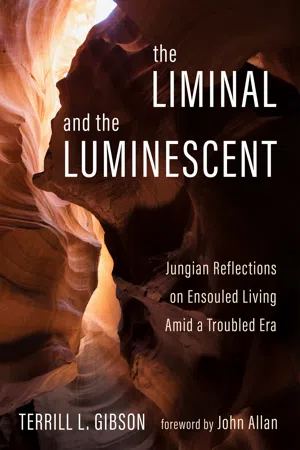
The Liminal and The Luminescent
Jungian Reflections on Ensouled Living Amid a Troubled Era
- 216 pages
- English
- ePUB (mobile friendly)
- Available on iOS & Android
eBook - ePub
The Liminal and The Luminescent
Jungian Reflections on Ensouled Living Amid a Troubled Era
About this book
Our world is bathed in ongoing biological, political, cultural, climate, and spiritual crises that seem endless. If anything, these disruptions appear to be spiraling into ever larger threat fronts that challenge our survival as a species.
Carl Gustav Jung, renowned Swiss psychiatrist, avowed in his archetypal psychology that there is a portal of transforming possibility if we have the courage to enter that doorway. That threshold entering demands that we embrace our individual and collective sufferings and then seek the path of meaning and destiny that is always resident deeply at the core of such trauma.
This book narrates how this destiny is found and lived forward for both each individual life and for our varied human cultures. It affirms and gives examples of the deep-soul dimension of life that lies under the often chaotic surface--the liminal realm of animate and guiding dream, vision, myth, and spirituality where the gods meet us so that we all can find our mutual way Home. This liminal world is navigated through the metaphoric and literalness of pilgrimage, performance, and political processes in our personal and cultural lives. What might be your path of destiny?
Information
Prelude
The World of the Liminal
All life is bound to carriers who realize it, and it is simply inconceivable without them. But every carrier is charged with an individual destiny and destination, and the realization of these alone makes sense of life.
—C. G. Jung1
We live in a badly divided world. It always has been. Religion quarrels with science, alt-right with anarchist, Muslim with Jew, Hindu with Buddhist, Christian with everybody. economies and their rationalizing theories fight it out to the last cent—democratic socialist versus hard capitalist—as do the political handlers of economies: Republican versus Democrat, Tory versus Labor, Teabagger versus Progressive, populist versus socialist, alt-right versus Antifa, non-vaccinated versus vaccinated, masked versus unmasked, All Lives Matter versus Black Lives Matter. Even our brains are caught in seeming trench warfare between left and right hemispheres and their dueling neural integrities.
This is a badly divided world. Always has been. But recently there have been signs that this dualist tradition, this incessant struggle for philosophical hegemony, might be finding a more peaceful place of meeting and integration. In contemporary neurology and meditation practices, it is called the mindfulness movement; in the political realms, it is known as the Commons movement; in the environmental community, it is the Green movement. Among analytical therapies, this place of meeting and integration is called archetypal psychology.
Depth psychologists narrate this new kind of synthesis with a variety of descriptors, but this book will refer to it as the archetypal-liminal perspective, the liminal for short. There are many places to notice its more modern origins, such as William James’s Varieties of Religious Experience (1900), Rudolf Otto’s The Idea of the Holy (1918), or Joseph Campbell’s The Hero with a Thousand Faces (1949). But within my Jungian-analytic school, lightning really hit the ground and broke things wide open when Carl Gustav Jung published Answer to Job in 1953.
Written in a fit of automatic, feverish writing, Jung’s volume tore the veil off his flirtatious rejection of engaging in theological activity. Even while reproducing the same demurs in Answer to Job, the volume makes clear that his lifelong depth-psychoanalytical enterprise constituted psycho-theological work of the most profound significance. In the realm of divine-human dialogue, his work makes clear that the gods are as evolutionarily engaged as human beings; that creator and created are co-evolving together and that the whole enterprise depends on the co-extension of their being into wider and wider dimensions of conscious, compassionate lovingness. The widest container of the cosmos is not the gods, but compassion. In 1953, Jung demonstrated that the liminal is the place where this co-evolution most dramatically reveals itself.2
Then, in 1969, depth psychology cut another deep trench into understanding the thin places between personal and transpersonal experience with the publication of Joseph Henderson’s Threshold of Initiation. For many in the Jungian world, this book’s appearance heralded a deeper consideration of that fragile interface between human and archetypal, personal and numinal [from numen-divine nod]. Some consider it one of the biggest advancements of theoretical and clinical reflection made since Jung’s Answer to Job. Gifted and complementary commentary has unfolded in its wake, from Jeffrey Raff, Clarissa Pincola Estes, Ann Belford Ulanov, John Dourley, Marion Woodman, Dyanne Sherwood, James Hillman, Murray Stein, Tom Singer, and many, many others.
The liminal buffer zone, this thin place between worlds or dimensions of being, is where the gods come to parley with our human angst. It is here where our Destiny—both collective and individual—is revealed. Many believe that this in-between liminal realm, this vast, ripe emptiness within our understandings of conventional time and space, is where our primal wound is healed by the only ultimate balm there is—relationship and love, or what the alchemists called relatio. Many further believe that the gods and we humans are each afflicted by this primal wound; that this deep, authentic, liminal encountering and empathic relating and loving is the only hope for us all. It is by repeated and non-anxious depth repose in this liminal realm that both individuals and cultures can calm themselves and heal. So, it is necessary to find the doorway, the portal, into such depth chambers of the psyche in order for such repeated, transformative exposure to occur. It is through this portal that the depth psycho-spiritual journey begins.
Because the psyche is a vehicle for the experience of the numinosum, and the personality is profoundly affected by archetypal processes, conscious development of the personality becomes a spiritual journey in its own right.3
Jungian psychology is a mystery psychology. Jungian analysis is a mystery religion. It initiates its celebrants into liminal realms, attempting to accompany them in their search for and submission to their authentic destiny. It is a genuine profession, a profession of service to the deepest essence, the core being-ness of those it serves. Of course, it uses pragmatic sciences to help frame and inform its protocols of engagement for companioned sojourns with suffering seekers. But tools are not telos, diagnoses are not destinies. Mystery inspires science, but science does not define mystery. At its best, science can only point the way. In the liminal Queendoms of Mystery, science discovers its true bride: the Soul. Only in the liminal can science complete its mission—the achievement of individual and collective consciousness and compassion.
This book explores ideas about where the portal—that Mystery Portal into the depth chambers of the psyche—might be more reliably located or, perhaps better stated, experienced. It turns its attention to wonderings about how, when, and if we might enter this liminal zone and receive its healing. We will imagine together what our world would look like if there were a depth numinal politics more broadly practiced in both our individual and communal lives. Through theory, cinematic example, depth cultural/political reveries, and input from depth therapists and philosophers, we will attempt to navigate a safe voyage and return across these liminal seas of being with fresh clues and strategies for living less violent, more compassionate, and more meaningful lives both personally and collectively.
This book preaches a crusade—a crusade of recovery. It preaches for the recovery of soulful, public, communal, productive, creative, liminal space. This book offers hints about how we can broaden this peaceful place of co-habitation, civility, and even integration at both the personal and the cultural level. It is a book about Jungian analysis specifically and, more broadly, all psychotherapy. But most importantly it is about living life fully and well...
Table of contents
- Title Page
- Foreword
- Preface
- Acknowledgments
- Prelude
- Pilgrimage
- Performance
- Politics
- Postlude
- Bibliography
Trusted by 375,005 students
Access to over 1.5 million titles for a fair monthly price.
Study more efficiently using our study tools.
Frequently asked questions
Yes, you can cancel anytime from the Subscription tab in your account settings on the Perlego website. Your subscription will stay active until the end of your current billing period. Learn how to cancel your subscription
No, books cannot be downloaded as external files, such as PDFs, for use outside of Perlego. However, you can download books within the Perlego app for offline reading on mobile or tablet. Learn how to download books offline
Perlego offers two plans: Essential and Complete
- Essential is ideal for learners and professionals who enjoy exploring a wide range of subjects. Access the Essential Library with 800,000+ trusted titles and best-sellers across business, personal growth, and the humanities. Includes unlimited reading time and Standard Read Aloud voice.
- Complete: Perfect for advanced learners and researchers needing full, unrestricted access. Unlock 1.5M+ books across hundreds of subjects, including academic and specialized titles. The Complete Plan also includes advanced features like Premium Read Aloud and Research Assistant.
We are an online textbook subscription service, where you can get access to an entire online library for less than the price of a single book per month. With over 1.5 million books across 990+ topics, we’ve got you covered! Learn about our mission
Look out for the read-aloud symbol on your next book to see if you can listen to it. The read-aloud tool reads text aloud for you, highlighting the text as it is being read. You can pause it, speed it up and slow it down. Learn more about Read Aloud
Yes! You can use the Perlego app on both iOS and Android devices to read anytime, anywhere — even offline. Perfect for commutes or when you’re on the go.
Please note we cannot support devices running on iOS 13 and Android 7 or earlier. Learn more about using the app
Please note we cannot support devices running on iOS 13 and Android 7 or earlier. Learn more about using the app
Yes, you can access The Liminal and The Luminescent by Terrill L. Gibson in PDF and/or ePUB format, as well as other popular books in Psychology & Psychology of Religion. We have over 1.5 million books available in our catalogue for you to explore.