eBook - ePub
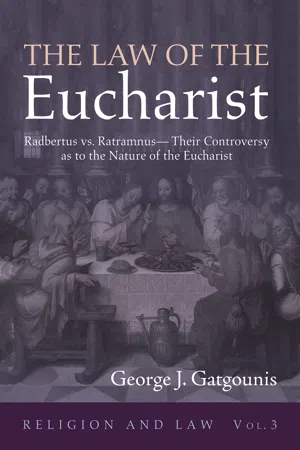
The Law of the Eucharist
Radbertus vs. Ratramnus—Their Controversy as to the Nature of the Eucharist
- 82 pages
- English
- ePUB (mobile friendly)
- Available on iOS & Android
eBook - ePub
The Law of the Eucharist
Radbertus vs. Ratramnus—Their Controversy as to the Nature of the Eucharist
About this book
Christians have been debating for centuries what Jesus meant at the Last Supper when he held out a piece of bread to his disciples and said, "This is my body, which is given for you. Do this in remembrance of me." Christians regularly celebrate the Eucharist, or Holy Communion, based on those words of Jesus, with some form of bread and wine. Most Christians believe that Christ is somehow present but disagree on what that actually means. The Law of the Eucharist: Radbertus vs. Ratramnus--Their Controversy as to the Nature of the Eucharist by the Rev. Dr. George Gatgounis, Esq., examines the issue from the writings of two ninth-century monks. Their arguments can be illuminating to modern exegetes who have to answer the same questions.
Information
Topic
Theology & ReligionSubtopic
Christian DenominationsChapter 1
The Interrelation of Radbert and Ratramn on the Nature of the Eucharistic Elements
Who Is Responding to Whom?
The most thorough treatment of Ratramn’s Eucharistic views is John F. Fahey’s The Eucharistic Teaching of Ratramn of Corbie. In it Fahey argues that Ratramn and Radbert must be understood in relation to each other:
It is no more misleading to quote a sentence out of context than it is to study a controversial book apart from its historical setting . . . like so many pieces of a jig-saw puzzle, the individual treatises seem misshapen and patternless until fitted together.32
To Fahey, a point/counterpoint relation between the two theologians is “historical fact.”33
Moreover, Fahey believes beyond any doubt that Ratramn wrote his treatise around 850 to offer an alternative theological model to ever-growing transubstantiationism articulated in Radbert’s first edition written in 831 (which was revised to its final form in 844).34 But Fahey believes Radbert wrote with Ratramn’s teachings in mind, at least from an oral tradition. If Fahey’s historical reconstruction is correct, Radbert fixed Ratramn as his adversary, furthering the personal and political forces that had already driven them into different positions.35 Personally, Radbert was an abbot and teacher who focused primarily on instruction of the plain folk, and his treatise was designed to be read by the unlettered faithful—while Ratramn was an erudite scholarly monk who purposed to suffuse himself with Augustine.36 To Fahey, the theological disagreement became another dimension of distance between them.37
Calogero Gliozzo disagrees with Fahey, however. He argues that Radbert indeed wrote first but with an another adversary in mind: “Paschase [Radbert], it is true, speaks of adversaries who oppose his doctrine; it seems, however, that he is referring to discourses made against him rather than to written words.”38 Gliozzo elaborates:
We may conclude that the adversaries of Paschase [Radbert] are not found together with him, because he had heard of their objections, that they were men more talkative than learned, and that Paschase knew of no work written in his time, which contained an error concerning the Eucharist.39
Because Ratramn was a scholar resident at Corbie, Gliozzo concludes that Radbert, who wrote first, had some other adversary(s) in mind. Accordingly, Charles, perhaps curious about the fantastic narratives in Radbert’s treatise, asked Ratramn for clarification because Ratramn was an Augustinian scholar.40
Fahey rebuts Gliozzio, however, because Radbert identified his adversary on the issue of the nature of Mary’s childbirth as “one of his brethren.”41 Fahey thinks the only “one of his brethren” who ever publicly opposed Radbert was Ratramn. Accordingly, Fahey concludes Radbert wrote first, responding to Ratramn’s oral teaching.42
Common Ground and Point of Divergence
Regardless of who is responding to whom, the interrelation between Ratramn’s and Radbert’s works on the Eucharist is a divergence not without common ground. This common ground includes both Ratramn and Radbert calling for faith, stressing divine power, agreeing that Christ’s body is present to give life, and affirming the role of the Word and Holy Spirit.43 The specific point of disagreement between the two scholars is the relation of the Eucharist to Christ’s historical body.44 Ratramn argued against the doctrine advanced by various unknown German teachers that Christ was naturally born, but “broke forth mirac...
Table of contents
- Title Page
- Radbertus and Ratramnus—Their Controversy Regarding the Eucharist
- Introduction
- Chapter 1: The Interrelation of Radbert and Ratramn on the Nature of the Eucharistic Elements
- Chapter 2: Radbert’s View of the Elements in the Eucharist
- Chapter 3: The Result of Worthy Partaking of the Elements
- Chapter 4: Ratramn’s View of the Elements in the Eucharist
- Chapter 5: Ratramn’s Theology of Transformation
- Chapter 6: The Nature of Transformation
- Chapter 7: The Place of Ratramn in the Diachronic Development of the Theology of the Eucharist
- Chapter 8: Conclusion
- Appendix
- Bibliography
Trusted by 375,005 students
Access to over 1.5 million titles for a fair monthly price.
Study more efficiently using our study tools.
Frequently asked questions
Yes, you can cancel anytime from the Subscription tab in your account settings on the Perlego website. Your subscription will stay active until the end of your current billing period. Learn how to cancel your subscription
No, books cannot be downloaded as external files, such as PDFs, for use outside of Perlego. However, you can download books within the Perlego app for offline reading on mobile or tablet. Learn how to download books offline
Perlego offers two plans: Essential and Complete
- Essential is ideal for learners and professionals who enjoy exploring a wide range of subjects. Access the Essential Library with 800,000+ trusted titles and best-sellers across business, personal growth, and the humanities. Includes unlimited reading time and Standard Read Aloud voice.
- Complete: Perfect for advanced learners and researchers needing full, unrestricted access. Unlock 1.5M+ books across hundreds of subjects, including academic and specialized titles. The Complete Plan also includes advanced features like Premium Read Aloud and Research Assistant.
We are an online textbook subscription service, where you can get access to an entire online library for less than the price of a single book per month. With over 1.5 million books across 990+ topics, we’ve got you covered! Learn about our mission
Look out for the read-aloud symbol on your next book to see if you can listen to it. The read-aloud tool reads text aloud for you, highlighting the text as it is being read. You can pause it, speed it up and slow it down. Learn more about Read Aloud
Yes! You can use the Perlego app on both iOS and Android devices to read anytime, anywhere — even offline. Perfect for commutes or when you’re on the go.
Please note we cannot support devices running on iOS 13 and Android 7 or earlier. Learn more about using the app
Please note we cannot support devices running on iOS 13 and Android 7 or earlier. Learn more about using the app
Yes, you can access The Law of the Eucharist by George J. Gatgounis in PDF and/or ePUB format, as well as other popular books in Theology & Religion & Christian Denominations. We have over 1.5 million books available in our catalogue for you to explore.