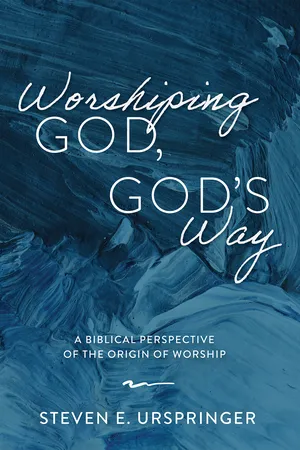
eBook - ePub
Worshiping God, God’s Way
A Biblical Perspective of the Origin of Worship
- 234 pages
- English
- ePUB (mobile friendly)
- Available on iOS & Android
eBook - ePub
About this book
Worshiping God, God's Way: A Biblical Perspective of the Origin of Worship explores the theology behind what Jesus called "true" worship in John 4:24. The book carefully highlights the emergence from the praise movement which began in the 1980s, to today's contemporary theology which uses the catchphrase, "everything we do is worship."
Information
Part One
Definition of Worship
Chapter 1
Humanity’s Assignment
Then Jesus told him, “Go away, Satan! Because it is written, ‘You must worship the Lord your God and serve Him only.’”
—Matt 4:10
In Matt 4:10, Jesus, prior to entering the work of his ministry, announces that worshiping God, and the service that accompanies it, is humanity’s assignment; to be worshipers who serve is the call. Many of us have found God’s various service assignments for our lives. Equally important is the discovery of the ministry of worship. To be called a worshiper sounds simple, but is it? Like the mission of service, which comes from heaven’s designated plan, worshiping God, God’s way, begins with a heavenly design. Do we know what that is?
Today, there is a widespread belief among Christian communities that say every portion of our lives is an expression of worship. The common phrase, “Everything we do is worship,” permeates church gatherings everywhere. Contrary to this catchphrase, not everything we do in daily life, regardless of our intention to serve God, is an act of worship. It would be less stressful to simply ignore this notion. Nonetheless, having encountered God, knowing him personally, we cannot forgo our responsibility to present his word accurately.
Being students of scripture, we accept the fact that we are on a life journey with him, and there will always be something new to learn, regardless of age or past religious experience. An early example of this is found in The Book of Job, chapter 47 (the last chapter). Job comes to the realization that the process of knowing God is ongoing. He says, “I had only heard about you, but now I see you.” God responds by saying that his servant Job delivered his word accurately, and because of this, all of Job’s prayers would be answered and his friends would be blessed. It is for this reason that an effort is made to deliver God’s word accurately when studying worship. Undoubtedly, all of us want our prayers to be answered, as well as our family and friends to be blessed. Therefore, when studying God’s word, fastidiousness is important, which is a big word that means “being correct.” We can know the truth about worship because heaven’s dictionary is in our hands, we only need to be diligent. For those of us who are drawn to worship, heaven’s perspective is an asset. The goal is to be aligned with worship as it is in heaven, worshiping God, God’s way. So, we start from the beginning.
Chapter 2
The Origin of Worship
Searching out the origin of worship must begin with referencing the word’s etymology in the dictionary, which comes from what is known as Old English. In the Old English language, the early spelling of worship was “Worth-Ship.”1 This simply means to honor someone or something in some form or fashion. This earthly explanation of worth-ship, now worship, is a sliver of a thought, far from the heavenly description that we read about in scripture. The worth-ship that comes out of respect of another man’s riches, talents, or accomplishments is ashes compared to worship that is offered to the one and only creator, God.
God is worthy of it all, but the definition of worship in today’s vernacular does not make room for God’s full supremacy. Modern language, combined with Christian doctrine, as well as postmodern traditions, have created a theology of worship. These doctrines have born within the Christian community a belief system that misrepresents heaven’s presentation of worship. Over the centuries, the word worship has lost its identity. In place of its heavenly designed response to God’s awesome power and greatness, we follow an outline, a prescribed service labeled worship.
In the book of John, chapter 4, Jesus brings to our attention a new/old concept: True Worship. The word that Jesus uses in John 4 is not worth-ship according to old English. What Jesus describes is derived from heaven itself, giving us a picture of our worship heritage, a heritage born not of this earth. The verse that establishes this heritage is found in the following scripture. It begins in the book of Neh.
You alone are the Lord. You made the heavens and all the stars. You made the earth and the seas, and everything in them. You preserve them all, and the angels of heaven worship him. (Neh 9:6)
Before the heavens and stars, the earth and the seas, angelic beings worshiped God in heaven. Nehemiah reveals the origin of worship. Worship was taking place as God was in the process of creating the universe. The universe was in a state of change, yet worship was a constant. Worship was activated at a time when the earth was not yet in existence. This leads me to believe that the act of worship is firmly rooted in heaven’s culture, older than creation itself. This is far from a manmade effort to satisfy an earthly spiritual need. Heaven-designed worship is much more elevated than a religious service entrenched in a selected, human perspective of common liturgy, modern or emerging church theology. In The Book of Neh, the word worship is the same word used throughout the entire Old Testament, and it is the same word that Jesus uses in the book of John chapter 4, with the additive of the Greek language. Not only is the word used at the beginning of creation, it describes worship in The Book of Rev at the end times. That is why I say, worship is a constant.
The act of worship that is found in the heavens, God is looking for, waiting for and craving from his creation, even today, right now. We know by reading Heb 13:8 that God is the same yesterday, today and forever. Like God himself, worship is relentless. The word itself does not change, nor can it be altered to suit a philosophy or theology, lifestyles, or worldviews. Worship can be called true when it is presented to God according to his blueprint. This heavenly designed blueprint of worship can be found throughout scripture and examined through the definitions that God offers to us in his word. It is these words that define for us the act of worship itself, what it is, when it happens, and with whom. When we understand heaven’s vocabulary, we are most likely to worship God, God’s way. The key is to see worship through God’s eyes, seeing his perspective as we cultivate our terminology of worship.
1. Cornwall, Let Us Worship, 48.
Chapter 3
Worship, the Word
When reading God’s word, various themes are present. In these themes, the predominant thread is worship. Angelic hosts cry out, “Worship him! Worship him!”
All the while, people are saying, “We are! We are!”
When reading the historical journey of the Hebrew nation, we see the people of God replace the act of worship for something else, something manmade. God makes it clear, yet their eyes are murky. When it comes to true worship, there is a blind spot in the human spirit, hindering people from grasping what God is wanting. Here lies the problem.
In the Old Testament, the act of worship was familiar; still, their stubborn hearts ruled them. Failing, they worshiped God in a way that pleased themselves. People, whether they consciously know it or not, have their own personal theology about worship. A woman once said to me that the church where she attends worships God in many ways. That said to me, everyone does it according to their own personal twist. It reminded me of the people of Israel—a past generation of children found in the wilderness. Worship traditions are passed on to each generation. This generation today is developing a new tradition of worship based on self-acceptance and personal preference.
Not only is the word worship misused, it has evolved into a product born out of a world of social media. People say, “That is the way worship is: it is many things, you have to accept it for what it is.” No! You do not have to accept anything not found in heaven’s fields.
The phrase “Worship and Praise” has found its place in nearly every home in America: it’s being broadcast on the airwaves, used in television marketing, and in advertising. It is heard or seen on every screen, hanging on the walls of our homes and on the screens in the palm of our hands. On every continent, in each country of the world, we have watched as Christians stand behind microphones singing worsh...
Table of contents
- Title Page
- List of Abbreviations
- Introduction
- Part One: Definition of Worship
- Part Two: Stories of Worship
- Conclusion
- Bibliography
Trusted by 375,005 students
Access to over 1.5 million titles for a fair monthly price.
Study more efficiently using our study tools.
Frequently asked questions
Yes, you can cancel anytime from the Subscription tab in your account settings on the Perlego website. Your subscription will stay active until the end of your current billing period. Learn how to cancel your subscription
No, books cannot be downloaded as external files, such as PDFs, for use outside of Perlego. However, you can download books within the Perlego app for offline reading on mobile or tablet. Learn how to download books offline
Perlego offers two plans: Essential and Complete
- Essential is ideal for learners and professionals who enjoy exploring a wide range of subjects. Access the Essential Library with 800,000+ trusted titles and best-sellers across business, personal growth, and the humanities. Includes unlimited reading time and Standard Read Aloud voice.
- Complete: Perfect for advanced learners and researchers needing full, unrestricted access. Unlock 1.5M+ books across hundreds of subjects, including academic and specialized titles. The Complete Plan also includes advanced features like Premium Read Aloud and Research Assistant.
We are an online textbook subscription service, where you can get access to an entire online library for less than the price of a single book per month. With over 1.5 million books across 990+ topics, we’ve got you covered! Learn about our mission
Look out for the read-aloud symbol on your next book to see if you can listen to it. The read-aloud tool reads text aloud for you, highlighting the text as it is being read. You can pause it, speed it up and slow it down. Learn more about Read Aloud
Yes! You can use the Perlego app on both iOS and Android devices to read anytime, anywhere — even offline. Perfect for commutes or when you’re on the go.
Please note we cannot support devices running on iOS 13 and Android 7 or earlier. Learn more about using the app
Please note we cannot support devices running on iOS 13 and Android 7 or earlier. Learn more about using the app
Yes, you can access Worshiping God, God’s Way by Steven E. Urspringer in PDF and/or ePUB format, as well as other popular books in Theology & Religion & Biblical Criticism & Interpretation. We have over 1.5 million books available in our catalogue for you to explore.