- 170 pages
- English
- ePUB (mobile friendly)
- Available on iOS & Android
eBook - ePub
About this book
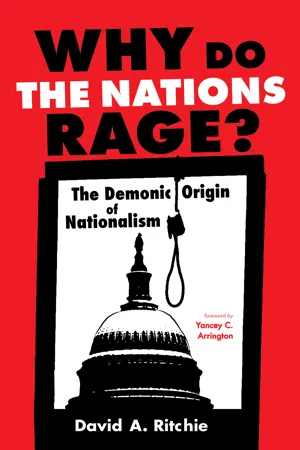
What if we understood nationalism as a religion instead of an ideology? What if nationalism is more spiritual than it is political? Several Christian thinkers have rightly recognized nationalism as a form of idolatry. However, in Why Do the Nations Rage?, David A. Ritchie argues that nationalism is inherently demonic as well. Through an interdisciplinary analysis of scholarship on nationalism and the biblical theology behind Paul's doctrine of "powers," Ritchie uncovers how the impulse behind nationalism is as ancient as the tower of Babel and as demonic as the worship of Baal. Moreover, when compared to Christianity, Ritchie shows that nationalism is best understood as a rival religion that bears its own distinctive (and demonically inspired) false gospel, which seeks to both imitate and distort the Christian gospel.
Information
Part I
More Things in Heaven and Earth
1
A People Possessed
“A nation is a soul, a spiritual principle.”
—Ernest Renan, Qu’est-ce qu’une nation? (1882)
“See to it that no one takes you captive by philosophy and empty deceit, according to human tradition, according to the elemental spirits of the world, and not according to Christ.”
—Colossians 2:8
A Rival Religion
The gallows got my attention. They arose from the chaos, signaling murderous intent, as the mob surged like a tsunami around the Capitol steps. “Hang Mike Pence!” voices shouted in unison as realtors and veterans and insurance agents, now insurgents, pressed and burst into the federal building. Lawmakers fled, as men wearing tactical gear swept the legislative chambers with zip-ties in hand, presumably for the purpose of arresting and punishing those leaders deemed treasonous. Some of the rioters came prepared for revolution. Some seem to have been swept up in the spirit of the moment, unaware of the ramifications of what their choices would have on their lives and their nation.
On that day, January 6, 2021, as I saw pictures and footage of the events transpiring in the United States Capitol, I felt angry that the violent political rhetoric in American politics had now increasingly manifested in violent actions. I felt concerned that this extreme event might be a prelude to an even more extreme future. I felt ashamed that such displays had now come to be expected from my nation’s toxic political theater. Most of all, as a pastor, I felt grieved that images of the name of my Savior were displayed alongside this spectacle of nihilistic division and death.
In the days that followed, videos surfaced of worship songs being sung on the Capitol lawn during the invasion and of the man with the iconic horned helmet and star-spangled face-paint offering a prayer “in Christ’s holy name” within the invaded Senate Chamber. Consequently, think pieces on the topic of “Christian nationalism” began to dominate editorial pages and social media feeds.
How did it come to this? How did Christianity come to be so identified with the ideology known as nationalism? How could some Christians themselves be so enchanted, so deceived, so (dare I say) possessed so as to justify conspiracy theories, mob violence, and insurrection?
Despite the recent focus on what many term as “white Christian nationalism” in America, nationalism itself is not inherently bound to any one ethnicity, religion, or nationality.1 Nor is it by any means a recent phenomenon. In fact, nationalism studies surged as the dust settled from World War 2, as a way to understand, reckon with, and hopefully prevent the devastation of such global conflict. Interestingly, the same time period saw a corresponding increase in interest regarding the Apostle Paul’s doctrine of “powers.”2 In exploring the powers, theologians rediscovered biblical language and categories to describe the spiritual evil that inspired Nazi Germany to inflict the unimaginable horror of the Holocaust.
But what if nationalism and the powers are more than casually related? What if the biblical category of powers actually helps explain the spiritual aspects and agencies behind nationalism in ways that the social sciences could not? What if the Apostle Paul can help us understand why nationalism is such an enduring and alluring form of idolatry, especially among people of faith today?
I have no intention of demeaning or devaluing sociological or historical perspectives on nationalism. Studying nationalism through the familiar lens of the social sciences can yield helpful and indispensable insights.3 We don’t need less than the social sciences. But we do need something more; something that helps us see beyond the confined horizons of the “immanent frame.”4 Indeed, there are more things in heaven and earth than are dreamt of in our secular philosophy, and a biblically-derived spiritual realism brings forth a necessary perspective for Christians to understand and navigate the transcendent dynamics behind nations and nationalism.
Since nationalism involves the exaltation of a nation (or a particular conception5 of a nation) to the highest place of allegiance, concern, and devotion, it is essentially idolatrous, as several Christian critics of nationalism have observed. However, in the coming pages, I will argue that nationalism is inherently demonic as well.
Through an interdisciplinary analysis of scholarship on nationalism and Paul’s doctrine of powers, we will learn how the impulse behind nationalism is as ancient as the tower of Babel and as demonic as the worship of Baal. Indeed, when examined through the lens of biblical demonology, you will discover that there is little distinction between the ancient pagan’s worship of a national patron deity and the contemporary nationalist’s tendency to exalt a particular nation to a place of functional divinity.
I will be upfront with my goal. By the time you come the final page of this book, I want you to see that Christianity and nationalism are rival religions.
I write about...
Table of contents
- Title Page
- Foreword
- Acknowledgements
- List of Abbreviations
- Part I: More Things in Heaven and Earth
- Part II: Ancient Origins
- Part III: The Apostle, the Powers, and the Nations
- Part IV: Christianity and Nationalism
- Part V: Where Do We Go from Here?
- Bibliography
Trusted by 375,005 students
Access to over 1.5 million titles for a fair monthly price.
Study more efficiently using our study tools.
Frequently asked questions
Yes, you can cancel anytime from the Subscription tab in your account settings on the Perlego website. Your subscription will stay active until the end of your current billing period. Learn how to cancel your subscription
No, books cannot be downloaded as external files, such as PDFs, for use outside of Perlego. However, you can download books within the Perlego app for offline reading on mobile or tablet. Learn how to download books offline
Perlego offers two plans: Essential and Complete
- Essential is ideal for learners and professionals who enjoy exploring a wide range of subjects. Access the Essential Library with 800,000+ trusted titles and best-sellers across business, personal growth, and the humanities. Includes unlimited reading time and Standard Read Aloud voice.
- Complete: Perfect for advanced learners and researchers needing full, unrestricted access. Unlock 1.5M+ books across hundreds of subjects, including academic and specialized titles. The Complete Plan also includes advanced features like Premium Read Aloud and Research Assistant.
We are an online textbook subscription service, where you can get access to an entire online library for less than the price of a single book per month. With over 1.5 million books across 990+ topics, we’ve got you covered! Learn about our mission
Look out for the read-aloud symbol on your next book to see if you can listen to it. The read-aloud tool reads text aloud for you, highlighting the text as it is being read. You can pause it, speed it up and slow it down. Learn more about Read Aloud
Yes! You can use the Perlego app on both iOS and Android devices to read anytime, anywhere — even offline. Perfect for commutes or when you’re on the go.
Please note we cannot support devices running on iOS 13 and Android 7 or earlier. Learn more about using the app
Please note we cannot support devices running on iOS 13 and Android 7 or earlier. Learn more about using the app
Yes, you can access Why Do the Nations Rage? by David A. Ritchie in PDF and/or ePUB format, as well as other popular books in Politica e relazioni internazionali & Nazionalismo e patriottismo. We have over 1.5 million books available in our catalogue for you to explore.