eBook - ePub
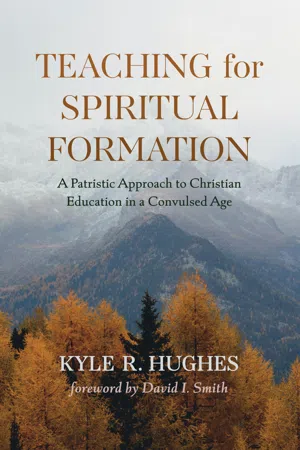
Teaching for Spiritual Formation
A Patristic Approach to Christian Education in a Convulsed Age
- 198 pages
- English
- ePUB (mobile friendly)
- Available on iOS & Android
eBook - ePub
Teaching for Spiritual Formation
A Patristic Approach to Christian Education in a Convulsed Age
About this book
In Teaching for Spiritual Formation, church historian and experienced Christian educator Kyle R. Hughes advances a fresh vision of Christian teaching and learning by drawing upon the riches of the Christian tradition, synthesizing the wisdom of the early church fathers with contemporary efforts to cultivate a distinctively Christian approach to education. Of interest to a wide range of Christian educators, this book examines how the writings of five significant church fathers can illuminate our understanding of the vocation of teachers, the nature of students, the purpose of curriculum, decisions about pedagogy, and how spiritual formation works. Besides reimagining these aspects of Christian education, Hughes also offers habits and practices that can help bring this vision of Christian teaching and learning to life, challenging Christian educators to sharpen their approach to the integration of faith and learning in practical and accessible ways.
Information
Topic
Theology & ReligionSubtopic
Christian Ministry1
Introduction
Christian Education in a Convulsed Age
Christian schooling presents both profound challenges and incredible opportunities for those seeking to provide students with an education that contributes to their formation into disciples of Jesus Christ. While many teachers, professors, and administrators have discerned a call to this vocation precisely because of their desire to see young people grow into Christ’s likeness, they may at times struggle to discern how best to carry out this work in an authentic and transformational way. We live in a convulsed age—as I write this, the United States is contending with far-reaching upheavals resulting from a global pandemic, economic downturn, and the legacy of racial inequality, and all of this in a broader time of intensifying political polarization, rapid technological and demographic change, and increasing environmental crisis. This is the world into which we are sending our students, young people who may already be experiencing the effects of these upheavals and uncertainties in their own lives, or perhaps are simply dealing with the more mundane (and yet, for them, no less real and significant) matters of meeting parental expectations, fitting in with peers, and facing learning difficulties. Likewise, many Christian educators are also experiencing convulsions in their work, adapting to new forms of virtual learning, staring down budget cuts, and wondering if their efforts are actually making any difference at all. As a teacher myself, I know that I often feel like I am just treading water. It can feel difficult enough to get through the required course content and grade yet another stack of essays; broader conversations about “the integration of faith and learning” can seem as distant and useless as the bottom of the sea.
And yet, the calling for Christian educators remains. Christ tells us that he came that we might have life—true, abundant, complete life—here and now, even in our present circumstances (John 10:10). It is this quality of life that we long for our students to taste and to see, as we have, that the Lord is good (Ps 34:8). It is a life in which we are reminded that we will have our portion of hardship and suffering, and yet it is in precisely those things that we will find true joy and communion with Christ (1 Pet 4:12–13). It is, moreover, a life in which we can become like trees planted by streams of water, yielding the fruit of love of God and love of neighbor for the healing of the world (Ps 1:3; Rev 22:2). This, then, is the life to which we endeavor to invite our students, even as we are very much in the process of figuring this out for ourselves. If anything, the present trials and tribulations of our world should only heighten the urgency with which we seek, for ourselves and for our students, the life that Christ brings. But how?
In light of the complexities and challenges of our present time and place, the early church fathers—those key figures of the first Christian centuries whose lives and writings guide the church’s doctrine and practice to this day—would at first glance appear to be unlikely conversation partners for educators interested in making deeper connections between their Christian faith and the work of teaching and learning. It is my contention, however, that it is precisely in a time such as ours that the voices of our great forefathers need to be invited to the table. We need the church fathers to speak afresh that wisdom that has endured through the centuries and proven itself time and again to be a source of inspiration and edification for Christians through the ages. This book, then, is an attempt to advance a fresh vision of Christian teaching and learning by drawing upon the riches of the Christian tradition, synthesizing the wisdom of the church fathers with contemporary efforts to cultivate a distinctively Christian approach to education.
Two Key Presuppositions
Before beginning our engagement with the church fathers and what they can teach us about Christian education, a few words are in order to explain how I have arrived at my understanding of the purpose of Christian education and the relevance of the church fathers. While some readers may no doubt be eager to move on to begin engaging with the first of the church fathers we will examine in this book (and are welcome to do so), further attention to these two points will help make sense of the approach that undergirds the following chapters.
The Purpose of Christian Education
First, I hold that the goal of Christian education is not simply to produce graduates who know things about English, history, math, science, or even theology but rather to form graduates who become certain kinds of people—disciples of Jesus Christ. To validate this claim, we must briefly consider what we mean by “education” in the first place. In James K. A. Smith’s influential definition, “An education . . . is a constellation of practices, rituals, and routines that inculcates a particular vision of the good life by inscribing or infusing that vision into the heart (the gut) by means of material, embodied practices.”1 For Christian educators, then, this means that “the primary goal of Christian education is the formation of a peculiar people—a people who desire the kingdom of God and thus undertake their vocations as an expression of that desire.”2 In other words, the ultimate end (that is, the telos) of Christian education is to help shape students’ understanding of “the good life” as one that is centered on Christ and his kingdom, such that they are challenged to reorient more and more of their lives in light of the gospel. Rather than reducing students to what Smith provocatively calls “brains on a stick,” empty containers into which the expert teacher pours her knowledge, this approach to education proceeds from a truly Christian anthropology that sees students, like all people, as embodied beings, who by means of their habits, relationships, and the Holy Spirit are formed into people who come to desire the things of God above the things of this world.3
We will return to this point below, but for now it will suffice to say that Smith helps us to see that the work of Christian education is in fact the work of discipleship, here carried out not in the sanct...
Table of contents
- Title Page
- Acknowledgments
- Timeline of Key Events and Texts
- Foreword
- Chapter 1: Introduction
- Chapter 2: Who Are We as Teachers?
- Chapter 3: Who Are Our Students?
- Chapter 4: What Are We Teaching?
- Chapter 5: How Are We Teaching?
- Chapter 6: How Do We Plan for Growth?
- Conclusion
- Appendix 1
- Appendix 2
- Appendix 3
- Appendix 4
- Appendix 5
- Bibliography
Trusted by 375,005 students
Access to over 1.5 million titles for a fair monthly price.
Study more efficiently using our study tools.
Frequently asked questions
Yes, you can cancel anytime from the Subscription tab in your account settings on the Perlego website. Your subscription will stay active until the end of your current billing period. Learn how to cancel your subscription
No, books cannot be downloaded as external files, such as PDFs, for use outside of Perlego. However, you can download books within the Perlego app for offline reading on mobile or tablet. Learn how to download books offline
Perlego offers two plans: Essential and Complete
- Essential is ideal for learners and professionals who enjoy exploring a wide range of subjects. Access the Essential Library with 800,000+ trusted titles and best-sellers across business, personal growth, and the humanities. Includes unlimited reading time and Standard Read Aloud voice.
- Complete: Perfect for advanced learners and researchers needing full, unrestricted access. Unlock 1.5M+ books across hundreds of subjects, including academic and specialized titles. The Complete Plan also includes advanced features like Premium Read Aloud and Research Assistant.
We are an online textbook subscription service, where you can get access to an entire online library for less than the price of a single book per month. With over 1.5 million books across 990+ topics, we’ve got you covered! Learn about our mission
Look out for the read-aloud symbol on your next book to see if you can listen to it. The read-aloud tool reads text aloud for you, highlighting the text as it is being read. You can pause it, speed it up and slow it down. Learn more about Read Aloud
Yes! You can use the Perlego app on both iOS and Android devices to read anytime, anywhere — even offline. Perfect for commutes or when you’re on the go.
Please note we cannot support devices running on iOS 13 and Android 7 or earlier. Learn more about using the app
Please note we cannot support devices running on iOS 13 and Android 7 or earlier. Learn more about using the app
Yes, you can access Teaching for Spiritual Formation by Kyle R. Hughes in PDF and/or ePUB format, as well as other popular books in Theology & Religion & Christian Ministry. We have over 1.5 million books available in our catalogue for you to explore.