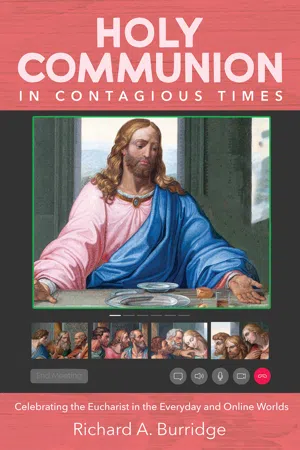
eBook - ePub
Holy Communion in Contagious Times
Celebrating the Eucharist in the Everyday and Online Worlds
- 300 pages
- English
- ePUB (mobile friendly)
- Available on iOS & Android
eBook - ePub
Holy Communion in Contagious Times
Celebrating the Eucharist in the Everyday and Online Worlds
About this book
Can the church celebrate the eucharist in "contagious times," like the coronavirus pandemic, and if so, how? In this book, Richard Burridge investigates a wide range of proposed options, both in the everyday physical world (fasting the eucharist, spiritual communion, solo and concelebrated communions, lay presidency, drive-in and drive-thru eucharists, and extended communion) and in cyberspace (computer services for avatars, broadcast eucharists online, and narrowcast communions using webinar software like Zoom). Along the way, he tackles the whole range of concepts of the church, ordination, and the eucharist. This book is essential reading for anyone desiring an informed and provocative guide to the theology and practice of holy communion in our challenging times.
Information
1
Introduction
Holy Communion and the (Inter-)national Closure of Churches in Contagious Times
At the end of 2019, I moved from London to a village in north Cheshire on the edge of Greater Manchester in the hope of finding a quieter life in order to give myself more fully to my research and writing. It seemed to have all the essentials: a beautiful location on the banks of a canal, looking at the Peak District, with a welcoming ‘local’ pub a short walk along the tow path and a golf club about a mile further along, and it was situated halfway up a long steep hill in between two Anglican churches, one at the bottom and one at the top. Paradoxically, the parish church in the upper village was about as ‘low’ as possible in the evangelical tradition of the Church of England, while its neighbour down the hill in the lower village was still clearly a product of the Anglo-Catholic ‘high’-church revival of the mid-late nineteenth century. Rather than their contrasting Sunday services, I began to frequent the mid-week ‘said-communion with sermon’ at the higher church lower down the hill on a Wednesday morning. The golf course had beautiful views all across to the north-west coast, but it was unfortunately impossible for me to cope with as I was waiting for a knee replacement operation—and buggies would not be allowed on the course until Easter. At least the pub landlord and his wife were very friendly and served excellent local ales with a wide range of gins, and I also found a music studio in the town offering tuition, music appreciation classes, and a Friday night ‘open-mic’ for regulars to play a party piece. Everything seemed set fair for a blissful future—if only we could deal with the persistent coughs and sniffles various people seemed to have picked up . . . .
Within a couple of months, everything had changed: the flu-like symptoms had developed into COVID-19, the pub and the golf course were closed down, my knee replacement had been cancelled by a hospital overwhelmed by victims of the pandemic, and the music studio’s events were all moved online. Meanwhile, all the parish churches had been instructed by the archbishops of Canterbury and York to shut their doors. The eucharist or communion services offered weekly or even daily in many churches for centuries were withdrawn as a potential source of infection. This had never happened before—not even in the worst pandemics of the Plague or the Black Death. Of course, the pandemic quickly produced its rollcall of heroes, as we clapped and banged saucepans on doorsteps every Thursday night ‘for the NHS’, or greeted the angels of mercy, presenting as delivery drivers, leaving food orders or cardboard boxed packages at the end of the garden path—the only human beings we saw, and the cost of whose service began to emerge as many succumbed to the rising death toll. But others started to ask, where were the churches and the clergy—and how could we survive spiritually without the bread of heaven and the blood of Christ?
The Church of England Shuts Up Shop
The initial steps began with the ‘first letter’ from the archbishops of Canterbury and York (March 10, 2020), which implemented the withdrawal of the chalice (resulting in communion in one kind only) and the suspension of all physical contact at the Peace (moving to so-called namaste greetings or bowing to each other). This was followed a fortnight later by their ‘second letter’ of March 24, 2020, with the announcement, that “All Church of England churches are to close with immediate effect, including for private prayer, in an effort to help limit the transmission of the coronavirus COVID-19,” and therefore they encouraged clergy that “live streaming of services is more important than ever.”1 This was quickly confirmed by the updated ‘third letter’ of March 27, 2020, which however also stressed that the closure of church buildings was “to prevent them being used for streaming.”2 It is interesting that there is no mention of communion or eucharist anywhere in the press releases, announcements, or any of the archbishops’ letters, and it soon became the ‘Elephant in the Room’, which concerned everyone, but which was not being discussed openly in the national communications.
The waters were further muddied by variations from diocese to diocese, and the regular moving of the goalposts: thus on March 12, 2020 London Diocese issued a list of churches livestreaming their services, and basic instructions for doing so,3 but then livestreaming was restricted on March 22 to the sole exception for those within ‘the curtilage’ that “Clergy who live adjacent to their churches may still go into the building and pray and even celebrate the Eucharist.”4
Yet the next day, London issued clear guidance for the “huge number of London parishes who are live streaming their worship”, by now too many to list individually, presumably not all within the curtilage, hence the confusion.5 On March 31, the London College of Bishops (with particular theological input from the bishops of Kensington and Fulham from their contrasting church traditions) provided a very helpful paper on “The Eucharist in a Time of Physical Distancing” with three options—suspending celebrating the eucharist altogether; the priest celebrating it livestreamed; or the priest celebrating alone or with members of their household, but having advertised the time publicly as per instructions in the BCP so the laity could join in prayer at the same time.6
The wide range of interpretations across various dioceses such as Durham, Bradford, Chichester, London, Chelmsford, Leeds, prompted the Church’s national adviser on medical ethics, the Rev’d Dr Brendan McCarthy, to say, “Public worship has been suspended in line with government advice in order to protect people as, together, we tackle this coronavirus epidemic.”7 On the other hand, the government issued a Statutory Instrument on March 26, allowing that “A place of worship may be used (a) for funerals, (b) to broadcast an act of worship, whether over the internet or as part of a radio or television broadcast, or (c) to provide essential voluntary services or urgent public support services” (paragraph 5.6).8 Internet commentators quickly noted the contrast between the government’s statutory instrument permitting churches “to broadcast an act of worship, whether over the internet or as part of a radio or television broadcast”, while “Church of England diocesan bishops remain more restrictive . . . and broadcasting is forbidden from inside church buildings.”9
Similar press coverage on Tuesday of Holy Week, April 7 suggesting that London Diocese was telling “Vicars to ignore guidelines banning them from their own churches” forced the London College of Bishops to issue a new statement instructing everyone, this time even including those able to access their buildings within the curtilage without going onto the public street, “to stop all live streaming from your church buildings for the time being.”10 The implication was clear, that we had been taken into a spiritual wilderness with no actual communions taking place in churches at all.
A popular meme often repeated on social media on both sides...
Table of contents
- Title Page
- Preface and Acknowledgements
- Chapter 1: Introduction
- Part I: Holy Communion in “Contagious Times” in the Everyday World
- Part II: Holy Communion and Technology in the Digital Online World
Trusted by 375,005 students
Access to over 1.5 million titles for a fair monthly price.
Study more efficiently using our study tools.
Frequently asked questions
Yes, you can cancel anytime from the Subscription tab in your account settings on the Perlego website. Your subscription will stay active until the end of your current billing period. Learn how to cancel your subscription
No, books cannot be downloaded as external files, such as PDFs, for use outside of Perlego. However, you can download books within the Perlego app for offline reading on mobile or tablet. Learn how to download books offline
Perlego offers two plans: Essential and Complete
- Essential is ideal for learners and professionals who enjoy exploring a wide range of subjects. Access the Essential Library with 800,000+ trusted titles and best-sellers across business, personal growth, and the humanities. Includes unlimited reading time and Standard Read Aloud voice.
- Complete: Perfect for advanced learners and researchers needing full, unrestricted access. Unlock 1.5M+ books across hundreds of subjects, including academic and specialized titles. The Complete Plan also includes advanced features like Premium Read Aloud and Research Assistant.
We are an online textbook subscription service, where you can get access to an entire online library for less than the price of a single book per month. With over 1.5 million books across 990+ topics, we’ve got you covered! Learn about our mission
Look out for the read-aloud symbol on your next book to see if you can listen to it. The read-aloud tool reads text aloud for you, highlighting the text as it is being read. You can pause it, speed it up and slow it down. Learn more about Read Aloud
Yes! You can use the Perlego app on both iOS and Android devices to read anytime, anywhere — even offline. Perfect for commutes or when you’re on the go.
Please note we cannot support devices running on iOS 13 and Android 7 or earlier. Learn more about using the app
Please note we cannot support devices running on iOS 13 and Android 7 or earlier. Learn more about using the app
Yes, you can access Holy Communion in Contagious Times by Richard A. Burridge in PDF and/or ePUB format, as well as other popular books in Theology & Religion & Christian Canon & Ecclesiastical Law. We have over 1.5 million books available in our catalogue for you to explore.