- 154 pages
- English
- ePUB (mobile friendly)
- Available on iOS & Android
eBook - ePub
About this book
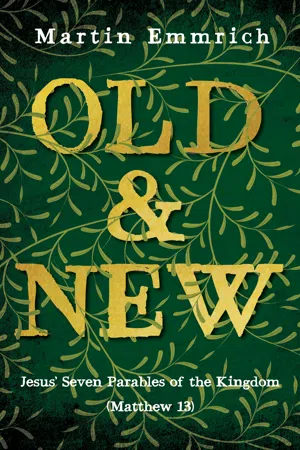
What did Jesus think of the kingdom of God? How did his concept differ from those of his contemporaries, and how does it still pose some stiff challenges for twenty-first-century Christians? Old and New contributes to the study of Jesus' parables as the first comprehensive analysis of the seven kingdom parables assembled in Matthew 13 in a single volume. Martin Emmrich argues that the placement, content, and arrangement of the chapter are highly significant in terms of the overall shape of Matthew's Gospel, as well as offering a timeless witness of Jesus' notion of the coming of his reign. Old and New features some unique exegetical details along with sweeping theological vistas, all of it carefully balanced with edifying illustrations and examples. The work not only deepens the reader's appreciation of the text, but also provides ample incentives for soul-searching reflection.
Information
Topic
Theology & ReligionSubtopic
Biblical Studies1
The Kingdom of God Requires a Decision
In the 2015 drama Mr. Holmes, the now 97-year old legendary detective attempts to solve the greatest mystery of his life: Why did he retire 35 years ago? The ensuing investigation into his past life is hampered by memory loss, but eventually, the truth begins to take shape, and the great Sherlock Holmes manages to put the pieces of the puzzle together for one last time. What he discovers is that he had refused to get personally involved with someone in a difficult case. The master class private investigator had always had the accolade of being a supremely rational person, whose famous ability to solve mysteries depended on focusing on facts and not emotions. So he would never become entangled in any relationship. His stubborn refusal caused a death. The experience forced him to resign from his profession and haunted him for the rest of his life. In the end, Holmes has to come to terms with the truth that the missing solution, not only to the mystery but to his own happiness, is a simple decision: he must allow himself to get personally involved with people.
In the same way, everyone faces the decision to get personally involved with God. Jesus’ teaching about the kingdom of God calls for the decision to take him at his word, the most crucial decision any human will make in his/her life. It is as dramatic as a man’s mishap, taking a tumble over a cliff, but was able to grasp a branch on his way to the bottom 1000 feet below. His strength fading, he cried, “God, if you’re real, save me, and I will trust and obey you with all my heart!” Then a mighty voice roared through the canyon: “So they all say when in trouble!” The man replied, “No, God, I mean it, I swear, save me!” “So be it,” said the voice, “I will save you. Let go of that branch, and I will catch and carry you.” — “Let go of the branch? Am I crazy?” the man shrieked, and he woke up — it was only a dream. But throwing yourself at God’s feet is like free fall, it is all or nothing, with no Plan B. It was so when people heard Jesus, whose teaching always forced a radical decision to embrace his new word of the kingdom.
The opening story of Matthew 13 is the parable of the Sower (13:1–9, 18–23). The imagery of sowing, soils, and harvesting were certainly recognizable metaphors of the Old Testament. Jer 31:27 identifies God as the Sower, saying, “The days are coming, declares the LORD, when I will sow the house of Israel and the house of Judah with the seed of man and the seed of beast.” The coming days are then specified as the era of a new covenant (31:31–34). Sowing seed, therefore, was no novel idea but connected with Israel’s eschatological expectations (cf. also Ezek 36:9; Hos 2:23, for the same motif), as well as the annual agrarian life cycle of sowing, growing, and ingathering that so defined their existence. But in the parable of the Sower, one must not miss the most obvious: The Sower is the Son of Man (13:37)! Jesus does not merely act like an Old Testament prophet declaring God’s word, but he boldly asserts his right to share the privileges of God.15 As Craig Blomberg notes with regards to Christ’s prophetic predecessors, “Never did such individuals apply symbols for God to themselves so consistently as did Jesus, and none ever claimed that he was doing precisely what the Scriptures said God himself would do.”16 Here, in Jesus’ self-identification with the Sower, he claims to do what God had previously promised to perform. In doing so, he assumed cosmic stature and went well beyond what any prophet would have said about himself, which makes Jesus someone new or different, set apart from the line of God’s spokesmen of the past. Jesus filling the role of the Sower is Jesus putting on God’s shoes, a veiled reference to his deity, or at the very least, a reference to his unparalleled closeness to the Father. Seen in context, the first of the seven parables entails the bombshell of a sensational claim.
Surely, his contemporaries expected the kingdom of God to come with unmistakable signs of authenticity. Jesus’ opponents never tired of asking for such signs,17 although they had witnessed the miracles that he performed in their midst. But the parable of the Sower at the beginning of this distinguished discourse sends out an important signal. Yes, Jesus performed signs of various kinds, and they confirmed the message of his preaching that the kingdom had finally arrived (cf. Mark 1:15). But primarily, the kingdom “is not coming with signs to be observed” (Luke 17:20), but through a word that requires a decision. Only an unqualified positive response to the word of God’s reign and to the person who calls himself the Son of Man will do to have a part in his kingdom. It cannot be had apart from him.
On the one hand, this is nothing new. From the very beginning, God’s word called for a life-or-death decision. In the Garden of Eden, God placed two trees at the heart of the primeval sanctuary, the tree of death (tree of knowing good and evil, Gen 2:16–17) and the tree of life. In conjunction with the prohibition to eat of the former upon penalty of death, the scenario confronted Adam and Eve with a basic decision, the choice between life and death.18 At the conclusion of the covenant renewal in the plains of Moab, Moses summarized the whole Law in terms of a choice of life and death that echoed the language of the two trees in Eden. “See, I have set before you today life and good, death and evil . . . I call heaven and earth to witness against you today, that I have set before you life and death, blessing and curse. Therefore, choose life that you and your offspring may live . . . ” (Deut 30:15, 19). The prophet Jeremiah exhorted Zedekiah to submit to God’s word in the context of the looming exile. But as if possessed by an indomitable death wish, the last king of Judah refused to listen. Jeremiah’s response reflected the king’s absurd suicidal decision: “Why will you and your people die by the sword, by famine, and by pestilence, as the LORD has spoken . . . ?” (Jer 27:13). In the same way, Ezekiel called on Israel: “Cast away from you all the transgressions that you have committed, and make yourselves a new heart and a new spirit! Why will you die, O house of Israel? For I have no pleasure in the death of anyone, declared the Lord GOD; so turn, and live” (Ezek 18:31–32, cf. 33:11).
God’s word requires a positive response, for in hearing it, we encounter the authority of heaven itself (cf. Matt 21:23–36), and the history of God’s dealings with his covenant people Israel confirms this. The word has always called for a decision. On the other hand, the parable of the Sower hints at something novel in the way the word confronts us. During the times of the Old Covenant, the word came to an established people, bounded by national identity, the people of Israel. Their decision to hear and to do the word was a decision of life and death. But the covenantal setting in which this word occurred was assumed throughout the Old Testament. Here, in the parable of the Sower, no such prerequisite is suggested. The word is sown, that is, scattered indiscriminately in some of the worst places imaginable! What farmer in his or her right mind would sow seed “along the path” (13:4), “on rocky ground” (13:5), or “among thorns” (13:7), rather than in the field that has been prepared and cultivated beforehand to receive it (13:8)?19 Indeed, the surprising offense of the seemingly foolish Sower who wastefully throws his precious seed all over the landscape is echoed by contrast at the very end of the discourse in the parable of the Net.20 The great dragnet is thrown into the sea and gathers aquatic creatures of every kind, both good and bad, before the catch is sorted out at the shore (13:47–48). With the images of indiscriminate scattering and gathering, respectively, the two parables form a delicate literary frame around the complex of seven stories in Matthew 13. The parable of the Sower sets its sights on the beginning of the kingdom’s coming, while the parable of the Net portrays the end, and both have an inclusive or universal appeal with contrasting outward (sowing) and inward (gathering) locomotion. They therefore bring a pleasing sense of closure to the chapter as a whole.
The parable of the Sower was already beginning to be fulfilled in Jesus’ own teaching ministry. He addressed his word to everybody with no distinction or discrimination. Tax collectors and harlots needed to hear it as well as the religious scribes and Pharisees.21 Religious pedigree offered no advantage, nor did the lack of it pose a disadvantage with Jesus. His refusal to discriminate could even be expressed in words that shocked the religious leaders whose devotion was beyond dispute among the people: “Amen, I say to you, the tax collectors and the prostitutes go into the kingdom of God before you” (21:31). Jesus was not promoting affirmative action but repentance as the point of entry. Moreover, although his ministry was largely confined to Israel by his own definition (Matt 15:24), Jesus’ final charge to the disciples made explicit that his word of good news was to go out to “all nations” (28:19), where the message would not meet with a peo...
Table of contents
- Title Page
- Preface
- Introduction
- Chapter 1: The Kingdom of God Requires a Decision
- Chapter 2: The Kingdom of God as God’s Decision
- Chapter 3: The Kingdom of God Admits of Opposition
- Chapter 4: The Kingdom’s Humble Seed and Miraculous Growth
- Chapter 5: The Kingdom’s Hidden Growth
- Chapter 6: The Kingdom Revealed in Its Full Expression
- Chapter 7: The Kingdom of Heaven’s Inestimable Value
- Chapter 8: The Kingdom Asserts Universal Claim
- Chapter 9: Old & New in Perspective
- Bibliography
Trusted by 375,005 students
Access to over 1.5 million titles for a fair monthly price.
Study more efficiently using our study tools.
Frequently asked questions
Yes, you can cancel anytime from the Subscription tab in your account settings on the Perlego website. Your subscription will stay active until the end of your current billing period. Learn how to cancel your subscription
No, books cannot be downloaded as external files, such as PDFs, for use outside of Perlego. However, you can download books within the Perlego app for offline reading on mobile or tablet. Learn how to download books offline
Perlego offers two plans: Essential and Complete
- Essential is ideal for learners and professionals who enjoy exploring a wide range of subjects. Access the Essential Library with 800,000+ trusted titles and best-sellers across business, personal growth, and the humanities. Includes unlimited reading time and Standard Read Aloud voice.
- Complete: Perfect for advanced learners and researchers needing full, unrestricted access. Unlock 1.5M+ books across hundreds of subjects, including academic and specialized titles. The Complete Plan also includes advanced features like Premium Read Aloud and Research Assistant.
We are an online textbook subscription service, where you can get access to an entire online library for less than the price of a single book per month. With over 1.5 million books across 990+ topics, we’ve got you covered! Learn about our mission
Look out for the read-aloud symbol on your next book to see if you can listen to it. The read-aloud tool reads text aloud for you, highlighting the text as it is being read. You can pause it, speed it up and slow it down. Learn more about Read Aloud
Yes! You can use the Perlego app on both iOS and Android devices to read anytime, anywhere — even offline. Perfect for commutes or when you’re on the go.
Please note we cannot support devices running on iOS 13 and Android 7 or earlier. Learn more about using the app
Please note we cannot support devices running on iOS 13 and Android 7 or earlier. Learn more about using the app
Yes, you can access Old and New by Martin Emmrich in PDF and/or ePUB format, as well as other popular books in Theology & Religion & Biblical Studies. We have over 1.5 million books available in our catalogue for you to explore.