- 280 pages
- English
- ePUB (mobile friendly)
- Available on iOS & Android
eBook - ePub
About this book
"Let me say to President Botha: apartheid is doomed! It has been condemned in the councils of God, rejected by every nation on the planet and is no longer believed in by the people who gave it birth. Apartheid is the god that has failed . . . let not one more sacred life be offered on its blood-stained altar."
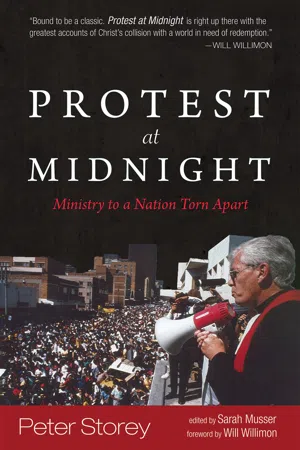
This is what Bishop Peter Storey preached in 1986 in the darkest hours of black suffering in a South Africa torn apart by racial oppression. Join him as a youthful chaplain to Nelson Mandela on Robben Island, defying armed police entering his pulpit, heading the SA Council of Churches with Bishop Desmond Tutu, leading 25,000 marchers against Johannesburg's secret police headquarters, and confronting Winnie Mandela's wrongs. Storey's ministry was shaped by one simple question: "What does it mean to obey Jesus in apartheid South Africa?" This book tells of his answer and challenges the silence of American churches in the face of nationalism, systemic racism, and right-wing populism in the USA.
Information
Topic
Theology & ReligionSubtopic
Religious Biographies1
The Island
It lies there like the just-visible hump of a submerged leviathan, barnacled with a sprinkling of ugly buildings and smelling of kelp and sea-growth. Just seven miles from the mainland city of Cape Town, it might as well be in the middle of the South Atlantic: Robben Island—South Africa’s most notorious prison.
There is nothing beautiful about this place. Exposed to driving Atlantic gales in winter and the hot summer South Easters, the island is ringed by treacherous black rock shoals and thundering surf. Apart from a few gum trees, its vegetation consists mainly of the rapacious Port Jackson willow. It is traversed by old military roads made of a blinding mixture of crushed shells and white limestone. A rutted landing strip is located at one end. At the other, a small harbor provides the only safe approach from the sea.
Ever since Europeans came to the Cape of Good Hope, the island has symbolized white domination and been chaptered with human suffering. Variously a leper colony, a place of exile, a mental asylum, naval garrison, and prison, it has always offered cold comfort.
By the time I set foot on its shores in 1962, the regime had already turned Robben Island into their most feared political prison.
Nelson Mandela arrived in mid-1964 to begin his life-sentence, though he had previously been held for a brief time on the island awaiting trial for treason. His first arrival had been via the degrading route that introduced most Robben Island prisoners to their new home, the prison boat Dias. Seasick and desperately trying to keep their balance while shackled to one another in the stinking, rolling hold, prisoners often endured white prison guards urinating on them through the skylight above. Within months, Mandela was taken back to Pretoria to join the rest of the Rivonia treason trialists, so-named because they were netted by a Security Police swoop on the ANC’s secret headquarters in the Johannesburg suburb of Rivonia. Those captured included most of the leaders of the fledgling armed wing of the ANC. The day after their sentencing in mid-1964, Mandela and his colleagues were secretly flown to the island airstrip to begin the incarceration that was to make the island notorious throughout the world. They had narrowly escaped the hangman’s noose, and when they asked what their sentence of life imprisonment actually meant, the answer was, “You will be here until you die.”
As the first Methodist chaplain there, I was also the first minister to visit them. That exposure was to have a huge impact on me. It dramatized the great gulf between white and black realities in our land. Each crossing in the Dias transported me between worlds that could not have been more different. Newly ordained, my primary appointment was to two white congregations in seaside Cape Town suburbs where I was expected to preach, teach, and minister to their needs within the context of a comfortable faith. The adults worked in banks, insurance companies, and other “normal businesses,” and their children spent the carefree after-school hours surfing the breakers that rolled in from the west. A few miles out into that same ocean was a different universe, a bleak and hellish prison-house prepared for those who dared to challenge the status quo upon which every comfortable white suburb rested.
When I first arrived, the new maximum-security cell block was being completed by common law prisoners, and this is where the Rivonia trialists ended up, becoming the most prominent of thousands of political prisoners to experience the horrors of the island over the next thirty years. Looking back, it seems absurd—even irresponsible—that someone as inexperienced as I should have been entrusted with the sensitive responsibility of being their minister. What could a kid in his twenties do for people of this caliber, and in such straits?
On my first visit, I was met at the small dock by a warrant officer in a pick-up truck and driven through the entrance archway crudely painted with the Prison Service’s motto, “We Serve with Pride.” I wondered if this officer or his fellow guards saw the similarity to another arched gateway in Poland, where the mocking words “Arbeit macht frei”14 greeted the train-loads of victims herded there by other claimants to a master-race ideology.
The white limestone road led to the Church of the Good Shepherd, also known as the Leper Church. Built in the leper-colony days, it is a church of beautiful proportions, but its lovely stone exterior belied the emptiness within. It had been stripped of altar, font, and pulpit, as if not one symbol of the grace of God should be permitted to penetrate the lives of the inmates. Nor were there any pews: the groups of common-law prisoners, together with some of the less prominent “politicals” marched from their nearby cells, had to sit on the cold floor. The absence of service books was less of a problem because Christian hymns were widely known by black South Africans, learned by heart when they were children. The singing was soulful and the sermons simple. I tried to offer homilies on the love of God for these men, and God’s care for their far-away families. In spite of my inadequacies, the words were always received with appreciation and with many sighs and exclamations, as if this strange young white man, this hour of rough and ready worship, and the words spoken in God’s name let a tiny crack of light into their shadowed lives.
On that first day, between morning and afternoon services, I was offered lunch in the mess hall used by the Afrikaner warders. It was an isolating experience. Their remarks about the prisoners were crudely racist, and I was stung and shamed by their assumption that because I was white I would share their prejudices. Their world had no space for whites with a different view. It was frightening to see how unquestioningly they assumed superiority over their charges and how they relished the power conferred on them by this brutal job. Our conversation soon stumbled. I didn’t have the courage to take them on alone, so I shrank into a cocoon of silence, seeking inner distance from them. I determined never to eat there again, and after that day Elizabeth provided sandwiches for my lunches.
Each visit over the next two years was a deeply lonely affair, but I was given one early gift. The warrant officer had pointed out a small, south-facing wooden bungalow. It was there that Robert Mangaliso Sobukwe, the charismatic leader of the Pan Africanist Congress, had begun his lonely exile after arriving the year before.15
He had just completed a three-year prison sentence for leading the “pass-burning” campaign that climaxed in the Sharpeville massacre, and instead of being released at the end of 1963, he remained incarcerated by parliamentary decree, utterly isolated for as long as the apartheid regime chose to keep him there. Justice Minister John Vorster liked to call him “public enemy number one.” Only his guards were permitted near him, and they were not supposed to speak to him. Sobukwe had been a Methodist lay preacher, so I asked to see him. I was refused at first, but some persistence revealed that the authorities were legally obliged to give me access. For every visit, however, I had first to get written authority from the Chief Magistrate of Cape Town.
By the time I visited him, Sobukwe had long since earned the grudging respect of his gaolers. My driver remarked that none of the baiting by bored young guards had succeeded in provoking him. “Every morning, this man comes out of his house dressed as if he is going off to work,” he said. “He is very dignified.”
As we approached the weathered hut, I wondered what kind of welcome I would receive. The media had portrayed Sobukwe as a dangerous black nationalist with a hatred of whites. Would he want to see me, a young white minister?
When he met me on the steps of his bungalow, I was immediately struck by his handsome chiseled features and patrician bearing. Tall and wiry and dressed in neat slacks, a white shirt, and tie, he offered me a guarded but polite welcome, inviting me inside as if this was his home and I was a guest coming for tea. The room we entered served as both bedroom and living space, with a neatly made bed, a simple bedside cabinet, a table and chair, and a small bookcase. It was spartan but adequate. Sobukwe gestured to the only chair and sat on the edge of the bed. Conversation was desultory at first. I knew he was sizing me up and didn’t blame him. I said that many Methodists would be excited to know that one of our ministers had got to see him. We swapped names of mutual acquaintances and stories of Healdtown, the Methodist college both he and Nelson Mandela had attended.
Our conversation soon warmed, and after that, each time I came to the island, we were able to have about thirty minutes together. He had a consistent aura of calm about him, sucking contentedly on his pipe while we talked. He chose his words carefully, spoke quietly, and had a gentle sense of humor. Our discussions were perforce circumscribed, always in the presence of the guard, who stood near the door pretending to be uninterested. Even so, it was possible to engage something of the depth and breadth of his thinking. His Christian faith was informed by wide reading, and it was clear that he saw his political activism as an extension of his spirituality.
Robert Sobukwe impacted me very powerfully. For all my contact with black South Africans, for the first time I was engaging with somebody risking all for the liberation of his people. The caliber of this man, the cruel waste of his gifts, and the silence of most South African Christians around his incarceration touched me to anger. He always expressed genuine appreciation of our times together, but even though I was one of the only people ever permitted to visit him, I sensed that he would never put too much trust in me. Why should he have faith in this white man, any more than any other? Once, when leaving him, I expressed shame that I could depart the island so freely, leaving him a prisoner. His response was quick. Gesturing toward Cape Town, with its Parliament occupied by his tormentors, he said, “I’m not the prisoner, Peter—they are.”
I was also the first chaplain to Nelson Mandela and his fellow Rivonia trialists. When they arrived in mid-1964, they entered a period of extreme hardship and very tough manual labor in the island’s lime quarry. I saw nothing of this because Sunday was their one day of rest. They were incarcerated in the squat Maximum Security B Section, with its ugly watchtowers, cold grey passages, and grey-painted barred doors. The whole place had a makeshift look about it, as if thrown together in a hurry, using the cheapest materials—all except for the frontage, built of finely pointed stone. It was a hateful place, and it struck me just how little it cost to oppress people. Stone walls, crude iron bars and doors, a mix of concrete and barbed wire, and a few miles of icy ocean were all that was needed. Robben Island terrorized not only its inmates but was a bleak and forbidding warning to all considering defiance of the apartheid state.
Services of worship for Mandela’s group were an exercise in ingenuity. I was not permitted into their cells, and in those early days of their incarceration they were not allowed out of them, even for church. Each cell in the now-famous narrow hallway in B Section had two doors: an inner iron grill, which was kept locked, and a wooden door, left open. I had to lead worship walking up and down the long passage, pausing at each door to make eye contact with the prisoner within. I was touched by the way each returned my glance very intentionally and by the friendliness on most of their faces. At each end of the passage stood a stony-eyed warder who preferred to fix his gaze on the middle distance until I turned around to retrace my steps. The forty-six-year-old Nelson Mandela was in the prime of his life, strong and robust, with a feisty look in his eye, and a ready twinkle, too. In those days he gave the impression of a coiled spring—much more the prize-fighter than the father figure who later became beloved arou...
Table of contents
- Title Page
- Foreword
- Preface
- Acknowledgments
- Abbreviations
- Introduction
- Chapter 1: The Island
- Chapter 2: District Six
- Chapter 3: Ocean in a Single Drop
- Chapter 4: Then Came the Bulldozers
- Chapter 5: Amateur Journo
- Chapter 6: Young Church
- Chapter 7: Widening World
- Chapter 8: No Soft Landing
- Chapter 9: Broken Open Church
- Chapter 10: Ministry with a Whiff of Tear Gas
- Chapter 11: Public Square Encounters
- Chapter 12: Shadows of War
- Chapter 13: Perfect Storm
- Chapter 14: Bearing Witness
- Chapter 15: National Leadership
- Chapter 16: Among God’s People
- Chapter 17: Stress Fractures
- Chapter 18: Winnie Crisis
- Chapter 19: Confronting Expediency
- Chapter 20: Soul Wounds
- Chapter 21: Thin Orange Line
- Chapter 22: Taking on the Guns
- Chapter 23: Days of Grace
- Chapter 24: Search for Healing
- Chapter 25: America the Vulnerable
- Chapter 26: A Church the World Might Take Seriously
- Chapter 27: Postscript: Loss and Gratitude
Trusted by 375,005 students
Access to over 1.5 million titles for a fair monthly price.
Study more efficiently using our study tools.
Frequently asked questions
Yes, you can cancel anytime from the Subscription tab in your account settings on the Perlego website. Your subscription will stay active until the end of your current billing period. Learn how to cancel your subscription
No, books cannot be downloaded as external files, such as PDFs, for use outside of Perlego. However, you can download books within the Perlego app for offline reading on mobile or tablet. Learn how to download books offline
Perlego offers two plans: Essential and Complete
- Essential is ideal for learners and professionals who enjoy exploring a wide range of subjects. Access the Essential Library with 800,000+ trusted titles and best-sellers across business, personal growth, and the humanities. Includes unlimited reading time and Standard Read Aloud voice.
- Complete: Perfect for advanced learners and researchers needing full, unrestricted access. Unlock 1.5M+ books across hundreds of subjects, including academic and specialized titles. The Complete Plan also includes advanced features like Premium Read Aloud and Research Assistant.
We are an online textbook subscription service, where you can get access to an entire online library for less than the price of a single book per month. With over 1.5 million books across 990+ topics, we’ve got you covered! Learn about our mission
Look out for the read-aloud symbol on your next book to see if you can listen to it. The read-aloud tool reads text aloud for you, highlighting the text as it is being read. You can pause it, speed it up and slow it down. Learn more about Read Aloud
Yes! You can use the Perlego app on both iOS and Android devices to read anytime, anywhere — even offline. Perfect for commutes or when you’re on the go.
Please note we cannot support devices running on iOS 13 and Android 7 or earlier. Learn more about using the app
Please note we cannot support devices running on iOS 13 and Android 7 or earlier. Learn more about using the app
Yes, you can access Protest at Midnight by Peter Storey, Sarah Musser in PDF and/or ePUB format, as well as other popular books in Theology & Religion & Religious Biographies. We have over 1.5 million books available in our catalogue for you to explore.