This beautifully illustrated, inspirational guide to bird photography is packed with practical advice for how to photograph birds presented in an informative but accessible writing style. Creative Bird Photography offers a fresh approach to its subject, looking closely at how to photograph specific aspects of birds’ lives, such as eating and drinking, courtship, and flight. The author gives examples, demonstrating particular points and approaches for taking great shots of all of these daily bird activities as well as taking "mood" photographs at dawn and dusk. Each shot is accompanied by detailed technical data, information about locations, and advice about other challenges that will need to be surmounted in order to achieve the perfect shot. Coster also shares fascinating anecdotes about his encounters with the birds featured. There are also up-to-date sections on bird photography basics, including equipment and storage of digital images.
- 160 pages
- English
- ePUB (mobile friendly)
- Available on iOS & Android
eBook - ePub
About this book
Information
Topic
ArtSubtopic
PhotographyBeing more creative
In this chapter I explore the idea of pushing the art of bird photography just that little bit further. This varies from the simple concept of zooming in on one part of the subject, to capturing movement and using birds as small elements in a landscape.
Some of the themes in this chapter take ideas covered in previous chapters, but push them further, resulting in pictures that go beyond what would be described as ‘normal’ bird photography. To some this may be going too far, but I sometimes find the conventions surrounding nature photography somewhat limiting, and I enjoy the challenge of trying out new ideas. There are many bird photographers who are very happy with producing beautiful images of birds that show every feather detail, and have no interest in anything that would be considered ‘arty’. I’ve even met people who think that silhouettes are a step too far. On the other side of the fence are those who seem to believe that any traditional composition is no longer worthy of consideration, and that anything ‘new’ must be good just because it is different – a surprising number of people who hold such views seem to pop up as judges in photo competitions. The danger here lies in the triumph of originality over quality. Appreciation of any art form is subjective, and with the sheer numbers of excellent images being produced nowadays the temptation to be overawed by something a little different is considerable, but not all these images warrant this reaction.
So are you arty or traditional? Actually, I don’t consider this to be a valid question. Any photograph you take has artistic considerations, whatever type of image you are making. A better question might be: is it editorial or interpretive? Editorial pictures demonstrate a species or particular behaviour, and interpretive ones attempt to capture the mood or impression of the subject rather than the absolute detail. There are photographers firmly in one camp or the other – I prefer to have a foot in both.
HEAD SHOTS
Let’s start with expanding on the portrait just a little. Opportunities to get really close to birds to enable ‘head shots’ are not that common, but if they do arise they can result in pictures with a high impact, as in the shot opposite of a Crowned Crane, taken in a bird park in East Anglia. Working in a bird park is ideal for this type of shot because the captive birds are very used to people and often allow a close approach, although you still have to move carefully and slowly to avoid scaring the subject. Photographing captive birds rather than birds in the wild can be a controversial subject among bird photographers, but this type of image would be almost impossible to make in the wild – and if you are considering purely the aesthetics of a picture, then it really doesn’t matter where it was taken.
When I saw this Crowned Crane walking slowly around the grounds, I was immediately drawn to the head with that magnificent circular ‘crown’. This was the most startling part of the bird, so I decided to concentrate my composition on the head. It was late in the day and the light was fading, so flash was required. I could have used fill flash, but the background was a bit messy and I wanted no distractions around the bird’s head. I therefore used full flash to render the background completely black. This would give me the graphic image I wanted, and by using a small aperture I would record no background detail, but achieve a good depth of field.
A simple head shot can thus produce a real eye-grabbing image. This direct, front-on view elicits an emotional response from the viewer more than any other view, and the angle of the bird’s head gives the bird a quizzical look and adds a lot of character to the picture. There is a ‘connection’ between subject and viewer, and this ‘unnatural’ image is a very powerful one. After all, who said that every bird photograph had to look natural? The key point here is that this is about producing an interesting image, which does not necessarily mean representing everything in an entirely ‘natural’ way.
INCLUDING THE ENVIRONMENT
Having gone in ultra close for the first image in this chapter, I’m now going to the other end of the spectrum and showing birds as part of the wider environment in which they live. In this type of picture the landscape around the birds plays as important a role as the birds themselves. It is not just a shot taken where you couldn’t get close enough to your subject, resulting in the subject appearing small in the frame – although I have seen some pictures described as ‘bird in its environment’ that were clearly the result of this. A really successful picture of this type has to be driven by the surroundings and not the bird.
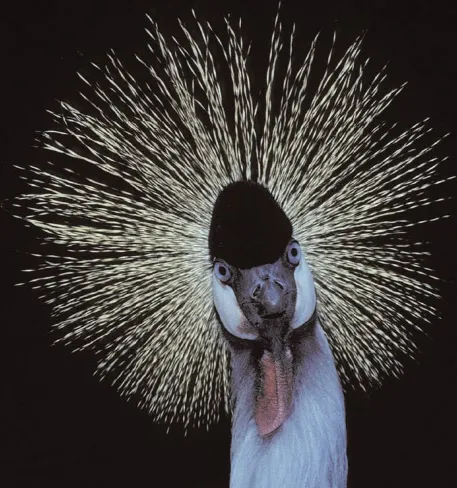

(Balearica regulorum)
Canon EOS 1N, 300mm f2.8 lens, tripod, flash, 1/200th sec @ f22, Fuji Provia 100
East Anglia, UK
I was visiting Fowlsheugh, an RSPB reserve south of Aberdeen on the east coast of Scotland. Many seabirds breed on the cliffs at the Fowlsheugh Reserve, and when I visited in late May the cliff tops were covered in the soft pink flowers of Thrift. Walking along the clifftop, I came across an area where the Thrift was growing among rocks that were covered in yellow lichens, the combination of the two making a very colourful scene. There were a few Kittiwakes collecting nesting material close by. I had settled down to try and photograph them when a pair of Oystercatchers (opposite, above) flew in and landed on the cliff edge. They looked superb in this setting, and I decided to try and include plenty of rocks and plants in my picture. I placed the Oystercatchers at the top of the frame, which enabled me to get as much of the colourful foreground in the picture as possible. To ensure this was reasonably sharp I stopped down to f16 and took the shot.
Both Oystercatchers were facing the same way, and this dictated their horizontal positioning in the frame, with the lead bird being much further away from the right frame edge than the rear bird is from the left-hand edge. This is important to the overall balance of the picture, which requires any space available to be in front of the birds, rather than behind them.
This shot concentrated on the immediate surroundings of the Oystercatchers, picking up as much detail in the surrounding environment as possible. In the shot of the Puffins (opposite, below), the environment is a much broader view of the entire landscape in which the birds live. It could in fact be equally described as a landscape with birds in it. This type of shot is actually a lot harder to accomplish than it looks, because you will not be able to obtain the broad view of the landscape behind the birds with a long telephoto lens. When using a wide-angle lens you must get very close to your subject, but of course birds have a habit of flying away if you approach them too close.
Hermaness National Nature Reserve is located on the north-west tip of Unst, the most northerly inhabited island in the Shetland Isles. In the summer it is home to some 25,000 pairs of Puffins that nest on the high cliffs, as well as other seabirds. While I was taking a rest during a walk around the reserve, I noticed a few Puffins standing around on the very edge of the cliff. They were at one side of a deep bay, so that the other side of the bay and the offshore islands that supported huge Gannet colonies could be used as a backdrop – if only the Puffins would allow me to get close enough. The other slight drawback was that the Puffins were not right on top of the cliff near the path, but further down, which made for a rather precarious approach high above the sea below. I decided that the best way to approach the birds was to make my profile as small as possible, and slowly crawl on my belly towards them. The birds would look at me occasionally as I edged towards them, and when they did so I froze until they looked away again. It took ages to get close enough for a shot, but eventually I managed to frame the picture as I had envisioned it while still safely on the footpath.
Seabirds a...
Table of contents
- COVER PAGE
- TITLE PAGE
- COPYRIGHT PAGE
- DEDICATION
- CONTENTS
- INTRODUCTION
- THE BASICS
- DIGITAL EQUIPMENT
- PORTRAITS
- FLIGHT
- LIFE CYCLE
- FOOD AND DRINK
- ACTION AND BEHAVIOUR
- DAWN AND DUSK
- BEING MORE CREATIVE
Trusted by 375,005 students
Access to over 1.5 million titles for a fair monthly price.
Study more efficiently using our study tools.
Frequently asked questions
Yes, you can cancel anytime from the Subscription tab in your account settings on the Perlego website. Your subscription will stay active until the end of your current billing period. Learn how to cancel your subscription
No, books cannot be downloaded as external files, such as PDFs, for use outside of Perlego. However, you can download books within the Perlego app for offline reading on mobile or tablet. Learn how to download books offline
We are an online textbook subscription service, where you can get access to an entire online library for less than the price of a single book per month. With over 1.5 million books across 990+ topics, we’ve got you covered! Learn about our mission
Look out for the read-aloud symbol on your next book to see if you can listen to it. The read-aloud tool reads text aloud for you, highlighting the text as it is being read. You can pause it, speed it up and slow it down. Learn more about Read Aloud
Yes! You can use the Perlego app on both iOS and Android devices to read anytime, anywhere — even offline. Perfect for commutes or when you’re on the go.
Please note we cannot support devices running on iOS 13 and Android 7 or earlier. Learn more about using the app
Please note we cannot support devices running on iOS 13 and Android 7 or earlier. Learn more about using the app
Yes, you can access Creative Bird Photography by Bill Coster in PDF and/or ePUB format, as well as other popular books in Art & Photography. We have over 1.5 million books available in our catalogue for you to explore.