In this mix of history, journalism, political analysis, and first-person accounts, former chief coroner and Vancouver mayor Larry Campbell, renowned criminologist Neil Boyd, and investigative journalist Lori Culbert, offer a portrait of one of North America's poorest, most drug-challenged neighbourhoods: Vancouver's Downtown Eastside. A Thousand Dreams raises provocative questions about the challenges confronting not only Vancouver's Downtown Eastside but also all of North America's major cities and offers concrete, urgently needed solutions, including:
Continued support for Insite, the safe injection site
Decriminalization of prostitution and drugs
The transfer of addiction services to the Health Ministry, allowing detox into the medical system
More government-funded SROs and more affordable social housing
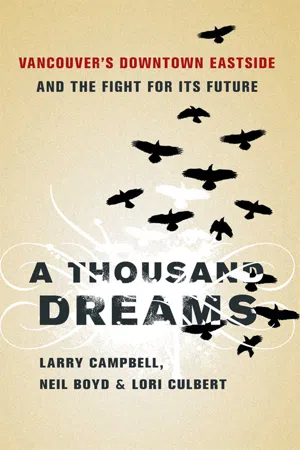
eBook - ePub
A Thousand Dreams
Vancouver's Downtown Eastside and the Fight for Its Future
- 352 pages
- English
- ePUB (mobile friendly)
- Available on iOS & Android
eBook - ePub
A Thousand Dreams
Vancouver's Downtown Eastside and the Fight for Its Future
About this book
Information
1 | The Early Years
VANCOUVER OFFICIALLY BECAME A CITY in April 1886. It burned to the ground two months later: a bush fire whipped up by high winds destroyed nearly all of the infant city’s 350 wooden buildings. Out of the ashes, the 2,500 residents constructed a new community of brick and stone buildings on the Pacific Ocean’s picturesque Burrard Inlet, with breathtaking views of mountains hugging a northern coastline covered in old-growth trees. The area was part of the traditional territory of the Squamish and Musqueam First Nations. The initial townsite covered six blocks of undulating terrain from Burrard Inlet to Hastings Street, between Cambie and Carrall Streets. Today, a portion of that historic section is called Gastown, and the rest is part of what is known as the Downtown Eastside.
Water Street was lined with warehouses in those early days. Cordova Street was the city’s commercial centre, because it was the highest (and therefore the driest) road: shoppers walked on wooden sidewalks to avoid the mud. Rich folks built their mansions at the western end of Hastings, on bluffs that overlooked the wharfs below. The newly completed Canadian Pacific Railway tracks delivered the first passenger train to Burrard Inlet in 1887.
The CPR had made a land deal with the new city, and the company built the initial version of the grandiose Hotel Vancouver on Granville Street. That was the start of businesses moving a few blocks southwest, to today’s downtown core. Cordova Street kept its prominence, however, because the first streetcar line was built along it and opened in 1890. By the turn of the century, Vancouver was home to at least sixty hotels, fancy ones patronized by wealthy shoppers and more modest ones frequented by loggers, miners, and fishermen off work for a few days. The Bismarck Café, built in 1904 at Abbott and Hastings, offered multiple private dining rooms, including one just for women, along with an orchestra and an electric fountain. The simpler hotels had barbershops and bath houses in the basement, so that men arriving after weeks in the bush could get themselves cleaned up for a night on the town. One hotel on Cordova had a “horse elevator” to take the animals into basement stalls where they would be kept for the evening— the city’s first underground parking lot, says local historian and author John Atkin. It was during the first decade of the twentieth century that many of Vancouver’s most prominent buildings were constructed, including the flagship Woodward’s department store and the Carnegie Library in 1903. The library was built at Main and Hastings, a key intersection for the growing city—Main was the central artery for cars and trucks. City hall and some banks were already located there, making that corner the financial and political heart of Vancouver. The impressive, three-storey library was named after American philanthropist Andrew Carnegie, who provided $50,000 for the project.
As local historian and author Sandy Cameron has written, this core area was very diverse and, at times, divided. Chinatown and Japantown were created in the late 1800s outside Vancouver’s official boundaries. People of Chinese descent, mainly single men working low-paying jobs, settled on swampy land near Carrall and Pender Streets. Japanese families gathered along Powell Street, where they prospered running their own fishing boats. On the evening of September 7, 1907, after a decade of anti-Asiatic sentiment and the formation of British Columbia’s Asiatic Exclusion League, about ten thousand Vancouverites converged on city hall. The trouble had been brewing for a long time. British Columbia’s labour shortage of the late nineteenth century had been replaced by a labour surplus in the early years of the twentieth century. The Chinese and the Japanese, willing to work for forty per cent of white wages, had originally been welcomed but were now reviled for taking jobs from white workers. Racist cartoons and editorials on the front page of the Vancouver Province newspaper expressed concern about the “yellow peril” and the eventual domination of the “bright browed races” by the Chinese and the Japanese. The rally at city hall was sponsored by trade unionists and federal Conservative politicians. After the speeches, the angry crowd poured into the Chinese and Japanese districts, beating people, smashing windows, and, in many instances, completely destroying the businesses of the new immigrants.
The federal government in Ottawa sent Mackenzie King, the young deputy minister of labour, to Vancouver in the fall of 1907 to settle damage claims arising from the riot. The prime minister of the day, Wilfrid Laurier, was originally open to settling only Japanese claims for loss, explaining to King that Japan was an important trading partner; China was not. But King persisted in his view that Chinese merchants should be compensated. He told Laurier that “fear, and not justice” appeared to be motivating the distinction. Laurier relented, and King returned to Vancouver in May 1908 to receive claims from Chinese merchants. In the course of his inquiry, King received two claims from smoking-opium merchants. The Lee Yuen Opium Company was the first to speak to the assembled commission, and King’s initial response to their request was reported in the Vancouver Province on May 29. He told those present that he would look into the smoking-opium business and expressed the view that Chinese druggists should be licensed in much the same way white druggists were.
Smoking-opium factories had operated in the cities of Vancouver, Victoria, and New Westminster for the previous forty years, selling their product to both whites and Chinese. There had been little concern with the businesses. An 1885 judicial inquiry had concluded that alcohol represented a much more significant social problem in the province than did the use of smoking opium. But in the early days of June 1908, King privately received a deputation of local Chinese merchants and clergymen interested in anti-opium legislation. On June 3, he told the commission, with the media present, “It should be made impossible to manufacture this drug anywhere in the Dominion. We will get some good out of this riot yet.”
Upon his return to Ottawa, King submitted a report on the “dire need” to suppress the trade in opium, and within six weeks the minister of labour rose in the House of Commons to propose the first reading of the Opium and Drug Act. It was the beginning of the criminalization in Canada of certain mind-active drugs. Cocaine was declared a prohibited substance in 1911, with marijuana, “the new menace,” added in 1923. Opiated tonics, elixirs, and analgesics, the commercial products of a white patent-medicine industry, were not targeted by these new prohibitions, nor were alcohol and tobacco. The prohibition on the sale and manufacture of smoking opium was not premised, either, on a careful weighing of the harms of various psychoactive substances; it was a calculated political response to a racist riot. How else to explain the introduction of the law by Canada’s minister of labour?
At the time, the United States and China were moving to secure the global prohibition of opium. The movement was spearheaded by an American missionary with close ties to President Teddy Roosevelt, Bishop Brent of the Philippines. Roosevelt provided his full support for an idea that he believed had a kind of moral imperative. The Chinese, who had had British Indian opium forced on their population in the late 1850s after losing two opium wars, were happy to try to end the trade. Only Britain opposed the move to global prohibition at the International Opium Commission in Shanghai in 1909. The British argued for regulation of the trade, suggesting that criminalization was likely to produce far worse consequences than regulation of access by the medical profession and others. But the British were painted as amoral profiteers, and America succeeded in its mission. A line between legal and illegal drugs was drawn in Shanghai, and the horrific consequences remain with us today.
Once the train of prohibition was sent running down the tracks, it quickly gathered steam. The initial federal legislation prohibited only the manufacture and sale of smoking opium, with maximum penalties of three months’ imprisonment, but police lobbied for new offences and increased penalties. They were remarkably successful. The offence of possession of illegal drugs was created in 1911, and by 1929 (after the RCMP had become the enforcement arm of the federal Department of Health), penalties for sale, manufacture, and distribution were increased to a maximum of seven years’ imprisonment. That was boosted to fourteen years in 1954 and to life imprisonment in 1961. An industry of illegal drug control had been created.
There was more hardship to come for the Chinese and the Japanese of Vancouver. The entire Japanese population was forced to move to internment camps, mainly located in B.C.’s interior, after the attack on Pearl Harbor in 1941. And the Chinese community, suffering continued discrimination, fought to improve their basic human rights—one of many forms of resistance displayed by defiant Downtown Eastside residents over the years. The area also had a tradition of union activism. In the Relief Camp Workers general strike of 1935, about 1,700 men left Depression-era camps over working conditions and twenty-cents-a-day pay, says Sandy Cameron in his book Fighting for Community. After six fruitless weeks, three hundred of the men occupied the museum on the top floor of the Carnegie Library, and hundreds of others took over the Woodward’s food floor, chanting, “When do we eat?” They were supported by other unemployed men who marched up Hastings Street and cheered as the “When do we eat?” banner was unfurled from the Carnegie’s window. The occupation ended that evening, after the mayor offered the strikers food and lodging for two days. But seven hundred of the frustrated men boarded a freight train to Ottawa to continue protesting. The dreaded relief camps were abolished in 1936.
The 1930s brought hundreds of men into Vancouver looking for work. When the Depression ended, most able-bodied men returned to their hometowns. But those who had been injured working in rough resource sector jobs, as well as the sick and the elderly, were left behind. It was a phenomenon that occurred in many large North American cities in the 1940s, turning working-class communities into “skid roads.” The down-and-outers stayed on in the Downtown Eastside for companionship and acceptance, and they could afford the dollar-per-day rent in the boarding houses on their meagre government-issued cheques. Many passed the day in dark beer parlours. After prohibition ended in 1920, the temperance movement convinced the government that people shouldn’t be seen drinking alcohol, so beer parlours were either located in hotel basements or had their windows covered over. Inside, there was no sense of time or much concern about how many ten-cent beers the patrons consumed.
Still, although the neighbourhood had its alcoholics, the streets were largely civilized places. The Downtown Eastside had the highest number of theatre seats in the city, as families and the well-heeled flocked to plays and movies; it also had the most bar seats in Vancouver, mainly filled by those numbing life’s challenges with cheap beer, but some occupied by the theatre crowd sipping highballs. Even into the 1950s, John Atkin says, the two extremes were not in conflict: “It could all coexist, because it was somehow in balance. You could still see an area sort of rough around the edges, but very viable.”
Among the centrepieces of Skid Road was the Carnegie Library, a place where people attended community functions, socialized, and read books. In the city museum, on the library’s top floor, one of the most popular attractions was a mummified child found in an Egyptian tomb. But the much-loved building also had its challenges. A librarian wrote to the medical health officer in 1940, concerned about “chicken lice” that had likely migrated into the Carnegie from the city market next door. Dr. Stewart Murray sent back a rather flippant reply, expressing surprise at the complaint and suggesting the fleas “boost[ed] the number of living things that visit the library.” There were plenty of living creatures inside the Carnegie in those days, including rats that chewed through books stored in the library basement.
The future of the fifty-four-year-old building became uncertain in 1957, when the growing city of Vancouver moved its library several blocks southwest, to the burgeoning downtown area of Robson and Burrard Streets. The museum took over all three floors of the Carnegie, which had fallen into disrepair; the building’s roof was leaking, and plaster was falling from the walls. There were funding battles and public complaints, and the museum closed ten years later. Mayor Tom Campbell told the Vancouver Sun in 1968 that the closure of the museum was essentially a demolition order for the Carnegie. “I can’t see any use for a derelict building,” Campbell said. “I want to see a modern highrise office building or hotel in its place.” The land was so valuable, Campbell argued, that redeveloping it could rejuvenate the neighbourhood.
With more roads being built and cars becoming more common, Vancouver’s streetcar line was disabled in 1955. The Interurban rail system for commuters shut down three years later. The Interurban and the streetcars had shared a central station at Hastings and Carrall, which an estimated ten thousand people used every day. The North Shore Ferry halted its service to Columbia Street in the late 1950s, and Union Steamship boats stopped bringing commercial travellers and tourists by water to the city. John Atkin argues that the loss of those commuters and shoppers was another death knell for the area. “All the stores and the coffee shops that relied on the pedestrian traffic closed up in a few years,” says Atkin, who today conducts walking tours of historic Vancouver. By the 1960s, the area’s hotels had started to change from well-respected nightly rentals to rundown residential buildings.
A city hall profile of Skid Road in January 1965 showed a neighbourhood filled with mainly unmarried, undereducated men. There were about 5,300 residents, thirty per cent of them of British origin, thirty-seven per cent from the continent of Asia, and a small handful of Aboriginal people. Among them were many pensioners, disabled people, and “transients” who worked in the resource industries and collected social assistance in the off-season. The city hall report estimated there were about five hundred unemployable people living in the neighbourhood; twenty-five per cent of them were alcoholics, four per cent were suspected of being sex-trade workers, and four per cent were drug addicts. (Heroin injection was first documented in the Downtown Eastside in the late 1960s, as it was in many urban centres across North America.) The area had two per cent of the city’s population but racked up thirty-three per cent of the criminal charges laid by police, though the vast majority of these were for relatively minor offences like public drunkenness and theft.
The 1965 city hall report, simply entitled Downtown East Side, said Vancouver’s Skid Road had distinguished itself from those of many other cities because its residents had rallied to stop politicians, developers, and bulldozers from levelling the place. “The popular image of skid road is of a depressed area peopled by chronic alcoholics and hopeless derelicts; an area usually regarded as a necessary evil. This image should be dispelled,” said the report’s introduction, written by the city’s director of planning, W.E. Graham. “Many people live here because they have little choice. Some are physically disabled and live solely on welfare assistance; some are pensioners eking out their allowances in the cheapest accommodation they can find. Some, by lack of skills, are practically unemployable, and some live here simply because they enjoy the constant activity of the area. Compared to the rest of the city, few people here have any family ties. Many have acute personal problems—and almost all are poor.”
George Chow moved to the Downtown Eastside in 1965, when he was fourteen years old. He was a member of the fourth generation in his family to migrate from China to Canada seeking work: his great-grandfather came in the late 1890s, his grandfather in 1911, and his father in 1955. Chow’s mother brought him to join his father a decade later, and the family—two parents and three sons—shared a two-room apartment over a London Drugs store at Union and Main Streets. Chow and his younger brother John slept in bunkbeds in a corner of the main room, which contained the kitchen and a living space, while their parents slept with the baby in the smaller second room. There were communal bathrooms in the building for the tenants. The brothers watched TV in the caretaker’s suite, because their family didn’t own one. Chow recalls thinking that the apartment building was clean and well kept, and downtown Vancouver vibrant. He and his brother went to “new Canadian classes” at the now-closed Sir William Dawson school, where they spent three months studying English with children who had moved to Vancouver from all parts of the world. The brothers played soccer or rode their bikes in a park that is now home to the Strathcona Community Gardens. “Friday after school we’d walk down Pender Street, and we’d cut down to Pigeon Park and continue our journey to Woodward’s. Sometimes we’d venture up to Granville Street,” recalls Chow, who would later become a Vancouver city councillor. His family often ate out at Chinatown’s many restaurants, including the Ho Ho, the Bamboo Terrace, and Ming’s, most of them decorated with dazzling neon signs. Young George and John followed the glittering lights along Hastings at night, passing the lit-up pig outside Save-on-Meats while walking to theatres to see John Wayne and Bruce Lee movies.
In the fall of 1965, Chow entered Britannia high school. His parents insisted he wear pants ...
Table of contents
- Cover Page
- Title Page
- Copyright Page
- Dedication
- Contents
- Preface
- 1: The Early Years
- 2: We Call It the Downtown Eastside
- 3: Lethal Heroin, Killer Coke, and Expo 86
- 4: The Cain Report
- 5: Woodward’s
- 6: Homeless and Mentally Ill
- 7: Vancouver’s hiv/aids Epidemic: The Worst in the Western World
- 8: Harm Reduction: A Grassroots Struggle
- 9: Da Vinci’s Inquest
- 10: The Missing Women
- 11: Four Pillars
- 12: Canada’s First Supervised Injection Site
- 13: The Harm Reduction Two-Step
- 14: Sex Work, Safety, and Sanctuaries
- 15: naomi and the Fight to Save Insite
- 16: Housing Vancouver’s Poor
- 17: The Road Ahead
- Sources
- Acknowledgements
Trusted by 375,005 students
Access to over 1.5 million titles for a fair monthly price.
Study more efficiently using our study tools.
Frequently asked questions
Yes, you can cancel anytime from the Subscription tab in your account settings on the Perlego website. Your subscription will stay active until the end of your current billing period. Learn how to cancel your subscription
No, books cannot be downloaded as external files, such as PDFs, for use outside of Perlego. However, you can download books within the Perlego app for offline reading on mobile or tablet. Learn how to download books offline
Perlego offers two plans: Essential and Complete
- Essential is ideal for learners and professionals who enjoy exploring a wide range of subjects. Access the Essential Library with 800,000+ trusted titles and best-sellers across business, personal growth, and the humanities. Includes unlimited reading time and Standard Read Aloud voice.
- Complete: Perfect for advanced learners and researchers needing full, unrestricted access. Unlock 1.5M+ books across hundreds of subjects, including academic and specialized titles. The Complete Plan also includes advanced features like Premium Read Aloud and Research Assistant.
We are an online textbook subscription service, where you can get access to an entire online library for less than the price of a single book per month. With over 1.5 million books across 990+ topics, we’ve got you covered! Learn about our mission
Look out for the read-aloud symbol on your next book to see if you can listen to it. The read-aloud tool reads text aloud for you, highlighting the text as it is being read. You can pause it, speed it up and slow it down. Learn more about Read Aloud
Yes! You can use the Perlego app on both iOS and Android devices to read anytime, anywhere — even offline. Perfect for commutes or when you’re on the go.
Please note we cannot support devices running on iOS 13 and Android 7 or earlier. Learn more about using the app
Please note we cannot support devices running on iOS 13 and Android 7 or earlier. Learn more about using the app
Yes, you can access A Thousand Dreams by Larry Campbell,Neil Boyd,Lori Culbert in PDF and/or ePUB format, as well as other popular books in Social Sciences & Poverty in Sociology. We have over 1.5 million books available in our catalogue for you to explore.