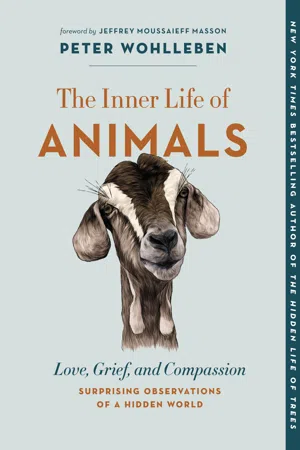
eBook - ePub
The Inner Life of Animals
Love, Grief, and Compassion—Surprising Observations of a Hidden World
- 272 pages
- English
- ePUB (mobile friendly)
- Available on iOS & Android
eBook - ePub
The Inner Life of Animals
Love, Grief, and Compassion—Surprising Observations of a Hidden World
About this book
“Like The Hidden Life of Trees, Peter Wohlleben's The Inner Life of Animals will rock your world. Surprising, humbling, and filled with delight, this book shows us that animals think, feel and know in much the same way as we do—and that their lives are, to them, as precious as ours are to us.”—Sy Montgomery, author of The Soul of an Octopus
Through vivid stories of devoted pigs, two-timing magpies, and scheming roosters, The Inner Life of Animals weaves the latest scientific research into how animals interact with the world with Peter Wohlleben's personal experiences in forests and fields. We learn that horses feel shame, deer grieve, and goats discipline their kids. Ravens call their friends by name, rats regret bad choices, and butterflies choose the very best places for their children to grow up.
In this captivating book, Peter Wohlleben follows the hugely successful The Hidden Life of Trees with insightful stories into the emotions, feelings, and intelligence of animals around us. Animals are different from us in ways that amaze us—and they are also much closer to us than we ever would have thought.
“Wry, avuncular, careful and kind. . . Each story adds to a widening vision of intelligence, emotion and relationship.”—The Guardian
Published in Partnership with the David Suzuki Institute
Information
1
SELFLESS MOTHER LOVE
IT WAS A hot summer day at my forester’s lodge deep in the woods near Hümmel in the Eifel, a mountain range in Germany. The year was 1996. To cool off, my wife and I had set out a wading pool under a shady tree in the garden. I was sitting in the water with my two children, and we were enjoying juicy slices of watermelon when, all of a sudden, I became aware of a movement out of the corner of my eye. A rusty-brown something was scampering toward us, freezing for an instant every now and then as it advanced. “A squirrel!” the children cried in delight. My joy, however, soon turned to deep concern as the squirrel took a few more steps and then keeled over onto its side. It was clearly ill, and after it had taken a few more steps (in our direction!), I noticed a large growth on its neck. It looked as though what we were dealing with here was an animal that was definitely suffering from something and might even be highly infectious. Slowly but surely, it was approaching the pool. I was on the point of gathering up the children and beating a hasty retreat when the menacing advance resolved itself into a touching scene. The lump turned out to be a baby wrapped around its mother’s neck like a furry ruff. The baby’s stranglehold, along with the shimmering heat, meant the squirrel mother could only suck in enough air to take a few steps before falling over sideways, exhausted and gasping for breath.
A squirrel mother cares for her children with selfless devotion. When danger threatens, she carries them to safety in the manner I have just described. She can end up totally spent, because she may have as many as six tiny tots to tote one after the other, each one clasped around her neck. Despite her devotion, the chances of her little ones surviving are low, and about 80 percent die before they are a year old. Although the rusty rascals can avoid most enemies during the day, death stalks them at night while they are sleeping. When darkness falls, predatory pine martens creep through the branches to interrupt the squirrels’ dreams. When the sun shines, the danger comes from agile hawks threading their way through the trees on the lookout for a tasty meal. When a hawk spots a squirrel, a spiral of fear begins. And I mean that literally, for the squirrel tries to escape the hawk by disappearing to the other side of the tree. The hawk banks steeply to follow its prey. In a flash, the squirrel disappears to the other side of the tree again. The hawk follows. Moving at breakneck speed, both animals spiral around the trunk. The nimbler one wins—usually the little mammal.
Winter, however, is more devastating than any predator. To make sure they go into the cold season well prepared, squirrels build drays. They anchor these spherical nests between branches high up in tree crowns and fashion two separate exits with their paws so they can escape any uninvited guests. The nest is made mostly of small twigs, and the interior is cushioned with soft moss that helps conserve heat and provides a comfortable place to sleep. Comfortable? Yes, animals value comfort, too, and squirrels don’t like twigs poking into their backs while they’re trying to sleep any more than we do. A soft moss mattress guarantees a restful night.
From my office window, I regularly see squirrels pulling this soft green material from our lawn and carrying it high up into the branches. And I see something else, too. As soon as the acorns and beechnuts tumble to the ground in fall, squirrels gather these nutrient-rich packages, carry them a few yards, and bury them. They hide food caches to make sure they have food over the winter. Instead of going into true hibernation, they spend most of their winter days dozing. In this state of winter lethargy, they use less energy than usual, but they do not shut down completely like, say, hedgehogs. Every once in a while, a squirrel wakes up and gets hungry. Then it slips down the tree and looks for one of its numerous caches. And it looks, and looks, and looks. At first, it’s funny watching the little animal trying to remember where it’s hidden its food. It burrows a bit here, digs a little there, sitting upright every once in a while as though taking a break to think. But that doesn’t help. The landscape has changed considerably since the fall. The trees and shrubs have lost their leaves, the grass has dried up, and worse, everything might now be covered in cottony white snow. As the frantic squirrel continues its search, my heart goes out to it. Nature is ruthlessly sorting out who will live and who will die. Most of the forgetful squirrels—primarily this year’s young—will not live to see spring because they will starve to death. Then I find small clumps of beech trees sprouting in the ancient beech preserves. Baby beeches look like emerald-colored butterflies fluttering at the ends of slender stalks and they usually grow alone. They gather in clumps only in places where a squirrel has failed to retrieve the nuts it stashed, often because it simply forgot where they were, with the fatal consequences I have just described.
I find the red squirrel to be a prime example of how we sort animals into categories. Their dark button eyes are adorable, their soft fur is a beautiful reddish color (there are also some that are brownish black), and they pose no threat to humans. In spring, young trees sprout from their forgotten food caches, so you could say they help establish new woodlands. In short, we are kindly disposed toward them. We avoid thinking about their favorite food: baby birds. From my office window at the lodge, I am also privy to their predatory raids. When a squirrel scales a tree in spring, consternation reigns in the small colony of fieldfares that raise their young in the old pines along the driveway. The little birds, which are related to thrushes, flutter around the trees, chittering and chattering, trying to drive off the intruder. Squirrels are the birds’ deadly enemies, because the little mammals calmly help themselves to one downy chick after another. Even nesting cavities offer the baby birds only limited protection. Armed with long, sharp claws at the end of slender paws, squirrels can fish even supposedly well-protected nestlings out of the tree hollows where they are hiding.
So are squirrels bad or are they good? Neither. A quirk of Nature ensures that they arouse our protective instincts, and so we experience positive emotions when we see them. This has nothing to do with them being good or useful. And on the flip side of the coin, their habit of killing the songbirds we also love doesn’t mean they are bad either. The squirrels are hungry and must feed their young, which depend on nourishing milk from their mother. We would be thrilled if squirrels met their need for protein by gorging themselves on the caterpillars of the cabbage white butterfly. If they did this, our emotional balance sheet would come out 100 percent in the squirrels’ favor, because these pests are a nuisance in our vegetable gardens. But caterpillars are also young animals, and in this case they grow up to be butterflies. And just because the caterpillars happen to like the plants we have earmarked for our dinner doesn’t mean that killing butterfly babies counts as a net benefit for the natural world. The squirrels, meanwhile, are not the slightest bit interested in what we think of them. They are too busy surviving and, while they are at it, making the most of life.
But back to maternal love in these little red rascals. Are they really capable of experiencing this emotion? A love so strong that a squirrel mother places a higher value on the lives of her offspring than she does on her own? Isn’t it just a case of a spike in the hormones coursing through the squirrel’s veins that triggers preprogrammed protective behavior? Science has a tendency to reduce biological processes to involuntary mechanics, so, before painting such a dispassionate picture of squirrels and other animals, let’s take a look at maternal love in our own species. What happens in a human mother’s body when she holds an infant in her arms? Is maternal love innate? Science would say yes and no. Maternal love itself is not innate, but the conditions necessary for developing this love are.
Shortly before a child is born, the hormone oxytocin flows through the mother’s system, which helps her develop a strong bond with her child. In addition, large quantities of endorphins are released, which dull pain and reduce anxiety. This cocktail of hormones remains in the mother’s bloodstream after the birth of her child, ensuring that the baby is welcomed into the world by a mother who is relaxed and in a positive mood. Nursing stimulates further production of oxytocin, and the mother-child bond intensifies. The same thing happens in many animals, including the goats my family and I keep at our forest lodge (goat mothers also produce oxytocin). A mother goat starts getting acquainted with her kids when she licks off the mucus that covers her babies after birth. The clean-up process intensifies their bond, and as the mother goat bleats softly to her children, her offspring reply in thin, reedy voices, and the vocal signatures are imprinted in both mother and kids.
Things do not go well if something goes awry at clean-up time. When a mother goat in our small herd is ready to give birth, we put her in a stall of her own so she can deliver her kids in peace. There is a small gap under the door of the stall, and once during a birth, a particularly small kid slipped out under it. By the time we noticed the mishap, precious time had passed, and the mucus covering the kid had already dried. The result? Despite our best efforts, the mother goat refused to accept her baby. The time to trigger mother love had passed.
Something similar can happen with people. If a human mother in hospital is separated from her newborn baby for an extended period of time, the maternal bond becomes more difficult to establish. The situation is not as dramatic as with goats, because people are not totally dependent on hormones and can learn how to love. If people were like goats, adoptions would never work out, because adoptive mothers often meet their children years after their birth. Adoption, therefore, is the best opportunity we have for investigating whether maternal love is more than just an instinctive reflex and something that can be learned. But before we tackle this question, I would like to shine some light on instincts and how they work.
2
INSTINCT—A SECOND-RATE EMOTION?
I OFTEN HEAR THAT there’s no point comparing animal emotions to human emotions, because animals act and feel instinctively, whereas humans act consciously. Before we turn to the question of whether instinctive behavior is second-rate, let’s take a closer look at instincts. Science uses the term “instinctive behavior” to describe actions that are carried out unconsciously without being subjected to any thought processes. These actions can be genetically hard wired or they can be learned. What is common to all of them is that they happen very quickly because they bypass cognitive processes in the brain. Often these actions are the result of hormones released at certain times (in moments of anger, for example), which then trigger physical responses. So are animals nothing more than biological automatons on autopilot?
Before rushing to judgment, let’s consider our own species. We are not free of instinctive behavior ourselves. Quite the opposite, in fact. Think about a hot element on an electric stove. If you were to absent-mindedly put your hand on one, you’d take it away again in a flash. There’s no preceding conscious reflection, no internal monologue along the lines of: “That’s strange. It smells like someone’s barbecuing something and my hand suddenly really hurts. I had better remove it.” You just react automatically without making a conscious decision to remove your hand. So people behave instinctively, too. The question is simply the extent to which instincts determine what we do every day.
To shed some light on the matter, let’s turn to recent studies of the brain. The Max Planck Institute in Leipzig published the results of an astonishing study carried out in 2008. With the help of magnetic resonance imaging (MRI), which translates brain activity into digital images, test subjects were observed making decisions (whether to push the computer button with their right hand or with their left). The activity in their brains clearly showed what their choices were going to be up to seven seconds before the test subjects themselves were aware of them. This means that the behavior had already been initiated while the volunteers were still considering what to do. And so it follows that it was the unconscious part of the brain that triggered the action. It seems that what the conscious part of the brain did was to come up with an explanation for the action a few seconds later.1
Research into these kinds of processes is still very new, and so it’s impossible to say what percentage and what kinds of decisions work this way, or whether we’re capable of rejecting processes set in motion unconsciously. But still, it’s amazing to think that so-called free will is often playing catch-up. All the conscious part of the brain is doing in this case is coming up with a face-saving explanation for our fragile ego, which, thanks to this reassurance, feels it’s completely in control at all times. In many cases, however, the other side—our unconscious—is in charge of operations.
In the end, it doesn’t really matter how much our intellect is consciously in control, because the fact that a surprising number of our reactions are probably instinctive shows only that experiences of fear and grief, joy and happiness are not at all diminished by being triggered instinctively instead of being actively instigated. Their origin doesn’t reduce their intensity in any way. The point is that emotions are the language of the unconscious, and in day-to-day life, they prevent us from sinking beneath an overwhelming flood of information. The pain in your hand when you put it on a hot element allows you to react immediately. Feeling happy reinforces positive behaviors. Fear saves you from embarking on a course of action that could be dangerous. Only the relatively few problems that actually can and should be solved by thinking them through make it to the conscious level of our brain, where they can be analyzed at leisure.
Basically, then, emotions are linked to the unconscious part of the brain, not the conscious part. If animals lacked consciousness, all that would mean is that they would be unable to have thoughts. But every species of animal experiences unconscious brain activity, and because this activity directs how the animal interacts with the world, every animal must also have emotions. Therefore, instinctive maternal love cannot be second-rate, because no other kind of maternal love exists. The only difference between animals and people is that we can consciously activate maternal love (and other emotions)—for example, in the case of adoption, where there can be no question of an instinctive bond created between mother and child at birth because first contact often happens much later. Despite this, instinctive maternal love develops over time, and when it does, the accompanying hormone cocktail flows through the mother’s bloodstream.
Aha! Have we finally successfully isolated a human emotional domain that animals cannot enter? Let’s take another look at our red squirrel. Canadian researchers have been watching its relatives in the Yukon for more than twenty years. About seven thousand animals took part in the study, and, although red squirrels are solitary animals, five adoptions were observed. Admittedly, each case involved squirrel babies of a close family member being raised by another female. Only nieces, nephews, or grandchildren were adopted, which shows that squirrel altruism has its limits. From a purely evolutionary standpoint, there are advantages to this arrangement, because it means very closely related genetic material is preserved and handed down. Although it has to be said that five cases in twenty years is not exactly overwhelming proof of an adoption-friendly attitude in squirrels.2 So let’s take a look at some other species.
What about dogs? In 2012, a French bulldog called Baby hit the headlines. Baby lived in an animal sanctuary in Brandenburg, Germany. One day, six baby wild boar were brought in. The sow had likely been shot by hunters, and the tiny striped piglets wouldn’t have stood a chance on their own. At the sanctuary, the animals got full-fat milk—and full-on love. The milk came from the caregivers’ bottles, but the love and warmth came from Baby. The bulldog adopted the whole crew right away and allowed the piglets to sleep snuggled up to her. She also kept a watchful eye on the little tykes during the day.3 But could that be called a true adoption? After all, Baby didn’t nurse the piglets. But nursing is not a necessary component of human adoptions either, and yet there are reports of dogs—such as the Cuban dog Yeti—who even did that. Yeti had just given birth to a litter of puppies, which meant she had a lot of milk. When a few pigs on the farm also had babies, Yeti lost no time adopting fourteen piglets, even though their own mothers were still around. The little piglets followed their new mom around the farmyard and, of most importance here, Yeti nursed them.4 Was that an example of conscious adoption? Or did Yeti just have maternal instincts to spare? We could ask these same questions of human adoptions, where people with strong desires look for and find an outlet for them. You could even liken the keeping of dogs and other pets to interspecies adoption; after all, some four-legged friends are accepted into human society almost as though they were members of the family.
There are other cases, however, where superabundant hormones or surplus milk can be ruled out as the driving forces behind...
Table of contents
- Cover
- Title Page
- Contents
- Foreword by Jeffrey Moussaieff Masson
- Introduction
- 1. Selfless Mother Love
- 2. Instinct—A Second-Rate Emotion?
- 3. Loving People
- 4. Anybody Home?
- 5. Pig Smarts
- 6. Gratitude
- 7. Lies and Deception
- 8. Stop, Thief!
- 9. Take Courage!
- 10. Black and White
- 11. Cold Hedgehogs, Warm Honey Bees
- 12. Crowd Intelligence
- 13. Hidden Agendas
- 14. Simple Sums
- 15. Just for Fun
- 16. Desire
- 17. Till Death Do Us Part
- 18. What’s in a Name?
- 19. Grief
- 20. Shame and Regret
- 21. Empathy
- 22. Altruism
- 23. Upbringing
- 24. Getting Rid of the Kids
- 25. Once Wild, Forever Wild
- 26. Snipe Mess
- 27. Something Special in the Air
- 28. Comfort
- 29. Weathering the Storm
- 30. Pain
- 31. Fear
- 32. High Society
- 33. Good and Evil
- 34. Hey, Mr. Sandman
- 35. Animal Oracles
- 36. Animals Age, Too
- 37. Alien Worlds
- 38. Artificial Environments
- 39. In the Service of Humanity
- 40. Communication
- 41. Where Is the Soul?
- Epilogue
- Acknowledgments
- Notes
- Index
- Copyright Page
Trusted by 375,005 students
Access to over 1.5 million titles for a fair monthly price.
Study more efficiently using our study tools.
Frequently asked questions
Yes, you can cancel anytime from the Subscription tab in your account settings on the Perlego website. Your subscription will stay active until the end of your current billing period. Learn how to cancel your subscription
No, books cannot be downloaded as external files, such as PDFs, for use outside of Perlego. However, you can download books within the Perlego app for offline reading on mobile or tablet. Learn how to download books offline
Perlego offers two plans: Essential and Complete
- Essential is ideal for learners and professionals who enjoy exploring a wide range of subjects. Access the Essential Library with 800,000+ trusted titles and best-sellers across business, personal growth, and the humanities. Includes unlimited reading time and Standard Read Aloud voice.
- Complete: Perfect for advanced learners and researchers needing full, unrestricted access. Unlock 1.5M+ books across hundreds of subjects, including academic and specialized titles. The Complete Plan also includes advanced features like Premium Read Aloud and Research Assistant.
We are an online textbook subscription service, where you can get access to an entire online library for less than the price of a single book per month. With over 1.5 million books across 990+ topics, we’ve got you covered! Learn about our mission
Look out for the read-aloud symbol on your next book to see if you can listen to it. The read-aloud tool reads text aloud for you, highlighting the text as it is being read. You can pause it, speed it up and slow it down. Learn more about Read Aloud
Yes! You can use the Perlego app on both iOS and Android devices to read anytime, anywhere — even offline. Perfect for commutes or when you’re on the go.
Please note we cannot support devices running on iOS 13 and Android 7 or earlier. Learn more about using the app
Please note we cannot support devices running on iOS 13 and Android 7 or earlier. Learn more about using the app
Yes, you can access The Inner Life of Animals by Peter Wohlleben, Jane Billinghurst in PDF and/or ePUB format, as well as other popular books in Biological Sciences & Zoology. We have over 1.5 million books available in our catalogue for you to explore.