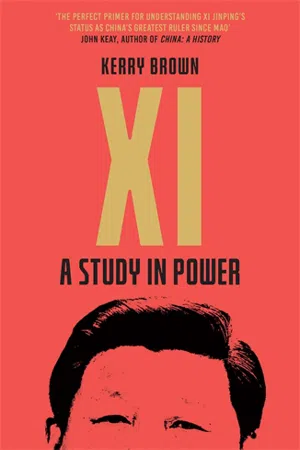
'Kerry Brown's
Xi is the perfect primer for understanding Xi Jinping's status as China's greatest ruler since Mao and as this century's least assailable statesman' John Keay, author of
China: A History
'A valuable primer for anyone looking to get up to speed on Xi Jinping's rise to global power' Jeff Wasserstrom,
Guardian
'Offers a nuanced and thorough explanation of Xi's China and why the Communist Party, for all its flaws, has long life in it' Oliver Farry,
Irish Times
Although Xi Jinping came to power a decade ago, he remains an enigmatic figure in the West. His priority has always been to keep Chinese society as stable as possible, steering a course through a period of astounding economic growth, while ensuring that nothing challenges the political status quo.
But with unrest stirring in Hong Kong, reports of human rights abuses taking place in the Xinjiang region and, devastatingly, the outbreak of a virus that would change the world, suddenly understanding Xi's China is more important than ever before.
In this short and timely book, academic and author Kerry Brown examines the complexities behind the man, explaining the impact that his rule is already having on the West. But who is Xi really, and what is his vision for China's future? And, crucially, what does that mean for the rest of the world?
Two decades ago, I was a British diplomat serving in Beijing. During an earlier stay, I had become aware of the leadership compound that lay beside the vast Forbidden City in the heart of the capital but had never managed to set foot in the place. However, during the visit of a senior British politician around the turn of the millennium, I was invited to accompany them to this hallowed place. The experience was disorientating. Driving through the chaotic and crushing traffic in the city centre, our embassy car swept into a side gate. It was as though we had disappeared into another world. Peace reigned. Beyond the security guards at the entrance, there was no one in sight. Classical buildings stood by tranquil lakes. The grass looked as though it had been cut by scissors. Everything was still, calm – the opposite of the metropolis, one of the largest 2 and most congested in the world, we had left outside. The place exuded an intangible sense of power.
In modern China, power is largely seen as something real, which certain people possess and others don’t, but which has an air of mystery about it. One of the numerous ‘givens’ for Western journalists covering Chinese elite politics over the past few decades is that those at the top of the ruling Communist Party of China have an abundance of it. There are not many of these people. The assumption is that they are laden with vast surfeits of this thing called ‘power’; they can run riot with it, annexing everything around them at their individual will. But is this really the case? Does ‘power’ have such a common currency and such consistent characteristics? Two of the finest historians of the modern country’s events, Fred Teiwes and Warren Sun, went to great lengths in their meticulous account of the final years of Mao’s rule to say that, while everyone can agree that he did have massive authority, ‘things were more complicated’.1
One source of confusion about structures of power in China is the idea that leaders today are little different from the emperors who led the country during its long imperial history until 1912. Like them, Mao, Deng and Xi are similar to modern gods, ruling with absolute authority over their subjects, enjoying an almost semi-divine status. It is questionable whether Chinese emperors did in fact have such powers. 3 The vast majority of their subjects probably spent their lives completely oblivious as to who was reigning over them. But the China that Xi Jinping lives in and rules today is not the same as the Chinas that existed before. Ironically, for all the claims about the great antiquity of Chinese history, the People’s Republic of China is not yet a hundred years old. It is a young state. Places such as the United Kingdom, France and even the United States and Australia can make claims to some sort of cohesive national narrative going back at least 150 years, and in some cases much further. Their governance structures and administrations are often much better established than those of the People’s Republic in Beijing, which only took form in 1949. While the concept of ‘China’ is, on the surface, a very ancient one – and there certainly is overlap between the geographical reach of predecessor states and the current one (particularly the expansionist Qing era, 1644–1912) – one could claim that much of the country we see today has been created since the Second World War, and in many cases even more recently. Power is moulded both by what it is directed at and what it is intended to have influence over. Like water, it changes its shape depending on what it strikes against. Xi Jinping’s powers are therefore different to those of China’s leaders prior to 1949 because the place he exerts power over did not exist then.
Even after 1949, each core leader has had bespoke styles and kinds of power, as much because of the changing economic 4 and political situation of their country, as anything to do with them personally. Mao Zedong, who ruled from 1949–76, was the great founder, a figure of God-like proportions. His successor, Deng Xiaoping, who was leader from 1978–89, was more prosaic and strategic – history will probably judge him as being much more effective than Mao in creating sustainable outcomes. After Deng’s era came Jiang Zemin, who ruled as party head from 1989 to 2002. He presented a more extrovert, oft-mocked leadership style, despite the fact that with his slippery, often buffoonish character he stabilised the country after the 1989 Tiananmen Square uprising and recommitted to play a role in the global economy through finally joining the World Trade Organization in 2001. Hu Jintao, the faceless, egoless successor to Jiang, mastered the art of making China a vast factory for economic growth, quadrupling the size of its GDP over the decade he was in office from 2002 to 2012, an unrivalled achievement in modern history. After all of these leaders came Xi. He has been talked of, by no less a figure than President Obama, as the leader who has most quickly and effectively consolidated his position since the time of Mao. What links these different figures is that they worked within the Communist tradition of governance. Maybe Xi is the most powerful of them all. But this is because China has greater significance as a country now than it did in the past. It is not because Xi has some kind of magic quality. The reasons 5 for his power are very prosaic – China has more money, more technology, more military equipment than ever before, and this is in comparison to a West that is weakening. There is nothing mysterious in any of this.
Xi and his colleagues certainly see themselves as occupying a phase in a continuous project that started in 1949, one where their actions are only possible because of the achievements of their predecessors. Xi himself has made it clear that the idea of repudiating Mao will not happen, at least under his watch. For Xi, without the Chairman, there would be no China as it exists today, in pole position to achieve its dreams of modernity and to overtake the US to become the world’s largest economy within the next decade. If Xi is the most powerful leader of the country since Mao, this is because of the systems and structures, and achievements, that arose from the hard work of his predecessors. He himself doesn’t deny this. He will see the country achieve things that Mao dreamt of but could never realise – his country having a navy with more vessels than the US, one that is able to speak back as an equal to American presidents, one that has eradicated absolute poverty. This sense of belonging to a great tradition of Communist Party leadership since 1949 in China, therefore, is crucial in understanding Xi as a political figure.
Xi’s power also exists to serve a purpose. This is not about his own individual aims. It is about the great objective of the 6 Communist Party to build a strong, rich country. This transcends specific leaders, and particular eras. The Communist Party is an atheist organisation. But that doesn’t mean it has no faith. Belief in the almost semi-mystical entity of ‘China’ with its spiritual import, its cultural richness and human vastness is the great overarching creed that has prevailed since 1949, and it has roots that extend far further back than this. Making this China powerful, strong and central in world affairs once more, as it had been in the distant past, is the key mission. Xi is a servant of that greater mission, almost in the same way the Pope leads the Catholic Church in its mission to deliver humanity to the Kingdom of Heaven. The main difference is that for Xi’s faith, that kingdom will be found on this earth. Of all the sources of Xi’s power, this one is the most potent.
The nature of the leadership he practises needs to be interpreted as serving these larger, longer-term aims related to faith in the great nation. If we want to describe Xi as an autocrat, it is because he is serving autocratic aims. There must be total fidelity to the great cause of making China great again. This is a jealous objective, and one that does not permit any vagueness nor any lack of commitment. Xi’s leadership style can be seen as almost designed to recognise this. The autocratic cause creates the leadership style, not the other way around. This is a crucial issue, if one truly wants to understand what is happening in China today. 7
On more mundane levels, Xi’s powers also need to be seen as circumscribed and limited. The Communist Party of China does not merely have a strong guiding, nationalist faith, but also a strong identity and ethos. Most of this was created long before Xi even became a member in 1974. To succeed in it at any level means adhering to this pre-determined set of rules and customs. You become as the party wants you, rather than you making the party become like you. As scholar Zheng Yongnian pointed out, contemporary China does indeed have an emperor – but it is in the form of the organisation of the Communist Party, rather than a human individual.2
In terms of the context of Xi’s power, and how one can compare him to predecessors like Mao, we have to recognise that the country that he rules over today has radically transformed from the one that existed only four decades ago. Socially, culturally, economically and in its physical appearance, it is almost a different country. Change itself is the great constant of modern China – change in terms of how people live, what work they do and how fast this change has occurred. The sole constant is the fact that the Communist Party has continued to have a monopoly on power. Beyond that, everything else seems to have been remodelled.
Even an outsider like myself can testify to this. In the mid-1990s I lived in a fairly typical provincial city in China for two years. It had no high-rise buildings, was served by 8 often pockmarked roads and its central area was dominated by a charming, chaotic and ramshackle old city where temples nestled beside shops, merchants’ houses and tombstone sellers. Returning to this place in the early 2000s after a few years’ absence, I was wholly unable to find my way around. Literally nothing remained to orientate me. A vast, shiny new airport had been built, as had a new museum about ten times the size of the old one, with huge halls displaying dinosaurs, furnished with interactive, hi-tech teaching aids. New civic buildings dominated one part of the city. There were skyscrapers everywhere, glittering in the sun. The roads were pristine, with glitzy, expensive imported cars driving along them. Only after much searching could I find at least one of the old temples, turning the corner of a huge new boulevard running south through where the old city once was. There it stood, almost stranded in a sea of change, its doors and courtyard recognisable. I found this strangely moving and reassuring. But after gazing at it for a while, I realised that even this place had experienced an extensive makeover.
This is not a unique incidence. Change has infected every part of China. It means that the kinds of tasks and the sorts of objectives the leadership – by which I mean the institution rather than specific personalities – must fulfil have also changed. And yet, as we will see, a choice has been made by Xi and those around him, deep in the party, to maintain this 9 almost old-fashioned, highly unified leadership model. It is as though the Communist Party were like that former temple I recognised in among the sea of change the day I revisited my old home – a focal point to orientate and reassure people that they have not strayed on to a totally different planet. In a country undergoing this extent of transformation, and with the impact of all its technological advances, the commitment to a single, authoritative centralising figure has remained the default. In Xi’s China, the party is not back to the future, but back to the past. In every other aspect of Chinese life, the reverse is true, with things becoming more complex, diverse and renewed by the day. To opt for a leadership like this has a simple logic: in a world where everything else is pervaded by change, transformation and transition, the party and the party alone is the great bastion of stability and permanence. To coin a phrase, in the kingdom of change, the changeless one is King!
How deliberate a construct is the Xi political persona, bearing in mind the context of leadership customs and the party’s custodianship of a strong, enduring identity and ethos? Acknowledging this is not to the denigration of Xi’s individu...
Table of contents
Title Page
Dedication
Contents
Preface
CHAPTER ONE: Xi Jinping: The Enigma of Chinese Power
CHAPTER TWO: The Xi Story – 1953–2002
CHAPTER THREE: The Zhejiang Years – 2002–2007
CHAPTER FOUR: Xi in the Centre: His Time in Power – 2007–2017
CHAPTER FIVE: Xi and the New Era – 2017–2022
CHAPTER SIX: Xi and the World – 2021 Onwards
CHAPTER SEVEN: Xi and the Future
Afterword: Who is Xi?
Acknowledgements
Index
About the Author
Copyright
Trusted by 375,005 students
Access to over 1.5 million titles for a fair monthly price.
Study more efficiently using our study tools.
Frequently asked questions
Yes, you can cancel anytime from the Subscription tab in your account settings on the Perlego website. Your subscription will stay active until the end of your current billing period. Learn how to cancel your subscription
No, books cannot be downloaded as external files, such as PDFs, for use outside of Perlego. However, you can download books within the Perlego app for offline reading on mobile or tablet. Learn how to download books offline
Perlego offers two plans: Essential and Complete
Essential is ideal for learners and professionals who enjoy exploring a wide range of subjects. Access the Essential Library with 800,000+ trusted titles and best-sellers across business, personal growth, and the humanities. Includes unlimited reading time and Standard Read Aloud voice.
Complete: Perfect for advanced learners and researchers needing full, unrestricted access. Unlock 1.5M+ books across hundreds of subjects, including academic and specialized titles. The Complete Plan also includes advanced features like Premium Read Aloud and Research Assistant.
Both plans are available with monthly, semester, or annual billing cycles.
We are an online textbook subscription service, where you can get access to an entire online library for less than the price of a single book per month. With over 1.5 million books across 990+ topics, we’ve got you covered! Learn about our mission
Look out for the read-aloud symbol on your next book to see if you can listen to it. The read-aloud tool reads text aloud for you, highlighting the text as it is being read. You can pause it, speed it up and slow it down. Learn more about Read Aloud
Yes! You can use the Perlego app on both iOS and Android devices to read anytime, anywhere — even offline. Perfect for commutes or when you’re on the go. Please note we cannot support devices running on iOS 13 and Android 7 or earlier. Learn more about using the app
Yes, you can access Xi by Kerry Brown in PDF and/or ePUB format, as well as other popular books in Politica e relazioni internazionali & Biografie in ambito politico. We have over 1.5 million books available in our catalogue for you to explore.