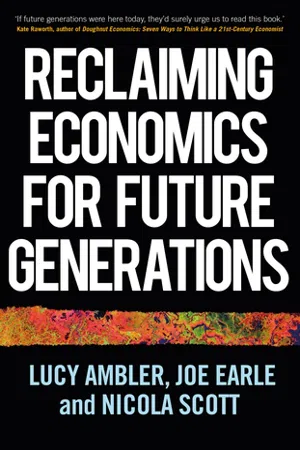
Today's economies fail to recognise that we are in a rapidly worsening crisis, reproducing and often worsening vast and harmful inequalities between people and countries. The current models are unsustainable, and at a time when global temperatures are rising and divides are deepening, humanity is left in a rapidly worsening situation of its own making, the destruction of the living world, which will make large parts of the earth uninhabitable.Without access to the knowledge, skills or tools to build a better future, local, national and global economies will continue to fail to address the interlinked challenges of systemic racism, inequalities faced by women, the Covid-19 pandemic and the nature and climate emergency.Across the world, economics students are coming together under the banner of the student movement, Rethinking Economics, to create a better economics – one which can help to create a world where all our children can flourish regardless of their gender, background or birthplace.Drawing on over sixty interviews with students and professionals from identities and backgrounds marginalised in economics and a wide range of global and historical research, this book illustrates the ways in which the discipline is currently not fit for purpose and sets out a vision for how it can be diversified, decolonised and democratised.The struggle to reclaim economics could not be more crucial - our futures depend on it. This book explains how it can be done.
eBook - ePub
Reclaiming economics for future generations
- 392 pages
- English
- ePUB (mobile friendly)
- Available on iOS & Android
eBook - ePub
Reclaiming economics for future generations
About this book
Information
Part I
What has gone wrong with economics?
Chapter 1
Undiverse and uninclusive
With contributions from Ariane Agunsoye, Michelle Groenewald, Danielle Guizzo and Bruno Roberts-Dear
At the age of sixteen, Francesca Rhys-Williams, a contributor to this book, decided she wanted to study economics; however, it was not a subject option available at her high school, so she went to another school for her economics course. She was surprised to find the class included few women.
The lack of gender diversity in economics is well documented. According to a basic search of the Research Papers in Economics database, women make up only a quarter of academic economists worldwide.1
Economics in government and international institutions is similarly dominated by men. For example, of 173 central banks globally, only fourteen were headed by women in 2019, up from twelve the previous year.2
In this chapter, we demonstrate that women, people of colour and less socioeconomically privileged people are significantly underrepresented in academic economics and become progressively less represented further along the career ladder from undergraduate to senior professor. For example, in US economics departments, one in three assistant professors are women but only one in six full professors are.3
We highlight the lived consequences of this lack of diversity and inclusivity through focus groups with high-school students and interviews with people at different life stages who are underrepresented in the discipline, including university students and academic economists (a full list of interviewees is provided in the Appendices). Hearing people underrepresented in economics express their experience of and relationship with the subject helps us to understand the stories behind the statistics.
In highlighting this problem, we focus on the United States and the United Kingdom because, as we show in the next chapter, the former dominates the global discipline of economics today and the latter has historically. Practically, focusing our argument on two countries gives us the necessary space to go into more depth. However, throughout the chapter we weave in stories and statistics from other countries, which suggests that this pattern is repeated in economics globally, playing out in different ways according to local history and culture. This view is supported by the testimony of interviewees we spoke to from countries across the world including India, Chile, Finland, South Korea, South Africa, Guyana, Brazil and Malaysia.
In the next chapter we explore the mechanisms by which the lack of diversity and inclusivity in US economics is exported to other countries across the world because of the position of the US, at the top of a global hierarchy of economics.
Barriers to becoming an economist
In this section, we explore the barriers young people from backgrounds and identities that are underrepresented in economics face to study economics at university. Collectively, they are an important part of the reason that academic economics in the UK and US lacks diversity.
What is economics?
As an outsider, one of the first hurdles to becoming an economist is even knowing what it is. We held focus groups with ethnically diverse students from two non-fee-paying mixed-sex high schools in the UK who did have the opportunity to study A Level economics at their school (only about half of UK non-fee-paying and non-selective school students have that opportunity).4
Many focus group students only had a vague understanding of the subject, and consequently were deterred from opting to study it, such as fourteen-year-old Beth who remarked: ‘I need more knowledge about it … what I think of immediately in my mind is a pie chart and a calculator … You have to commit yourself to something that you have not done, ever.’
Barbara, a seventeen-year-old student studying an A Level in Economics, also remarked how not knowing anyone in economics can affect a student’s choice to study it and that, ‘There’s a lot of mainly White people in economics, because they have maybe family friends that study economics. They’ll know more about the subject.’ So even at this age, there’s awareness of a lack of student diversity in the subject.
As students in the UK choose their first formal examined subjects (GCSEs) at age 13–14, with some choosing at age 12–13, those like Beth and Barbara have no way to find out whether economics is something they would enjoy or be good at, and often believe that they do not have sufficient knowledge about the subject to pursue its study.
We know that over two-thirds of British undergraduate economics students in 2018–2019 studied economics at A Level5 and it is the key route into economics at university.6 However, half of non-selective, non-fee-paying schools offered economics at A Level in 2017, compared to three-quarters of fee-paying schools and four-fifths of selective non-fee-paying grammar schools.7 As a result, economics education is harder to access in the UK if you come from a less socioeconomically privileged background.
Our interviews with university economics students and professionals also highlight the role of a person’s familial and social networks supporting them at the start of their study of economics (and this is potentially even more important for people from underrepresented backgrounds). For example, student interviewees from a range of identities8 mentioned they had family members or knew of people (mostly men) who worked in economics or in a related field.
Alex from a low-income background in North America talked about their lack of understanding of what economics was when they were growing up:
Economics, at least around where I grew up, was never taught in schools. Coming to university, economics was an entirely new thing [and] from a background of not having anyone in my life who had a professional career or who had been to university, it was very new … When I chose to study economics, I had no idea what an economist did. I just knew economics is resource allocation and that’s what I wanted to do … I got into economics as I have this drive to relieve the barriers that people face to self-sufficiency and just living … And I knew I wanted to influence government public policy to make things easier for already marginalised people.
To become an economist, you need to know what economics is and seek it out. That most commonly happens through family networks and schools. Others, like Alex, are drawn to it through their life experiences. Young people often have a curiosity about the world and many of their questions are economic in nature. This can be a strong motivating factor to want to study economics, even if, as in Alex’s case, they had not engaged with it in school.
Erika, who identifies as Japanese American and middle class with working-class family members, recalled the life her grandmother experienced on a low income with cancer as being a motivating factor for choosing economics, as she wondered at that time:
How does she live? Until I realised ‘Oh, she lives on social security. How does that work? How did she get her medical bills paid for? How does social security work and what, who gets it and what do we think about that?’ I wanted to understand that more.
However, as we will see later, what is often taught in economics does not reflect the lives lived by people such as Erika’s grandmother and Alex’s family.
Economics is too mathematical
The idea that economics is very mathematical and technical is often cited as a barrier to increasing diversity in economics. Participants of our UK focus groups highlighted this feeling, describing economics as ‘the maths side of business’, ‘the mathematical side of money’, ‘the money side of business’ or focused on ‘graphs, statistics and maths’. These views are also widely held by 15–17-year-olds across the UK according to recent research by the Royal Economic Society’s Women’s Committee.9
A minority in our focus groups defined economics in a broader way, suggesting that it is ‘about our government, the people around us and what we and communities can control’, and ‘how people use money to influence how our environment is’.
The focus on maths, graphs and the language used in economics was perceived to be a barrier by some of the 16–17-year-old focus group participants who were studying economics. In their conversation, three students expressed their apprehensions.
Emmanuel: The graphs. We have about 50 different graphs. We studied it for about 6 weeks, and we’ve already got 50 different graphs … There’s a lot to remember … So, if it’s just been for six weeks, I would be doing that for two years. It’s tough.
Barbara: I agree. There are quite a lot of graphs. It does make sense I’d want to then like the writing part of it.
Daniel: It’s the terminology that they are using now which I do not understand … When we are talking about demands – I just do not get it.
The sentiment of economics being ‘too technical’ or ‘maths-focused’ was also held by some undergraduate students in economics before they chose to study it at university. Emilia from Finland studying in the UK, Anna from Denmark, and Luis from Mexico who studied in the US, all highlighted this view.
While some suggest that girls and women are put off economics by the maths, this claim is not supported by the evidence.10 Rather than innately disadvantaging any group, the mathematical and graphical reasoning in economics and the technical jargon are another barrier to entry, which certain groups are supported to master in school and family life, e.g. boys being told they are good at maths, while other groups of young people have much more to do individually or have to catch up when they get to university.
Economics isn’t for people like me
Even if you find out what economics is and are drawn to it despite the maths, another barrier is feeling, or being told, that it isn’t for people like you. Stereotypes about what kind of people are economists develop early in life. Many of our 13–14-year-old focus group students weren’t aware of what economics was and yet still made links to particular gender and racial identities when they visualised an economist. Cara, aged 13–14 years old, observed, ‘Well, whenever you go into central London, and you see all these people in suits, they are usually young White men, who you think have just come out of ...
Table of contents
- Cover
- Half Title
- Series Information
- Title Page
- Copyright Page
- Contents
- A note on how this book was written
- List of additional contributors
- Foreword
- Introduction
- Part I What has gone wrong with economics?
- Part II Reclaiming economics
- Appendices
- List of figures and tables
- Notes
- Acknowledgements
- Index
Trusted by 375,005 students
Access to over 1.5 million titles for a fair monthly price.
Study more efficiently using our study tools.
Frequently asked questions
Yes, you can cancel anytime from the Subscription tab in your account settings on the Perlego website. Your subscription will stay active until the end of your current billing period. Learn how to cancel your subscription
No, books cannot be downloaded as external files, such as PDFs, for use outside of Perlego. However, you can download books within the Perlego app for offline reading on mobile or tablet. Learn how to download books offline
Perlego offers two plans: Essential and Complete
- Essential is ideal for learners and professionals who enjoy exploring a wide range of subjects. Access the Essential Library with 800,000+ trusted titles and best-sellers across business, personal growth, and the humanities. Includes unlimited reading time and Standard Read Aloud voice.
- Complete: Perfect for advanced learners and researchers needing full, unrestricted access. Unlock 1.5M+ books across hundreds of subjects, including academic and specialized titles. The Complete Plan also includes advanced features like Premium Read Aloud and Research Assistant.
We are an online textbook subscription service, where you can get access to an entire online library for less than the price of a single book per month. With over 1.5 million books across 990+ topics, we’ve got you covered! Learn about our mission
Look out for the read-aloud symbol on your next book to see if you can listen to it. The read-aloud tool reads text aloud for you, highlighting the text as it is being read. You can pause it, speed it up and slow it down. Learn more about Read Aloud
Yes! You can use the Perlego app on both iOS and Android devices to read anytime, anywhere — even offline. Perfect for commutes or when you’re on the go.
Please note we cannot support devices running on iOS 13 and Android 7 or earlier. Learn more about using the app
Please note we cannot support devices running on iOS 13 and Android 7 or earlier. Learn more about using the app
Yes, you can access Reclaiming economics for future generations by Lucy Ambler,Joe Earle,Nicola Scott, Julie Froud in PDF and/or ePUB format, as well as other popular books in Business & Business General. We have over 1.5 million books available in our catalogue for you to explore.