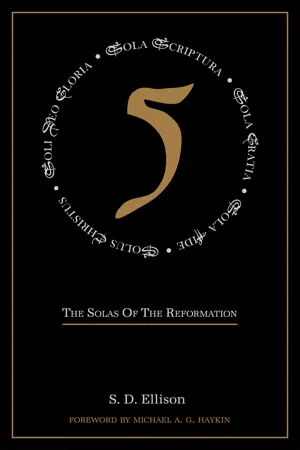
What are the five solas? Why do they matter? Are they biblical? How do they apply to me?Five: The Solas of the Reformation, by S. D. Ellison, is a primer written to introduce readers to the glorious truths of the Reformation. This book will guide people through the historical and biblical basis for each of the Solas: Sola Gratia (Grace Alone), Sola Fide (Faith Alone), Sola Scriptura (Scripture Alone), Solus Christus (Christ Alone), and Soli Deo Gloria (Glory to God Alone). However, just as importantly, Five: The Solas of the Reformation will show how these great reformational truths can be applied to our own lives.
- English
- ePUB (mobile friendly)
- Available on iOS & Android
eBook - ePub
About this book
Information
Topic
Theology & ReligionSubtopic
Christian Theology1
SOLA SCRIPTURA
Scripture Alone
Scripture’s Power and Beauty1
The city was notorious for violence. Gambling was rife. Entertainment consisted of provocative dancing,drunkenness,and,perhaps unsurprisingly, sexual immorality. The citizens would often parade the city streets naked while singing vulgar songs. God was roundly dishonoured in both word and deed. All of this was an embarrassment to those who governed early sixteenth century Catholic Geneva, Switzerland.
As they attempted to restrain this behaviour, the governing council of Geneva, the Council of Two Hundred, took increasingly drastic action. To begin with, the council passed various laws, hoping that legislation would remedy the problem. However, in the face of mere legislation, the decline in Geneva’s morals continued unabated. The council also decided to break with Catholicism and align the city with the Protestant Reformation. This was not a theological decision, but a desperate attempt to curb the wild behaviour of Geneva’s citizens. Finally, the council extended an invitation to a man named John Calvin to become Geneva’s Chief Pastor.
In August 1536, Calvin arrived in Geneva. It was quite an unspectacular beginning to his ministry. Calvin found himself roundly ignored by both the city at large, and the council who had invited him. Worse still, he was not paid for his first year of work. After serving for less than two years, in 1538, he was dismissed from his position. Circumstances in Geneva continued to deteriorate, and so once again, the city turned to Calvin. Given his initial experience, Calvin was understandably reluctant to return. Yet, out of a sense of duty, he eventually agreed.
Come September 1541, Calvin found himself in the city of Geneva once more. In returning to Geneva, he returned to his main weapon against the lude behaviour he had previously observed – the Bible. In fact, he resumed preaching from the very place that he had finished in 1538. Every day, Calvin preached from the Bible. Slowly, but surely, and as biblical knowledge increased, people were convicted of their sin and underwent a moral transformation by the power of God. The city cared for the poor and unwanted. Education was provided for all classes of people. Industry was developed. True liberty was enjoyed. Remarkably, at least in the historian’s eyes, this was accomplished by one man simply preaching the Bible.
This brief history of John Calvin’s arrival in Geneva illustrates powerfully the Reformation cry of Sola Scriptura—Scripture Alone. Indeed, it illustrates the power and the beauty of Scripture. In what follows, we will observe this power and beauty of Scripture in the thinking of the Reformers and the pages of Scripture. We will then end this chapter by considering how the Reformation cry of Sola Scriptura is relevant for us today.
The Authority of this Power and Beauty
It is important to highlight that the primary issue underlying the Reformation was not the issue of justification, but the issue of authority. Martin Luther’s complaint against the Catholic Church was, first and foremost, their claim to final authority. It just so happened that justification was the avenue through which the issue was most starkly demonstrated. This becomes apparent as we consider Luther’s view of Scripture.
Martin Luther: Captive to the Word of God
The Catholic Church of the sixteenth century held to a two-source theory of authority: Scripture and Tradition. Seedlings of this kind of thinking can be traced back to the fourth century. It can be discerned in the work of the early Church Fathers, such as John Chrysostom, Basil and Augustine. These seedlings developed into saplings during the twelfth century. And, largely due to the writings of the canon lawyers, this two-source theory of authority became more explicit and widespread. These saplings matured further in the fourteenth century through the writings of William of Ockham. Therefore, by the sixteenth century, it was firmly established that Scripture and Tradition were to be considered equally authoritative and supplementary sources of divine revelation.2 This two-source theory of authority was finally confirmed by the Council of Trent in the Counter-Reformation. This council met three times between December 1545 and December 1563 in an attempt to combat Reformation teaching that was circulating throughout Europe.
Surprisingly, Luther’s view of Scripture is not explicitly expressed in his 95 Theses, famously nailed to the Wittenberg Church door in 1517. Instead, Luther’s view was made explicit as a result of three debates which took place in light of the 95 Theses. Here Luther’s view of Scripture emerged as being at odds with the position of the Catholic Church. Initially, Luther faced Sylvester (Mazzolini) Prierias, a Dominican theologian, drafted in by Pope Leo X to respond to Luther’s position. Prierias quickly discerned that the issue at stake was one of authority. This was followed by a debate between Luther and Cardinal Cajetan in October 1518. However, Luther’s toughest challenge came in 1519 when he faced the well-known theologian, Johannes von Eck, on the issue of authority. These three debates made it abundantly clear that Luther viewed Scripture alone as the final authority.3 As one historian notes, the stronger the argument for the Papacy’s infallibility, the more Luther relied on the Scriptures.4
These debates did not settle the matter.As the dispute continued,Luther’s position crystallised, leading to the clarity in Luther’s famous statement delivered at the Diet of Worms in 1521. When asked to recant all that he had written on the subject, Luther replied:
Unless I am convinced by the testimony of the Scriptures or by clear reason…I am bound by the Scriptures I have quoted and my conscience is captive to the Word of God. I cannot and I will not retract anything, since it is neither safe nor right to go against conscience. I cannot do otherwise, here I stand, may God help me.5
It is apparent, then, that “[i]n Martin Luther’s day, sola Scriptura had to do with the Bible being the sole authority for Christians over against challenges to it from the traditions of the medieval church, church councils, and the popes. The reformers wanted Scripture to stand alone as the Church’s true authority.”6 Martin Luther was captive to the Word of God.
Ulrich Zwingli and John Calvin: Devoted to Scripture
Luther was not alone. Others, recognising and accepting the Reformation cry of Sola Scriptura, were also captive to the Word of God.Ulrich Zwingli, a contemporary of Luther, led the Reformation in Zurich, Switzerland. Zwingli was convicted under the principle of Sola Scriptura to abandon the prescribed lectionary of the day. Rather than following the set readings of the Church week-by-week, Zwingli devoted himself to preach verse-by-verse through whole books of the Bible.7
This verse-by-verse exposition, as we have observed above, was also John Calvin’s practice. Calvin was part of the second generation of the Reformers. By the time he was writing, the cry of Sola Scriptura had continued to develop and mature in Reformation thinking. This is particularly evident in his Institutes of the Christian Religion, where Calvin is scathing of the Catholic Church and their continued defence of a two-source theory of authority. In Calvin’s mind, to argue that ultimate authority may be derived from human tradition as well as Scripture is despicable. He writes:
Now daily oracles are not sent from heaven, for it pleased the Lord to hallow his truth to everlasting remembrance in the Scriptures alone…But a pernicious error widely prevails that Scripture has only so much weight as is conceded to it by the consent of the church. As if the eternal and inviolable truth of God depended upon the decision of man!8
Zwingli and Calvin were devoted to the Word of God. They believed it, submitted to it and preached it.
Defining Sola Scriptura
There is no single, definitive, statement on Sola Scriptura from the Reformers. Rather, there is a clear understanding of Scripture as the sole authority for the Christian and the Church, which was later termed Sola Scriptura. It is incumbent upon us,then,to attempt to define exactly what the Reformers understood of Scripture. What were the key components in their doctrine of Scripture?
In light of 2 Timothy 3:16–17 (ESV), “All Scripture is breathed out by God and profitable for teaching, for reproof, for correction, and for training in righteousness, that the man of God may be competent, equipped for every good work”, the Reformers understood God’s Word to be inspired, inerrant, and sufficient. These three elements were the key components to the Reformers’ doctrine of Scripture.
Unlike theological discussion today, there wasn’t much of a debate regarding the inspiration of Scripture in the sixteenth century. Both the Catholic Church and the Protestant Reformers believed the Bible to be divinely inspired. The Reformers, however, logically reasoned if Scripture is inspired by God,it must be inerrant.Matthew Barrett helpfully explains Luther’s logic on this:
[I]t is important for us to note that for Luther sola scriptura was directly connected to the inerrancy of Scripture. Luther did not use the term ‘inerrancy’ in his writings or in debate, yet the concept is present throughout his thinking on the matter. If Scripture is not inerrant, then sola scriptura is without a foundation. For Luther, what made the Bible alone the supreme authority was that it was not only inspired by God but as a result of being God-breathed the Scriptures, and the Scriptures alone, could not and do not err. On the other hand, church councils and popes can and do err. So while Rome believed Scripture and Tradition were inerrant authorities, Luther argued that Scripture alone is our inerrant authority from God.9
The Reformers asserted that as Scripture comes from God, it must subsequently be without error.
In addition to this, the Reformers argued that Scripture is also sufficient—it is all we need. This is summarised by John MacArthur:
The Reformation principle of sola Scriptura has to do with the sufficiency of Scripture as our supreme authority in all spiritual matters. Sola Scriptura simply means that all truth necessary for our salvation and spiritual life is taught either explicitly or implicitly in Scripture. It is not a claim that all truth of every kind is found in Scripture… [Rather] Scripture is the highest and supreme authority on any matter on which it speaks.10
In other words, “everything necessary, everything binding on our conscience, and everything God requires of us is given to us in Scripture.”11 God’s Word is sufficient for the Christian and for the Church. Consequently, there is no need for additional authority and revelation. It is not difficult to appreciate how this cut against the grain of the Catholic Church’s two-source theory of authority.
Sola Scriptura, then, is the assertion that Scripture alone is the highest and final authority because it is divinely inspired, inerrant, and sufficient. The underlying issue in the Reformation was that of authority. The Reformers sought to implement Scripture alone as the highest and final authority because they understood tradition, church councils and popes are human, prone to error, and thus insufficient. Consequently, they could not operate at the same level of authority as Scripture. This was the Reformers’ thinking, “[b]ecause Scripture is the God-breathed and therefore infallible word of the living God, it carries absolute unique authority – the authority of God himself…If Scripture truly is the word of almighty God, then the issue of final authority is settled.”12
Sola Scriptura in Scripture
Given the Reformers’ high view of Scripture, it is only logical to explore the Bible to see if it teaches all that they claimed.
Life by Every Word (Deuteronomy 8:3)
We begin our exploration of Scripture with the Old Testament book of Deuteronomy. The title “Deuteronomy” is from a Latin mistranslation of 17:18 (“a copy of this law”) meaning “Second Law”. The Hebrew title is “These are the Words”, a more fitting title for the book which contains a collection of speeches, or sermons, delivered by Moses. As the nation of Israel is on the verge of entering the Promised Land, Moses delivers an exposition of the Law. His aim was to convince Israel to trust and obey God. In his second sermon, he recounts the lessons that God taught Israel in the wilderness (8:1–20). As part of this section, he makes it clear that one lesson was dependence on the Word of God alone (v. 3):
1The whole commandment that I command you today you shall be careful to do, that you may live and multiply, and go in and possess the land that the LORD swore to give to your fathers. 2And you shall remember the whole way that the LORD your God has led you these forty years in the wilderness, that he might humble you, testing you to know what was in your heart, whether you would keep his commandments or not. 3And he humbled you and let you hunger and fed you with manna, which you did not know, nor did your fathers know, that he might make you know that man does not live by bread alone, but man lives by every wor...
Table of contents
- Cover Page
- Title Page
- Copyright Page
- Contents
- Acknowledgements
- Foreword
- Introduction
- 1. Sola Scriptura Scripture alone
- 2. Sola Gratia Grace alone
- 3. Sola Fide Faith alone
- 4. Solus Christus Christ alone
- 5. Soli Deo Gloria Glory to God alone
- Conclusion
- Endnotes
Trusted by 375,005 students
Access to over 1.5 million titles for a fair monthly price.
Study more efficiently using our study tools.
Frequently asked questions
Yes, you can cancel anytime from the Subscription tab in your account settings on the Perlego website. Your subscription will stay active until the end of your current billing period. Learn how to cancel your subscription
No, books cannot be downloaded as external files, such as PDFs, for use outside of Perlego. However, you can download books within the Perlego app for offline reading on mobile or tablet. Learn how to download books offline
Perlego offers two plans: Essential and Complete
- Essential is ideal for learners and professionals who enjoy exploring a wide range of subjects. Access the Essential Library with 800,000+ trusted titles and best-sellers across business, personal growth, and the humanities. Includes unlimited reading time and Standard Read Aloud voice.
- Complete: Perfect for advanced learners and researchers needing full, unrestricted access. Unlock 1.5M+ books across hundreds of subjects, including academic and specialized titles. The Complete Plan also includes advanced features like Premium Read Aloud and Research Assistant.
We are an online textbook subscription service, where you can get access to an entire online library for less than the price of a single book per month. With over 1.5 million books across 990+ topics, we’ve got you covered! Learn about our mission
Look out for the read-aloud symbol on your next book to see if you can listen to it. The read-aloud tool reads text aloud for you, highlighting the text as it is being read. You can pause it, speed it up and slow it down. Learn more about Read Aloud
Yes! You can use the Perlego app on both iOS and Android devices to read anytime, anywhere — even offline. Perfect for commutes or when you’re on the go.
Please note we cannot support devices running on iOS 13 and Android 7 or earlier. Learn more about using the app
Please note we cannot support devices running on iOS 13 and Android 7 or earlier. Learn more about using the app
Yes, you can access Five by S. D. Ellison in PDF and/or ePUB format, as well as other popular books in Theology & Religion & Christian Theology. We have over 1.5 million books available in our catalogue for you to explore.