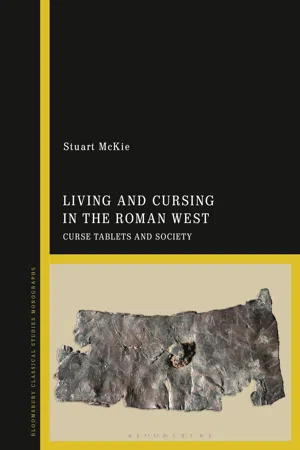
Focusing on the Roman west, this book examines the rituals of cursing, their cultural contexts, and their impact on the lives of those who practised them. A huge number of Roman curse tablets have been discovered, showing their importance for helping ancient people to cope with various aspects of life. Curse tablets have been relatively neglected by archaeologists and historians. This study not only encourages greater understanding of the individual practice of curse rituals but also reveals how these objects can inform ongoing debates surrounding power, agency and social relationships in the Roman provinces.
McKie uses new theoretical models to examine the curse tablets and focuses particularly on the concept of 'lived religion'. This framework reconfigures our understanding of religious and magical practices, allowing much greater appreciation of them as creative processes. Our awareness of the lived experiences of individuals is also encouraged by the application of theoretical approaches from sensory and material turns and through the consideration of comparable ritual practices in modern social contexts. These stimulate new questions of the ancient evidence, especially regarding the motives and motivations behind the curses.
- 296 pages
- English
- ePUB (mobile friendly)
- Available on iOS & Android
eBook - ePub
About this book
Information
1
Introduction
In one form or another, the ritual of cursing an enemy by inscribing a piece of lead existed for over 1,000 years in the regions around the Mediterranean, and for 500 years in the regions of northern Europe that became part of the Roman Empire. Despite numerous attempts by religious and legal authorities to outlaw the practices, they succeeded in addressing difficult moments in the everyday lives of people in the Graeco-Roman world. One such person was an unnamed woman who lived in Mainz. At some point in the late first or early second century AD, she lost all the money left to her by her (presumably) late husband. According to her version of events – the only version we have – the fortune had been stolen by a certain Ulattius Severus, clearly someone she trusted: perhaps a relative or her guardian. Having no legal right to pursue her case through the courts, this woman turned to the gods in her time of need. She went to the temple of Magna Mater, where she had heard from friends or acquaintances that it was possible to perform a cursing ritual against thieves and embezzlers. She procured a thick sheet of lead, perhaps from the priests at the temple and possibly for a small fee, and inscribed her curse against the man who had betrayed her (SD 492, Figure 1.1).
I ask you, Lady Mater Magna, that you avenge me in the matter of the fortune of my husband Florus. The one who has deceived me, Ulattius Severus: just as I write this wrongly, so shall everything that he does, everything he undertakes, everything should go wrongly for him. Like salt and water shall it go for him. Everything he has taken away from me from the fortune of my husband Florus, I ask you Lady Mater Magna, that for this you avenge me.
The priests directed her to a pit behind the temple, which was lined with the burnt remains of animal and plant matter that others had given to the goddess. After taking in her enclosed, smoky surroundings, she spoke the words that would invoke the vengeful power of the goddess, and finally threw her tablet into the piles of ash at the bottom of the pit. We will never know the outcome of this event, but it is likely that the wife of Florus walked out of the temple feeling that she had done something to rectify the wrongs done to her. She may have reported back to the friends who had told her about the rituals performed at the temple, setting the rumour mill in motion. If word reached Ulattius Severus, it may have sowed a seed of doubt in his mind, meaning the next time a business arrangement turned sour, or the next time he suffered an illness or injury, he may have begun to worry about the divine implications of his dealings with Florus’ wife.

Figure 1.1 SD 492 from Mainz written by the wife of Florus. Image from Blänsdorf 2012, copyright GDKE Rheinland-Pfalz.
Some of what I have presented here is, of course, creative speculation, but it nevertheless demonstrates the significance of curse tablets for the social lives of the people who produced them. Although what often survives is only a few scratched lines, barely legible on corroded lead sheets, these objects, and the rituals of which they were part, were explicitly directed towards the faults and failings in the relationships that connected people to others around them. Community life in the ancient world – as in any human society throughout history – was never lived in total harmony, and rituals such as cursing offered means through which ancient people could define, negotiate and at times destroy the relationships they made with others. In doing so, they drew upon influences from local, regional and global beliefs and practices, connecting their actions to those of countless others across the Roman Empire. At the same time, ancient cursing rituals were totally adaptable, allowing individual people to make them relevant to their own circumstances, like Florus’ wife attacking the business dealings of her embezzling guardian. What survives are hundreds of individual appeals to the gods, with huge variations in language, style, content and form.
The focus of this book is on these individual situations and how, by closely examining the curse tablets and the contexts in which they were produced, modern historians can develop a greater understanding of the lives of their makers. In the past, much scholarship on curse tablets has been concerned with attempting to fit them into schemes of categorization, based on either motive or language use, or has used them as evidence for changes in Latin or Greek language.1 Where their ritual importance has been recognized, it has, until very recently, been done within a pan-Imperial tradition of magical practice and belief.2 Such macro-scale analysis is unsustainable, and fundamentally misses the point of curse tablets, which were individualized reactions to personal crises. In this book I will take a significantly different approach to the curses from the Roman west by examining them within the physical and social contexts of the communities in which they were produced. My central aim is to show that curse tablets were an important means of addressing moments of crisis, and that cursing rituals were creatively performed, taking inspiration from the world around them in those moments of crisis. To do so, I will build on several recent developments in the study of ancient religion, especially the Lived Ancient Religion approach, as well as the sensory and material turns in archaeology. Curse tablet scholarship is beginning to feel the presence of these new approaches, but this book represents a paradigm shift in the analysis of these fascinating ancient objects.
Lived ancient religion
Scholars of contemporary religion have long recognized the immense importance of framing religion as lived experience. Drawing on Heidegger and Merleau-Ponty, and closely related to ideas of ‘vernacular’ and ‘everyday’ religion, the ‘lived religion’ approach contends that religion is fundamentally based in daily practice and patterns of social life, not abstract belief.3 As Primiano argued, ‘official religion’ has no objective existence that can be separated from the combined actions of individuals, up to and including religious or civic leaders.4 Privileging belief and measuring it against some dogmatic standard is a ‘highly western, protestant conceptualisation of religion’5 that makes little sense in other historical and cultural environments, including the Roman Empire. Religion is not handed down by authorities and then mindlessly replicated, but is produced by the actions of humans, enacted within social contexts that provide shared experiences and learned practices.6 It is therefore complex, multifaceted and often messy, full of contradictions and inconsistencies as individuals adopt and adapt religious practices to make them meaningful in their everyday lives. Attending to individual experience means also being more aware of the impact of sensory perception and memory on the generation of religion, as well as the intersections between religion and other factors in human life, such as age, gender, race and class.7
Lived religion approaches have great potential for advancing our understanding of Roman religion, as has been amply shown by recent projects led by Rüpke.8 When applying these approaches to the ancient world, the Lived Ancient Religion (LAR) Projects retained the questioning of institutionalized models of religion and the refocusing of enquiry onto individual experience, but, perhaps naturally for historians and archaeologists, added an interest in religious change over time. Rüpke offers the following description of how to use the Lived Ancient Religion model:
… scattered evidence should be contextualised and interpreted by relating it to individual agents, their use of space and time, their formation of social coalitions, their negotiation with religious specialists or providers, and their attempts to make sense of religion in a situational manner and thus render religion effective.9
Applying this model has revitalized Roman religion, overhauling older images of lifeless, automatic repetition of rituals in favour of a vibrant, creative and changeable religious world in which the actions of individuals had a cumulative effect on the direction of wider religious movements.10 Curse tablets have been part of these discussions, but have not yet attracted sustained attention. The time is therefore right for a full analysis of curses from a ‘lived religion’ perspective. Rüpke’s description of the model chimes very well with the aims of this book, which will focus especially on spatial and temporal contexts, the social relationships formed around cursing rituals, and the ways in which people used curses to not only make sense of their world, but to change it.
Agency and power
At the centre of the idea of religion as the product of lived experience is the concept of agency, which can be most usefully described as the ability to ‘make a difference in the world.’11 Since the work of Bourdieu and Giddens, agency has been understood in relationship with ‘structure’, which is anything that guides, encourages or limits agency.12 These two concepts exist in a recursive relationship, each challenging and developing the other. In other words, the actions that people take are influenced by explicit instructions received from authority figures, codes of conduct, expected behavioural standards and so on. At the same time, the actions of individuals feed back into those structures, developing them, and producing change over time.13 People learn how to act in the world not just through their own experiences, but also through witnessing the actions of others and having conversations with the people around them. The wife of Florus, who cursed her embezzling guardian in first-century Mainz, may have made her curse after seeking advice from friends or the priests of the temple, and onlookers may have taken inspiration from her actions to produce their own future curses. Relationships are therefore firmly at the heart of agency, either among people or between people and objects, because agency emerges from how people interact with the humans, animals and objects around them.14 Theorists such as Gell, Hodder and Latour have proposed models where material objects and human beings are intimately connected, and are equally responsible for the production of agency.15 The physical properties of objects have the capacity to guide or limit human agency. For example, the soft, malleable quality of lead makes it a good material for writing, but as a physical experience it is very different from writing with ink on paper, and those differences informed the ways that people performed cursing rituals. In theoretical terms, we might say that curses emerged from the relationships between the human curser and the physical materials. Thinking about religion through the lens of agency adds another dimension, as humans engage in relationships with gods, spirits, ancestors and other superhuman figures, who might not be physically, materially present, but all of whom are believed to have the ability to affect the real world.16
Graham’s recent book has made a powerful case for placing ‘more-than-human things’ – objects, the natural environment, animals, the intangible divine and so on – on an equal footing with humans in the production of religious agency, inspired by post-humanist theories loosely grouped under the label of ‘new materialism’.17 From this kind of perspective, it becomes more apparent how religious experiences emerge from the physical and relational interactions between things. To give a specific example, a human might intend to perform a sacrifice, but cannot actually do one without the mutual, active engagement of knives, bowls, al...
Table of contents
- Cover
- Half-Title Page
- Dedication
- Series Page
- Title Page
- Contents
- List of Figures
- List of Tables
- Acknowledgements
- List of Abbreviations
- 1 Introduction
- 2 Cursing and Religion in the Roman West
- 3 Rituals, Gestures and Movements
- 4 Motives and Social Frameworks
- 5 Agency, Power and Relationships
- 6 Epilogue
- Appendix: Select Catalogue of Curses
- Notes
- Bibliography
- Index
- Copyright
Trusted by 375,005 students
Access to over 1.5 million titles for a fair monthly price.
Study more efficiently using our study tools.
Frequently asked questions
Yes, you can cancel anytime from the Subscription tab in your account settings on the Perlego website. Your subscription will stay active until the end of your current billing period. Learn how to cancel your subscription
No, books cannot be downloaded as external files, such as PDFs, for use outside of Perlego. However, you can download books within the Perlego app for offline reading on mobile or tablet. Learn how to download books offline
Perlego offers two plans: Essential and Complete
- Essential is ideal for learners and professionals who enjoy exploring a wide range of subjects. Access the Essential Library with 800,000+ trusted titles and best-sellers across business, personal growth, and the humanities. Includes unlimited reading time and Standard Read Aloud voice.
- Complete: Perfect for advanced learners and researchers needing full, unrestricted access. Unlock 1.5M+ books across hundreds of subjects, including academic and specialized titles. The Complete Plan also includes advanced features like Premium Read Aloud and Research Assistant.
We are an online textbook subscription service, where you can get access to an entire online library for less than the price of a single book per month. With over 1.5 million books across 990+ topics, we’ve got you covered! Learn about our mission
Look out for the read-aloud symbol on your next book to see if you can listen to it. The read-aloud tool reads text aloud for you, highlighting the text as it is being read. You can pause it, speed it up and slow it down. Learn more about Read Aloud
Yes! You can use the Perlego app on both iOS and Android devices to read anytime, anywhere — even offline. Perfect for commutes or when you’re on the go.
Please note we cannot support devices running on iOS 13 and Android 7 or earlier. Learn more about using the app
Please note we cannot support devices running on iOS 13 and Android 7 or earlier. Learn more about using the app
Yes, you can access Living and Cursing in the Roman West by Stuart McKie in PDF and/or ePUB format, as well as other popular books in History & Roman Ancient History. We have over 1.5 million books available in our catalogue for you to explore.