- 264 pages
- English
- ePUB (mobile friendly)
- Available on iOS & Android
eBook - ePub
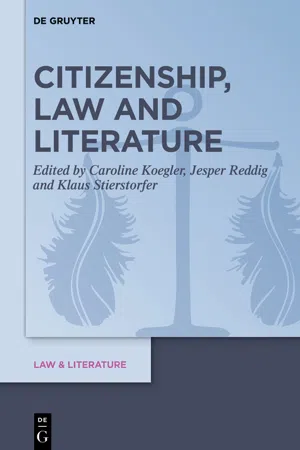
Citizenship, Law and Literature
About this book
This edited volume is the first to focus on how concepts of citizenship diversify and stimulate the long-standing field of law and literature, and vice versa. Building on existing research in law and literature as well as literature and citizenship studies, the collection approaches the triangular relationship between citizenship, law and literature from a variety of disciplinary, conceptual and political perspectives, with particular emphasis on the performative aspect inherent in any type of social expression and cultural artefact. The sixteen chapters in this volume present literature as carrying multifarious, at times opposing energies and impulses in relation to citizenship. These range from providing discursive arenas for consolidating, challenging and re-negotiating citizenship to directly interfering with or inspiring processes of law-making and governance. The volume opens up new possibilities for the scholarly understanding of citizenship along two axes: Citizenship-as-Literature: Enacting Citizenship and Citizenship-in-Literature: Conceptualising Citizenship.
Information
I Citizenship-as-Literature: Enacting Citizenship
Resistance and Activism: The Literature of the Non-Citizen
Chandani Lokuge
1 Introduction: The Power of Literature
One compelling aspect of the power of literature is that it transforms encompassing public issues into humanist stories, whose emotive and cognitive resonances transcend the limits of political propaganda, leading the reader to a deep level of interrogation, philosophical integrity, and ethical enquiry. This transformative power of literature is vigorously demonstrated in the field of the postcolonial where much of the literature explores from the “inside out,” as it were, the plight of millions of people living through and via legislative “plottings” written for them by political regimes of power which may have oppressed them into second-class citizens in their own countries. Foregrounding the consequences of this oppression, postcolonial literature moves the reader into a humanist understanding of colonized peoples.
Leading researchers in the interdisciplinary field of Law and Literature such as Desmond Manderson1 have deliberated that it would be a “romantic fantasy” to believe in “the capacity of literature to cure law or perfect its justice”; or that literature can “save the day or complete the law.”2 It is more accurate perhaps to theorize that, through imaginative attention to the individual caught in the grips of an injustice that the law blinds itself to, literature opens up levels of meaning that can lead the reader into an interrogation of the law, which then acts as a catalyst or preamble to change. As Manderson asserts, “[i]t is beyond doubt that legal structures constantly ask of us that we imagine the implications of our acts on the lives of others […]. [T]his justice is of great importance to law.”3 Facilitating such imaginations, literature comes in full force as an accomplice of the law, exploring its abstractions and incompleteness by giving them human form. Affect plays a crucial role, as Mohsin Hamid and Francine Hope have observed in the New York Times4 with regard to Harriet Beecher Stowe’s novel, Uncle Tom’s Cabin (1852). Instead of functioning as a call to arms, the novel persuaded readers into a more empathetic understanding that slaves were human beings with feelings like those of their masters. Through fostering such an understanding, the novel raised awareness about black-white equality at a time when inequality was the legislated norm for American citizens. As Mohsin and Hope concluded in their review, it “hardened [in readers] opposition to slavery, thereby helping set in motion the war that led to slavery’s abolition.”5 Closer to my adopted-home Australia and to our time, Australian indigenous political activist Alexis Wright provoked a similar reaction with her novel, Carpentaria (2006). Set in a region that has a violent, damaging history of colonization, the novel critiqued the legal system’s dispossession of the traditional rights of the indigenous people. By its enquiry into the suffering inner-lives of indigenous characters against the failed Australian political discourses on Reconciliation, and as such through its attention to the “incommensurate” particulars that law excludes, Carpentaria demonstrated the ways in which literature can expose how “justice” is better understood as a complex version of “injustice.”6 Thus, ultimately, the novel is not the “other” of the law but an essential component of it. Carpentaria was not only awarded Australia’s prestigious national prize for literature, the Miles Franklin, in 2007, but it also instigated the then Australian government towards implementing a New Reconciliation with the indigenous people, proving that writers can sometimes be, as the poet Percy Bysshe Shelley observed, “the unacknowledged legislators of the world,” a mantra that was eloquently used by Salman Rushdie in his defence of literature in his prison memoir, Joseph Anton (2012).7
In the following sections of this chapter, I will focus on a new branch of postcolonial immigrant literature. This category, which I identify as the literature of the non-citizen or non-citizenship literature, is by or about asylum seekers who, revolting against discrimination in their homelands, seek international refugee status (under the 1951 Convention Relating to the Status of Refugees) and relocation in another country. Their resistance to and activism against political oppression both in their own country and the country where they seek to relocate will form the basis of my discussion. The chapter will conclude with a case study, namely, Behrouz Boochani’s No Friend but the Mountains: Writing from Manus Prison (2018),8 framed by current Australian asylum and refugee politics.
2 From Postcolonial Immigrant Literature to the Literature of the Non-Citizen
An important new development in the conceptualization of citizenship in postcolonial literary studies falls under the broad category of immigrant literature that deals with the effects of the host country’s citizenship laws and policies on migrant identities. Postcolonial literary theory, to an extent, speaks to immigrant literature in neo-colonial settings that explore the lives of oppressed people emigrating to foreign countries in search of better lives only to encounter isolation and loneliness, and the yearning to return to the innocence of their past, as in W G Sebald’s The Emigrants (1992). Australian philosopher Raimond Gaita’s biographical memoir, Romulus My Father (1998), revitalizes the tragic downward spiral of his father, a Yugoslav who migrated to Australia from Germany in 1950 through the “assisted passage” scheme of the Robert Menzies government. A deeply introspective story of madness, suicide, and family breakdown, it is also a searing revelation of Australia’s infrastructural failure at that time in assisting new migrants to settle in, which resulted in their extensive isolation, alienation, and loneliness. Relatively recent novels such as Home Fire (2017) by Kamila Shamsie (discussed in more detail by Katja Sarkowsky in this volume) humanize these migrant issues by exploring dangerous alternative routes such as radicalization that migrant characters who live on the periphery embrace in a desperate search for that illusive “simple past.”
One of the most potently developing literary canons of the twenty-first century within the broad field of immigrant literature is non-citizenship literature. This is a form of political “prison” literature in which, escaping hierarchal oppression and incarceration within the homeland, the protagonists make a bid for asylum in another country. In a recent lecture, titled “On Freedom” (2019), London-based Nigerian novelist, essayist, and public intellectual, Ben Okri, argued that literature is about “countering enchantment.”9 By enchantment, Okri referred to the ways in which the individual can be mesmerized by ideas of “unfreedom” that their law-makers feed them. Okri contended that lured by political rhetoric, these individuals are prone to accepting what self-interested governments decree as just and right, and drift into a kind of enchanted stasis. Okri’s latest novel, Who Is the Prisoner? The Freedom Artist (2019) interrogates this idea in relation to all oppressed people in the world – refugees, asylum seekers, and silenced artists (writers) among them. The story reaches its climax when, waking up to the truth, “the forces deep in the human spirit [finally] revolt against its oppression.”10 Consequently, the oppressed rebel momentously and attain freedom by destroying the metaphorical “tower of power” that the oppressive hierarchy has built around themselves. Set in an unnamed dystopian fantasy world, the novel develops into an impassioned plea for justice for the freedom of the individual, particularly of the “other” that is threatened in the post-truth society created by political hierarchies.
Literature of the non-citizen is a significant new development also in Australia, fuelling engagement with conceptualizations of citizenship in Australian literary studies. The literature has been slow to develop in Australia for two key reasons: the majority of asylum seekers who may aspire to publicize their experiences through the creative mode cannot communicate in English, while writing from outside is almost impossible due to the restriction of visitors (including the media) to detention centers. However, this branch of literature has produced a few powerful and compelling novels that have been awarded national and international literary awards.
This type of literature is framed by the political context particular to Australia. Australia is signatory to the Convention Relating to the Status of Refugees. It has a high immigrant intake that has averaged in the last decade at approximately one percent of the total population.11 The prelude to citizenship is the “Permanent Resident” visa granted to people (including refugees) who apply formally to migrate. However, Australia has a mandatory detention policy, enforced in 1992, for people entering the country without a valid visa. With the increased number of unauthorized (thereby considered illegal) arrivals, in 2001, Australia introduced mandatory offshore processing of entry visas. In 2013, Australia enforced a policy, st...
Table of contents
- Title Page
- Copyright
- Contents
- Citizenship-as-Literature, Citizenship-in-Literature
- I Citizenship-as-Literature: Enacting Citizenship
- II Citizenship-in-Literature: Conceptualising Citizenship
- Contributors
- Index
Trusted by 375,005 students
Access to over 1.5 million titles for a fair monthly price.
Study more efficiently using our study tools.
Frequently asked questions
Yes, you can cancel anytime from the Subscription tab in your account settings on the Perlego website. Your subscription will stay active until the end of your current billing period. Learn how to cancel your subscription
No, books cannot be downloaded as external files, such as PDFs, for use outside of Perlego. However, you can download books within the Perlego app for offline reading on mobile or tablet. Learn how to download books offline
Perlego offers two plans: Essential and Complete
- Essential is ideal for learners and professionals who enjoy exploring a wide range of subjects. Access the Essential Library with 800,000+ trusted titles and best-sellers across business, personal growth, and the humanities. Includes unlimited reading time and Standard Read Aloud voice.
- Complete: Perfect for advanced learners and researchers needing full, unrestricted access. Unlock 1.5M+ books across hundreds of subjects, including academic and specialized titles. The Complete Plan also includes advanced features like Premium Read Aloud and Research Assistant.
We are an online textbook subscription service, where you can get access to an entire online library for less than the price of a single book per month. With over 1.5 million books across 990+ topics, we’ve got you covered! Learn about our mission
Look out for the read-aloud symbol on your next book to see if you can listen to it. The read-aloud tool reads text aloud for you, highlighting the text as it is being read. You can pause it, speed it up and slow it down. Learn more about Read Aloud
Yes! You can use the Perlego app on both iOS and Android devices to read anytime, anywhere — even offline. Perfect for commutes or when you’re on the go.
Please note we cannot support devices running on iOS 13 and Android 7 or earlier. Learn more about using the app
Please note we cannot support devices running on iOS 13 and Android 7 or earlier. Learn more about using the app
Yes, you can access Citizenship, Law and Literature by Caroline Koegler,Jesper Reddig,Klaus Stierstorfer in PDF and/or ePUB format, as well as other popular books in Literature & Law Theory & Practice. We have over 1.5 million books available in our catalogue for you to explore.