eBook - ePub
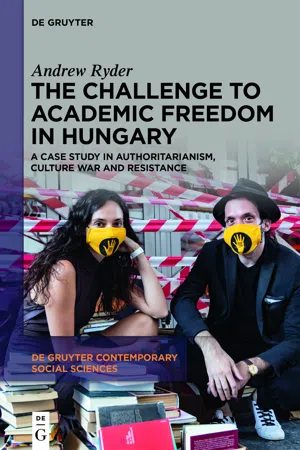
The Challenge to Academic Freedom in Hungary
A Case Study in Authoritarianism, Culture War and Resistance
- 252 pages
- English
- ePUB (mobile friendly)
- Available on iOS & Android
eBook - ePub
The Challenge to Academic Freedom in Hungary
A Case Study in Authoritarianism, Culture War and Resistance
About this book
No detailed description available for "The Challenge to Academic Freedom in Hungary".
Information
Chapter One Setting the Context: Academic Freedom and Hungarian Society
This chapter gives a detailed interpretation of academic freedom and places it in a historic framework. It also provides insights into the relationship between the state and academia and the impact of neoliberalism on higher education. It reviews authoritarianism in Hungary, detailing its rise, and nature and its implications for academic freedom through a discussion of ‘the culture war’. The chapter also provides a historical overview of the development of higher education in Hungary. The chapter thus provides contextual background to a series of case studies and testimonies presented in the main body of the book.
Defining Academic Freedom
Academic freedom can be perceived in many ways. It can be seen as an individual right, including freedom of opinion and expression and freedom of association. It is a fundamental freedom for academics within the law to question and test conventional wisdom and develop new ideas without undue harassment or interference. It is a freedom that does not constrain research questions or the freedom to teach the truth as we see it (Russell, 1993).
Another dimension of academic freedom is the institutional right of autonomy for academic institutions. Correspondingly, public authorities are expected to respect academic freedom and to protect it. Academic freedom is not codified as a stand-alone, autonomous right under international law. However, the Charter of Fundamental Rights of the European Union is an exception that explicitly guarantees academic freedom and is a binding obligation, while other bodies like the Council of Europe and United Nations also seek to uphold academic freedom (Vrielinka et al, 2011). UNESCO (1997) in a ‘soft law’ instrument endorsed a statement affirming that ‘the right to education, teaching, and research can only be fully enjoyed in an atmosphere of academic freedom’. However, it would appear that alignment to these ideals may be lower in EU states than might be expected, a problem compounded by trying to get countries to conform to ‘soft law’ like the UNESCO recommendation and the limited and/or convoluted powers of intervention afforded by other protections for academic freedom. This, coupled with the rapid speed of change in the function and management of universities and increased political turbulence and extremes, has arguably led to an increasing dilution of academic freedom. As a consequence, the protection of the academic freedom of the majority of the individual academic staff in Europe’s universities has probably diminished over recent years (Karran, 2009, Pap, 2021). Universities have often been the centre of political and intellectual dissent, and thus authoritarian regimes in the past and present have been fearful of academia and have sought to curb its autonomy and freedom (Kori, 2016). A key task for this book is to determine the relevance of these issues to Hungary.
In September 2018 the European Parliament voted in favour of launching Article 7 (Treaty on the EU) proceedings against the Hungarian government, based on a European Parliament Report prepared by MEP Judit Sargentini. The Sargentini Report adopted by the European Parliament in September 2018 called on the Council of the EU to use Article 7 (this procedure has the potential to suspend Hungary from certain rights in the EU for infringing the rule of law). The report mentioned the expulsion of the CEU, the Government ban on Gender Studies, and the discrimination against Roma students in primary and secondary schools. More could have been said in this report on the deeper structural changes introduced in education, as are outlined in this chapter (Zeigler, 2019). Nevertheless, it was a landmark moment, being the first time article 7 was activated by the European Parliament.
It should also be noted that in 2018 the Academic Freedom Index (AFI) placed Hungary in category B alongside countries like Columbia and Haiti, other EU member states are in category A. The index is formed through expert assessments based on indicators that measure academic freedom and autonomy and shows a serious deterioration in academic freedom in Hungary since 2010 (Kinzelbach et al, 2020). An updated version of the AFI in 2021 placed Hungary in category C, together with Burma, Brazil, and India. All other EU member states, apart from Hungary, are included in category A (Kinzelbach et al, 2021).
Universities have long been an ideological battleground. Modernisation theory suggests a link between university education and mass protest and the university is often celebrated as a site of critique and dissent. In contrast though, in autocratic states, universities have been compliant in the legitimation of dictators and the indoctrination of students, and the use of knowledge outputs to bolster such regimes (Dahlum and Wig, 2021). Some warn that constraints on academic freedom will lead to a deterioration in the quality of public debate and the maintenance of pluralist democracy. The central aim of this book is to assess the level of threat to academic freedom in Hungary, a nation-state that Prime Minister Viktor Orbán has described as an “illiberal democracy”.
The Historic Development of Academic Freedom
Academic freedom, the right and freedom to investigate and debate issues without intimidation, fear and censorship is a concept that some would argue has ancient origins (Nelson, 2010). The Socratic tradition of learning and investigation as developed by the ancient Greek philosopher Socrates, encouraged the presentation of a hypothesis but then encouraged refutation to test, temper, and develop the argument presented. Socrates was put on trial by the Athenian state, charged with and convicted of corrupting the Athenian youth and not worshipping the gods of the city-state. For Socrates, seeking the truth and asking challenging questions was at the centre of his work, but this challenged and threatened the interests of powerful élites who conspired to remove Socrates through prosecution. Socrates was punished by being ordered to drink hemlock, a poison. The actions against him can be viewed as an early assault on intellectual freedom (Cabtree, 2003). However, as democracy in ancient Greece gave way to tyrants and given that the Roman Empire rested on the supreme and dictatorial powers of the Emperor, any fledgling notion of free intellectual inquiry was stifled. Intellectual freedom was further stunted with the rise of Christianity which marked the late Roman Empire and middle ages as a period where the nature of enquiry was hemmed in by superstition and irrationality. It was an age where church leaders were seen as the arbiters of what was legitimate thought. The inquisition and other waves of church-led persecution are testaments to the intellectual and religious tyranny of those times.
Universities were established in Europe from the eleventh century, but these were not the first, since such institutions had been established in the Middle East, Africa, and Asia before the establishment of the first European university in Bologna in 1088. The medieval universities in Europe developed as supra-national institutions under the jurisdiction of Papal power and combined practical learning for the ‘higher’ vocations or professions with a search for universal truths. The latter goal was sometimes impeded by religious dogma but the secularization of higher education or transference of control to the state helped limit such tension (Berdahl, 1990). With the advent of the Renaissance, notions of intellectual freedom were rekindled. Tensions and notions of intellectual and religious freedom of enquiry were evident in the sixteenth century with the clash between Martin Luther, a theologian, and professor in Wittenberg, Germany, and church authorities wedded to the Catholic faith. Luther was profoundly disturbed by what he perceived as the corruption, decadence, and lack of spirituality of the Catholic Church. Luther challenged the supremacy of the pope and the clerical élite and was excommunicated by the Pope in 1521 for his views. This rupture over what can be described as an issue of freedom of thought and faith led to the Reformation and religious and social revolt across Europe that laid the foundations for the Enlightenment. As Durkheim noted, the advent of Protestantism unleashed new intellectual freedoms and represented a paradigm shift that brought about huge philosophical, cultural, and scientific changes in a Europe that was no longer so tightly constrained by superstition and the rigid dogma of the Catholic Church (Jones, 1986). As a consequence, enlightenment ideals emphasised the importance of democracy and liberty and placed limits on the secular power of the church, concepts that spawned the industrial revolution and the rise of the modern nation-state.
The nation-state gave rise to the modern-day university as one of the core institutions in society that shaped and moulded national character and intellectual leadership. In this sense, the university entered more directly into the realm of politics, not just through the state’s funding of universities. Questions and tensions arose about the autonomy of academic institutions and the role they should play not only in terms of national identity formation but also in their challenges to the status quo. Consequently, the concept of academic freedom became more defined and codified. For example, Wilhelm von Humboldt’s educational reforms and the establishment of the University of Berlin (now Humboldt University) emphasised the importance of Lehrfreiheit (freedom to teach) and Lernfreiheit (freedom to learn), both of which were encapsulated in Akademische Freiheit (academic freedom), providing something of a prototype for other universities (Anderson, 2004). In Britain Cardinal Henry Newman, a key intellectual pioneer in the nineteenth century believed that universities should operate without religious dogma. Newman felt critical scholarship and universal knowledge, where knowledge pursued for its own ends and not for instrumental purposes, should shape the learning environment (Matthews et al, 2021). Despite the great influence of these liberal principles and the pioneering work conducted by Humboldt, Germany though was also to become the scene of one of the greatest challenges to academic freedom in the modern age. During the Third Reich, academic freedom and institutional autonomy were eradicated under the Nazis. Academics who were critical of the regime were dismissed and replaced by intellectually subservient Nazi academics (Beveridge, 1959). Elsewhere totalitarianism challenged academic freedom, particularly in the USSR.
From the 1930s, The Hungarian thinker and polymath Michael Polányi1 considered both the purpose of scientific enquiry and the challenges presented by totalitarianism. This was a concern that deepened following his visit to the Soviet Union in 1935 where he met the lead communist politician Nikolai Bukharin, a strong advocate of a centralised command economy. Bukharin argued that distinctions between the pure and applied sciences in the capitalist West deprived scientists of the consciousness of their social functions, creating an illusion of pure science. Bukharin felt the freedom of scientists must be subservient to the comprehensive planning of the Soviet economy and the five-year economic programmes (Polányi, 1939). During the 1930s, a growing body of researchers and academics became aligned to the view that planning and the state could play an important role in scientific development, most importantly the betterment of society. A leading proponent of such a view in the 1930s was the scientist John Bernal (1975), who believed that if scientists were left to their own devices they would be less likely to develop innovations and discoveries that could be applied to the needs of society. Bernal asserted that capitalism, with its reliance on competition and profits, pushed science into searching for the means to maximise profit rather than the social improvement that would benefit all.
In contrast to this shift to Soviet-style socialism and a vogue for centralisation in Science, Polányi advocated a society where free intellectuals search for truth for its own sake. A prerequisite for such a state of affairs was for science to be free from political, ideological, and economical influences. Polányi (1936, 117) felt that if scientists were too closely aligned with power then they “forfeited their right to restrain governments in the name of truth” and that “unless intellectuals make a new departure, inspired by unflinching veracity, the truth will remain powerless against propaganda.” Polányi, therefore, felt that totalitarianism impeded academic freedom and he rejected the classical, liberal conception of liberty. In his view, such individualism and its failure to recognise and nurture transcendent moral values had, in crisis, mutated societies into forms of totalitarianism. In other words, denying the reality of transcendent moral ideas opens a door to totalitarianism. Polányi argued that there was a strong interconnection between independent science and political liberty (Polányi 1937, Hartl, 2011).
Polányi reasoned that knowledge production could operate in a manner somewhat akin to the free market where the actions of consumers can determine the demand and hence to a degree the value of an intellectual product (Beddeleem, 2020). Likewise, Polányi (1962) argued that scientists in a ‘republic of science’ should be free to engage in open debate and pursue truth as an end in itself rather than be shackled to power and authority. It could be argued that Polányi was trying to promote a form of academic dissensus where debate and an exchange of views in open discussion could help determine the value of scientific outputs and arguments. Such an approach could provide an antidote to the scourge of totalitarianism (Polányi 1998).
Polányi was not alone in his criticism of Marxist notions of Science. John Bernal’s book (1939) ‘The Social Function of Science’ made the case Bukharin had made to Polányi for closely harnessing Science to the cultural and material needs of society. In a review of Bernal’s book John Randal Baker (1939, 175) attacked this viewpoint:
The doctrine of those who profess that the only proper objects of scientific research are to feed people and to protect them from the elements, that research workers should be organised in gangs and told what to discover, and that the pursuit of knowledge for its own sake has the same value as the solution of crossword puzzles.
Baker and Polányi were to be instrumental figures in establishing the Society for Freedom in Science (1940 – 1963), a network of thinkers that sought to promote and defend open and free intellectual thought. Interestingly, another active member was the Austrian economist Frederick von Hayek, like Polányi an émigré of Central Europe who had, since 1931, been Professor of Economics at the London School of Economics. Hayek had allied himself with Polányi because his disposition to more laissez-faire approaches to the needs of society made him recoil from the socialism and planning espoused by groups like the ‘Social Relations of Science’ movement (Beddeleem, 2017). Hayek was to become a leading luminary of what we now term neoliberalism. Some would argue that this philosophical viewpoint has had a more profound influence in the last forty years on science and enquiry than the views propounded by Polányi in this sphere, leading to market principles increasingly being applied to academic institutions.
Liberalism, Commodification and Audit Culture
The post-war period, in countries like Britain, witnessed the ascendancy of Keynesian economics and central planning and development of a welfare state, what the French economist Jean Fourastié (1979) called the ‘Les Trente Glorieuses’ the glorious thirty, a ‘gilded age’ in which, from 194...
Table of contents
- Title Page
- Copyright
- Contents
- Acknowledgements
- About the Author
- List of Abbreviations
- Preface
- Chapter One Setting the Context: Academic Freedom and Hungarian Society
- Chapter Two Reflections, Resilience, and Dignity
- Chapter Three The Central European University and the Quest for an Open Society
- Chapter Four Gender Studies and Culture War
- Chapter Five The Hungarian Academy of Sciences: The Triad of Academia, the State and Business
- Chapter Six The Corvinus: Privatisation and Audit Culture
- Chapter Seven ‘Free SZFE’: Resistance at the University of Theatre and Film Arts
- Chapter Eight Critical Reflections on the Past, Present and Future
- Chapter Nine Conclusion: Speaking Truth to Power
- Andras L. Pap: Afterword In Search of (Lost) Freedom
- Bibliography
- Index
Trusted by 375,005 students
Access to over 1.5 million titles for a fair monthly price.
Study more efficiently using our study tools.
Frequently asked questions
Yes, you can cancel anytime from the Subscription tab in your account settings on the Perlego website. Your subscription will stay active until the end of your current billing period. Learn how to cancel your subscription
No, books cannot be downloaded as external files, such as PDFs, for use outside of Perlego. However, you can download books within the Perlego app for offline reading on mobile or tablet. Learn how to download books offline
We are an online textbook subscription service, where you can get access to an entire online library for less than the price of a single book per month. With over 1.5 million books across 990+ topics, we’ve got you covered! Learn about our mission
Look out for the read-aloud symbol on your next book to see if you can listen to it. The read-aloud tool reads text aloud for you, highlighting the text as it is being read. You can pause it, speed it up and slow it down. Learn more about Read Aloud
Yes! You can use the Perlego app on both iOS and Android devices to read anytime, anywhere — even offline. Perfect for commutes or when you’re on the go.
Please note we cannot support devices running on iOS 13 and Android 7 or earlier. Learn more about using the app
Please note we cannot support devices running on iOS 13 and Android 7 or earlier. Learn more about using the app
Yes, you can access The Challenge to Academic Freedom in Hungary by Andrew Ryder in PDF and/or ePUB format, as well as other popular books in Education & Education General. We have over 1.5 million books available in our catalogue for you to explore.