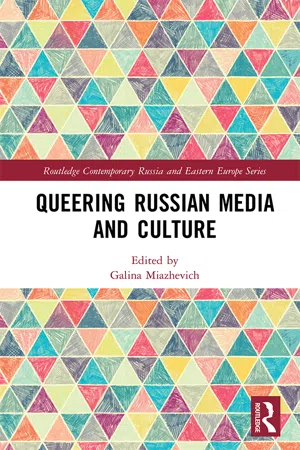
This book explores how queerness and representations of queerness in media and culture are responding to the shifting socio-political, cultural and legal conditions in post-Soviet Russia, especially in the light of the so-called 'antigay' law of 2013. Based on extensive original research, the book outlines developments historically both before and after the fall of the Soviet Union and provides the background to the 2013 law. It discusses the proliferating alternative visions of gender and sexuality, which are increasingly prevalent in contemporary Russia. The book considers how these are represented in film, personal diaries, photography, theatre, protest art, fashion and creative industries, web series, news media and how they relate to the 'traditional values' rhetoric. Overall, the book provides a rich and detailed, yet complex insight into the developing nature of queerness in contemporary Russia.
- 204 pages
- English
- ePUB (mobile friendly)
- Available on iOS & Android
eBook - ePub
Queering Russian Media and Culture
About this book
Information
1 Queer first-person life writing in post-Soviet Russia
Between symbol and secret
DOI: 10.4324/9781003042358-2
Introduction
Volume three of the monumental History of Private Life, edited by Philip Ariès and Roger Chartier, traces the emergence of modern notions of subjectivity and privacy through changes in writing, specifically, first-person forms of life writing such as memoirs, journals and diaries. Before the second half of the 17th century, ‘memoirs described the public lives of men who had had little or no private life’ (Foisil 1989, 328). Defined in opposition to the aristocratic memoir, the personal diary, epitomised by Rousseau’s Confessions and Rousseau: Judge of Jean-Jacques, is an ‘exaltation of privacy as the ground of philosophical truth’, and that truth ‘is vested entirely in the individual gaze, marginal and almost secret, upon the things of this world’ (Goulemot 1989, 389, 383).
Of course, as Jean Marie Goulemot (1989, 387) notes, the diary produced an effect ‘only by ceasing to be secret’, suggesting a complex dialectical relationship between the public and the private spheres, between concealment and exposure, between secrecy and knowledge. And so, the practice of diary keeping, especially as it was secularised in the modern era, also contributed to the concealment of one’s true self. As Alain Corbin (1989, 499) points out, ‘This ongoing inner monologue [represented by the practice of diary keeping] enabled each individual to control how he looked to others, and thus to make himself more indecipherable. The very need for personal privacy contributed to the need for introspection.’1 Consider, for example, Pechorin’s diary, situated at the centre of Mikhail Lermontov’s novel A Hero of Our Time, which reveals the ‘real’ Pechorin – a master of outward disguise – to be misunderstood in public and genuine only in his private-most reflections.
Not surprisingly then, the diary became a privileged site for the exploration and exposure of what the modern era constructed as one of the central secrets of the individual: sex. As Michel Foucault (1990, 35) puts it: ‘What is peculiar to modern societies, in fact, is not that they consigned sex to a shadow existence, but that they dedicated themselves to speaking of it ad infinitum, while exploiting it as the secret.’2 We see the full purchase of the sexual secret in the much-celebrated diaries of Anais Nin. (Incidentally, those diaries, for all their frankness, were abridged; an unexpurgated edition was published only after Nin’s death, underscoring the tension between concealment and revelation, censorship and sincerity, that is at the heart of the modern diary as genre.) The modern privileging of sexuality along with its banishment to the private realm as a secret was institutionalised in the West in the practice of psychoanalysis, which posited sexuality as central to an individual’s being and proposed the making public (to the analyst) of private sexual experiences and feelings – the talking cure – as a treatment for neurosis.
The close, mutually-reinforcing association of subjectivity, privacy and sexuality that stands at the foundation of the modern diary as genre suggests, therefore, that an examination of first-person life writing has the potential to reveal some of the key features in the construction of the public and private realms in a given society, in this case, post-Soviet Russia. Hence the enormous post-Soviet interest in Soviet-era first-person life writing for the unique insights it provides into the entanglement of the private and public spheres, or the realms of ‘intimacy and terror’ (Garros et al. 1995; Figes 2007; Paperno 2009). As Orlando Figes (2007, xxx) puts it: ‘What did private life mean when the state touched every aspect of it through legislation, surveillance and ideological control?’ These Soviet-era diaries, collected by organisations such as Memorial or made available through the opening of archives following the fall of communism, have acquired particular salience in post-Soviet Russian society as it re-negotiates the boundary between the public and private realms in ways that distinguish it both from its Soviet past and from its Western counterparts.
By first-person life writing, I am referring to the genres of autobiography or memoir, on the one hand, and diaries or journals, on the other. These forms of first-person life writing are distinguished by whether they were written with the explicit intention of being published (autobiography/memoir) or without such an intention (journals and diaries), although that distinction is not absolute – journals and diaries may assume an ideal or future reader. Post-Soviet biographies are, of course, also examples of life writing that are worthy of study, as Dan Healey discusses in Russian Homophobia from Stalin to Sochi (2018), as they have become an important battlefield in the culture wars in post-Soviet Russia, as evident in the removal of any references to homosexuality in a recent government-funded biopic of the composer Petr Chaikovsky (Luhn 2013). But I am interested here in the conditions under which queer voices themselves, rather than representations of queer voices, find a place in post-Soviet media.
In that respect, posthumously published diaries and journals are an especially interesting form of queer life writing as they appear to be largely exempt from the kind of censorship and self-censorship that affect other forms of queer life writing in post-Soviet Russia. The pressure to leave out queer content in contemporary autobiographical writing, for example, is so great, these autobiographies are of value only as examples of self-censorship (see my brief discussion below of the autobiographies of Boris Moiseev and Roman Viktiuk). At the same time, perhaps to compensate for the frank depictions of same-sex desire in the diaries, they are often elaborately framed, which provides interesting material for examining how post-Soviet readers make sense of those depictions, interact with those voices, for, as Irina Paperno (2009, xii) notes, ‘All of these personal records, regardless of when they were written, belong to the present moment, when they are assembled, framed, and put into the public domain for everybody to see.’ And so, the question I will explore below is how Soviet and pre-Soviet works of queer first-person life writing contribute to post-Soviet attempts to re-imagine the relationship between the private and the public spheres in relation to sex and sexuality.
This chapter will therefore focus on four works of queer first-person life writing from the pre-Soviet and Soviet periods that were published posthumously in post-Soviet Russia, namely: the diaries and journals of Grand Duke Konstantin Romanov (1858–1915), cousin of the last tsar and a poet who published poetry under the cryptonym K.R.; the poet and writer Mikhail Kuzmin (1872–1936); the Soviet musical theatre and cabaret star Vadim Kozin (1903–1994); and the artist Konstantin Somov (1869–1939) to see how those queer voices have been framed for a post-Soviet readership; in other words, how do these frames establish the conditions of legibility for queer sexuality. But first, let me offer an overview of the post-Soviet politics of silence and exposure which forms the discursive backdrop against which these works of queer life writing have appeared.
The cultural politics of silence and exposure
The emergence of first-person queer life writing tracks fairly closely with attempts at liberalisation that began during perestroika, culminating in the publication of Eduard Limonov’s sensational semi-autobiographical novel It’s Me, Eddie! which was published in Russia first in the journal Glagol in 1990 and as a book in 1991 (Limonov 1991) – it sold over a million copies. The frank depiction of homosexuality in the novel, however, turned out to be an anomaly, for Limonov and for Russian society more generally (see Gessen 2003).
The call to silence regarding queer sexuality in post-Soviet Russia has a conservative and a liberal interpretation, both of which are informed by a post-Soviet desire to disentangle or separate the public and private realms. The politically conservative view, which in some ways reflects the enduring influence of Soviet prudery, presents the private realm as a threat to the public realm. We see this expressed very clearly in the introduction to a 2004 biography of the poet Sergei Esenin, Zhizn’ Esenina, by Stanislav and Sergei Kuniaev, which appeared in the book series Bessmertnye imena, or Immortal Names. The authors present their biographical treatment of the poet in opposition to the many salacious Russophobic (?!) psycho-biographies of the poet that have appeared since the fall of the Soviet Union, beginning with the 1991 publication of excerpts from Anatolii Mariengoff’s Tsiniki (Cynics), his journal from 1918–1924, in the inaugural issue of the journal Glas. Those biographies, the Kuniaevs claim, have ‘sullied’ not only the image of the poet but that of Russia herself, as they explain in the introduction to their biography of the poet:
This book was conceived and born in a most difficult time for Russia. Perhaps, no less difficult than Esenin’s time. With less rage, perhaps, than back then, Russia and her national poets are being humiliated. But the attempts by Russophobes can do nothing to the fate of Esenin’s legend. It is destined to grow and spread.
(Kuniaev and Kuniaev 2001, 20)3
It is, therefore, no surprise that when they deal with the question of homosexuality in reference to Esenin’s friend and fellow poet Nikolai Kliuev, the Kuniaev brothers, whom Dan Healey (2018, 188) describes as ‘anti-Semitic, radical nationalist critics’, frame it in religious terms as ‘the sodomitical sin’ (Kuniaev and Kuniaev 2001, 80).
We also see this conservative position, albeit less nationally inflected, in the deliberate toning down of sexual content in the Russian edition of John Malmstad and Nikolay Bogomolov’s biography of the queer Silver Age writer and poet Mikhail Kuzmin. As Malmstad (Malmstad and Bogomolov 1999, xii) notes in his introduction to the English edition, this was done because many in Russia are ‘often upset by any inquiry, biographical or critical, that seems “too personal”’. And so, Kuzmin’s sexuality ‘and many other personal matters and issues are treated far more fully in this [English] account of his life than in the Russian version’ (ibid., xiii).
The censoring of sexual content from biographical depictions of queer individuals, especially figures of national importance, has only intensified in the Putin era, as reflected in the excision of any allusion to Chaikovsky’s sexuality in a government-sponsored biopic of the composer, mentioned above. This can be understood not only as the continuation of Soviet-era prudery but also as part of a broader campaign sponsored by the Putin government in collaboration with the Russian Orthodox Church to promote ‘traditional family values’. This has led to the censoring not only of homosexual content but also of references to sexual relations outside the family, as evident in the protests organised by the Russian Orthodox Church against Aleksei Uchitel’s film Matilda (2017), named for the mistress of Russia’s last tsar, Nicholas II; the tsar was canonised by the Church in 2000 (see Bennetts 2017).
The continued reticence concerning open discussion of sexuality in relation to cultural figures is evident too in Naum Ikhil’evich Kleiman’s introduction to the 1997 publication of a two-volume edition of the memoirs of film director Sergei Eisenstein. Despite the many playful and rather daring allusions to queer sexuality throughout the memoir itself, the only mention of sexuality in the twelve-page introduction appears in the final paragraph, where Kleiman (1997, 16) offers a caveat:
The reader will not find much here about that which today we would like to know about Eisenstein himself. He could not then write about a lot – due to the conditions of the time. About certain things he didn’t want to write, assuming, following Pushkin, that a celebrity, like any other person, has the right to a private life, not subject to disrespectful public discussion. He simply didn’t have the time to write about a lot – as he rushed to fulfil his ‘position ...
Table of contents
- Cover
- Half Title
- Series Page
- Title Page
- Copyright Page
- Dedication
- Table of Contents
- List of figures and tables
- List of contributors
- Acknowledgements
- Introduction
- 1. Queer first-person life writing in post-Soviet Russia: Between symbol and secret
- 2. Queer readings of Soviet children’s films, 1931–1954
- 3. Representations of female masculinity in Soviet history, or visibility of diversity through art practice
- 4. Transgression and the social body in Petr Pavlensky and Seroe Fioletovoe’s political performance art
- 5. A quare story of the North Caucasian lesbian and trans women in the staging of The Voices
- 6. Russia as the West’s queer other: Gosha Rubchinskiy’s politics of fashion
- 7. Queer economics: Worlds, appearances and the symbolic exchange
- 8. Lesbian love stories and online popular culture: The case of web series
- 9. Queering #MeToo: Russian media discourse on same-sex sexual harassment in the context of a global anti-harassment movement
- Afterword: Making Russia queerer, or the strange paradox of President Putin’s incitement to discourse
- Index
Trusted by 375,005 students
Access to over 1.5 million titles for a fair monthly price.
Study more efficiently using our study tools.
Frequently asked questions
Yes, you can cancel anytime from the Subscription tab in your account settings on the Perlego website. Your subscription will stay active until the end of your current billing period. Learn how to cancel your subscription
No, books cannot be downloaded as external files, such as PDFs, for use outside of Perlego. However, you can download books within the Perlego app for offline reading on mobile or tablet. Learn how to download books offline
Perlego offers two plans: Essential and Complete
- Essential is ideal for learners and professionals who enjoy exploring a wide range of subjects. Access the Essential Library with 800,000+ trusted titles and best-sellers across business, personal growth, and the humanities. Includes unlimited reading time and Standard Read Aloud voice.
- Complete: Perfect for advanced learners and researchers needing full, unrestricted access. Unlock 1.5M+ books across hundreds of subjects, including academic and specialized titles. The Complete Plan also includes advanced features like Premium Read Aloud and Research Assistant.
We are an online textbook subscription service, where you can get access to an entire online library for less than the price of a single book per month. With over 1.5 million books across 990+ topics, we’ve got you covered! Learn about our mission
Look out for the read-aloud symbol on your next book to see if you can listen to it. The read-aloud tool reads text aloud for you, highlighting the text as it is being read. You can pause it, speed it up and slow it down. Learn more about Read Aloud
Yes! You can use the Perlego app on both iOS and Android devices to read anytime, anywhere — even offline. Perfect for commutes or when you’re on the go.
Please note we cannot support devices running on iOS 13 and Android 7 or earlier. Learn more about using the app
Please note we cannot support devices running on iOS 13 and Android 7 or earlier. Learn more about using the app
Yes, you can access Queering Russian Media and Culture by Galina Miazhevich in PDF and/or ePUB format, as well as other popular books in Social Sciences & Ethnic Studies. We have over 1.5 million books available in our catalogue for you to explore.