eBook - ePub
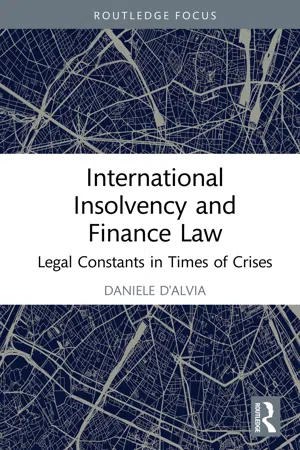
International Insolvency and Finance Law
Legal Constants in Times of Crises
- 88 pages
- English
- ePUB (mobile friendly)
- Available on iOS & Android
eBook - ePub
About this book
Focusing on the Global Financial Crisis 2007-2010 and the new emerging Covid-19 crisis in 2020, this book examines the discourse on risk and uncertainty in the markets through the lens of financial crises. Such crises represent a failure of the law to regulate, and constitute the basis through which a new theory of legal constants can be introduced in comparative law. Crisis impose a dramatic reformulation of the law, the Covid-19 confirms this trend, and new out-of-law instances are appearing beyond a paternalistic approach of direct State regulation. Restructuring procedures are playing a vital role in businesses' survival, and new out-of-law mechanisms such as moratorium agreements and private workouts have become essential to preserve businesses. It is clear that the role of the law has completely changed, and this book argues that constants outside of the law are new ways to promote an "uncodified-codification" of the law. The case for uncodified uncertainty in the Covid-19 crisis is a primary example of how no codification process can ignore the importance of out-of-law instances in the act of making law. This book explores how this approach influences the harmonisation process of international economic law between national insolvency regimes and international agreed frameworks, demonstrating the role of comparative law in formulating legal constants using Covid-19 and the complexity of modern financial markets as the criterion to introduce the reader to this new theory, which claims a new role for comparative law in policy making processes within the framework of international economic law.
1 The Times of Crisis between Insolvency and Financial Law
DOI: 10.4324/9781003278320-2
1.1 The Legal Theory of Finance
In 2013, Katharina Pistor wrote a working paper at Columbia Law School titled “A Legal Theory of Finance”.1 In it, Pistor claims that finance is legally constructed; this means that finance does not stand outside the law. For example, Pistor makes the case that financial assets are disciplined by legal rules and regulators. Although this can vary from jurisdiction to jurisdiction, the legal enforcement of financial commitments is present in every jurisdiction and can influence the scope of the entire financial system. In other words, without legal enforcement, contractual promises cannot be honoured, and the capital outflows or inflows between jurisdictions cannot be effective. For this reason, market participants often design financial instruments that are not in conflict with the existing rules in different jurisdictions. It means that contract law plays a major role in contemporary financial markets, and contractual rules are able to provide financial operators as well as the financial industry with new contractual devices, which – according to Pistor – in turn, seek legal vindication.
In claiming legal vindication, financial operators can try to mitigate uncertainty and prevent liquidity volatility. According to Pistor, liquidity is not a free asset, and when the future shows a liquidity scarcity, the refinance of financial commitments becomes more challenging. This is because every financial system is inherently unstable, and the exercise of discretionary power to enforce legal commitments can bring about a new theory of political economy of finance.
Pistor takes into account a conception of liquidity borrowed from Bernanke.2 From this perspective, liquidity is connected to the ability to sell any asset for other assets or cash at will. For instance, in a business reorganisation procedure we might think of carve-out mergers and acquisitions transactions and the dismissal of business’ going concern (i.e. the selling of an asset for cash), and in respect of financial markets, we can imagine any secondary market where the investor is selling financial instruments, being they derivatives, bonds, or stocks, to second-hand investors. In sovereign debt restructuring practices: an exchange offer or debt-for-debt swap or through the use of an internal collective action mechanism3 (if included in the debt instrument).
To this end, Pistor defines liquidity shortage, namely the impossibility of finding second-hand investors willing to buy financial assets, as one of the main triggers of a financial crisis. Specifically, she claims that uncertainty, rather than underpinning money creation processes, undermines the possibility of obtaining new financing and, therefore, it qualifies liquidity shortage in terms of crisis. Consequently, if financial assets are legally constructed, the law directly contributes to finance’s instability. The main example that is brought to the attention of the reader is the case of sovereign debt. The law of the issuer, namely the national law of the country that is borrowing money from investors through a Eurobond, matters, because at the apex, the law is much more flexible in comparison with the periphery (the contractual terms and conditions of a bond prospectus or the offering memorandum or circular). Indeed, at the apex, the law is more elastic because the survival of the entire system is at stake, and the discretionary power can be limited to save the system. On the other hand, at the periphery, the law is less elastic, and default can result in an involuntary exit. Furthermore, if we agree with this vision, we must consequently admit that the survival of the system is determined at its apex.
Specifically, states or financial intermediaries are in greater proximity to the apex. Hence, they are also more likely to benefit from a relaxation of the rules or a suspension of the full force of the law. A direct example can be seen in sovereign debt contracts whose enforceability is doubtful, or elastic. States’ assets cannot be seized and liquidated, and only assets located overseas can be frozen (if ever). In other words, a state cannot be subject to liquidation as happens in the case of private distressed companies that might be liquidated if they do not find a viable alternative to restructure their finances. Furthermore, sovereign governments that owe debt to many foreign creditors can choose which creditors to favour when making payments by implementing a de facto seniority structure of sovereign debt.4 Essentially, the state issuing sovereign debt can “escape” legal obligation by changing the law or altering the order of priority of payments. However, financiers have been able to sue their own sovereigns for default. The Brady Plan of the 1980s was the turning point for sovereign debt litigation;5 today’s investors in sovereign debt markets differ from a handful of major syndicated commercial banks prior to the Brady Plan. The growth of secondary sovereign bond markets and the transferability of bonds have opened up access to a wide range of new investors, including professional sovereign debt litigants. These are distressed debt funds that have taken advantage of a business opportunity presented by the secondary market in the absence of a sovereign bankruptcy regime to operate a business model based on sovereign litigation. They have been labelled “vulture funds” as they acquire defaulted (or nearly defaulted) sovereign debt at a significant discount from their issue price on the secondary market, with a premeditated view to hold out6 from a restructuring and to litigate for the debt’s full face value with interest and delay penalties, and subsequently pursuing the debtor country’s assets to realise the full value of the claim.7 They sue sovereigns in multiple jurisdictions in order to seize sovereign assets to satisfy their court judgements.
Under the threat of potential litigation, states try to pay the majority of debt the majority of the time in the hope that this can more easily enable them to access further financing through capital markets and official sector intervention. On the other hand, the litigation risk has exponentially escalated due to the fact that sovereigns frequently issue debt to foreign investors. The latter have brought arbitration proceedings against the state once it defaults on its external debt.
Arbitration is also the field that allows us to make some preliminary reflections on soft law. Historically, the contractual right to choose soft law as the governing law has been narrowly restricted to arbitration. For instance, the Uniform Commercial Code provides the closest US non-arbitration precedent, allowing parties to vary their provisions by choosing soft law promulgated by intergovernmental authorities, such as the United Nations Commission on International Trade Law (UNCITRAL) or the International Institute for the Unification of Private Law (UNIDROIT), or to trade codes such as the Uniform Customs and Practice for Documentary Credits. The Hague Principles on Choice of Law in International Commercial Contracts also favour the right to parties to choose “rules of soft law” that “are generally accepted on an international, supranational or regional level as a neutral and balanced set of rules”. It seems that international commercial, financial, and other business transactions are increasingly conducted under “soft law” rules, which are non-state rules that may be aspirational or reflect best practices but are not yet legally enforceable. The attraction to soft law is focused on the fact that it does not need governmental validation or consent. Nonetheless, it is undeniable that the law still plays a vital role in shaping the enforcement of legal obligations. The law and the power that is exercised by the state can effectively change the level of enforcement and vindication. By contrast, soft law can be seen as a reliable methodology to provide parties with friendly regulatory frameworks that are seen as a non-mechanical form of regulation. Indeed, parties tend to spontaneously adhere to soft law frameworks rather than hard law, which is often perceived as a sort of external imposition. For this reason, it has sometimes been said that soft law is harder than hard law.8
This dynamic evolution of regulatory regimes has contributed to the exponential growth of hybrid models of regulation. For instance, a new hybrid model of the law has consented to the exponential growth of swaps and derivatives contracts. Indeed, the International Swaps and Derivatives Association (ISDA) has played a major role in the rise of derivatives by creating standard contracts and adapting them to different legal systems around the world. In other words, the ISDA was formed to develop templates for derivative instruments that would be enforceable in multiple jurisdictions. This is a direct example of the critical role that the law is playing in shaping the future, and indirectly in allowing private organisations discretionary power to determine market practices. This is, according to Pistor, the establishment of a central planner that can exercise its authority and power in order to influence the legal environment. The central planner can be a public entity such as the state or a private organisation such as the ISDA, whose objective is to ensure that critical pieces of legislation validate the contracts it sponsors.
The same example can be found in sovereign debt, with the International Capital Market Association (ICMA), which, in 2014, published a new standard of the pari passu clause for inclusion in the terms and conditions of sovereign debt securities, and an updated version of the aggregated collective action clauses for the terms and conditions of sovereign notes.9 A very good example of the application of those principles comes from the final restructuring deal that Argentina reached with its foreign bondholders in early August 2020 in the form of a bond exchange offer that was approved overwhelmingly by its foreign bondholders. The tortuous negotiating process lasted several months and came after Argentina had defaulted on its sovereign debt in late May 2020 for the ninth time in its history. On the issue of collective action clauses (CACs), prominent professors around the world wrote open letters to express their strong support for Argentina’s negotiating position.10 Specifically, those professors claimed that CACs based on aggregated voting across multiple series of bonds should be incorporated in the new bonds, as opposed to CACs that contained a requirement for series-by-series voting (a position that was favoured by certain bondholders). This is because aggregated CACs became the market standard as embodied in the model promulgated in 2014 by the ICMA and earlier-generation CACs based on series-by-series voting essentially only strengthened the hand of potential holdout creditors. Those are standard contractual terms to ensure the legal enforcement of financial obligations.
Pistor points out the cri...
Table of contents
- Cover
- Half-Title
- Series
- Title
- Copyright
- Dedication
- Contents
- Acknowledgements
- List of Abbreviations
- Introduction
- 1 The Times of Crisis between Insolvency and Financial Law
- 2 Legal Constants, and the Constant Outside of the Law
- 3 The Un(codified) Financial Systems in Times of Crisis
- 4 Cross-Border Insolvency Law: Venturing Beyond Structural Crisis
- Conclusions
- Index
Trusted by 375,005 students
Access to over 1.5 million titles for a fair monthly price.
Study more efficiently using our study tools.
Frequently asked questions
Yes, you can cancel anytime from the Subscription tab in your account settings on the Perlego website. Your subscription will stay active until the end of your current billing period. Learn how to cancel your subscription
No, books cannot be downloaded as external files, such as PDFs, for use outside of Perlego. However, you can download books within the Perlego app for offline reading on mobile or tablet. Learn how to download books offline
Perlego offers two plans: Essential and Complete
- Essential is ideal for learners and professionals who enjoy exploring a wide range of subjects. Access the Essential Library with 800,000+ trusted titles and best-sellers across business, personal growth, and the humanities. Includes unlimited reading time and Standard Read Aloud voice.
- Complete: Perfect for advanced learners and researchers needing full, unrestricted access. Unlock 1.5M+ books across hundreds of subjects, including academic and specialized titles. The Complete Plan also includes advanced features like Premium Read Aloud and Research Assistant.
We are an online textbook subscription service, where you can get access to an entire online library for less than the price of a single book per month. With over 1.5 million books across 990+ topics, we’ve got you covered! Learn about our mission
Look out for the read-aloud symbol on your next book to see if you can listen to it. The read-aloud tool reads text aloud for you, highlighting the text as it is being read. You can pause it, speed it up and slow it down. Learn more about Read Aloud
Yes! You can use the Perlego app on both iOS and Android devices to read anytime, anywhere — even offline. Perfect for commutes or when you’re on the go.
Please note we cannot support devices running on iOS 13 and Android 7 or earlier. Learn more about using the app
Please note we cannot support devices running on iOS 13 and Android 7 or earlier. Learn more about using the app
Yes, you can access International Insolvency and Finance Law by Daniele D'Alvia in PDF and/or ePUB format, as well as other popular books in Law & Finance. We have over 1.5 million books available in our catalogue for you to explore.