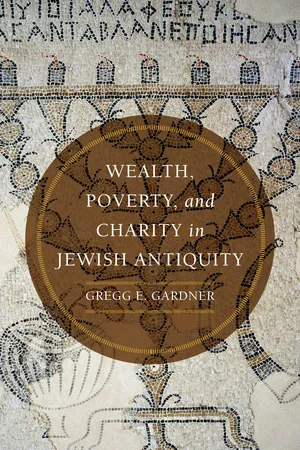
Charity is central to the Jewish tradition. In this formative study, Gregg E. Gardner takes on this concept to examine the beginnings of Jewish thought on care for the poor. Focusing on writings of the earliest rabbis from the third century c.e., Gardner shows how the ancient rabbis saw the problem of poverty primarily as questions related to wealth—how it is gained and lost, how it distinguishes rich from poor, and how to convince people to part with their wealth. Contributing to our understanding of the history of religions, Wealth, Poverty, and Charity in Jewish Antiquity demonstrates that a focus on wealth can provide us with a fuller understanding of charity in Jewish thought and the larger world from which Judaism and Christianity emerged.
- 302 pages
- English
- ePUB (mobile friendly)
- Available on iOS & Android
eBook - ePub
Wealth, Poverty, and Charity in Jewish Antiquity
About this book
Information
CHAPTER 1
The Wealth of the Early Rabbis
“Who is rich?” the Tanna Ben Zoma famously asks in m. Avot 4:1, answering, “He who rejoices in his lot. As it is said, ‘You shall enjoy the fruit of your labors; you shall be happy and you shall prosper’ (Ps 128:2).” This maxim, one of the most well-known sayings from the entire classical rabbinic corpus, is often read as an exhortation to be content with what one already has. A closer look, however, raises some questions. The passage’s instruction will only seem plausible to an audience that does not lack basic necessities. In addition, the citation of Psalm 128:2, ‘You shall enjoy the fruit of your labor,’ presumes that one can work, which includes having both the opportunity and the physical ability to earn a living. In short, what is often overlooked when reading m. Avot 4:1 is that these sentiments are more likely to have been expressed by authors and for an intended audience that did not want for food, clothing, or shelter, than those who were hungry and cold.1
What was the socioeconomic position of the individuals who authored the earliest rabbinic compilations? By answering this question, we will better understand the perspective, context, and content of Tannaitic approaches to poverty relief. It will also help shed light on how issues related to wealth—both having it in hand and understanding the roles that it can play in society—would influence rabbinic thinking more broadly. Scholars have been divided as to whether the Tannaim were rich or poor. The predominant view, based heavily on post-Tannaitic representations of early rabbis, has been that the Tannaim were uniformly poor.2 Others have argued for an adaptation of this position, namely that the Tannaim were mostly poor, but included some middle-class individuals.3 This chapter will take a fresh look at the issue. I will show that the Tannaim included individuals of modest or middling levels of wealth, alongside rabbis who were wealthy.4 I demonstrate how, in light of the relative wealth of the Tannaim, the poor are cast as reverse images of economic aspects of the rabbinic self. Contrary to traditional views that depict Torah study as a path to escape poverty, this chapter shows how the Tannaim saw poverty as a possible impediment to Torah study.5 The poor are also backgrounded, as the texts view laws on poverty relief from the perspective of the well-off and how they will fulfill their religious obligations, more so than the perspective of would-be recipients.
After the Tannaim (70–c. 250 C.E.), however, the socioeconomic composition of the rabbinic movement would change. Among the Amoraim of Roman Palestine (c. 250–500 C.E.), we begin to see rabbis who are needy. This is evident from the perspectives from which the texts were written and in the authors’ and redactors’ depictions of some rabbis as poor and recipients of support. The socioeconomic diversification of the rabbinic movement in the Amoraic era, which now included the voice of the poor, would have a profound impact on their thinking, setting the stage for significant changes in attitudes towards wealth and care for the poor.6
In short, this chapter demonstrates that exploring socioeconomic contexts can do more than help us understand poverty and the poor. A deeper, critical investigation can tell us more about the authors of these texts, including their own socioeconomic disposition, which in turn will help us better understand the ideas and attitudes expressed in the text. That is, it will illuminate the context of the authors themselves, within the limits and bounds of modern critical scholarship (i.e., avoiding the methodological pitfalls of writing “biographies” of the rabbis). More specifically, in contrast to earlier scholarship, this chapter demonstrates that the Tannaim themselves were likely wealthy or well-off, but none of them were poor. It would have been natural, therefore, for the early rabbis to shape their laws on poverty and poverty relief from the perspective of potential givers, rather than potential recipients.
More broadly, this chapter shows that wealth provided an important lens through which the rabbis saw society, which the Tannaim often categorized along socioeconomic criteria (“rich” or “poor”). In contrast to the Greeks and Romans, who saw society in terms of their citizenship, the Tannaim often saw material and economic criteria, where people’s status and positions were determined by their wealth or lack thereof. This opens the door to constructing laws on poverty relief based on one’s level of need, regardless of one’s political status. Seeing society through the prism of levels of wealth, therefore, contributes to this book’s larger argument on the role of wealth in rabbinic poverty laws and, more broadly, rabbinic law.
WEALTHY AND WELL-OFF RABBIS
A close examination of Tannaitic compilations suggests that the Tannaim were occupied in different professions. Most prominent were livelihoods directly dependent upon the land and its produce. Many texts address the concerns and perspectives of those who own land and manage its cultivation. These include discussions on the acquisition and ownership of land, the rights of buyers and sellers of land, and teachings that privilege land above other forms of payment in marriage settlements and compensation for damages.7 The laws for leasing land, primarily concentrated in Mishnah tractate Bava Metzi’a, exhibit an interest in maintaining a plot’s long-term productivity—which reflects the interests of landowners more so than those of temporary lessees.8 Many topics of discussion, such as when one party owns a cistern that is surrounded by the land of another, are relevant only to those who own land.9 In short, Tannaitic discourse often prioritizes the concerns of landowners, reflecting the interests of the rabbis who comprise both the authors and intended audience of these texts.10 As Hayim Lapin shows, the perspective of wealthy landowners also helps us understand the absence of discussions in civil law on how or whether small farmers brought their produce to market.11 The interests and problems that m. Bava Metzi’a addresses are most consistently those of the landholding town dwellers.12 The texts reflect the perspectives of those who had access to and the greatest use of coinage, as they marketed their goods through specialists, who bought produce in the marketplace and hired laborers.13 In this way, rabbinic attitudes towards money (explored further in chapter 4) flow from the rabbis’ own socioeconomic position.
The authors and redactors of Tannaitic compilations also chose to depict the members of their movement as owners and managers of land.14 Rabbi Yohanan ben Matthiah and his family are said to have owned and operated a farm that was profitable enough to hire labor (m. Bava Metzi’a 7:1). Rabbi Eliezer owned a vineyard, Rabbi Ishmael owned land in Kefar Aziz, and Rabbi Simeon Shazuri was from a family of wealthy landowners (m. Kil’ayim 6:4; t. Ma’aser Sheni 5:16; t. Bava Qamma 8:14).15 Landownership is presupposed when Rabbi Eleazar ben Diglai refers to the goats kept by his father’s household (m. Tamid 3:8). Rabban Gamaliel II’s tenants and hired laborers raised cattle and cultivated crops on his land (m. Pe’ah 2:4; m. Demai 3:1; m. Bava Metzi’a 5:8; t. Shabbat 15:2).
Activities not directly related to the land and its cultivation, such as crafts and commerce, were generally viewed with disdain by ancient authors. “Wage labor,” Cicero writes, “is sordid and unworthy of a fine man,” and Seneca writes, “There was no beauty or honor in the arts of the workman.”16 Examples of inimical attitudes toward these professions can likewise be found in early rabbinic texts. For example, Abba Gorion of Zaidan identifies animal drivers, barbers, sailors, and shopkeepers as those who engage in a “craft of robbers” (m. Qiddushin 4:14; cf. m. Ketubbot 7:10; t. Qiddushin 5:14).17 Likewise, such “practical” or “worldly” professions are often viewed as lowlier than others in Tannaitic texts (Sifre Deut. 357).18
Yet, once we start to look beneath the surface of these overtly programmatic statements, we uncover more receptive attitudes towards crafts and commerce. Many Tannaitic texts address issues that are of interest to those who work in labor and commerce (m. Demai 5:7; m. Bava Metzi’a 2:4, 4:1–12; m. Bava Batra 5:8; m. Avodah Zarah 4:9; m. Kelim 5:5; t. Demai 3:10; t. Bava Metzi’a 2:14).19 Some trades are singled out for special praise. Rabbi Judah, for example, commends camel drivers and sailors as proper folk and saintly (m. Qiddushin 4:14). Likewise, the texts portray some Tannaim as artisans and others as engaged in commerce, including Rabbi Yohanan the sandal maker and Rabbi Isaac Nappaha, a “blacksmith” as his name indicates (t. Shabbat 2:15; t. Eruvin 5:7).20 In Tannaitic writings, Rabbi Eleazar ben Azariah traded in wine and oil “all his life” (t. Avodah Zarah 4:1), Rabbi Judah ben Isaiah was a perfumer (t. Shevi’it 5:12), Rabbi Judah a baker (t. Menahot 1:15), Rabbi Joshua a grit dealer (t. Makhshirin 3:13), and Rabbi Eleazar ben Rabbi Zadok kept a store in Jerusalem “all his life” (t. Betzah 3:8). Tannaitic texts sometimes proclaim the value of labor in statements such as “see how beloved labor is to God” (t. Bava Qamma 7:10) and “teach your son a trade, or he will become a robber” (t. Qiddushin 1:11).21 These favorable attitudes, albeit intermixed with negative ones, nevertheless suggest that crafts and trade were plied by some early rabbis.22
The rabbinic movement thus included individuals at various levels of wealth. At the top were those depicted as exceptionally wealthy. The Tosefta portrays Rabbi Eleazar ben Rabbi Zadok as rich enough to purchase a synagogue in Jerusalem (t. Megillah 2:17). Rabbi Akiva, whom later rabbinic texts would reimagine as rising from an impoverished youth, exchanges valuable silver coins for even more valuable gold coins with Rabban Gamaliel and Rabbi Joshua (m. Ma’aser Sheni 2:7).23 Gamaliel is said to have owned slaves, who symbolized their master’s prestige (m. Berakhot 2:7; m. Sukkah 2:1; m. Pesahim 7:2; t. Pesahim 2:15; t. Mo’ed Qatan 2:16). The texts in which Gamaliel and his slave Tabi appear together, moreover, are authored from the perspective of the master, not that of the slave or a disinterested third party.24 Gamaliel’s landholdings afforded him banquets as lavish as any symposium in the Roman world—guests relaxed on furniture while being served food prepared with exotic spices (t. Betzah 2:13–14, 2:16; Sifre Deut. 38). Landownership, wealth, and status were closely intertwined in the ancient world and Gamaliel stood at the pinnacle, as he possessed unmatched amounts of all three.25
Not all rabbis, however, were extremely wealthy. Early rabbinic texts reflect the interests of those who owned small plots of land that they cultivated with their own hands (e.g., m. Pe’ah 4:10–11). Although an occupation does not determine the extent of one’s wealth (m. Qiddushin 4:14), it stands to reason that the incomes of craftsmen and merchants were more modest than those of large landholders. The Mekilta uses the term tekhakhim to indicate men of “medium wealth, of some means” (Mekilta, ‘Amaleq 4).26 The passage suggests that the binary of “rich and poor,” so frequently mentioned in Tannaitic texts, needs to be nuanced.27 Here, individuals who live at middling economic levels are distinguished from t...
Table of contents
- Imprint
- Subvention
- Title
- Copyright
- Dediation
- Contents
- Acknowledgments
- Abbreviations and Conventions
- Introduction
- 1. The Wealth of the Early Rabbis
- 2. Harvest Allocations for the Poor
- 3. Charity Laws
- 4. Giving Mammon (Wealth)
- 5. Pay for the Giver
- 6. Charity as an Investment
- 7. Poverty Relief and the Anxiety of Wealth
- 8. Some Further Perspectives: Early Christian and Later Rabbinic Traditions
- Notes
- Bibliography
- Index of Ancient Sources
- General Index
Trusted by 375,005 students
Access to over 1.5 million titles for a fair monthly price.
Study more efficiently using our study tools.
Frequently asked questions
Yes, you can cancel anytime from the Subscription tab in your account settings on the Perlego website. Your subscription will stay active until the end of your current billing period. Learn how to cancel your subscription
No, books cannot be downloaded as external files, such as PDFs, for use outside of Perlego. However, you can download books within the Perlego app for offline reading on mobile or tablet. Learn how to download books offline
Perlego offers two plans: Essential and Complete
- Essential is ideal for learners and professionals who enjoy exploring a wide range of subjects. Access the Essential Library with 800,000+ trusted titles and best-sellers across business, personal growth, and the humanities. Includes unlimited reading time and Standard Read Aloud voice.
- Complete: Perfect for advanced learners and researchers needing full, unrestricted access. Unlock 1.5M+ books across hundreds of subjects, including academic and specialized titles. The Complete Plan also includes advanced features like Premium Read Aloud and Research Assistant.
We are an online textbook subscription service, where you can get access to an entire online library for less than the price of a single book per month. With over 1.5 million books across 990+ topics, we’ve got you covered! Learn about our mission
Look out for the read-aloud symbol on your next book to see if you can listen to it. The read-aloud tool reads text aloud for you, highlighting the text as it is being read. You can pause it, speed it up and slow it down. Learn more about Read Aloud
Yes! You can use the Perlego app on both iOS and Android devices to read anytime, anywhere — even offline. Perfect for commutes or when you’re on the go.
Please note we cannot support devices running on iOS 13 and Android 7 or earlier. Learn more about using the app
Please note we cannot support devices running on iOS 13 and Android 7 or earlier. Learn more about using the app
Yes, you can access Wealth, Poverty, and Charity in Jewish Antiquity by Gregg E. Gardner in PDF and/or ePUB format, as well as other popular books in Storia & Storia antica. We have over 1.5 million books available in our catalogue for you to explore.