- 356 pages
- English
- ePUB (mobile friendly)
- Available on iOS & Android
eBook - ePub
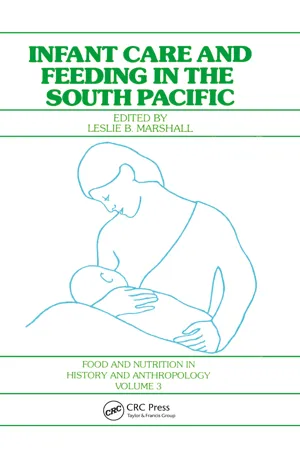
Infant Care and Feeding in the South Pacific
About this book
First Published in 1985. This is Volume 3 of a series on Food and Nutrition in History and Anthropology. In the aftermath of the controversial marketing of infant formula in the Third World, this volume describes infant care and feeding practices within their social, cultural and physical context among fourteen different Melanesian and Polynesian societies. The contributors address such issues as health and nutritional status, women's roles and social support, early socialization, symbolism and meaning of foods and feeding and intracultural variability. The material is valuable to health professionals, nutritionists and social scientists in understanding infant care and feeding practices in underdeveloped regions.
Information
CHAPTER 1
COMMENTARY: THE IMPORTANCE OF CULTURAL PERSPECTIVES ON INFANT CARE AND FEEDING†
INTRODUCTION
These ethnographic studies represent a unique collection documenting one of the most critical concerns for all social groups, the care and feeding of infants and children. Of particular importance is their emphasis on cultural factors in this process. This includes not only the beliefs that shape people’s understandings of infant care, but also the contingencies generated by particular social and cultural contexts in which infants and children are cared for. The chapters focus on a number of different societies in the Pacific. Through the examination of a wide range of topics, the authors raise methodological and theoretical issues around which future studies of infant care and feeding might be organized. Additionally, these studies offer information that will be of great relevance to policy makers by demonstrating the importance of social and cultural variables for developing and recommending programs concerned with improving maternal and child health.
METHODOLOGICAL ISSUES
These studies raise important methodological issues. The relevance of collecting in-depth case studies that include ethnographic detail is obvious. It is only when we have a sufficiently fine-grained description and analysis of feeding and caregiving practices as they are integrated within their cultural and historical contexts that we can begin to compare these data with regard to such topics as health, nutrition, and work, which are themselves culturally organized systems. The ethnographic perspective sees culture not as a patchwork of different ideas and practices, but as the system that integrates them all. Thus, one of the more important methodological and theoretical issues is the integration of different types of data to get at the underlying system of organization. For example, Montague (ch. 5) points out the value of this when she notes that Trobriand Islanders do not accurately report infants’ and childrens’ actual feeding patterns in brief survey interviews. Instead they provide data which describe locally ideal adult patterns. Thus, she suggests that interview data alone are not enough to understand what Trobrianders are doing. Interviews must be supplemented by detailed systematic observations of actual practice. This is necessary in many Pacific societies where ideals about what people eat and what they actually eat vary considerably. This difference, together with intra-group variation in behavior, potentially makes it difficult to characterize the dietary practices of any particular society (let alone comparing practices between societies) on the basis of interview data alone.
The major questions here are not only what is the relationship between what people say they do and what they actually do, but also why there is such a difference and what it means for the way people feed and care for their children. Inquiry should proceed on the assumption that there is a relationship between different cultural statements and practices even if people say there is not. Lepowsky (ch. 4), Montague (ch. 5), Conton (ch. 6), and others point out the underlying interaction of different systems with each other and their functional interrelations even when these are not articulated by the people themselves.
It is also important to understand the ways in which the people of a given society act according to explicit cultural norms and knowledge. For example, it is the case that most Pacific peoples have their own ways of perceiving and evaluating developmental progress. Standard clinical weights and bodily measurements do not capture their relevant categories. Jenkins, Orr-Ewing and Heywood (ch. 3) argue that it is important to understand how the stages of children’s growth are conceptualized emically as well as etically (according to Western ideas) in order to grasp the relationship of children’s growth to feeding practices in any society.
Several sets of original findings in this book demonstrate the importance of integrating different research perspectives. Lepowsky (ch. 4) provides an excellent example of the integration of cultural and biological approaches by combining medical and comparative ethnographic literature in a particular case study. Jenkins, Orr-Ewing and Heywood (ch. 3) show the relevance of undertaking nutritional studies in the context of ethnographic observation. In all of these chapters, it is clear that researchers must continue to draw on a variety of disciplinary perspectives on the study of infant care and feeding.
THE ROLE OF IDEOLOGY
A major theme discussed in many of the chapters is the role of ideology in shaping infant feeding practices. Only by understanding the cultural ideology that underlies a set of practices can we make sense of the meaning that actions and events have for participants. These studies include data focusing on people’s cultural ideas about what constitutes a healthy child and proper feeding practices. Montague’s research on ideology and nutrition in the Trobriand Islands (ch. 5) details the local cultural expectations about proper body configuration. This type of information, in turn, helps make sense of what otherwise might seem to be maladaptive feeding practices. Since parents positively value light body weight for their young children, they make sure that children eat enough to be muscled, but visible fat deposits are undesirable. Furthermore, in the Trobriands, the emphasis is on the musculature of the legs of children, not the arms.
Jenkins, Orr-Ewing and Heywood (ch. 3) found that the Amele beliefs that breastmilk increases in value as children age and that liquid foods are most suitable for small children, result in little supplementary food being offered to infants in the first year of life.
According to the Kaliai (ch. 9), breastmilk is the only female effluvium that is not polluted. It may be contaminated, however, especially by male substance (semen). Thus, the Kaliai must make sure a wetnurse is not sexually active. The neighboring Kove (ch. 10) share this belief and concern. The Kwaio (ch. 12) believe that the quality of breastmilk changes over time. This, too, is an important consideration in matching the needs of the nursling to a wetnurse.
Morse (ch. 14) compares infant care and feeding practices in Fijian and Fijian-Indian groups, pointing out that withholding the breast for three to four days, a custom practiced by both groups, is done for very different cultural reasons. This underlines the importance of understanding the beliefs behind apparently identical types of behavior, rather than just describing the acts themselves. Policy makers and health care workers in particular must be alert to these differences in meaning because they indicate that apparently similar health care interventions may have quite dissimilar implications in different societies and require alternative approaches for implementation.
Situations of social and historical change present complex problems for assessing the relations of ideological patterns to cultural practices. Counts (ch. 9) shows that the Kaliai have undergone considerable social change, including giving up their traditional procreation theory and changing their ideology regarding sexuality. In addition, they have introduced new foods into the diets of older children and adults. These changes do not, however, include new social or economic activities which compete with women’s traditional domestic responsibilities, and thus there are no new incentives of this sort for changing the age of weaning or introducing food supplements. Ideological changes in this case were not reflected in changes in infant feeding practices.
Among the Kwara’ae (ch. 13), where traditional taboo systems have been abolished and Christianity is being accepted, men and women no longer practice ritual separation and now live together in the same house. As a result of this and of the abandonment of infanticide, the fertility rate and family size are increasing. At the same time there are critical changes in available subsistence resources. This has led to changes in Kwara’ae family structure, work organization and infant care. However, as Gegeo and Watson-Gegeo point out, these changes are not merely a result of changing population characteristics and concomitant social structural accommodations. Many of the changes result from conscious decision-making by the Kwara’ae and a determination to maintain their traditional central values while participating in a modernizing society.
VARIATION
Another important theme to emerge from these chapters concerns variation in infant care and feeding practices. We expect a great deal of variation among Melanesian societies; what is quite impressive is the amount of variation within each social group.
Some sources of variation are imposed or enabled by external ecological conditions or by pressing social factors that parents do not themselves control. For example, in many places there is a seasonal variability in the food supply. As Barlow (ch. 8) points out for the Murik, there is variability in the foods and other resources to which different families have access. Katz (ch. 15) points out that in the outer islands of Fiji there are several additional things that contribute to variations in infant care practices: parental age, and social and economic factors. She found that feeding practices were related to whether or not the husband or male kin grew green vegetables in addition to essential root crops, and how much cash was available to the family to buy food. Family composition also had an effect on the individual child’s diet, because animal foods received high value and were given first to the adult men in a family. Katz found factors associated with early infant weaning in a traditional context which permitted a mother to return to work. She found that mothers whose consanguineal kin resided in the same village ended breastfeeding earlier, suggesting that a plentiful food supply and/or greater availability of infant caregivers enabled this kind of flexibility.
Conton (ch. 6), Counts (ch. 9), Chowning (ch. 10), Akin (ch. 12), Gegeo and Watson-Gegeo (ch. 13), and Nardi (ch. 16) are all concerned with variation in traditional patterns of infant care and feeding due to socio-historical and ideological changes brought about by contact with outside influences, especially Western religious dogma, trade practices, cash, and business.
Individual decision making is an important basis for variation in some societies. This point is made by Conton (ch. 6) for the Usino people who make their choices individually as to when to introduce semisolid and solid foods to infants. Conton argues that there is a lack of consensus in both theory and practice among the Usino people regarding food restrictions for nursing mothers and their children and for practices regarding supplementary feeding. There are no universally agreed upon restrictions, nor is there a common body of knowledge shared by all mothers about them. However, for the Usino people, almost all lactating mothers follow some food taboos to protect the health of the nursing offspring and all must avoid the ingestion of animal protein.
Gegeo and Watson-Gegeo (ch. 13) present the case for there being no clear agreement — even traditionally — within the Kwara’ae community about what women should eat during pregnancy except for one category of foods. In this society, individuals have a great deal of choice, not only in deciding dietary practices they themselves will follow, but what their young children may or may not eat. Variation extends to the choice of a child’s first foods, the times solid foods are introduced, and the age at which children are weaned. For the Kwara’ae, the variation is due to a complex interaction of individual choice and the birth order of the child. The role of birth order in determining the food habits of both mother and child is also discussed by Lepowsky (ch. 4) for Vanatinai society, where there are variations in mothers’ food taboos according to stages in their life cycle and the numbers of children that they have already borne.
In contrast to some peoples who have well-formulated explicit ideologies about infant care and feeding (as do the Murik, ch. 8), Usino people (ch. 6) do not talk much about these things. This apparent freedom of choice, however, must not be taken to mean that in some societies feeding practices and their underlying conceptual bases are applied strictly idiosyncratically rather than in a culturally normative way. Even Usino mothers’ range of personal choice must fall within the range of cultural definitions of food versus non-food and the meaning of feeding. There is always the possibility that a practice is culturally shaped even when the people do not (or cannot) articulate reasons for it. While it is important to document variation among and within cultures, it is even more important to look further into the cultural sources for the variability. We must not lose sight of the fact that variation derives from many different sources. For example, seasonal variation in Murik food supply (ch. 8) is related to and integrated with the ritual cycle of trade. This is a different kind of variability than Conton (ch. 6) or Carrier (ch. 11) describe: variation due to general acceptance of the idea that one eats what is available or variation due to social class difference or cultural change. To continue with the Usino case, eating whatever is available is a very different cultural attitude toward food than a situation in which people are suspicious of exotic foods (ch. 8) or animal substances (ch. 5), or in which certain foods have prestige value or are taboo. Thus, what seems to be a lack of Usino people’s ideology about food is itself a cultural phenomenon. Given the importance of feeding and the complexes of meaning attached to it in other Pacific societies, the Usino people’s laissez-faire attitude is quite striking, culturally distinctive, and probably related to other aspects of the culture and current situation. A great deal of free variation for multiple reasons is something that needs further study. This investigation of variation should uncover other kinds of information about feeding practices and their relation to other aspects of the culture. This is not to say that everything will turn out to be meaningful or well-integrated, but a focus on the diversity of surface variation must not be allowed to undermine the systematic underlying cultural sources for it across Pacific societies if the real implications of such variations are to become clear. In this effort, how explicitly a given cultural group articulates their norms and expectations regarding feeding practices is only one consideration among many, even though explicit norms frequently shape actual practice.
SOCIAL CONTEXT AND MEANING
Another theme developed in these ethnographic studies is the relation between the social context and the meaning of giving and receiving food. In many Pacific societies, including these, the meaning of giving food has less to do with nutritional value than with affective associations. Brea...
Table of contents
- Cover
- Half Title
- Series Page
- Title Page
- Copyright Page
- Table of Contents
- Preface to the Series
- Preface
- Acknowledgments
- Maps of the Research Sites
- Contributors
- 1 Commentary: The Importance of Cultural Perspectives on Infant Care and Feeding
- 2 Wage Employment and Infant Feeding: A Papua New Guinea Case
- 3 Cultural Aspects of Early Childhood Growth and Nutrition Among the Amele of Lowland Papua New Guinea
- 4 Food Taboos, Malaria, and Dietary Change: Infant Feeding and Cultural Adaptation on a Papua New Guinea Island
- 5 Infant Feeding and Health Care in Kaduwaga Village, the Trobriand Islands
- 6 Social, Economic, and Ecological Parameters of Infant Feeding in Usino, Papua New Guinea
- 7 Infant Care and Feeding Practices and the Beginnings of Socialization Among the Maisin of Papua New Guinea
- 8 The Social Context of Infant Feeding in the Murik Lakes of Papua New Guinea
- 9 Infant Care and Feeding in Kaliai, West New Britain, Papua New Guinea
- 10 Patterns of Infant Feeding in Kove (West New Britain, Papua New Guinea), 1966-1983
- 11 Infant Care and Family Relations on Ponam Island, Manus Province, Papua New Guinea
- 12 Women’s Work and Infant Feeding: Traditional and Transitional Practices on Malaita, Solomon Islands
- 13 Kwara’ae Mothers and Infants: Changing Family Practices in Health, Work, and Childrearing
- 14 The Cultural Context of Infant Feeding in Fiji
- 15 Infant Care in a Group of Outer Fiji Islands
- 16 Infant Feeding and Women’s Work in Western Samoa: A Hypothesis, Some Evidence and Suggestions for Future Research
- 17 Commentary: A Pediatrician’s Perspective
- 18 Commentary: Women’s Work and Infant Feeding in Oceania
- 19 Commentary: An Anthropological Perspective on Infant Feeding in Oceania
- Index
Trusted by 375,005 students
Access to over 1.5 million titles for a fair monthly price.
Study more efficiently using our study tools.
Frequently asked questions
Yes, you can cancel anytime from the Subscription tab in your account settings on the Perlego website. Your subscription will stay active until the end of your current billing period. Learn how to cancel your subscription
No, books cannot be downloaded as external files, such as PDFs, for use outside of Perlego. However, you can download books within the Perlego app for offline reading on mobile or tablet. Learn how to download books offline
Perlego offers two plans: Essential and Complete
- Essential is ideal for learners and professionals who enjoy exploring a wide range of subjects. Access the Essential Library with 800,000+ trusted titles and best-sellers across business, personal growth, and the humanities. Includes unlimited reading time and Standard Read Aloud voice.
- Complete: Perfect for advanced learners and researchers needing full, unrestricted access. Unlock 1.5M+ books across hundreds of subjects, including academic and specialized titles. The Complete Plan also includes advanced features like Premium Read Aloud and Research Assistant.
We are an online textbook subscription service, where you can get access to an entire online library for less than the price of a single book per month. With over 1.5 million books across 990+ topics, we’ve got you covered! Learn about our mission
Look out for the read-aloud symbol on your next book to see if you can listen to it. The read-aloud tool reads text aloud for you, highlighting the text as it is being read. You can pause it, speed it up and slow it down. Learn more about Read Aloud
Yes! You can use the Perlego app on both iOS and Android devices to read anytime, anywhere — even offline. Perfect for commutes or when you’re on the go.
Please note we cannot support devices running on iOS 13 and Android 7 or earlier. Learn more about using the app
Please note we cannot support devices running on iOS 13 and Android 7 or earlier. Learn more about using the app
Yes, you can access Infant Care and Feeding in the South Pacific by Leslie B. Marshall in PDF and/or ePUB format, as well as other popular books in Social Sciences & Nutrition, Dietics & Bariatrics. We have over 1.5 million books available in our catalogue for you to explore.