The highly arcane "wisdom" produced by the French psychoanalyst Jacques Lacan is either endlessly regurgitated and recited as holy writ by his numerous acolytes, or radically dismissed as unpalatable nonsense by his equally countless detractors. Contrary to these common, strictly antagonistic yet uniformly uncritical practices, this book offers a meticulous critique of some key theoretical and clinical aspects of Lacan's expansive oeuvre, testing their consistency, examining their implications, and investigating their significance.
In nine interrelated chapters, the book highlights both the flaws and the strengths of Lacan's ideas, in areas of investigation that are as crucial as they are contentious, within as well as outside psychoanalysis. Drawing on a vast range of source materials, including many unpublished archival documents, it teases out controversial issues such as money, organisational failure, and lighthearted, "gay" thinking, and it relies on the highest standards of scholarly excellence to develop its arguments. At the same time, the book does not presuppose any prior knowledge of Lacanian psychoanalysis on the part of the reader, but allows its readership to indulge in the joys of in-depth critical analysis, trans-disciplinary creative thinking, and persistent questioning.
This book will appeal to researchers and students alike in psychoanalytic studies and philosophy, as well as all those interested in French theory and the history of ideas.
Chapter 1 Lacan's Écrits Revisited: On Writing as Object of Desire
DOI: 10.4324/9781003252276-2
Maybe it was a patent case of morphogenetic resonance avant la lettre.1 Maybe it was a mere occurrence of simple acausal synchronicity. Whether on 15 November 1966 the undead soul of Carl Gustav Jung whispered ever so softly into the young ears of Rupert Sheldrake, analytical psychology gradually giving birth to formative causation, fact of the matter is that this remarkable Tuesday was a day of three mighty crashes—two of which carefully planned, a third definitely unplanned, two pre-scheduled and eagerly anticipated, a third totally unexpected, yet all three of them equally memorable and momentous. In the early hours of the morning, cargo flight Pan Am 708, departing from Frankfurt with a destination of Berlin, crashed on initial approach in what was then Eastern Germany, 15 kilometres from the landing strip at Tegel airport, killing all three crew members. Some 16 hours later, the American spacecraft Gemini 12 splashed down in the North Atlantic Ocean, less than 5 kilometres off target, after which the two crew members were safely picked up by a U.S. aircraft carrier. Both events made newspaper headlines around the world the following day, totally obfuscating the third crash, even though in many ways the latter would prove equally pivotal and consequential. If there is any truth in Jacques Dutronc's lyrical portrayal of Paris as waking up at 5am, the third probably already happened in the French capital quite some time before daybreak, yet various other cities in the provinces and around Europe would not have been spared the tremendous impact of a thumping doorstop, landing in huge quantities and colonizing large amounts of precious shelf space. For all I know, when the colossal paper scatter bomb inscribed Écrits (Lacan, 1966a) landed in the bookshops on Tuesday, 15 November 1966, it did not cause any casualties, yet no one could have predicted its triggering a small intellectual tsunami, at least in the francophone world, whose ripples would still be felt 50 years later.2
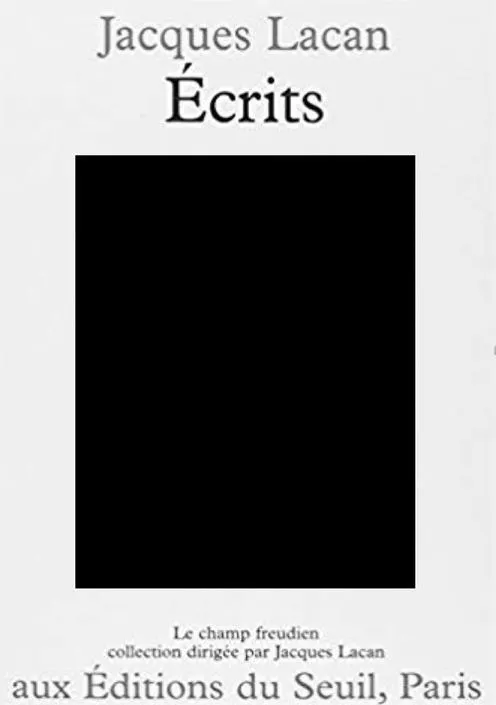
For all its explosive contents and its humongous size, Jacques Lacan's Écrits would have looked surprisingly plain to anyone daring to approach it and mustering the strength to pick it up. White as mortal sin graciously forgiven, with no image or drawing teasing or enticing the reader, it was as if the hefty tome was afraid to disclose itself, drawing an unadorned ivory veil over its heavy haecceity, compelling curious hands to look for telltale signs elsewhere, or forcing scrutinizing eyes to discern themselves in the central space of the white paper jacket. Inviting both projection and reflection, the volume's uncannily empty cover is the learned man's intellectual equivalent of the white sleeve the Fab Four would use, almost exactly two years later, for their weighty ninth release. Equally uncommon for a book, its front cover featured the name of its author twice, once at the top and once at the bottom, once in red and once in black, once in the same large font as the name of the publisher, and once in a smaller font, just above the name of the publisher—the name of the author thus repeated, although not exactly in the same way, as if one mention would not have been sufficient as an index of authorial ownership and intentionality.3
More than any other cover, this doubly inscribed signboard infesting the French bookshops on that fateful morning of 15 November 1966 would have probably instigated an involuntary volte-face, from front to back, in a quick and easy sleight of hand. There, in what the French call “la quatrième de couverture”, and what is designated in English rather more prosaically as the “back cover”, more whiteness would await, yet now with a duplicated and colour-changed title and an anonymous précis, which was as much an explicit injunction to the reader as it was a succinct description of the volume's raison d’être. Turning the book around, like a leisurely browser checking out the song titles of an album after having admired its cover, here is what interested, intrigued, or bemused minds would discover.4
One must have read this collection from cover to cover to realise that a single debate is pursued in it, always the same. Should it seem dated, it shall nonetheless prove to be that of the Enlightenment.
For there is a field in which dawn itself is late in arriving: the field that runs the gamut from a bias of which psychopathology has not rid itself to the false evidence with which the ego entitles itself to flaunt its existence.
Obscurity passes itself off as an object in this field and flourishes through the obscurantism that finds anew its values in it.
No wonder, then, that it is precisely in this field that people resist the discovery by Freud, a term that may be extended here on the basis of an amphibology: Jacques Lacan's discovery by Freud.
The reader will learn what is demonstrated in it, which is that the unconscious stems from pure logic—in other words, from the signifier.
Epistemology will always be lacking here, unless it starts from a reform, which is the subversion of the subject.
Its advent can only be produced in reality [réellement] and in a place that is currently occupied by psychoanalysts.
For 15 years, Jacques Lacan has been transcribing this subversion for analysts on the basis of their everyday experience.
The thing is of too much concern to everyone not to make a ruckus.
With these writings [écrits], Lacan enjoins us to ensure that this subversion is not hijacked by the culture industry.
(Lacan, 1966a, back cover)
At the risk of straying into slightly self-indulgent, and always already fictionalized autobiographical reminiscences, when I assimilated these words for the first time in the original French, back in the mist of time, some time during the autumn of 1984, I had absolutely no idea what they meant. But then again, as Lacan himself intimated in the opening sentence, a proper appreciation of the nature and the stakes of the debate would have required my having read the entire volume, from beginning to end, all 900-odd pages of it. Inquisitive as I am, I followed Lacan's unequivocal exhortation to read. Almost 40 years later, I am still as curious as I was back then, and I still find myself reading, occasionally wondering what I missed, or whether I should re-read what I have already read numerous times over. In all sincerity, despite endless re-readings, I still cannot claim that I fully appreciate what Lacan was trying to convey here, from which culture industry he was trying to rescue his subversion, and to which persistently obscure field he had addressed his Fiat Lux.
Be that as it may, the back cover of Écrits indicates that Lacan placed his book firmly under the aegis of the Enlightenment, a statement which many a reader would no doubt have acknowledged, and probably long before having scrutinized the volume from cover to cover, as supremely ironic, given that what appears to reign supreme in these 900 pages, from beginning to end, presents itself as being exactly the opposite. Rather than signalling the end of obscurity and celebrating the long-awaited arrival of a new dawn, Écrits would seem to take its readers on an O’Neillian or Célinesque voyage into the darkest depths of the night, towards an intellectual hadopelagic zone, where eternal blackness reigns and where no ordinary mortal is sufficiently well equipped to find his bearings, let alone survive.5 Returning to the empty white expanse on the book's front cover and choosing, as other publishers undoubtedly would have done, a suitable work of art to fill in the blank space—capturing a key feature of what lies beneath the surface with a view to inflaming the reader's imagination—it would thus not be Eugène Delacroix's La liberté guidant le peuple that might impose itself, as a latter-day pictorial emblem of the French Enlightenment tradition, but a version of the undisputed highlight of suprematism, Kazimir Malevich's infamous Black Square (see Figure 1.1).
Figure1.1 Jacques Lacan, Écrits (imaginary cover).
And what are we supposed to make of the book's peculiar title? In her Lacan: In Spite of Everything, Élisabeth Roudinesco averred that, as a summa which constitutes “the founding Book [sic] of an intellectual system”, Lacan's volume resembles both Ferdinand de Saussure's Course in General Linguistics (Saussure, 1959[1916]) and Hegel's Phenomenology of Spirit (Hegel, 2018[1807]; Roudinesco, 2014[2011], p. 99). Whereas I broadly concur with the status Roudinesco accords to Écrits, I respectfully disagree with the comparisons that are being made, irrespective of the fact that neither Saussure's nor Hegel's book refer to writing (écrit; écriture) in their titles. For although it is self-evident that Saussure's book was written, it was not actually written by himself, but by Charles Bally and Albert Séchehaye, two of his students, based on lecture notes. As to Hegel's Phenomenology of Spirit, this was written over a very short period of time and under great duress, which partly explains why the substance of the book is measurably less well developed than its preface and introduction (Pinkard, 2018, p. xvi).
Restricting myself to the title of Lacan's doorstop, there is a small handful of books in French with exactly the same title (see, for example, Ensor, 1950; Janáček, 2009; Malévitch, 1975; Munch, 2011; Rigaut, 1970). What unites these books, in all their diversity, is that they invariably concern posthumous collections of written texts by people who are primarily known for other creative accomplishments (in painting, music, or poetry for instance). In other words, in these cases, the title Écrits is meant to retain the reader's interest, purely by virtue of the fact that the author is not primarily recognized as a writer. Whenever the title Écrits is employed to describe a collection of works by established authors of fiction or non-fiction, it is generally expanded through the addition of a classifying adjective denoting a unifying quality of the writings presented, as in Jean-Paul Sartre's Écrits de jeunesse (Sartre, 1990), or Victor Hugo's Écrits politiques (Hugo, 2002). In this case, Écrits would not suffice as a descriptive noun for the book's contents, precisely because the author is already principally known for being a writer.
In simply calling the book Écrits, the author, publisher, and/or editor thus decided that the title did not have to be about anything at all for the book to be about something specific, because the name of the author somehow guaranteed the contents of the volume and the subject under discussion, since he was not directly associated with writing. Indeed, even though he was 65 years old when Écrits appeared, and he had intermittently published innovative essays in specialized journals, Lacan had primarily gained a name for himself as a speaker. To the French intellectual community of the mid-1960s, the name of Jacques Lacan would have been synonymous with a weekly seminar on psychoanalysis, whose audience had grown exponentially from January 1964, when it started taking place at the famous “École Normale Supérieure” in the rue d’Ulm, under the auspices of the “École pratique des Hautes Études” (Lacan, 1994[1973], p. 1). Speaking about his intellectual trajectory to trainee psychiatrists in Bordeaux on 20 April 1967, Lacan disclosed that he himself had chosen the title of his book:
I collected together something I had to call Écrits, in the plural, because it seemed to me that that was the simplest term to designate what I was going to do. I brought together under that title the things I had written just to put down a few markers, a few milestones, like the posts they drive into the water to moor boats to, in what I had been teaching on a weekly basis for 20 years or so… In the course of those long years of teaching, from time to time I composed an écrit and it seemed to me important to put it there like a pylon to mark a stage, the point we had reached in some year, some period in some year. Then I put it all together. It happened in a context in which things had gained ground since the time when I started out in teaching.
(Lacan, 2008[2005], pp. 60–61)6
On 12 May 1971, when Lacan delivered “Lituraterre” at his weekly seminar in Paris, he further disclosed to his audience that his title Écrits was effectively “more ironic than one might think: when it concerns either reports, a function of conferences, or let's say “open letters” where I bring into question a facet of my teaching” (Lacan, 2013[1971a], p. 328).7 Hence, the essays collected in Écrits had allegedly fallen out of Lacan's weekly teaching to psychoanalytic trainees, or out of his presentations at conferences and his public lectures, as the tangible material residues of an ephemeral discourse, with the proviso that in some cases the texts had been prepared before, and with the explicit purpose of being read out loud.8
On 9 January 1973, at the very beginning of a lecture on “the function of the written” (la fonction de l’écrit)—although this title would have been added afterwards, notably when the lecture was edited and prepared for publication as part of that year's seminar—Lacan conceded that when it came to choosing a title for his book, he could not think of anything better than to call it Écrits (Lacan, 1998[1975], p. 26). I have no good reason to think that he was disingenuous when he said he had not been able to come up with anything else, much as he was broadly correct in saying that most of the texts included in the book had originally been written for conferences, or published as me...
Table of contents
Cover
Half Title
Series Page
Title Page
Copyright Page
Dedication
Contents
List of Figures
Introduction
1 Lacan's Écrits Revisited: On Writing as Object of Desire
2 What Are Words Worth? Lacan and the Circulation of Money in the Psychoanalytic Economy
3 That Obscure Object of Psychoanalysis
4 The Sculptural Iconography of Feminine Jouissance: Lacan's Reading of Bernini's Saint Teresa in Ecstasy
5 Esprit de Corps, Work Transference, and Dissolution: Lacan as an Organizational Theorist
6 Psychoanalysis as gai saber: Towards a New Episteme of Laughter
7 Once He Was a Poet: On Psychoanalysis as Poetry in Lacan's Clinical Paradigm
8 Lacan's Clinical Artistry: On Sublimation, Sublation, and the Sublime
9 Lacan with Antigone: On Tragedy and Desire in the Ethics of Psychoanalysis
Bibliography
Acknowledgements
Photo Acknowledgements
Index
Trusted by 375,005 students
Access to over 1.5 million titles for a fair monthly price.
Study more efficiently using our study tools.
Frequently asked questions
Yes, you can cancel anytime from the Subscription tab in your account settings on the Perlego website. Your subscription will stay active until the end of your current billing period. Learn how to cancel your subscription
No, books cannot be downloaded as external files, such as PDFs, for use outside of Perlego. However, you can download books within the Perlego app for offline reading on mobile or tablet. Learn how to download books offline
Perlego offers two plans: Essential and Complete
Essential is ideal for learners and professionals who enjoy exploring a wide range of subjects. Access the Essential Library with 800,000+ trusted titles and best-sellers across business, personal growth, and the humanities. Includes unlimited reading time and Standard Read Aloud voice.
Complete: Perfect for advanced learners and researchers needing full, unrestricted access. Unlock 1.5M+ books across hundreds of subjects, including academic and specialized titles. The Complete Plan also includes advanced features like Premium Read Aloud and Research Assistant.
Both plans are available with monthly, semester, or annual billing cycles.
We are an online textbook subscription service, where you can get access to an entire online library for less than the price of a single book per month. With over 1.5 million books across 990+ topics, we’ve got you covered! Learn about our mission
Look out for the read-aloud symbol on your next book to see if you can listen to it. The read-aloud tool reads text aloud for you, highlighting the text as it is being read. You can pause it, speed it up and slow it down. Learn more about Read Aloud
Yes! You can use the Perlego app on both iOS and Android devices to read anytime, anywhere — even offline. Perfect for commutes or when you’re on the go. Please note we cannot support devices running on iOS 13 and Android 7 or earlier. Learn more about using the app
Yes, you can access Critique of Psychoanalytic Reason by Dany Nobus in PDF and/or ePUB format, as well as other popular books in Psychology & Post-Structuralism in Philosophy. We have over 1.5 million books available in our catalogue for you to explore.