An excellent read for entrepreneurs, corporate business leaders, board members, and strategists aiming to future-proof their business by integrating sustainability into the very core.This book offers a way forward, helps you understand the Sustainability Revolution, and provides valuable insights into the journeys and strategic choices of sustainability trailblazers such as Patagonia, Interface, Ørsted, Unilever, IKEA, Oatly, and others.Because you are not the first company to discover the potential in doing well by doing good, or as William Gibson said: "The future is already here - it's just not very evenly distributed".Still, many wicked problems urgently need innovative solutions. Solutions that the world of business is particularly well equipped to address through the ingenuity, creativity, collaboration, and resources that it can so often call forth more effectively and efficiently than other human organizations. Here and now, this requires a move beyond business as usual and a transformation into Better Business.
eBook - ePub
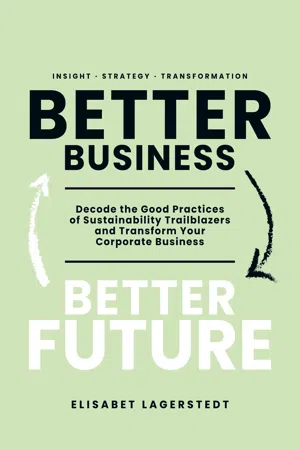
Better Business Better Future
Decode the Good Practices of Sustainability Trailblazers and Transform Your Corporate Business
- 352 pages
- English
- ePUB (mobile friendly)
- Available on iOS & Android
eBook - ePub
Better Business Better Future
Decode the Good Practices of Sustainability Trailblazers and Transform Your Corporate Business
About this book
Information
CHAPTER 1
THE REVOLUTION SUSTAINABILITY
“We’ve watched the COVID-19 situation unfold at incredible speed… The climate crisis is playing out on a much slower timeframe.
We know roughly what to expect and when to expect it, and we should be preparing with the same level of urgency.”
DR. DE MENOCAL 53
We are literally going to start this chapter on a burning platform. But probably not one you would expect.
One July night in 1988, Daryl Connor, a consultant and writer, was watching the news on TV when he heard about a horrific explosion on the Piper Alpha oil rig in the North Sea just outside of Scotland. The explosion and subsequent fires destroyed the platform and claimed 167 lives. What captured his interest was the story of one of the survivors, Andy Mochan.54
The explosion had abruptly woken Andy up in his quarters and injured him badly. He still somehow managed to escape to the platform edge. Daryl Connor writes: “Beneath him, oil had surfaced and ignited. Twisted steel and other debris littered the surface of the water. Because of the water’s temperature, he knew that he could live a maximum of only 20 minutes if not rescued. Despite all that, Andy jumped fifteen stories from the platform to the water. When asked why he took that potentially fatal leap, he did not hesitate. He said, “It was either jump or fry.” He chose possible death over certain death. Andy jumped because he felt he had no choice—the price of staying on the platform was too high.”
/ It helps us realise that
we often don’t move
until we have to—or until
we have a real crisis
on our hands /
Daryl Connor used the story in one of his 1990s management books as a metaphor for describing the determined commitment needed to create a significant change. Today, the metaphor is most often used to convey the message that remaining with the status quo, or staying put, is not an option and that something needs to be done even if it may be both risky and uncertain. The story may, however, create slightly different associations than it did 25 years ago when the oil and gas industry was booming. Today, it is an industry in transformation due to another burning platform (climate change) and an increasing focus on renewable energy. As a metaphor, however, it is still highly relevant because it shows the difficulty and importance of making a choice and taking action, especially when we feel stuck between a rock and a hard place. Further, it helps us realise that we often don’t move until we have to—or until we have a real crisis on our hands. I am confident that Andy would not have made the fifteen-story jump into the cold water were it not for the imminent threat to his life.
So let’s jump right in.

THE CONSEQUENCES OF
THE GREAT ACCELERATION
“The Great Acceleration of the world economy
over the last 70 years has brought an
unprecedented increase in output and
human welfare. Human population grew
from 2.5 billion in 1950.”
WORLD ECONOMIC FORUM55
Over the past century, the world has seen unprecedented economic development and an exponentially growing population. Industrialization and globalization have led to wealth and prosperity; they have increased our lifespan by decades and brought billions out of poverty across the globe. Figure 4 illustrates the GDP development over the last two millennia.
The exponentially growing GDP has simply created a brand new world over the last century. When my own grandmother was born in 1908, most Swedish households still had no electricity and none had the modern appliances that we take for granted today. Lacking a good Swedish example, Figure 5 shows the diffusion of innovation in US households from 1900–2005, which is representative of her lifetime.
When my grandmother passed away in 2005, a lot had happened during those good 95 years. In fact, in less than a century, the world had in many ways completely transformed. This unprecedented development improved quality of life and made it less cumbersome in many ways. Just imagine having to wash your clothes by hand, having no shower, no refrigerator, no TV, no holiday in an exotic country, and not even a car or a telephone—much less today’s mandatory smartphone.
Better economic conditions and ground-breaking innovation improved living conditions, and a globalized economy led to reduced child mortality and longer lifespans, but also to an exponentially growing global population. Figure 6 shows the world population growth over the past 12,000 years.
So, what is wrong with this? Higher GDP and more people on this planet bring increasing potential for products and services, which in turn means a flourishing economy. All good for business, right? Unfortunately not, as the amazing developments of the past century also brought a lot of unintended consequences. It is widely recognized today that the unprecedented population growth coupled with unsustainable production and consumption practices upon which we have built our modern society is putting the planetary systems and life as we know it under significant stress.
In the report, The Trajectory of the Anthropocene – The Great Acceleration (2015), researchers zoomed further in on the development and summarized their observations and conclusions with the insight that the period from about 1950 until today is unique in human history: “The second half of the twentieth century is unique in the entire history of human existence on Earth. Many human activities reached take-off points sometime in the twentieth century and have accelerated sharply towards the end of the century. The last 50 years have without doubt seen the most rapid transformation of the human relationship with the natural world in the history of human-kind.”59
Figure 7 shows a number of socio-economic and earth system trends, published in the report above, which helps visualize this development. It is not only GDP and population that have skyrocketed; several indicators point in the direction of exponential growth.
WORLD GDP OVER THE LAST TWO MILLENNIA
Total output of the world economy; adjusted for inflation and expressed in international-$ in 2011 prices.

FIGURE 4
Global prosperity in terms of GDP (Our World in Data). 56
THE SIZE OF THE WORLD PUPULATION OVER THE LAST 12.000 YEARS

FIGURE 6
The size of the world population over the last 12,000 years (Our World in Data).58

FIGURE 5
The diffusion of innovation in U.S. households 1900-2005. From “The 100-year march of technology in one graph” (TheAtlantic.com).57
SOCIOECONOMIC TRENDS

FIGURE 7
Trends from 1750 to 2010 in globally aggregated indicators for socioeconomic development, and trends from 1750 to 2010 in indicators for the structure and functioning of the Earth System.60
EARTH SYSTEM TRENDS

Even though the pace of change has been rapid over the past decades, futurists Ray Kurtzweil and Peter Diamandis claim that we will never experience a change and development this slow again and that we are already facing exponential growth in a vast number of technological areas. According to Diamandis, over the next 100 years we will experience as much change as we have over the past 20,000 years. The futurist Chris Luebkeman supports this claim, saying that “The changes we have witnessed during our lifetimes will pale in comparison to those which lie before us.”61 Others speak about system and paradigm shifts beyond capitalism, or even about new portals opening to other dimensions.
“Over the next 100 years
we will experience as much
change as we have over
the past 20,000 years.”
PETER DIAMANDIS
In my first book, Navigera in i Framtiden (2018), I set out to explore this concept of accelerating exponential change and what business leaders can do to surf its waves rather than become its victims. The unprecedented advances in technology and digitalization seem to have led to a human attention span shorter than that of a goldfish. This means that we now tend to focus on what is immediately in front of us rather than addressing brutal facts and what matters most in the long term, not only due to the short-sightedness of the quarterly economy but also due to our natural cognitive limitations. This short-sightedness is, however, no...
Table of contents
- DEDICATION
- TABLE OF CONTENTS
- PREFACE
- ACKNOWLEDGEMENTS
- INTRODUCTION
- 1. THE SUSTAINABILITY REVOLUTION
- 2. IT’S TIME TO MOVE BEYOND BUSINESS AS USUAL
- 3. LEARNING FROM THE FRONTLINES OF BETTER BUSINESS
- 4. THE PLAYING FIELDS OF BETTER BUSINESS
- 5. SUMMARY AND WAY FORWARD
- EPILOGUE
- SELF-ASSESSMENT
- ABOUT THE AUTHOR
- COPYRIGHT
Trusted by 375,005 students
Access to over 1.5 million titles for a fair monthly price.
Study more efficiently using our study tools.
Frequently asked questions
Yes, you can cancel anytime from the Subscription tab in your account settings on the Perlego website. Your subscription will stay active until the end of your current billing period. Learn how to cancel your subscription
No, books cannot be downloaded as external files, such as PDFs, for use outside of Perlego. However, you can download books within the Perlego app for offline reading on mobile or tablet. Learn how to download books offline
Perlego offers two plans: Essential and Complete
- Essential is ideal for learners and professionals who enjoy exploring a wide range of subjects. Access the Essential Library with 800,000+ trusted titles and best-sellers across business, personal growth, and the humanities. Includes unlimited reading time and Standard Read Aloud voice.
- Complete: Perfect for advanced learners and researchers needing full, unrestricted access. Unlock 1.5M+ books across hundreds of subjects, including academic and specialized titles. The Complete Plan also includes advanced features like Premium Read Aloud and Research Assistant.
We are an online textbook subscription service, where you can get access to an entire online library for less than the price of a single book per month. With over 1.5 million books across 990+ topics, we’ve got you covered! Learn about our mission
Look out for the read-aloud symbol on your next book to see if you can listen to it. The read-aloud tool reads text aloud for you, highlighting the text as it is being read. You can pause it, speed it up and slow it down. Learn more about Read Aloud
Yes! You can use the Perlego app on both iOS and Android devices to read anytime, anywhere — even offline. Perfect for commutes or when you’re on the go.
Please note we cannot support devices running on iOS 13 and Android 7 or earlier. Learn more about using the app
Please note we cannot support devices running on iOS 13 and Android 7 or earlier. Learn more about using the app
Yes, you can access Better Business Better Future by Elisabet Lagerstedt in PDF and/or ePUB format, as well as other popular books in Business & Management. We have over 1.5 million books available in our catalogue for you to explore.