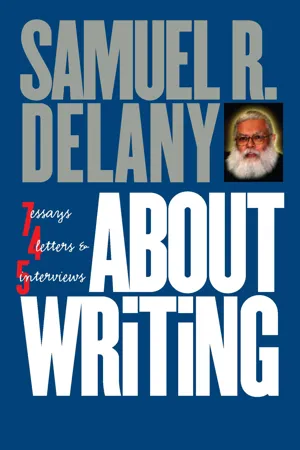
From the four-time Nebula Award–winning novelist and literary critic, essential reading for the creative writer.
Award-winning novelist Samuel R. Delany has written a book for creative writers to place alongside E. M. Forster's
Aspects of the Novel and Lajos Egri's
Art of Dramatic Writing. Taking up specifics (When do flashbacks work, and when should you avoid them? How do you make characters both vivid and sympathetic?) and generalities (How are novels structured? How do writers establish serious literary reputations today?), Delany also examines the condition of the contemporary creative writer and how it differs from that of the writer in the years of Hemingway, Fitzgerald, and the high Modernists. Like a private writing tutorial,
About Writing treats each topic with clarity and insight. Here is an indispensable companion for serious writers everywhere.
"Delany has certainly spent more time thinking about the process of generating narratives—and subsequently getting the fruits of his lucubrations down on paper?than any other writer in the genre. . . . Delany's latest volume in this vein (
About Writing) might be his best yet... Truly, as the jacket copy boasts, this book is the next best thing to taking one of Delany's courses. . . . [R]eaders will find many answers here to the mysteries of getting words down on a page." —Paul DiFilippo,
Asimov's Science Fiction
"Useful and thoughtful advice for aspiring (and practicing apprentice) authors. About Writing is autobiography, criticism, and a guidebook to good writing all in one." —Robert Elliot Fox, Professor of English, Southern Illinois University at Carbondale
"Should go on the short list of required reading for every would-be writer." —
New York Times Book Review (on
Of Doubts and Dreams in
About Writing)
- 272 pages
- English
- ePUB (mobile friendly)
- Available on iOS & Android
eBook - ePub
About this book
Information
Print ISBN
9780819567154
Subtopic
Literary Criticism TheoryTeaching/Writing
The young painter who has set about learning to paint “realistically” is often surprised that the eye must do the learning; the hand more or less takes care of itself. “But I can already see what’s there! Tell me what I’m supposed to do to set it down.”
Keep your hand still and look more closely.
As “realistic” painting does not exhaust art, neither does the comparatively high resolution of narrative storytelling exhaust fiction. But the young writer who has decided to utilize his or her experience of the world at this comparatively high resolution, for like reasons, is always surprised when he or she is told to go back and reexamine his or her experience.
“But I want to know how to write an exciting piece of action!”
Examine your reactions when you are excited; as well, when you are bored.
“But how do I create a vivid character?”
Look closely at what individualizes people; explore those moments when you are vividly aware of a personality. Explore the others when you cannot fathom a given person’s actions at all.
“No, no! You don’t get the point. Tell me about style!”
Listen to the words that come out of your mouth; look at the words you put on paper. Decide with each whether or not you want it there.
But it will always be a paradox to the young artist of whatever medium that the only element of the imagination that can be consciously and conscientiously trained is the ability to observe what is.
Teachers of narrative fiction fail or succeed according to the ingenuity with which they can present the above in as many ways as possible—a success or failure that, alas, has nothing to do with their own writing ability.
A teacher at the Clarion Writers’ Workshop,* you may live in the dormitory with the students, or room in a separate building. The students are energetic, dedicated, writing and revising throughout the six weeks. The solution to most literary problems is time and thought. But if someone can be there immediately to suggest where thought might be directed, so much the better. I chose to room in the student dorm. I had given occasional lectures and one-day seminars. Summers ago I had taught remedial reading to a volunteer class of adolescents at a community center. But Clarion for five days was my first formal teaching experience. A handful of the students were older than I. Several had sold stories and novels already.
The situation would intrigue any teacher of fiction.
A writer of fiction, I could not resist it.
The real worth of that summer, as with any intense, living experience, is in the texture of the experience itself.
I had set up exercises and discussion topics for the formal three-hour morning classes. Part of this time was set aside for the group discussion of stories handed in the previous days.
In my first class, we began by discussing some complex ideas about the way information is carried by and between words. We read some sentences, a word at a time, to see just what the information given was—tone of voice, mood, order of presentation, and importance—and at which points in the sentence this information became apparent. I tried to examine just what happened in the microleaps between words. I had notes. But there were great silences in the discussion when I and the students were at a loss for what to say next. Afterward, I was very relieved when two people came up to discuss ideas of their own that more or less took off from things I had said in class. But later, when I asked two others, whose comments had seemed the most astute, what they thought of the session, I was cheerfully informed they hadn’t the foggiest idea what I was talking about.
The next morning in class, a young woman whose writing had already struck me as among the most talented* asked guardedly, “But what do you feel about just pure storytelling?”
I wasn’t quite sure what to say, so I came out with “I like it a whole lot!”
Then we spent five seconds wondering if we should say anything more, and decided on a truce.
An exercise fared better.
I asked the students to choose partners. Limiting themselves to written words (pencil, pen, and paper; or typewriters), each was to collect material from the other for a brief biography. “Write a question, exchange papers with your partner; write down your answer to her or his question (or your comment or request for further explanation of the question), then give the paper back. Read what you’ve obtained, and write down another question, and continue the process until you feel you have enough information for a short biography. If possible, conduct the experiment without seeing your partner—for example, pass your papers back and forth under a door.”
The dorm hall, usually filled in the evening with frisbees and laughter, tonight was oddly quiet. I passed some four couples sitting on the hall floor, exchanging notebooks, and one young man with his typewriter before a closed door, sliding out a sheet of yellow paper.**
Several people gave me rather odd looks. One girl, coming out of her room to deliver a paper to a boy in another, asked with somewhat amused belligerence, “Where did you get this idea, anyway?”
Next morning in class, I asked for someone to read the questions and answers. No one raised a hand.
“Someone must have done the exercise,” I said. “I saw too many of you working on it.”
People shifted in their chairs, glanced at one another.
Momentarily I suspected I was the victim of a practical joke.
But when a discussion did, haltingly, begin, it seemed that, almost without exception, the twenty-five very bright, very sensitive young people had found, when their communication was limited to the written word, that almost in spite of themselves they had shunted into personal areas and intensely emotional parts of themselves that felt too uncomfortable for oral display … though no one was averse to my or another’s reading these papers.
As the discussion progressed, some people volunteered to read sections out loud. Even from this, it became clear that when a one-to-one situation was fixed between information wanted and information granted, with the communicants checking out one another after each step, the result was a strange freedom, an obsessive honesty, a compelling and rising clarity. The general superiority of the prose style to most of their fictional attempts was duly noted.
This was certainly what I had hoped the point of the exercise would be. But I had never tried it in this way. I was surprised by the emotional force behind the point.
Another exercise we did in class.
“This morning,” I said, “I want you all to look around the room—get up and walk around, if you’d like. Observe the people in the room with you, very closely. Keep looking until you notice something about one of your classmates that you’ve never noticed before. Now examine this thing about them, this aspect of her behavior or his appearance, until you see something about it different from the way anyone else you’ve ever seen exhibits this feature of appearance or behavior. Then write down what you’ve seen in a sentence or two.”
I drank two styrofoam cups of coffee from the urn in the corner while the class milled and prowled by one another. One girl came up to me and said, “But I just don’t see anything!”
“Make up something,” I told her softly, “and see if anyone notices.”
Twenty minutes later, most people were seated again. I suggested we bring the class to order and hear some of the examples. If there was any embarrassment here, it was of a lighter tone. Before we started, there was some humorous anticipation of the crashing triviality of what had been observed. But by the third example, the giggles had ceased. People were leaning forward in their chairs, or looking back over their own examples with renewed attention.
If the previous exercise had discovered a lucid, working prose, this one, in example after example, pushed language to the brink of the poetic. The readings, as we went about the room, became a torrent of metaphors—how many of the unique things noted were resemblances between something present and something else! And those that were not metaphorical still had an astonishing vividness, the gesture, expression, or turn of speech caught with the stark economy of the tuned ear, the fixed eye.
There were other discussions on the economic significance of story setting, the natural tendency of words to say things other than you intend and obscure your meaning, and the necessity for rendering your fictional incidents intensely through the senses. Whenever one of my convoluted arguments brought us to a point of confused silence, Robin Wilson, who led the half of the class devoted to story discussion, patiently and kindly extricated me from the snarls of my own inexperience.
The high point of the five days’ classes for me was when, after a discussion of the way the vividness of fictional characters usually lies between rather than in the facts we know about them, one young woman produced a character sketch of an aging, alcoholic midwestern lady with bohemian pretensions. I had asked the class to put together these sketches of fictional characters through a collection of actions—purposeful, habitual, and gratuitous—which should be observed with the same astuteness with which they had observed one another. Unfortunately I cannot reproduce the sketch here. But when it was read, among the dozen or so other examples, the class was silent in that way which makes someone who has previously been uproariously applauded feel he has turned in a poor showing after all.
I left Clarion aware just how short five days were—I had actually been on campus five days and two weekends. Besides the three hours a day of classes, I had read some sixty-five or seventy student stories (and one novel) and had managed at least one story conference with each student—in some cases, with the more prolific, three, four, or five. It was stimulating, intense, even numbing. Most of the students seemed to feel that the individual work with particular stories was the most valuable part of the workshop. The most repeated exchange in these sessions was:
“Now in this paragraph/sentence/section here, can you tell me just what you were trying to say?”
Answer …
“Well, I think it would have been better if you’d written that …”
In perhaps three or four cases I was able to reassure some people who had worked very hard that the work, at least, was evident. For the rest, I just felt very flattered.
Rilke says in a letter that in the end all criticism comes down to a more or less happy misunderstanding.
I suspect he is right—which is why the literary worth of a workshop like Clarion cannot be defined by simply reviewing what, critically, went on.
—New York City
1970
*The Clarion Writers’ Workshop is a writing workshop, held annually since 1967, that specializes in imaginative writing, fantasy, and science fiction. It runs for six weeks during the summer, June through July, with a different professional writer in attendance as instructor every week, with one branch held at Michigan State University and the other, Clarion West, held annually over the same period, in Seattle, Washington. Since 2004 Clarion South has been held in Brisbane, Australia.
* Vonda N. McIntyre, whose story “Of Mist, and Grass, and Sand” four years later would win a well-deserved Hugo.
** The then-sixteen-year-old Jean Marc Gawron, who three years later was to write An Apology for Rain (1974), and three years after that, Algorithm (1978).
Thickening the Plot
I distrust the term “plot” (not to mention “theme” and “setting”) in discussions of writing: it (and they) refers to an effect a story produces in the reading. But writing is an internal process writers go through (or put themselves through) in front of a blank paper that leaves a detritus of words there. The truth is, practically nothing is known about it. Talking about plot, or theme, or setting to a beginning writer is like giving the last three years’ movie reviews from the Sunday New York Times to a novice filmmaker. A camera manual, a few pamphlets on matched action, viable cutting points, and perhaps one on lighting (in the finished film, the viewer hardly ever sees the light sources, so the reviewer can hardly discuss them, but their placement is essential to everything from mood to plain visibility) would be more help. In short, a vocabulary that has grown from a discussion of effects is only of limited use in a discussion of causes.
A few general things, however, can be noted through introspection. Here is an admittedly simplified description of how writing strikes me. When I am writing I am trying to allow/construct an image of what I want to write about in my mind’s sensory theater. Then I describe it as accurately as I can. The most interesting point I’ve noticed is that the writing down of words about my imagined vision (or at least the choosing/arranging of words to write down) causes the vision itself to change.
Here are two of the several ways it changes:
First—it becomes clearer. Sudden lights are thrown on areas of the mental diorama dark before. Other areas, seen dimly, are revised into much more specific and sharper versions. (What was vaguely imagined as a green dress, while I fix my description of the light bulb hanging from its worn cord, becomes a patterned, turquoise print with a frayed hem.) The notation causes the imagination to resolve focus.
Second—to the extent that the initial imagining contains an action, the notating process tends to propel that action forward (or sometimes backward) in time. (As I describe how Susan, both hands locked, side-punched Frank, I see Frank grab his belly in surprise and stagger back against the banister—which will be the next thing I look at closely to describe.) Notating accurately what happens now is a good way to prompt a vague vision of what happens next.
Let me try to indicate some of the details of this process.
I decide, with very little mental concretizing, that I want to write about a vague George who comes into a vague room and finds a vague Janice …
Picture George outside the door. Look at his face; no, look closer. He seems worried …? Concerned …? No. Look even closer and write down just what you see: The lines across his forehead deepened. Which immediately starts him moving. What does he do? … He reached for the … doorknob? No. Be more specific … brass doorknob. It turned … easily? No, the word “brass” has cleared the whole knob-and-lock mechanism. Look harder and describe how it’s actually turning … loosely in its collar. While he was turning the knob, something...
Table of contents
- Cover
- Title Page
- Copyright
- Dedication
- Contents
- Preface and Acknowledgments
- An Introduction: Emblems of Talent
- Part I: Seven Essays
- Part II: Four Letters
- Part III: Five Interviews
- Appendix: Nits, Nips, Tucks, and Tips
- About the Author
Trusted by 375,005 students
Access to over 1.5 million titles for a fair monthly price.
Study more efficiently using our study tools.
Frequently asked questions
Yes, you can cancel anytime from the Subscription tab in your account settings on the Perlego website. Your subscription will stay active until the end of your current billing period. Learn how to cancel your subscription
No, books cannot be downloaded as external files, such as PDFs, for use outside of Perlego. However, you can download books within the Perlego app for offline reading on mobile or tablet. Learn how to download books offline
Perlego offers two plans: Essential and Complete
- Essential is ideal for learners and professionals who enjoy exploring a wide range of subjects. Access the Essential Library with 800,000+ trusted titles and best-sellers across business, personal growth, and the humanities. Includes unlimited reading time and Standard Read Aloud voice.
- Complete: Perfect for advanced learners and researchers needing full, unrestricted access. Unlock 1.5M+ books across hundreds of subjects, including academic and specialized titles. The Complete Plan also includes advanced features like Premium Read Aloud and Research Assistant.
We are an online textbook subscription service, where you can get access to an entire online library for less than the price of a single book per month. With over 1.5 million books across 990+ topics, we’ve got you covered! Learn about our mission
Look out for the read-aloud symbol on your next book to see if you can listen to it. The read-aloud tool reads text aloud for you, highlighting the text as it is being read. You can pause it, speed it up and slow it down. Learn more about Read Aloud
Yes! You can use the Perlego app on both iOS and Android devices to read anytime, anywhere — even offline. Perfect for commutes or when you’re on the go.
Please note we cannot support devices running on iOS 13 and Android 7 or earlier. Learn more about using the app
Please note we cannot support devices running on iOS 13 and Android 7 or earlier. Learn more about using the app
Yes, you can access About Writing by Samuel R. Delany in PDF and/or ePUB format. We have over 1.5 million books available in our catalogue for you to explore.