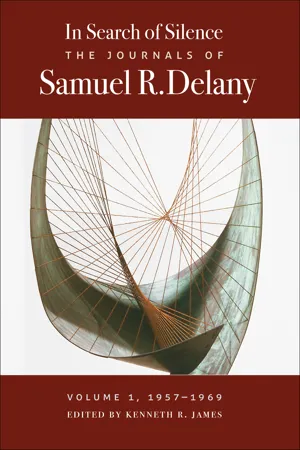
The renowned novelist and critic's private journals, spanning from his years as a high school student in the Bronx to early adult life in San Francisco.
For fifty years Samuel Delany has cultivated a special relationship with language in works of fiction, criticism, and memoir that have garnered critical praise and legions of fans. The present volume—the first in a series—reveals a new dimension of his genius.
In Search of Silence presents over a decade's worth of Delany's private journals, commencing in 1957 when he was still a student at the Bronx High School of Science, and ending in 1969 when he was living in San Francisco and on the verge of reconceiving the novel that would become
Dhalgren.
In these pages, Delany muses on the writing of the stories that will establish him as a science fiction wunderkind, the early years of his marriage to the poet Marilyn Hacker, performances as a singer-songwriter during the heyday of the American folk revival, travels in Europe, experiences in a New York City commune, and much more—and crosses paths with artists working in many genres, including poets such as Robert Frost, W. H. Auden, and Marie Ponsot, and science fiction writers such as Arthur C. Clarke, Michael Moorcock, Roger Zelazny, and Joanna Russ. Delany scholar Kenneth R. James presents the journal entries alongside generous samplings of story outlines, poetry, fragments of novels and essays that have never seen publication, and more; James also provides biographical synopses and an extensive set of endnotes to supply contextual information and connect journal material to Delany's published work.
"This is a tremendously significant and vital addition to the oeuvre of Samuel Delany; it clarifies questions not only of the writer's process, but also his development—to see, in his juvenilia, traces that take full form in his novels—is literally breathtaking." —Matthew Cheney, author of
Blood: Stories
"Traversing Delany's youth, we see a precocious mind grappling with his own talent he lives on two registers, participating in the world and also observing it, living simultaneously as a kid in NYC and, 'a writer of genius.'" —Robert Minto,
New Republic
"Mesmerizing . . . a true portrait of an artist as a young Black man . . . already visible in these pages are the wit, sensitivity, penetration, playfulness and the incandescent intelligence that will characterize Delany and his extraordinary work." —Junot Díaz, author of
The Brief Wondrous Life of Oscar Wao
- 202 pages
- English
- ePUB (mobile friendly)
- Available on iOS & Android
eBook - ePub
About this book
Information
1

Bronx Science and Other New York Scenes
As of the first entry of Notebook 1, Samuel Delany—born April 1, 1942—is a fifteen-year-old sophomore at the Bronx High School of Science. Most of the young people Delany mentions in this and the entries to follow are either fellow students at Science or, after Notebook 1, part of Marilyn Hacker’s social circle at NYU.
With the exception of an extended sequence in Notebook 4, most of the private journal entries from this period are brief and fragmentary. However, the notebooks in which the entries appear are far from empty; many of their pages hold class notes and homework assignments, with most of the remainder devoted to drafts of stories, poems, play scripts, and more. By the time of his writing of the first entry of Notebook 1, Delany had already completed two novels, Lost Stars and Scavengers—the first of which he had written while still at the Dalton School—and was working on a third, Those Spared by Fire.1 By Notebook 3 he had moved on to his fourth, Cycle for Toby.
As various entries indicate, during this period Delany contributed to his school’s literary magazine, Dynamo, and participated in the Hunter College Dramatic Program for Young People. His fiction and nonfiction had already begun receiving significant recognition: in Notebook 4 Delany mentions receiving prizes from the nationwide Scholastic Writers Awards for the short story “The Gravedigger” and the essay “Portrait of the Artist as Six Characters in Search of Tea and Sympathy.”
Although the entries from this period present a picture of a talented and ambitious young artist, they also hint at a teenager in flux and responding to a number of pressures. In an autobiographical fragment in Notebook 4, Delany states that while his strengths are in the arts, his professional interests are still “diversified” and that he is “fascinated” by nuclear physics. In a private entry in the same notebook, he ponders an account he had written in the notebook of a friend of Hacker’s describing a cruising experience. And in the closing entry from this period, Delany mentions staying with friends for several days: a hint of the uneasy atmosphere at home.
The first three of the four entries from Notebook 1 are written on pages that have come loose from their spiral binding; see appendixes 1 and 2 for a fuller discussion of these pages. Notebooks 3 and 4 contain the first of the marginal comments by Hacker, indicated in bold type.
NOTE
1. Samuel R. Delany, The Motion of Light in Water: Sex and Science Fiction Writing in the East Village (1988; reprint, Minneapolis: University of Minnesota Press, 2004), 88–89.

NOTEBOOK 1—JANUARY–FEBRUARY 1958
to every thing. That’s it: my writing—at times—captures the intangible. Good for me! (Conceited bastard that you are!) And it is almost always when I write about Ellen! I must stop being so analytical when I read; and be more so when I write. I have lost more effect from the greatest works of literature than anybody in the world!—I bet. That’s it! I’m too chemical. I know too much about what is being done with the words and themes. Although I can whip the words into place myself; I can see the scars on the backs of the words whipped by other writers. That analytical frame of mind is hell. I write creatively as though I were writing a math textbook, and damn it, it comes out just as good. I know what humor is, I know what suspense is. Someday I will know what tragedy is. I do not want to know; then I will be static completely. The hell of it is; when I don’t understand the construction, I don’t get the effect; or rather, I block out the effect. Oddly, in my contemporaries this is not true; I can read their writing and achieve the effect and not be so scathingly analytical. I hope it continues.

R.U.R.
Dickens
George [Eliot]—The Mill on the Floss
Hawthorne
Thackeray
Victor Hugo—Les Misérables
Cooper
Melville
Try to think up a situation involving kids. What types of characters: Ellen; a shy girl. Reserved: Vinni; Shy as hell. Tito; he is an all around type of person. Other; confused. Vivian, all around. Phyllis is out & out glamour girl type. Ruben; he will do whatever is demanded of him. Paul is an inhibited younger brother type. Whom should I pair Ellen up with? Not Paul. Who’s taller then Ellen? Joe! Not for Ellen. Tito! That’s who! All right. How? Vinni & Butch. Ruben with Vivian. What about Mildred? Mildred is indispensable as a character. Analyze Mildred: Nice. Shy. Likes to pretend. No! That is not right for Ellen. Characters: A Dreamer! That’s right, a crazy mixed up kid. That is Ellen. Punchinello! That’s Butch. But that’s cruel. So what. Forget about the actors. That’s hard. Let’s see. I like the dreamer. And I like Ellen in the C.M.K. role. What about the boys. I like the juvenile delinquent kick. What to do with it. Tito is the hero type, he is more dynamic then Vinni. Vinni is tragic type. Vinni, he can be the juvenile delinquent with his friend. Tito wants to grow up. Growing up. There is a conflict, man—or boy, against society. What will be the symbol for adulthood. The dreamer, her symbol is the tree. The tree! That’s it. It’s all falling into place. Good. Tito and Mildred are brother & sister. The tree—I see her throwing herself at the tree. Ellen makes a play for him. Vinni is sort of in love with Ellen. Vinni kills Paul. Oh, that’s fun. Butch, what & where is she? She wants to help Mildred. What is her problem. Vinni! That’s her problem. Vinni & Tito are friends. (What about Other? Forget about him!) So far so good. What to do about Paul. I don’t know! Where do we stick him in. I have this feeling we should start off with Paul. No. Yes, I don’t know. I have to get a first scene. How I like the back alley. All right. The back alley. What do we do with it? I’ve got to get—I’ve got it. Mildred & Paul. Mildred to see the tree. And Paul teases her. Then Tito to chase Paul away with Vinni. Mildred—
Wr...
Table of contents
- Cover
- Title Page
- Copyright
- Contents
- Editor’s Introduction
- 1. Bronh Science and Other New York Scenes
- 2. In Search of Silence
- 3. Journaux d’Orphée
- 4. City College
- 5. Married Life in the East Village
- 6. The Fall of the Towers and Voyage, Orestes
- 7. Babel-17 and Beyond
- 8. Travels in Europe
- 9. Changing Scenes
- 10. Prism, Mirror, Lens and Other Projects
- 11. To San Francisco
- 12. Appendixes
- Acknowledgments
- Notes
- Bibliography
- Index
Trusted by 375,005 students
Access to over 1.5 million titles for a fair monthly price.
Study more efficiently using our study tools.
Frequently asked questions
Yes, you can cancel anytime from the Subscription tab in your account settings on the Perlego website. Your subscription will stay active until the end of your current billing period. Learn how to cancel your subscription
No, books cannot be downloaded as external files, such as PDFs, for use outside of Perlego. However, you can download books within the Perlego app for offline reading on mobile or tablet. Learn how to download books offline
Perlego offers two plans: Essential and Complete
- Essential is ideal for learners and professionals who enjoy exploring a wide range of subjects. Access the Essential Library with 800,000+ trusted titles and best-sellers across business, personal growth, and the humanities. Includes unlimited reading time and Standard Read Aloud voice.
- Complete: Perfect for advanced learners and researchers needing full, unrestricted access. Unlock 1.5M+ books across hundreds of subjects, including academic and specialized titles. The Complete Plan also includes advanced features like Premium Read Aloud and Research Assistant.
We are an online textbook subscription service, where you can get access to an entire online library for less than the price of a single book per month. With over 1.5 million books across 990+ topics, we’ve got you covered! Learn about our mission
Look out for the read-aloud symbol on your next book to see if you can listen to it. The read-aloud tool reads text aloud for you, highlighting the text as it is being read. You can pause it, speed it up and slow it down. Learn more about Read Aloud
Yes! You can use the Perlego app on both iOS and Android devices to read anytime, anywhere — even offline. Perfect for commutes or when you’re on the go.
Please note we cannot support devices running on iOS 13 and Android 7 or earlier. Learn more about using the app
Please note we cannot support devices running on iOS 13 and Android 7 or earlier. Learn more about using the app
Yes, you can access In Search of Silence by Samuel R. Delany, Kenneth R James in PDF and/or ePUB format, as well as other popular books in Literature & Literary Biographies. We have over 1.5 million books available in our catalogue for you to explore.